.png?width=112&height=112&name=Image%20Hackathon%20%E2%80%93%20Vertical%20(80).png)

Instead, they're scanning the latest headlines across multiple social media channels at once.
Press releases help control the narrative surrounding your brand.
Whether it's sharing a new product release or changes in your organizational structure, a regular cadence of meaningful news can help a company stand out and build mindshare with journalists over time.
In this post, we'll discuss:
- What is a press release?
- Benefits of Press Releases
- Types of Press Releases
- Sample Press Release Format
- How to Write a Press Release
- Press Release Template
- Press Release Examples
- Tips for Publishing Press Releases
.png)
Free Press Release Template
A free guide and template to help you run your company's PR.
- Company Announcements
- Promotion Checklist
- Guide to PR Best Practices
Download Free
All fields are required.
What is a press release/news release?
A press release is an official statement (written or recorded) that an organization issues to the news media and beyond. Whether we call it a “press release,” a “press statement,” a “news release,” or a “media release,” we're always talking about the same basic thing.
While the heading should contain action verbs, the first paragraph should answer the “who,” “what,” “why,” and “where.” The press release should also contain understandable language and a quote.
Most press releases are succinct at just a page long – two pages tops.
Ultimately, companies want to provide enough information so that news outlets have sufficient material for publishing their own stories about whatever the company is announcing in the release.
One thing to remember is that press releases live in the public domain, which means your stakeholders and customers can see them.
So, instead of thinking of a press release solely as a ticket to earning news coverage, consider it as a valuable piece of marketing content.
Benefits of Press Releases
Aside from helping your company generate media coverage, press releases offer several benefits.
- Brand exposure: Press releases can help create brand awareness by sharing your company's news, updates, or achievements. This exposure can attract potential customers and increase brand recognition.
- SEO benefits: Press releases distributed online can improve your search engine rankings. Including relevant keywords and links in your press release can help boost your website's visibility in search results.
- Investor and stakeholder communication: Press releases are an effective way to communicate with investors, shareholders, and other stakeholders, keeping them informed about significant company announcements, financial results, or strategic initiatives.
- Crisis management: When you’re stuck in a challenging situation, a well-crafted press release can help control the narrative, provide accurate information, and manage public perception.
While there's no cut-and-dried formula for what a press release should include, here are a few types of occasions to help you carve out a focus for your press release and determine what content would help you broadcast your news in the best way:

Types of Press Releases
- New Product Launches
- Mergers and Acquisitions
- Product Updates
- Events
- Grand Openings
- New Partnerships
- Rebranding
- Executive Promotions/Hiring
- Awards
Product Launches
The product launch type of press release is valuable to get the word out about the new solutions your organization is offering to consumers.
It should emphasize the product's specs, pricing, availability, and any other details that may be valuable to consumers.
Mergers and Acquisitions
Organizational change is noteworthy enough to warrant a press release, especially for informing current and future stakeholders about the growth and trajectory of a company.
To announce an acquisition or merger, include details about all organizations involved, information about the merger or acquisition, and quotes from the leadership teams.
Product Updates
Similar to a new product launch, product updates and expansions are also ripe for promotion. Explain what the change is, why it was made, and how it benefits the user.
Events
Press releases are an important component of event marketing to attract promotion from news outlets and other media sources.
You'll want to include:
- What the event is about
- Who should consider attending
- When and where it will be held
- Pricing
Grand Openings
Whether you opened up a new office, relocated, or are opening for the first time, announce the details with a grand opening press release.
Announce the date and location the grand opening will be held, who is involved, how the grand opening is being celebrated, and the reason for the move (if applicable).
New Partnerships
Similar to mergers and acquisitions, a press release announcing new partnerships is a mutually beneficial marketing tactic.
To effectively execute this type of release, be sure to write a summary about each company, why the partnership was created, who benefits, and any additional important details for current and future stakeholders.
Rebranding
Rebranding is a difficult thing for any business to do, and it can occasionally result in confusion and awkwardness.
One way to make the transition smoother is by announcing the rebrand with a press release, including details on what is changing, the reason for making the change, dates the changes go into effect, and quotes from the leadership team.
Executive Team Changes
Executives often serve as faces of the company, and a press release functions to kick off this role.
It may include biographical information to establish their credibility along with a photo and other pertinent details.
Awards
When it comes to business excellence, it's OK to brag. Press releases about awards and accomplishments serve to cement your organization as an authority in your space.
Such a press release includes information about the company and why they were given the award, information about the award itself, and details about the ceremony (if applicable).
Press Release Format
- Contact information and 'For Immediate Release' at the top.
- Title and italicized subheading to summarize the news.
- News location and news peg in opening line.
- Two to three paragraphs to add context and additional details.
- Bulleted facts and/or figures.
- Company description at the bottom.
- Three pound symbols (###) at the end to signify the end of the release.
When formatting a press release, you want to write it in a newsy, straightforward way so a journalist who might write about it can imagine it as an article on their news site.
To start, here are the basics every press release should include:
- Your contact information located on the top left corner
- The phrase “For immediate release” located on the top right
- A headline that quickly explains the announcement
- Your business location in the first sentence of the press release
- A quick bio about your company at the end of your press release.
You also might want to include “###” or another signifier to show the journalist that the release has ended. In the past, this prevented busy journalists from waiting or flipping the page for more information when there was no more news.
However, this tradition is still adopted and highly-respected today.
.webp?)
Free Marketing Software
Easy marketing tools that deliver fast time-to-value, unified in one place.
- AI Tools
- Email Marketing
- Social Media Management
- And More!
Now, onto the body of your press release:
- Your first paragraph should state what the announcement while providing some context around your business and what it does.
- The next two to three paragraphs should include quotes from a company spokesperson or business executive to explain the “why” behind this announcement.
- Your last paragraph should be an “About Us” section that explains what your company is and what it offers.
In this example, Catbrella Inc., a fictitious ad agency that just gained its 10th Twitter follower after two years of paid social media efforts, announces its achievement in a press release.
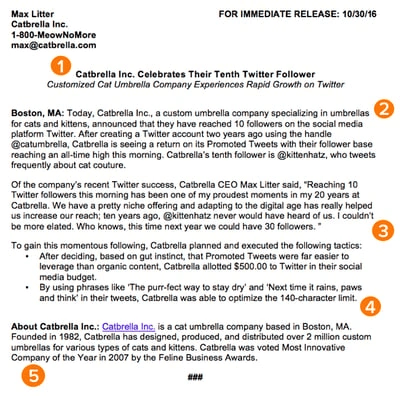
*Disclaimer: HubSpot is entirely responsible for the silliness of this faux announcement.
How to Write a Press Release
- Write a compelling headline.
- Add more context with a subheadline.
- Convey the news value to the press.
- Offer a tempting quote.
- Provide valuable background information on the subject.
- Summarize the ‘who’ and the ‘what’ in a boilerplate.
- Include contact information.
- Proofread before publishing.
Writing a press release to break important company news can help businesses grow better, but doing it right is just as important. Here's how to write a press release, like the one above, step-by-step.
1. Write a compelling headline.
You‘ve got your announcement in mind, and now it’s time to get it down in words to share with your community, industry, and followers.
Just like writing the perfect blog post title, setting up your press release for success starts with your headline. You only have one line to work with, which can seem scary, but consider your words carefully to make your headline captivating.
Here are some tips to make your headline stand out:
- Use action verbs.
- Be specific.
- Keep it short.
Most importantly, make it interesting: Keep in mind that reporters get dozens, if not hundreds, of releases each day, so invest the time to write a compelling headline.
Consumers, on the other hand, see news stories all over their timelines. As such, your headline needs to be interesting enough to reel them in.
2. Add more context with a subheadline.
While your headline is meant to draw readers in, your subheadline gives readers a better idea of the news you’re sharing.
When crafting your subheadline, aim to encapsulate your press release in one sentence. Make sure it supports the headline you crafted to entice people to keep reading.
3. Convey the news value to the press.
If you want your press release to be newsworthy, you have to give readers a reason to care.
A good way to ensure this is by using the reverse pyramid formula when writing your press release: Going from the most important information to the least important.
While the first paragraph of your release should explain the who, what, where, the second paragraph should cover the why.
Reporters don‘t have a ton of time to sift through details and fluffy background information — they just need the facts that’ll help them tell your story to someone else from a position of authority.
There shouldn't be any new, crucial information covered after these sections because the readers could potentially miss them.
4. Offer a tempting quote.
Once you‘ve set the scene, it’s time to bring your details to life with a quote that reporters can use for context around your announcement and help paint a picture of how your news affects the given industry, customer base, and landscape.
Ideally, quotes will be from key stakeholders in your company including your executive team, project leads, or those directly impacted by your announcement.
Quoting key figures and authorities underlines the importance of your development. The chosen quote should shape your narrative and emphasize the core of the announcement.
Don't ask everyone in your office for a comment or feel compelled to quote all 25 people included in the acquisition. Pick one or two critical spokespeople and focus the quotes around their unique perspective.
5. Provide valuable background information on the subject.
In this last paragraph, keep in mind that the reader should already have key details they need regarding your announcement.
Offer details here that strengthen your narrative, like creative or noteworthy ways your company developed the project or announcement at hand. Or, when applicable, comment on the future implications of your announcement.
Another good way to add value to your press release is by using newsjacking. A process of relating your press release to something currently going on to make it more valuable to the journalist and reader.
6. Summarize the “who” and the “what” in a boilerplate.
Twitter is chock-full of reporters lamenting press releases or pitches that don't clearly explain what the company does or what the announcement is actually about.
Describe what your company does in clear, plain language and include a link to your company's website early on.
If you cite data, include a reference link for the data source, and make sure every name in the release has an associated title and company as well.
7. Include contact information.
Make it easier for journalists to reach out to your company by providing your media contact information.
This allows them to quickly get in touch with you to get additional details, schedule an interview, or request accompanying visuals or materials.
It can also help streamline the communication process and increase the likelihood of receiving media coverage or engaging in further dialogue with journalists or relevant stakeholders.
When giving your contact information, be sure to include:
- Your contact person’s name
- Email address
- Phone number
8. Proofread before publishing.
As with anything else you write, you should always proofread your press release before sending it out to the media. You want to present your company in the best light possible, and typos can distract from your message.
Take the time to do one final read-through before publishing.
Better yet, have an editor or colleague look at it. This gives you the opportunity to tweak sentences, fix any confusing parts, double-check the formatting, and ensure that it’s easy to read and understand.
The last thing you want is to announce big news with a typo that takes the public's attention over the subject matter.
In addition to proofreading your press release, utilizing a tool like HubSpot's AI paragraph rewriter can further enhance the clarity and coherence of your message.
To keep yourself honest on this front, ask a colleague to read the release without context and ask them to relay the information back to you. If they can't recall the who, what, or why get back to the drawing board.
Free Press Release Template
A free guide and template to help you run your company's PR.
- Company Announcements
- Promotion Checklist
- Guide to PR Best Practices
Download Free
All fields are required.
Press Release Templates
Now, it’s finally time to write your press release. How do you even begin? Use the templates below to guide your press release creation process.
Each document has placeholders for the critical information you need to include, depending on the announcement you’re making.
1. New Product Press Release Template
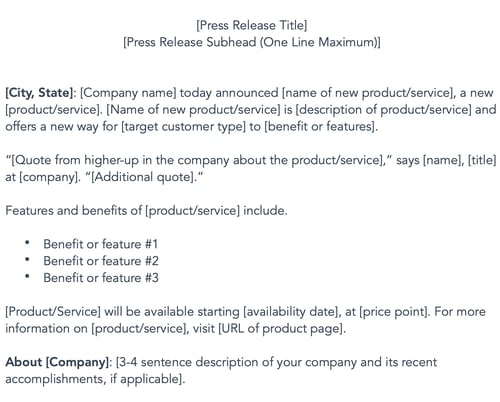
Download This Press Release Template for Free
Adding a new product to your existing lineup is always an exciting development, one that you should announce the moment you’re ready to generate interest, jumpstart sales, and get early signups.
This press release template from HubSpot allows you to do just that in a succinct manner, while still advertising the benefits and features that you’re offering customers.
You can also share when the product will be available, how much it costs, and where to find more information. This sort of critical intel is essential to drive early qualified leads.
2. Startup Fundraising Press Release Template
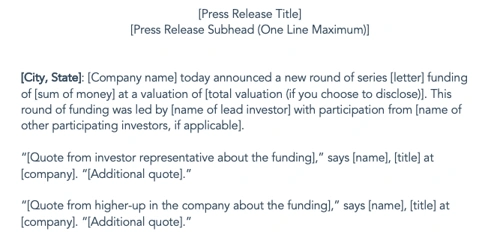
Download This Press Release Template for Free
Use this template to announce a new round of fundraising for your business. You can include a quote from your investor and one from your representative, as well as the reasons for why you’re fundraising.
Fundraising is one of the most critical things you need to do for your startup, regardless of which stage your company is in — whether you’re still in the developing stages or at a more mature level.
You might already have a few rounds of funding under your belt, but if you’re delving into a new round, the public should know.
Using this press release template will not only help you build buzz around your company, but help you attract the attention of angel investors looking for new, growing startups to invest in.
3. New Partnership Press Release Template
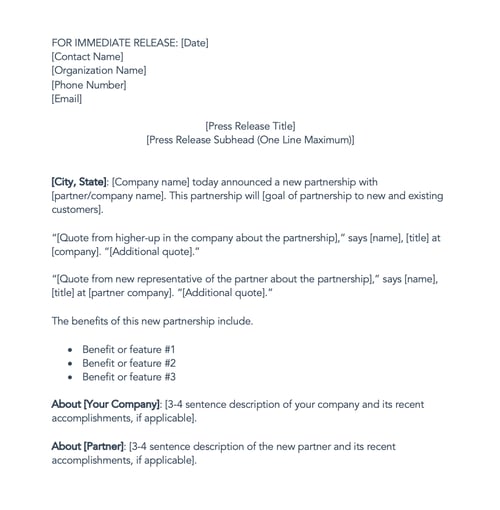
Download This Press Release Template for Free
If you’re partnering with another business to offer an improved product or a new integration, use this press release template. You get space to describe the new benefits and features customers will enjoy, as well as direct quotes from your and your partner’s representatives.
A partnership announcement will generate excitement for your mutual collaboration and allow you to attach your name to another leading company (and vice versa, for your partner).
Note: If you’re merging or acquiring another company, we have a different template for that — download it here with the rest of the kit.
4. Momentum or Milestone Press Release Template
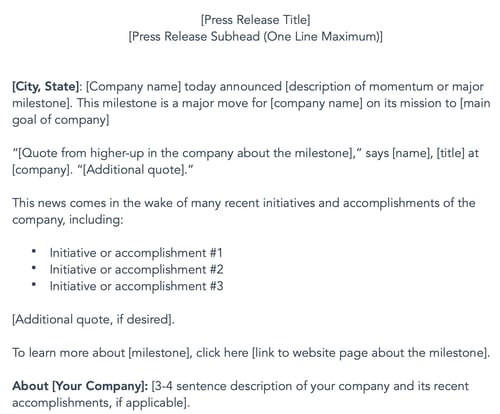
Download This Press Release Template for Free
Milestones are absolutely worth announcing — especially if you’re a public company or planning to seek funding from investors.
Use this template to share your milestone, why it’s important, and which successes you’ve recently experienced. In addition, you can share direct quotes from your executives and directors about the positive impact of the momentum you’re seeing.
Not sure what a milestone press release can look like? Here's one example from HubSpot.
5. New Executive Hire Press Release Template
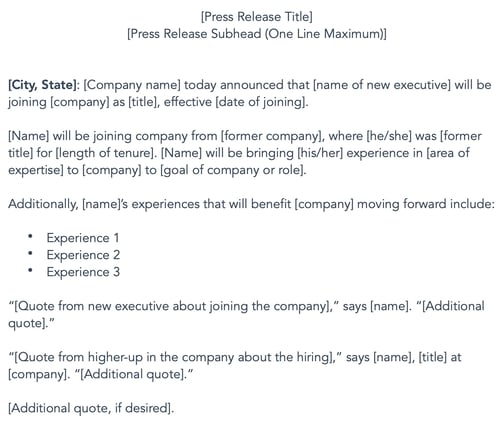
Download This Press Release Template for Free
Whether you’ve recently hired a new Chief Marketing Officer or on-boarded another high-level executive to your Board of Directors, it’s essential to announce these major changes.
It not only helps the public get to know your leadership team, but helps your own company experience the excitement of having a new executive on their side. Plus, it can be an excellent morale booster for your new hire.
Use this template to do just that. You have space to share direct quotes and specific examples of why your newest executive is such a great fit for your company.
Looking for more? The kit below includes all of the above press release templates, plus more templates based on the type of announcement your company wants to make.
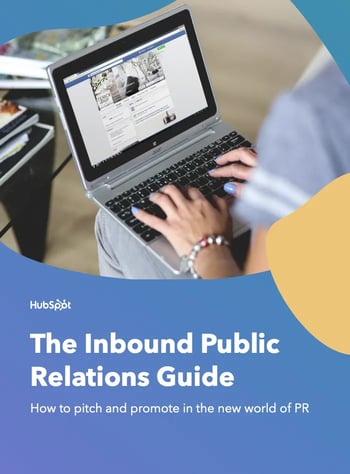
Download This Press Release Template for Free
This template kit also offers creative replacements for the traditional press release and a guide on how to create a comprehensive promotional plan.
You'll have exactly what you need to drive brand awareness and stand out among your competitors.
Press Release Examples
Many people think press releases have to be chock full of buzzwords and branded terms.
Instead of stuffing your next release with industry jargon, take a page out of our book (OK fine, ebook), The Newsworthy Guide to Inbound Public Relations, and brainstorm some creative approaches for your next announcement.
Can you include new data? A remarkable graphic or video? A shareable SlideShare? If so, a creative angle can help carry your content and increase the likelihood of social sharing.
Now, to get you thinking on the right track, take a look at some creative press release examples below, the type of news each one is reporting on, and what makes the release unique:
1. Microsoft
Type of press release: Acquisition
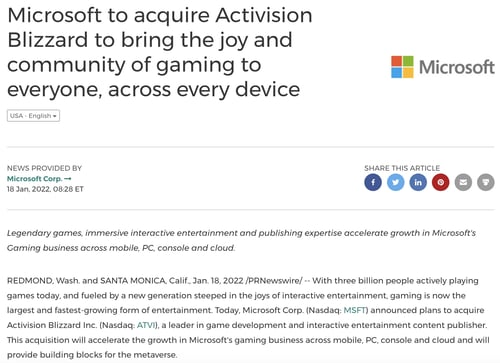
The first thing that stands out in this press release is the headline. It tells a full story without being too long:
It covers who's involved (Microsoft and Activision), what's happening (an acquisition), and why it matters (to bring the joy and community of gaming to everyone).
Throughout the press release, you get quotes from leaders in both organizations, helping explain the benefit of this acquisition and how it will move the industry forward.
What I like: Context is everything. Toward the bottom of the press release, you get additional context surrounding each company's market share and how this acquisition will impact the industry.
Free Press Release Template
A free guide and template to help you run your company's PR.
- Company Announcements
- Promotion Checklist
- Guide to PR Best Practices
Download Free
All fields are required.
2. Flourish
Type of press release: Team and office expansion
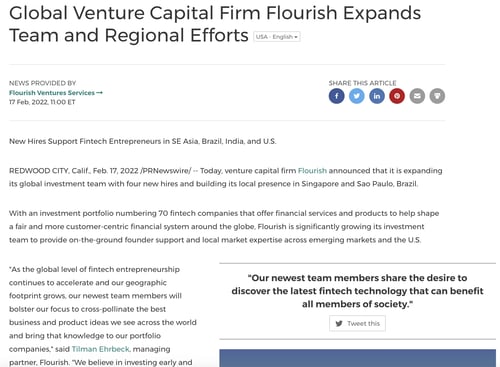
Organizational changes can seem relatively boring. One way to generate some interest is to include visual elements to add more dimension to the story.
In this press release announcing a team and office expansion, venture capital firm Flourish shares photos of some new hires right at the top, immediately drawing readers in.
The release dives into the reason behind the expansion and the key areas of focus moving forward. Then, we get a quick bio for each hire featured in the image, which can help build excitement surrounding the brand's future.
What I like: This author went the extra step and added visual elements in this press release, helping to draw readers in and give prominent names to faces.
3. SuperCom
Type of press release: Event
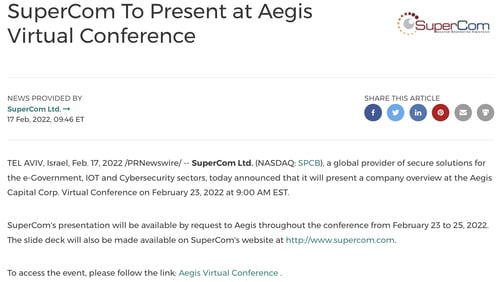
As the shortest press release in the bunch, SuperCom shows that less is often more.
In this release, security solutions company SuperCom announced its participation in an upcoming conference.
When it comes to events, the most important details are date and location. As long as you have those key pieces, everything else is a bonus.
Pro tip: Take time to get a quote or two from leadership to help get more buzz around timely press releases or event announcements.
One thing that would've elevated this release is a quote on who can benefit from attending this event and why, as a way to reel in potential attendees.
4. HubSpot
Type of press release: Program launch
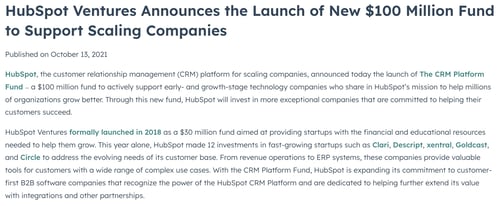
We've also crafted this comprehensive, easy-to-follow press release template complete with a promotional plan and considerations for your next announcement.
We use these same guidelines when writing and formatting our releases here at HubSpot, and created a faux, sample release to illustrate what content goes where and why.
5. JetBlue and Spirit Airlines
Type of press release: New Partnership (in progress)
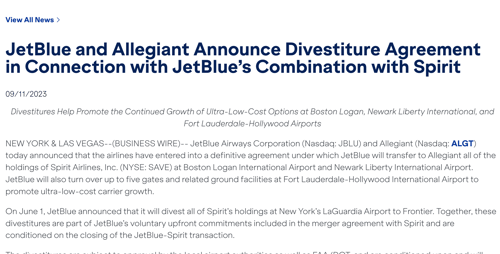
It's big news for business partnerships to be announced, and even bigger when it's between household names.
JetBlue and Spirit Airlines have been making headlines for divestiture news and have kept the public up to snuff on the current state of the agreement.
What I like: Readers get to see multiple quotes from JetBlue's CEO, and get to know which exact airport holdings can be affected and transferred if the deal is made official.
6. Southwest Airlines Press Release
Type of press release: Service changes and improvements
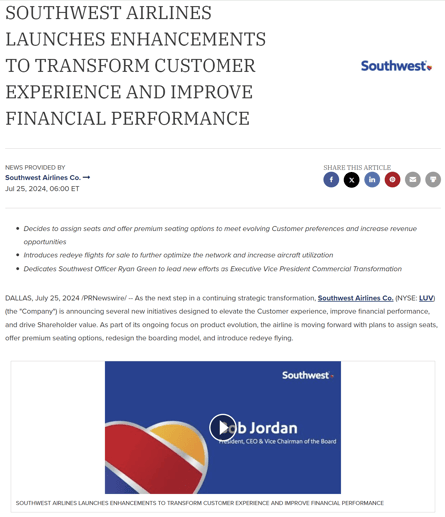
This press release from Southwest Airlines gives a detailed update on new additions coming to customers. Though the release is longer than most, it's full of valuable information, such as why these changes are coming and their benefits.
What I like: The press release includes statistics to back the company's decision. For added convenience, Southwest Airlines summarizes the most important details at the top of the long press release.
7. Bank of America
Type of press release: Partnership Announcement
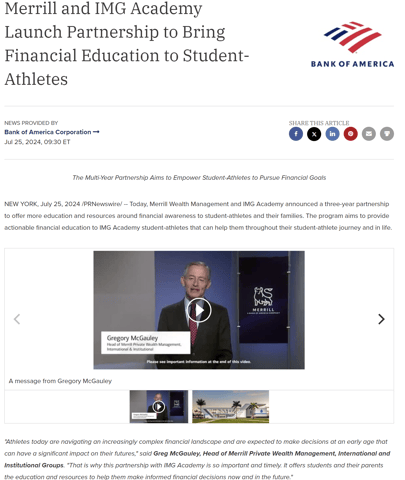
Bank of America announces a partnership between Merrill and IMG Academy that will bring financial literacy to students using Bank of America an education resource.
What I like: The press release includes a video message from Gregory McGauley Head of Merrill. Video can add value to your press release and make the information easier to digest.
8. Rally House
Type of press release: New Location Opening
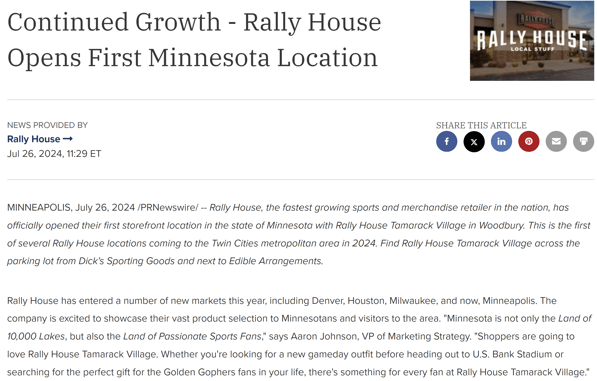
This release is short and simple, and it announces the opening of a new location.
What I like: The release includes a quote from Rally House's VP of Marketing Strategy. Quotes can lend legitimacy to your press release.
9. Easy on Hold
Type of press release: New Feature Announcement
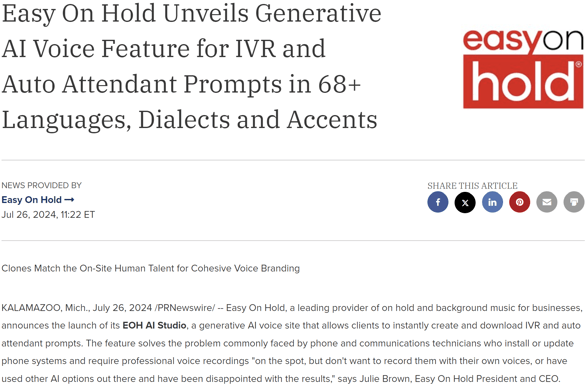
Easy on Hold announces a new feature, EOH AI Studio, that allows clients to create and download IVR and auto-attendant prompts.
What I like: The press release succinctly sums up the feature with a bulleted list of its tools and uses.
10. Warner Bros. World Yas Island
Type of press release: Partnership Announcement
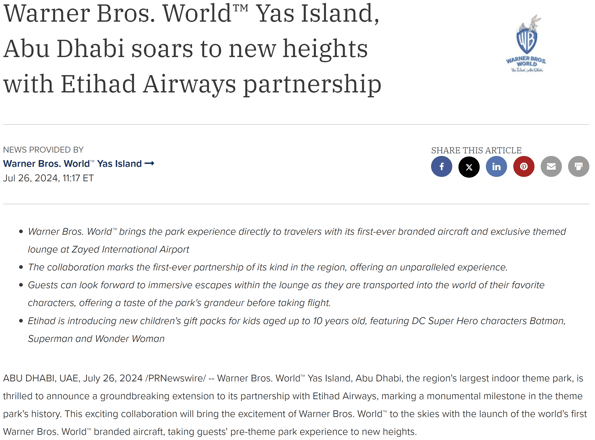
Warner Bros. World is launching its first-ever branded aircraft and exclusive themed lounge at Zayed International Airport, according to this press release.
What I like: The press release bullets the most important information at the top, and it includes a behind-the-scenes video of the aircraft.
Tips for Publishing Press Releases
Writing a press release is really only half the battle. Once you‘re finished with production, it’ll be time to focus on distribution.
Of course, we're all familiar with the traditional distribution levers we can pull, which include publishing the press release on our website/blog as well as sharing the press release with our followers/subscribers via social media and email.
To get the maximum amount of distribution possible, here are some tips you can follow.
1. Reach out to specific journalists.
Instead of blasting a press release out to every journalist you can find an email address for, focus on a few journalists who have experience covering your industry (and company, hopefully) and send them personalized messages.
Connect the dots. Show why what you wrote connects to what they write.
Pro tip: Meltwater's press distribution service integrates with the Meltwater media database that connects these dots for you.
2. Send the release to top journalists the day before.
Give journalists some time to craft a story around your press release by sending it to them — under embargo — the day before it officially goes live.
“Under embargo” just means they aren't allowed to share the information in the press release until the time you specify.
3. To avoid competition, don't publish your release on the hour.
If you're publishing your press release on a distribution service like PR Newswire or Business Wire, avoid publishing it on the hour (e.g., 1 p.m., or 3 p.m., or 5 p.m.).
The reason? Most companies schedule their releases to go out on the hour, which means if your release goes out on the hour too, it's more likely to get lost in the shuffle.
Instead, try going with a more distinct time (e.g., 1:12 p.m., or 3:18 p.m., or 5:22 p.m.).
4. Share your media coverage.
If all goes according to plan, and your press release gets picked up by the media, your job still isn't finished.
To keep the buzz going, you can release a “second wave” of distribution by sharing the specific stories that news outlets write based on your press release.
Pro tip: You can also share the news on your digital channels, like social media and email, to bring awareness to your announcement.
How To Stand Out In The News
The key to keeping your PR strategy new school is forgetting preconceived notions of what public relations is and instead focusing on creating highly remarkable content.
Instead of ditching releases as a tactic, give them a modern makeover to make them more useful for your marketing.
Think about how you've used inbound methods to transform your marketing strategies to be more personalized, approachable, and build relationships.
Those same principles apply to your PR strategy: Create content to craft your own story and use tactful outreach to get the media familiar with (and excited about) your brand.
Editor's note: This post was originally published in November 2019 and has been updated for comprehensiveness.
Public Relations
![How to write an effective communication plan [+ templates]](https://53.fs1.hubspotusercontent-na1.net/hubfs/53/communication%20plans.jpg)
![5 Steps to Build a Public Relations Strategy [+ KPIs and Tools You Need]](https://53.fs1.hubspotusercontent-na1.net/hubfs/53/public-relations-1-20250113-3978600.webp)
![What is a Media Kit — and How to Make One That Wows [+Examples]](https://53.fs1.hubspotusercontent-na1.net/hubfs/53/what-is-a-media-kit.png)
.jpg)
![Earned Media, Explained in 400 Words or Less [Examples]](https://53.fs1.hubspotusercontent-na1.net/hubfs/53/75_Earned%20Media%2c%20Explained%20in%20400%20Words.png)