Although these platforms address overlapping business challenges, their identity models, retention structures, and activation paths differ. Confusion around customer data platform vs. CRM capabilities often leads to redundant tools, fragmented reporting, and personalization efforts that never launch. Third-party cookie deprecation continues to reshape how DMPs operate as browsers and regulators restrict cross-site tracking.
This CDP vs. CRM vs. DMP comparison explains how each platform differs in data structure, technical capabilities, and business impact.
Table of Contents
- What is a customer data platform (CDP)?
- What is a customer relationship management (CRM) system?
- What is a data management platform (DMP)?
- Key Differences Between CDP, CRM, and DMP
- CDP vs. CRM
- CRM vs. DMP
- CDP vs. DMP
- Is HubSpot a CDP?
- How to Choose Between a CRM, DMP, and CDP
What is a customer data platform (CDP)?
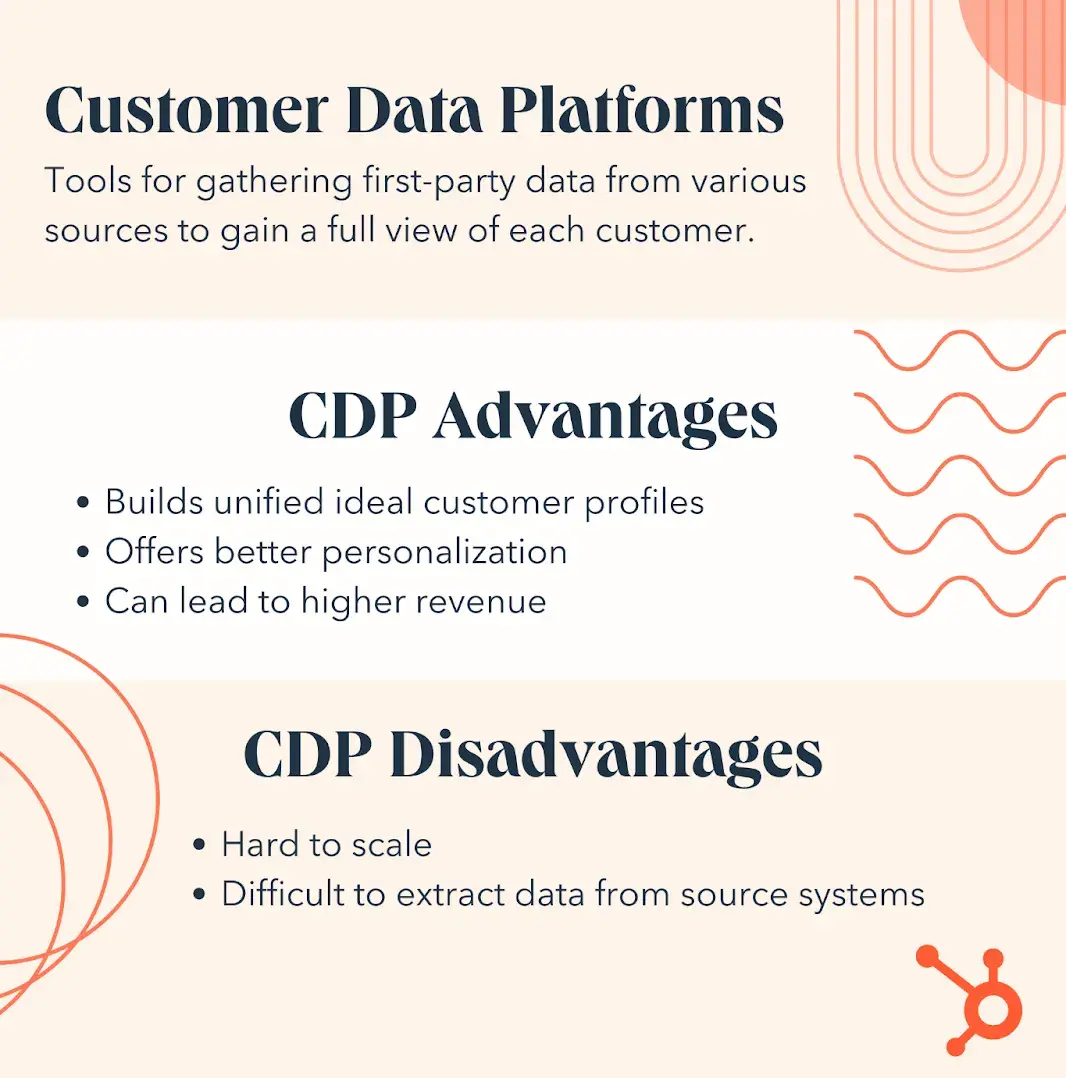
A customer data platform collects and unifies first-party customer data from multiple sources into persistent profiles that organize behavioral, transactional, and event-level history. These profiles allow marketing teams to segment audiences and orchestrate personalization across channels. Extended history retention supports lifecycle analysis and predictive modeling. AI customer data platforms add predictive segmentation, automated scoring, and real-time model updates.
For a deeper breakdown of CDP architecture and implementation models, see this guide to customer data platforms.
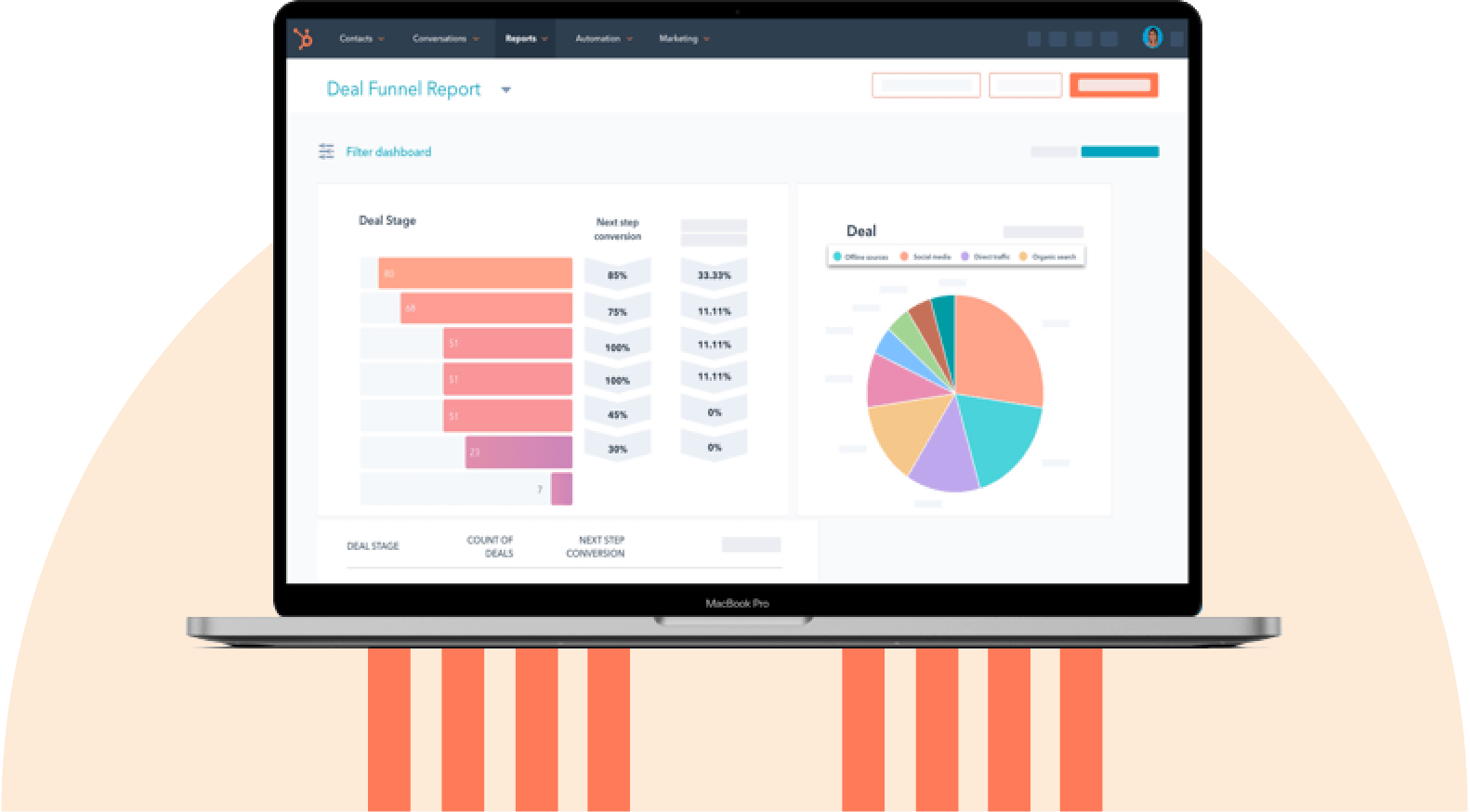
HubSpot's Free CRM Software
Free CRM Software & Tools for Your Whole Team
- Sales
- Marketing
- Operations
- Customer Service
Where CDPs Add the Most Value
CDPs are especially useful when customer signals live across many systems and need to connect at the profile level.
- Event tracking and product usage analytics: Web and in-app events enrich profiles with feature adoption, frequency, and intent signals.
- Cross-channel profile consolidation: Website behavior, email engagement, purchase history, and support activity can live in one connected record.
- Orchestration-ready segments: Segments can sync into marketing automation and ad platforms for campaign execution.
Advantages of CDPs
A customer data platform strengthens personalization and lifecycle marketing by reducing fragmentation across customer systems. CDPs support cross-channel orchestration when audience definitions depend on connected behavioral and transactional signals.
- Unified customer profiles for segmentation: Connected profiles make segmentation more accurate, especially when website behavior, product usage events, and purchase history influence targeting decisions.
- Personalization with real-time inputs: Real-time event streams make it possible to trigger messaging based on recent actions, not static lists.
- Cross-channel campaign execution: Audience segments can flow into marketing automation and advertising platforms to keep targeting consistent across email, web, and paid media.
- Lifetime value and retention analysis: Extended history supports lifecycle reporting that connects early engagement to retention, expansion, and revenue contribution.
HubSpot supports many CDP-adjacent workflows through its unified customer platform, which connects marketing, sales, and service data inside shared records.
Trade-offs of CDPs
CDPs introduce operational and technical complexity.
- Implementation requires integration mapping and governance alignment.
- Profile accuracy depends on clean data inputs across systems.
- Real-time event processing at scale can increase infrastructure costs.
- Compliance obligations increase when storing identifiable customer history.
Organizations comparing vendors should review detailed evaluation criteria before committing to implementation. This guide on how to choose a CDP outlines key technical and operational considerations.
Pro tip: CDPs deliver the most value when behavioral data directly influences segmentation and retention strategy.
What is a customer relationship management (CRM) system?
A customer relationship management system stores and manages contact information, sales activity, and service interactions across the customer lifecycle. CRMs provide operational visibility into pipeline health, communication history, and account status. CRMs support sales, marketing, and customer service teams with forecasting, deal tracking, and coordinated outreach.
CRMs typically rely on structured objects such as contacts, companies, and deals, which organize data around revenue workflows rather than behavioral event streams. CRMs prioritize relationship tracking, pipeline progression, and lifecycle stage management over cross-channel behavioral aggregation.
A CRM records pipeline activity and preserves communication history across email, calls, and meetings. Workflow automation ties follow-up tasks to lifecycle stages and deal movement. Shared reporting connects marketing, sales, and service around consistent performance metrics.
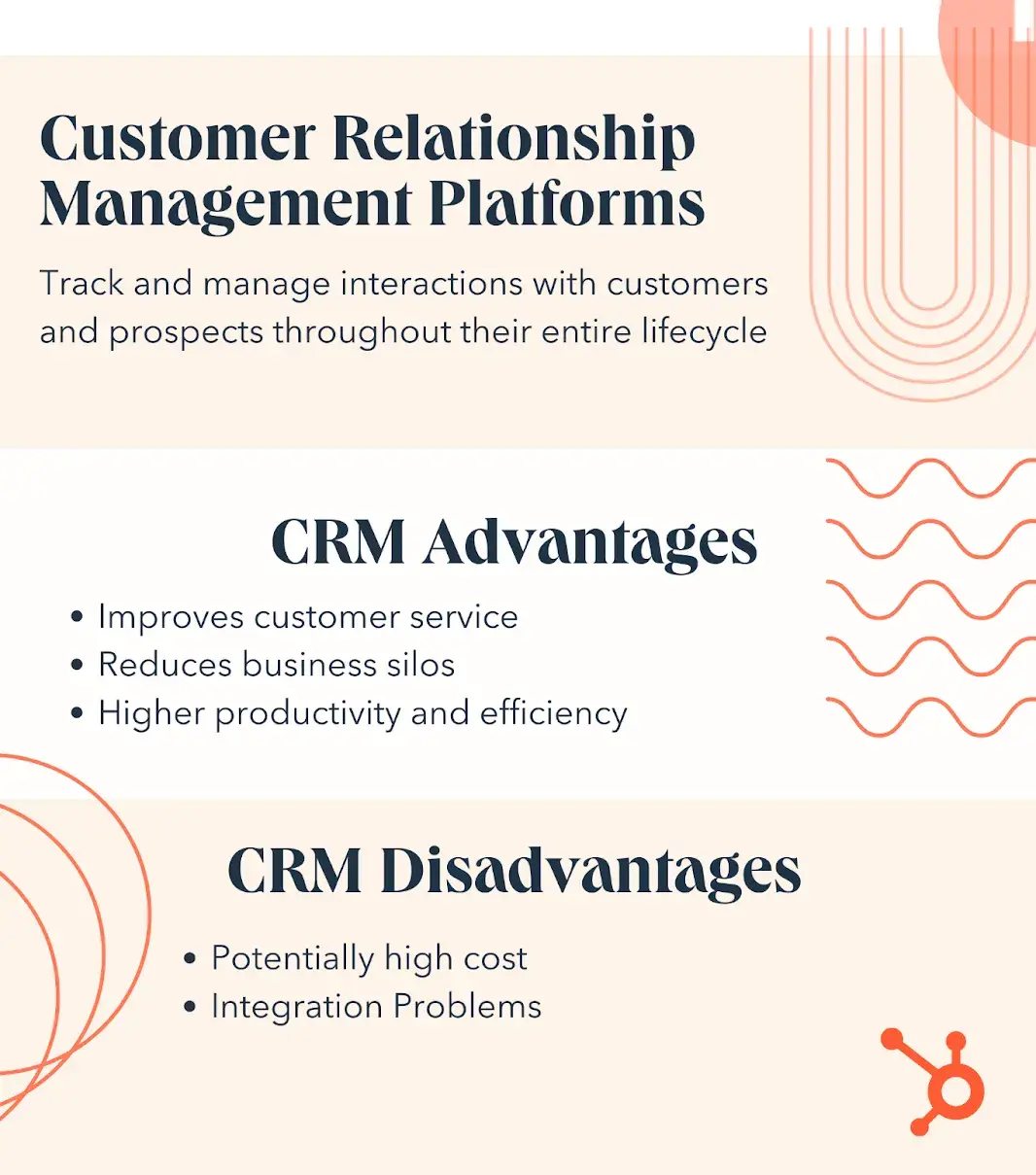
Advantages of CRMs
CRMs strengthen revenue operations by centralizing relationship data and improving coordination across teams.
- Improved customer service: Shared visibility into communication history, support tickets, and account activity allows teams to respond with context, streamlining the customer lifecycle.
- Reduced business silos: Sales, marketing, and service teams operate on the same contact and account records, improving alignment and reducing duplicated effort across systems.
- Higher productivity and efficiency: Workflow automation, task management, and pipeline tracking reduce manual work and keep teams focused on active deals and customer engagement.
Trade-offs of CRMs
CRMs deliver structured pipeline visibility, but their relationship-first design comes with limits.
- Marketing and product usage signals often require external sync.
- Cost scales with users, automation complexity, and add-ons.
- Siloed CRM deployments can limit personalization accuracy.
What is a data management platform (DMP)?
A data management platform collects and organizes anonymous audience data for advertising and paid media targeting. DMPs aggregate second- and third-party signals into segments that activate inside programmatic advertising environments. This model prioritizes audience reach and targeting efficiency over persistent customer history.
DMPs operate inside advertising ecosystems and rely on anonymous audience identifiers, while CRMs and CDPs work with known, identifiable customers.
DMPs build audience segments using second- and third-party data tied to anonymous identifiers such as cookies and device IDs. As third-party cookies phase out, the durability of these segments declines.
Modern Context Shaping DMP Value
- Privacy Sandbox initiatives and browser restrictions reduce cross-site tracking reliability.
- Data clean rooms shift targeting and measurement toward privacy-preserving collaboration models built on strong first-party data foundations.
- AI audience modeling continues, but model quality depends on compliant data access and signal reliability.
Unlike a CDP or CRM, a DMP does not maintain named profiles or extended relationship history.
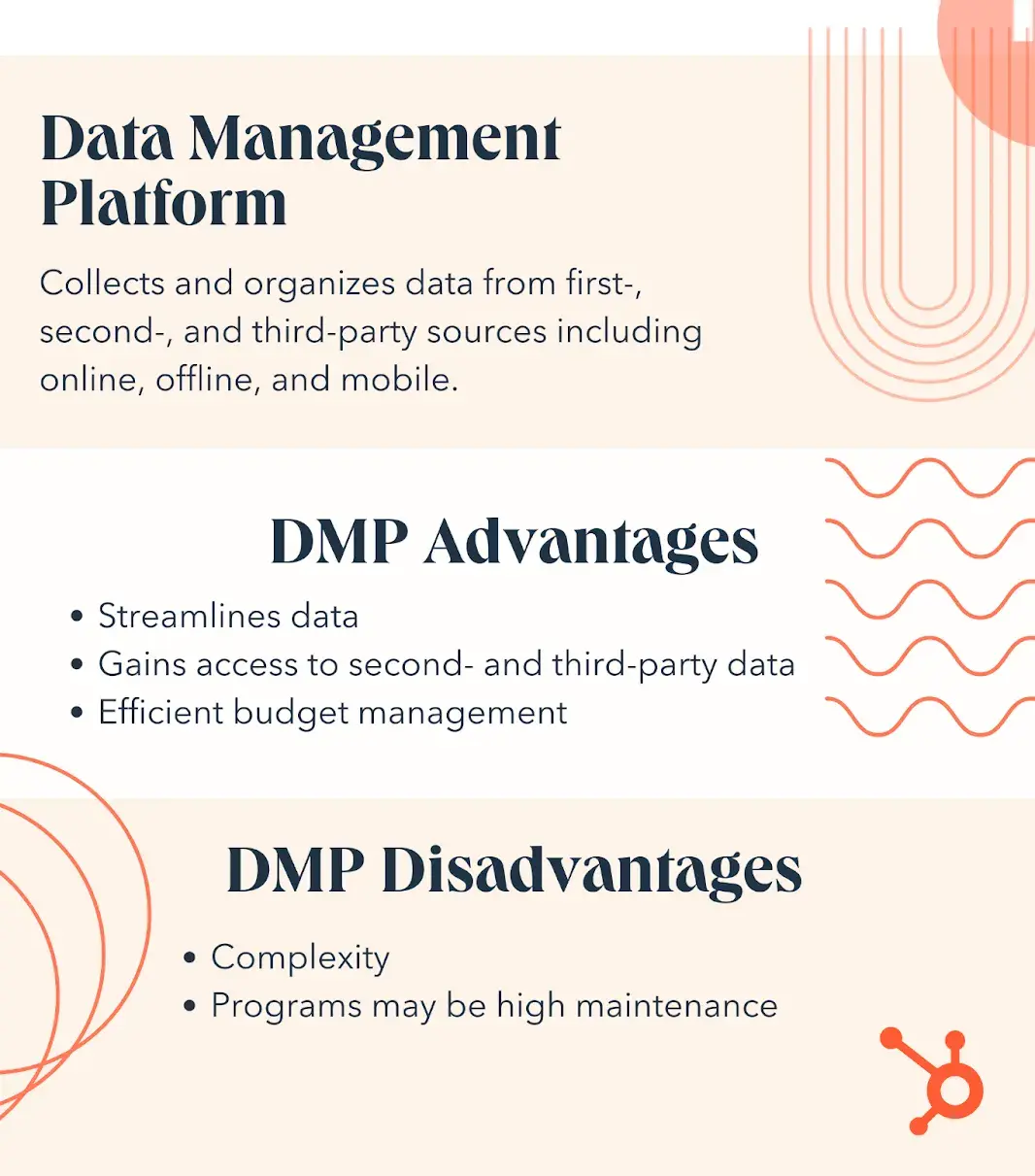
Advantages of DMPs
DMPs support advertising execution by organizing audience data for scalable targeting and media efficiency.
- Streamlined audience segmentation: DMPs aggregate data from multiple sources into usable segments, allowing ad teams to activate campaigns without manually stitching datasets.
- Access to external audience data: Second- and third-party datasets expand reach beyond owned channels, helping teams identify new audiences for acquisition.
- More efficient media spend: Centralized audience management improves targeting precision, reducing wasted impressions and improving campaign performance.
Trade-offs of DMPs
- DMP effectiveness depends on advertising ecosystem stability.
- Reliance on third-party cookies reduces long-term durability.
- Retention windows limit historical insight.
- Privacy regulations introduce compliance complexity.
Key Differences Between CDP, CRM, and DMP
A customer data platform, customer relationship management system, and data management platform differ in identity model, retention structure, and activation purpose.
- CDPs create persistent, identifiable profiles.
- CRMs manage relationship and revenue records.
- DMPs segment anonymous audiences for advertising.
Data Sources and Types
Each platform collects different categories of data and stores them under different retention rules.
- A CDP collects first-party data from digital and offline channels and connects signals to identifiable profiles.
- A CRM stores relationship and revenue data tied to contacts, companies, and deals.
- A DMP aggregates second- and third-party signals into anonymous advertising segments.
| PLATFORM | DATA SOURCE | DATA TYPE | IDENTIFIABLE | RETENTION |
| Customer Data Platform (CDP) | First-party systems (websites, apps, email, CRM, payments, offline events) | Behavioral, transactional, engagement, consent, demographic | Yes | Long-term, persistent profiles |
| Customer Relationship Management (CRM) | Direct sales, marketing, and service interactions | Contact records, deal data, engagement logs, revenue data | Yes | Long-term, lifecycle-based |
| Data Management Platform (DMP) | Second- and third-party advertising networks, publisher data, cookies | Anonymous behavioral data, device IDs, demographic overlays | No | Short-term, expiration-based |
A CDP supports profile unification across channels. A CRM supports structured lifecycle tracking. A DMP supports advertising reach and segmentation without persistent identity resolution.
HubSpot's Free CRM Software
Free CRM Software & Tools for Your Whole Team
- Sales
- Marketing
- Operations
- Customer Service
Primary Use Cases
Each platform aligns with a different operational objective across the customer lifecycle.
- Customer Data Platform (CDP): Cross-channel personalization: Best for marketing teams that need connected behavioral and transactional signals to drive segmentation and orchestration.
- Customer Relationship Management (CRM): Lifecycle and revenue management: Best for sales, marketing, and service teams that need pipeline tracking, forecasting, and relationship history in one place.
- Data Management Platform (DMP): Paid media segmentation: Best for ad teams optimizing audience reach through anonymous identifiers and partner datasets.
Technical Capabilities
Technical structure determines how each system processes identity, activates data, and governs compliance.
| capability | cdp | crm | dmp |
| Identity resolution | Deterministic + probabilistic cross-device matching | Tied to known contacts | Anonymous identifiers only |
| Real-time personalization | Yes — behavioral triggers + segmentation | Limited — workflow-based | No — ad targeting only |
| AI modeling | Predictive segmentation, scoring | Forecasting, reporting models | Audience modeling for ads |
| Ad activation | Syncs first-party segments to ad platforms | Indirect via integrations | Native programmatic activation |
| Sales pipeline tracking | No | Yes — structured deal tracking | No |
| Compliance management | Consent governance required | Role-based access controls | Cookie and ad compliance |
| Historical retention | Extended profile history | Lifecycle-based retention | Expiration-window based |
CDP vs. CRM
A CDP focuses on behavioral data unification. A CRM centers on relationship management and revenue operations.
CDPs connect behavioral and transactional events into unified profiles used for segmentation and personalization. CRMs organize known contacts, deals, and service interactions to manage pipeline activity and account history.
CDPs are best suited for teams that depend on product usage, web behavior, and engagement signals to drive marketing execution. CRMs support sales and revenue teams where forecasting accuracy, account visibility, and deal progression shape performance outcomes.
CRM vs. DMP
CRM vs DMP differences come down to identity, data structure, and purpose.
A CRM manages identifiable customer records tied to revenue workflows. A DMP builds anonymous audience segments for advertising activation.
CRMs store contact, deal, and service data to support pipeline visibility and lifecycle management. DMPs aggregate second- and third-party signals to support paid media targeting at scale.
CRMs are best suited for teams focused on customer relationships, retention, and revenue tracking. DMPs support advertising teams that need to expand reach and activate audiences across programmatic channels.
CDP vs. DMP
A CDP creates persistent profiles tied to known customers using first-party data. A DMP aggregates anonymous signals into advertising segments designed for paid media activation. CDPs maintain extended history connected to identifiable records. DMPs operate within shorter retention windows tied to cookie lifespans.
Third-party cookie deprecation reduces the durability of DMP-based targeting. Privacy Sandbox initiatives, clean rooms, and first-party data strategies shift value toward systems that consolidate owned customer signals and support compliant measurement.
Is HubSpot a CDP?
HubSpot offers a unified platform that combines CRM and CDP capabilities within a single data architecture. Its customer platform connects marketing automation, sales activity, and service interactions inside shared contact and company records. This structure allows HubSpot to unify first-party customer data across marketing, sales, and service. It supports segmentation, attribution, and automation from a centralized system of record.
HubSpot is not a standalone data management platform. It does not operate as an anonymous audience marketplace built on third-party cookie aggregation. Instead, HubSpot supports CDP-like functionality through its integrated data layer, which consolidates behavioral, transactional, and engagement signals inside identifiable profiles.
HubSpot’s data foundation, available through its Data Hub, enables teams to connect structured and unstructured data across systems. The broader customer platform aligns marketing, sales, and service workflows on shared records, while the core CRM supports pipeline tracking, forecasting, and lifecycle management.
HubSpot’s architecture supports cross-channel segmentation in Marketing Hub, structured deal management in Sales Hub, service history and ticket tracking in Service Hub, and unified reporting across the entire customer lifecycle. HubSpot’s system design reinforces first-party data strategy and revenue operations alignment over third-party advertising aggregation.
How to Choose Between a CRM, DMP, and CDP
Platform selection should start with measurable outcomes. Customer acquisition cost (CAC), attribution accuracy, and personalization performance all depend on how well your systems connect.
Most organizations don’t choose a single platform. They combine systems based on how their data, teams, and workflows operate.
1. Define your primary use case.
Start with the problem you need to solve, then identify where most of your requirements cluster.
- If your biggest gap is pipeline visibility, forecasting, and account management, a CRM should anchor your stack.
- If personalization depends on behavioral data across channels, a CDP becomes a priority.
- If growth relies on expanding reach through paid media, a DMP may still support acquisition.
These needs often overlap. A team focused on personalization still needs CRM-driven lifecycle tracking, and a revenue-focused team often needs CDP data to improve targeting and conversion.
2. Audit your data environment.
Evaluate where your data lives, how it is structured, and how easily it can be connected.
- If behavioral data is spread across tools and cannot be tied to profiles, unification becomes the primary challenge.
- If sales and lifecycle data already live in a central system, the focus shifts to activation and enrichment.
- If acquisition depends heavily on external data sources, audience expansion may still play a role.
The goal is to determine whether the core issue is fragmentation, activation, or scale, then align your platform decisions accordingly.
Marketing and IT teams mapping their ecosystem often review customer data collection software to understand how signals enter and flow between systems.
3. Evaluate identity requirements.
Your ability to identify users shapes how systems need to work together.
- If you need to connect behavior across devices and sessions, you need a system that supports identity resolution at the profile level.
- If your workflows depend on known contacts, accounts, and deal stages, structured relationship data becomes the priority.
- If your strategy includes reaching new audiences, anonymous identifiers may still play a role in advertising.
Most organizations operate across both known and unknown users, which makes a combined approach more practical than a single-platform decision.
4. Assess compliance and privacy constraints.
Regulatory requirements influence what data you can collect, store, and activate.
- If your strategy depends on first-party data, alignment between systems that manage profiles and relationships becomes critical.
- If your current acquisition model relies on third-party tracking, long-term durability may be limited.
- If consent and governance requirements are strict, data storage and activation processes need tighter control.
This step helps determine how resilient your data strategy will be as privacy standards continue to evolve.
5. Review integration and system complexity.
Look at how easily systems connect and how consistent your reporting is across teams.
- If core systems already integrate well, you can extend capabilities without adding significant overhead.
- If workflows depend heavily on APIs and custom pipelines, implementation effort and maintenance increase.
- If reporting varies across tools, it signals a need for stronger data alignment.
Strong customer data integration improves reporting consistency and allows teams to act on shared insights rather than fragmented views.
6. Align with long-term data strategy.
Your platform decisions should reflect where your organization is heading, not just current gaps.
- If you are moving toward first-party data ownership, systems that unify and activate customer data become more important.
- If revenue operations are scaling, structured lifecycle management remains central.
- If paid acquisition continues to drive growth, audience targeting capabilities still matter.
The right choice is the combination of systems that supports both current execution and future data control. Comparing leading CDP platforms alongside your CRM and advertising stack can help clarify where each system fits.
Making the Right Choice for Your Team
CDP vs. CRM vs. DMP decisions shape acquisition efficiency, measurement accuracy, and long-term data control. Unified customer data aligns campaigns, attribution, and follow-up on shared records, which lowers customer acquisition cost and connects campaign activity to pipeline and revenue outcomes.
HubSpot’s unified platform reduces fragmentation across marketing, sales, and service systems and supports first-party data strategies as privacy constraints continue to tighten.
Editor's note: This post was originally published in March 2023 and has been updated for comprehensiveness.
HubSpot's Free CRM Software
Free CRM Software & Tools for Your Whole Team
- Sales
- Marketing
- Operations
- Customer Service

.webp)