Table of Contents
- What is SMS marketing?
- AI’s Impact on SMS Marketing
- How to Get Started with SMS Marketing
- Kickstarting & Reporting on SMS Campaigns
- SMS Marketing Best Practices
- Frequently Asked Questions About SMS Marketing
What is SMS marketing?
SMS, an acronym for “Short Message Service,” is a communication channel for sending and receiving text messages on mobile devices. It allows users to send brief messages, typically 160 characters, to individuals or groups instantly. Text messaging has gained immense popularity due to its simplicity, convenience, and widespread availability across different devices and networks.
On the other hand, MMS, or “Multimedia Message Service”, goes beyond simple text and allows users to send multimedia content such as pictures, videos, audio files, and even formatted text.
SMS marketing allows businesses to connect with their target audience through personalized and timely text messages. It leverages the widespread use of mobile phones and the convenience of SMS to deliver promotional offers, updates, reminders, and other engaging content directly into the palm of the recipients’ hands.
Integrating SMS marketing alongside email and social media allows businesses to strike the right balance when it comes to timing and frequency of their messages.
AI’s Impact on SMS Marketing
HubSpot’s AI-powered tools help marketers generate personalized SMS messages faster. These tools use customer data and campaign context to help teams write, refine, and scale SMS campaigns more efficiently.
Harnessing the capabilities of AI, you can leverage customer data and insights to create tailored SMS campaigns that resonate with your recipients.
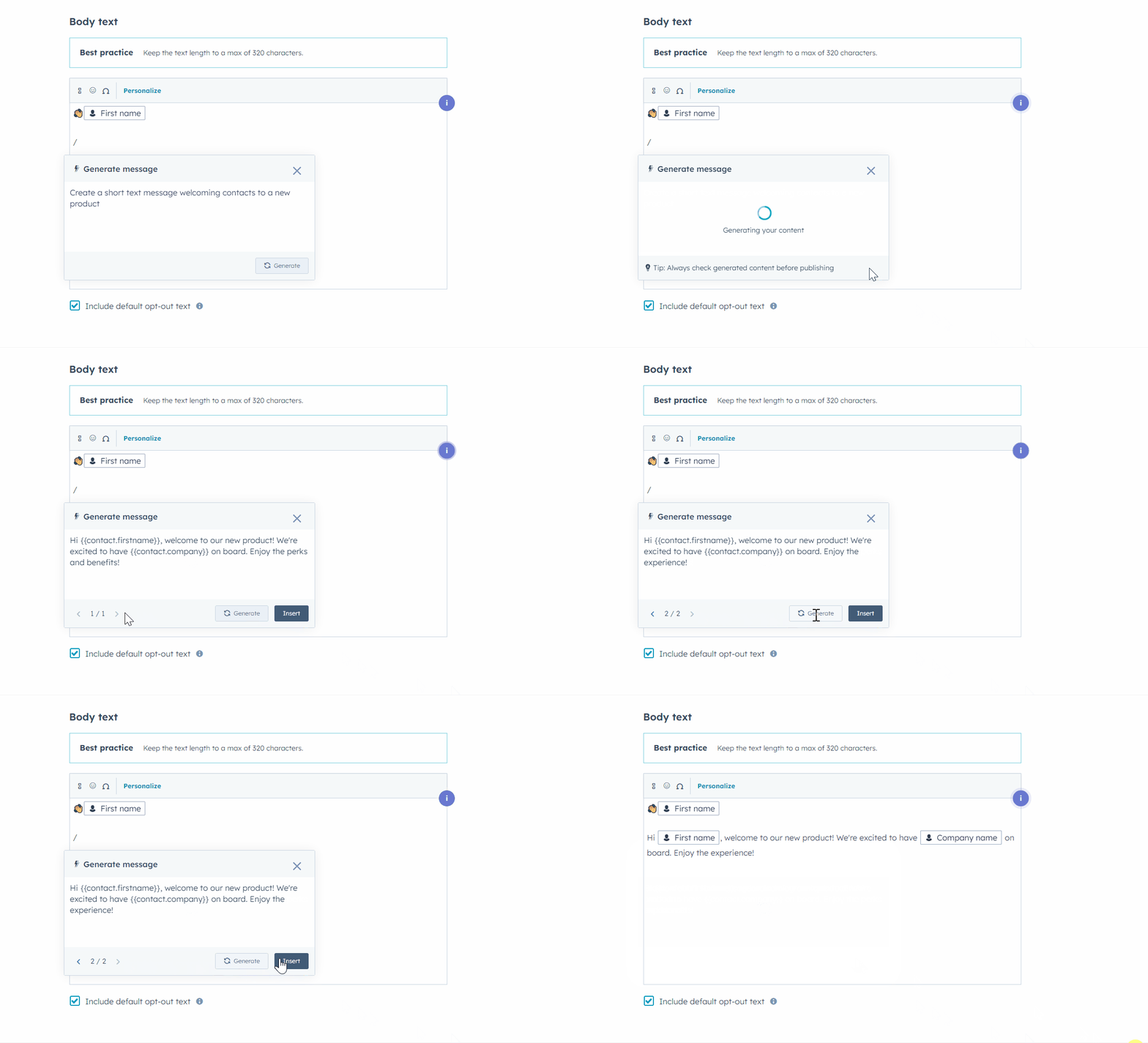
Check out HubSpot’s newest AI tools. >>
How to Get Started with SMS Marketing
Editor’s note: To help make things clearer, we’ve used HubSpot’s tools to illustrate best practices. However, the tips and tricks below should be applicable to a wide range of tools and products.
And while HubSpot’s SMS tools may not be accessible in all regions, the valuable guidance shared in this post is applicable to other regional channels, such as WhatsApp, with more than 2 billion monthly active users globally.
1. Identify your SMS use case.
The key to achieving success with SMS marketing lies in effective planning. As you prepare to launch your first SMS campaign, it is essential to have a clear idea of the use case you are addressing with your messages.
By aligning your SMS strategy to the various stages of the buyer’s journey, you gain a deeper understanding of the purpose behind each message and how it contributes to both your target audience’s needs and your business goals. This strategic approach enables you to ensure that every SMS you send serves a specific purpose in guiding your persona towards the desired outcome.
Consider these common SMS use cases:
Informative
- Appointment reminders: appointment reminders may be the most valuable SMS message.
- Order updates: provide real-time tracking information and keep customers informed about their purchase progress.
- Receipt confirmation: ensure customers have proof of their purchase and create a seamless customer experience.
- Product launches: generate excitement and awareness among customers for a new product.
- Brand announcements: effectively communicate important updates, new initiatives, or significant milestones to your audience.
Promotional
- Seasonal campaigns: leverage the time-sensitive nature of holidays or specific seasons to drive customer engagement, boost sales, and create a sense of urgency.
- Loyalty programs: nurture customer relationships, reward loyalty, and promote continued engagement and brand advocacy.
- Event management: effectively communicate event details, updates, and reminders to attendees for a seamless and organized event experience.
Customer Service
- Timely support: providing quick and convenient assistance to customers.
- Onboarding flows: guide new customers through the onboarding process and ensure successful user adoption.
Sales
- Marketing to sales handoff: seamlessly transfer leads or prospects from the marketing team to the sales team.
- Upsell/Cross sell opportunities: leverage existing customer relationships to offer additional products or services.
Non-Forbidden Message Categories
- If you’re using HubSpot’s SMS tools, you should also be aware of use cases that are non-compliant due to the forbidden message categories. These regulations are upheld by most SMS service providers and are outlined by CTIA.
- If you’re sending your SMS messages using HubSpot, be sure to review your use case against the forbidden message categories in order to ensure you don’t run the risk of being filtered or blocked.
Pro tip: For more information on HubSpot’s integration with WhatsApp, please visit our feature page.
2. Build a compliant consent process.
Establishing a robust and compliant consent process is crucial for the success of your SMS campaigns, protecting you from sending messages to inappropriate contacts, which could undermine the effectiveness of your campaign and expose you to the risk of being blocked.
Depending on the specific use case you have chosen, your consent process may vary, but it should incorporate essential elements to ensure compliance and maximize results. In this section, we will explore the key inputs to address in every consent process, empowering you to build a solid foundation for engaging your audience through SMS campaigns.
Gather explicit consent: Obtaining consent to send SMS messages is vital when it comes to SMS marketing, setting it apart as a highly effective and engaged channel. Explicit consent is defined as consent given when you ask an individual for permission to send them marketing materials, and they agree. The recipient has to manually opt-in to receive your content through written consent, clicking a checkbox on a form, or confirming through double opt-in.
Alternatively, implicit consent is defined as consent given when an individual gives you their email address for some business purpose, but has not explicitly stated that they want to receive marketing content from you.
- Utilize opt-in terminology: Contacts have the option to opt in by using any of the three words: START, UNSTOP, or SUBSCRIBE. These keywords allow individuals to express their interest and willingly join your communication channel.
- Provide value in exchange for consent: Transparency is key, so it’s important to offer your contacts something valuable in exchange for their consent. Clearly communicate the frequency of messages they can expect and define the specific content they will receive, such as order updates, exclusive discounts, or dedicated customer support. By providing this clarity and promising real value, you’ll build trust and increase the likelihood of obtaining and retaining consent.
- Manage contact consent status: A consent management tool helps marketers track, update, and enforce SMS consent across their contact database. HubSpot’s CRM can centralize contact records so teams can manage consent status in bulk or one record at a time.
- Always offer opt-out: Prioritize giving your contacts the option to opt out of receiving messages.
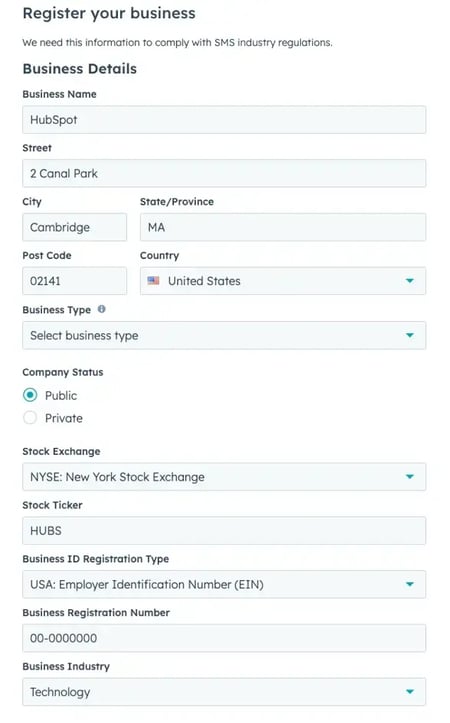
3. Register your business for SMS.
Before sending SMS messages, it is crucial to register your business with your SMS service provider. While the specific nomenclature may vary across providers (check out HubSpot’s guide to setting up SMS messaging), the registration process typically involves following these steps:
- Register your business: Provide specific details about your business, including status, website URL, registration number, and industry.
- Provide SMS details: Enter additional information about how your business intends to use SMS and manage consent. Ensuring you have properly outlined your intended use cases and consent process is vital to this step.
- Get an SMS number: Generate a phone number that your business will use to send SMS messages.
4. Set up your first campaign.
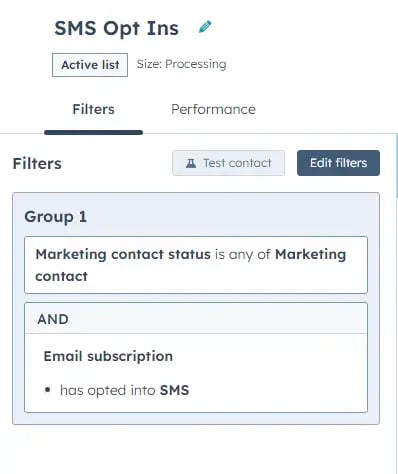
Create a list of contacts who have explicitly agreed to receive SMS messages from your business. As you grow that list, keep compliance front and center.
- Only include contacts who have clearly opted in to SMS communication.
- Review your list regularly to confirm consent status is current.
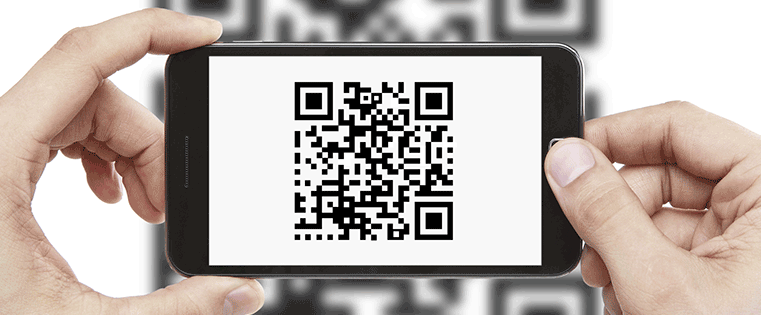
- Use low-friction opt-in methods, such as QR codes or social media sign-up paths, to grow your subscriber base.
- Make sure every list-building tactic aligns with your consent requirements.
5. Write actionable SMS copy.
When you send an SMS, you’re competing with messages from friends, family, and other brands. That’s why every text should quickly show the reader why it’s worth opening and acting on.
- Valuable: Give the reader a clear benefit, such as an update, offer, or reminder.
- Relevant: Match the message to their stage, preferences, or recent activity.
- Actionable: Include a clear next step.
- Concise: Keep the message short enough to understand at a glance.
Customize these messages according to the specific stage of the buyer’s journey your contacts are in. For optimal targeting, consider segmenting your list into smaller, more focused groups based on the various stages of the buyer’s journey.
SMS Campaign Samples
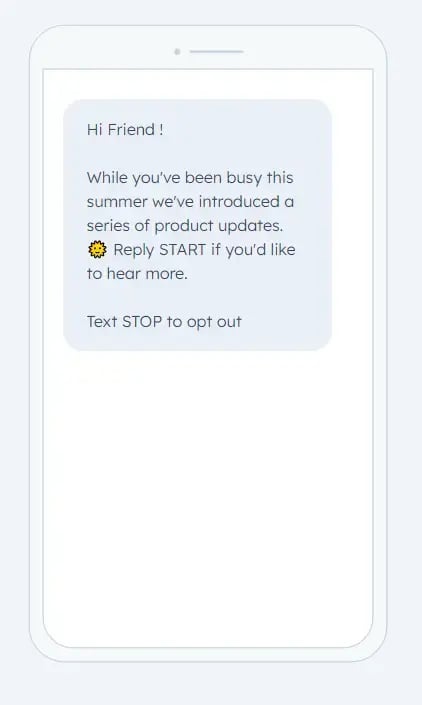
Re-engagement Campaign:
The SMS copy below reminds users that they’re still a member, user, or past customer of a given service and encourages them to re-engage with a brand in some way – ideally by highlighting perks they’ll discover when they re-engage.
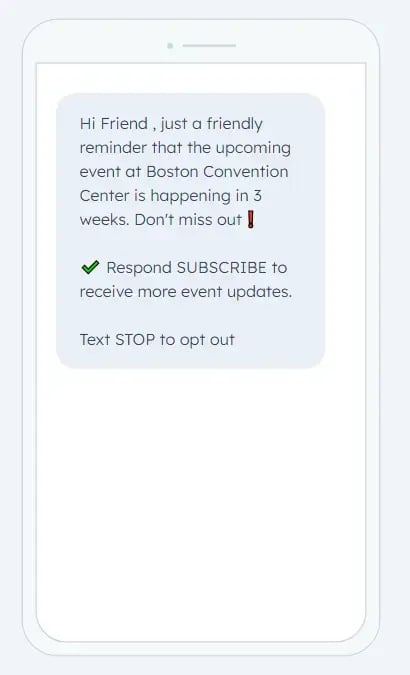
Event Updates:
When hosting an in-person or online event, sending event updates can keep your attendees excited, engaged, and in the know before, during, and sometimes even after an event.
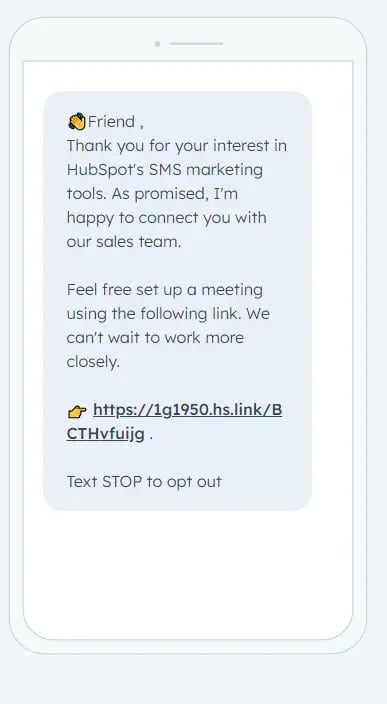
Marketing to Sales Handoff:
When a prospect converts, these messages can help smoothly introduce them to your sales team in case they choose to buy a product.
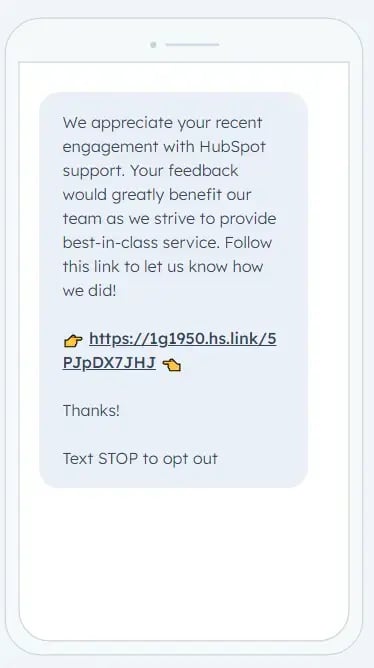
Customer Service Feedback:
After a deal is made, keep the customer journey going by following up and seeing how their experience went by sending customer service feedback or survey messages.
Kickstarting & Reporting on SMS Campaigns
Once your messages have been carefully crafted and thoroughly reviewed, it’s time to initiate sending them to your contacts! Take a step forward and begin delivering your impactful messages to engage and connect with your audience.
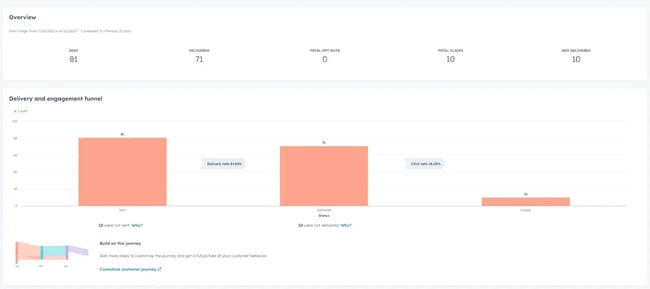
To understand whether your SMS campaign is working, track a small set of performance metrics consistently and use them to guide your next round of optimization.
- Click-through rate: Shows whether recipients engage with a link or offer.
- Conversion rate: Shows whether clicks turn into meaningful business results.
- Opt-out rate: Signals whether message frequency, relevance, or targeting needs work.
- ROI: Measures whether the SMS program is generating enough return to justify spend.
HubSpot analytics helps teams connect those metrics to campaign decisions so they can improve timing, targeting, and message copy.
Check out HubSpot’s Analytics tools.
SMS Marketing Best Practices
Building a sustainable SMS marketing program requires more than good copy. List hygiene, personalization, compliance, and message frequency all determine whether subscribers stay engaged or opt out.
- Welcome new contacts: Send a welcome message to any new contact. Clearly state who you are and why you’re messaging to provide valuable context.
- List management: Effective contact management is crucial for successful SMS marketing and ensures you’re sending the right messages to engaged contacts at the right time.
- Segmentation: By strategically categorizing your audience into segments, you can tailor your SMS campaigns, ensure message relevancy, and optimize engagement with specific segments of your target market.
- Brevity: By keeping messages brief, recipients can easily read and action the information across smartphones, watches, and digital assistants like Siri.
- Frequency: SMS is a high-cost communication channel. Make sure you reserve SMS for use cases that are deeply personalized and/or express urgency.
- Personalization: Tailor SMS communication, recommendations, or offers to individual recipients and acknowledge their name, preferences, and past interactions to create a sense of relevance and make a meaningful connection with them.
- AI assistance: Want to personalize a campaign but don’t have time to write 1,000 individual messages? AI tools like HubSpot’s workflows can bring a new level of efficiency, personalization, and effectiveness to your SMS campaigns.
- Compliance: If sending your SMS messages using HubSpot, never send a message that falls into a forbidden category.
- Transparency: Consistently reintroduce your brand, purpose, and message frequency.
- Opt out: Every message should include a clear message to unsubscribe.
Frequently Asked Questions About SMS Marketing
Is SMS marketing legal?
Yes, SMS marketing is legal when marketers have clear consent, comply with local regulations, and provide recipients with an easy way to opt out. Businesses that text people without permission risk complaints, filtering, or carrier blocking.
Is SMS marketing becoming obsolete?
No, SMS marketing is not becoming obsolete. It still works because text messages are widely read, highly visible on mobile devices, and effective for time-sensitive, personalized communication.
How much does SMS marketing cost?
SMS marketing costs vary by provider, region, message volume, and whether the business uses SMS, MMS, or automation features. Most businesses should evaluate cost alongside ROI, opt-in growth, and conversion performance rather than price alone.
What is a good open rate for SMS marketing?
A good SMS open rate is typically much higher than email, but the more important metrics are click-through rate, conversion rate, and opt-out rate. If people open your texts but don’t click or convert, the message or offer may need improvement.
How is SMS marketing different from email marketing?
SMS marketing is more immediate and better suited for urgent, short, or highly personalized messages, while email works better for longer-form content and richer design. Many businesses get the best results when they use both together as part of a multi-channel strategy.
How do I build an SMS subscriber list?
Build an SMS subscriber list by collecting explicit opt-ins through forms, keywords, QR codes, purchases, or other consent-based touchpoints. Make it clear what subscribers will receive, how often you’ll text them, and how they can opt out.
Step into SMS with HubSpot Today
Get started with HubSpot SMS for Marketers today! You can learn more about HubSpot’s SMS tools in our guide to creating and sending SMS messages in HubSpot. For pricing and packaging details, please visit our Pricing and Services catalog.
Not ready to invest in a new product just yet? Check out our free resource with a plethora of SMS templates you can use across many different business strategies by clicking the banner below.
Editor's note: This post was originally published in August 2017 and has been updated for comprehensiveness.
.webp?)
Free Marketing Software
Easy marketing tools that deliver fast time-to-value, unified in one place.
- AI Tools
- Email Marketing
- Social Media Management
- And More!
Mobile Marketing
.webp)