%20(1).png)
Landing pages also focus site visitors’ attention on one particular offer, limiting the distractions of everything else on the website. Visitors are on a landing page for just one single purpose: to obtain an offer by completing a lead-capture form.
But converting visitors into leads, even with landing pages, is much easier said than done. In fact, there are quite a few best practices every marketer should consider when setting up and optimizing landing pages.
Table of Contents
TL;DR: Good landing pages turn traffic into leads.
The most effective landing page best practices focus on conversion-first design: include the core page elements, remove distractions, match the CTA and headline, keep copy and design simple, emphasize the offer’s value, shorten forms, strengthen CTA button copy, add trust signals, and keep testing what works. Together, these tactics help marketers turn more campaign traffic into leads.
Lead Generation Tips
1. Include all critical elements of an effective landing page.
Landing pages, sometimes also called “lead-capture pages,” are used to convert visitors into leads by completing a transaction or by collecting contact information from them. In order to make these transactions happen, it’s critically important that landing pages consist of the following components:
- A headline and (optional) sub-headline
- A brief description of the offer that clearly emphasizes its value
- At least one supporting image
- (Optional) supporting elements such as testimonials or security badges
- And most importantly, a form to capture visitors’ information
2. Remove the main navigation.
Once a visitor arrives on a landing page, it’s the marketer’s job to keep them there. So if there are links on the page that enable visitors to move about the website, the business runs the risk of distracting them, which creates lead generation friction and increases the chance they’ll abandon the page before even converting. And, let’s face it: No respectable marketer wants that. One of the best ways to reduce this friction and increase landing page conversion rates is to simply remove the main navigation from the page. Simple as that!
3. Match the headline of the landing page to its corresponding CTA.
Keep messaging consistent in both the call-to-action (CTA) and the headline of the landing page. If people click on a CTA for a free offer only to find out there’s a catch on the landing page, the business will instantly lose their trust. Similarly, if the headline reads differently than the CTA, it might lead to confusion, and the visitor might wonder if the CTA is linked to the wrong page. Eliminate any and all confusion, and make sure the landing page consistently reflects what was promised in the call-to-action and vice versa.
4. Remember: Less is more.
Many marketers are probably aware of the phrase “keep it simple, stupid.” Apply that same philosophy to landing pages. A cluttered page usually results in a distracted, confused, and/or overwhelmed visitor. Talk about landing page friction! Instead, embrace white space, and keep the text and images on the page simple and to-the-point.
5. Emphasize the offer’s value.
Highlight the benefits of the offer with a brief paragraph or a few bullet points. The best landing page description offers more than just a list of what the offer consists of; it also clearly highlights the value of the offer and gives visitors a compelling incentive to download. For example, instead of “Includes specifications of product XYZ,” say something along the lines of, “Find out how XYZ can increase productivity by 50%.” In other words, emphasize how the offer addresses a specific problem, need, or interest the target audience cares about.
6. Encourage social sharing.
Don’t forget to include social media sharing buttons that enable prospects to evangelize a brand’s content and offers. To limit cluttering, just be sure to only include buttons for the social platforms the audience uses. And don’t forget to add an email forwarding option, since people have different sharing preferences. Keep in mind that even if a business’s social media contacts never buy from it, there’s always a possibility that someone in their personal network will!
7. Create more landing pages to generate more leads.
According to HubSpot’s Marketing Benchmarks Report, companies see a 55% increase in leads when increasing their number of landing pages from 10 to 15. The reason is simple: More landing pages create more chances to match the right offer to the right audience.
If marketers want to create more landing pages efficiently, they can start by:
- Using a landing page builder to publish pages faster.
- Creating more targeted offers for different audience segments.
- Tailoring content to each buyer persona.
- Repurposing existing assets into new conversion opportunities.
The more targeted pages are, the more opportunities marketers have to convert visitors into leads. In fact, this post elaborates on all of the above about why you (yes, you) need to create more landing pages.
8. Only ask for the information you really need.
Marketers might be wondering how much information they should require in their forms. There’s no one-size-fits-all answer, but the best approach is to collect only the information needed to qualify the lead.
In general:
- Fewer form fields usually increase conversion rates.
- Each extra field creates more work for the visitor.
- Longer forms can improve lead quality, but they often reduce total submissions.
- Testing is the best way to find the right balance for each business.
9. Consider whether “To Submit, or Not to Submit?”
That is the question most visitors are probably asking. That’s why one simple yet effective way to increase form conversion rates is to avoid using the default word “Submit” on the form button. No one wants to “submit” to anything. Instead, turn the statement into a benefit that relates to what prospects will be getting in return.
For example, if the form is to download a brochure kit, the submit button should say, “Get Your Brochure Kit.” Other examples include “Download Whitepaper,” “Get Your Free Ebook,” or “Subscribe to Our Newsletter.” Here’s another helpful tip: Make the button big, bold, and colorful, and make sure it looks like a button, which is usually beveled and appears “clickable.”
10. Reduce anxiety with proof elements.
People are more cautious than ever about sharing personal information, especially when a form asks for contact details. To reduce that anxiety and improve conversions, add proof elements like:
- Add a privacy message (or a link to your privacy policy) that indicates visitors’ email addresses will not be shared or sold.
- If the form requires sensitive information, include security seals, a BBB rating, or certifications so visitors know their information is safe and secure.
- Add testimonials or customer logos. It’s a great way to leverage social proof. For example, if the offer is for a free trial of the product or service, marketers might want to include a few customer testimonials about that particular product or service.
11. Make the form appear shorter.
Sometimes people won’t fill out a form just because it looks long and time-consuming. If the form requires a lot of fields, try making the form appear shorter by adjusting its styling. For example, reduce the spacing in between fields or align the titles to the left of each field instead of above it so that the form appears shorter. If the form covers less space on the page, it may seem as if the company is asking for less.
And whenever possible, use Smart Fields like those in HubSpot’s form builder to shorten forms for returning visitors. Smart Fields reduce repeated questions and help marketers improve conversion rates without losing important lead data.
12. Include rich media on your landing pages.
In this day and age, one of the ways to make landing pages stand out is to include rich media. Rich media can help the landing page stand out and make the offer easier to understand. For example, marketers can use:
- GIFs to draw attention to key actions.
- Videos to explain the offer quickly.
- Interactive images to make the page more engaging.
Design alone won’t drive conversions, but the right media can make the value proposition clearer and more compelling.
13. Pay attention to the copy.
The most critical component of landing pages is to have copy that inspires users to download the offer. How do marketers do this?
Well, the best way is to write copy that is targeted toward the persona. This means that the target market should feel like they could’ve written the copy themselves. When the target market feels like a brand understands their problems, they’re more likely to download the offer.
Frequently Asked Questions About Landing Page Best Practices
What is a good conversion rate for a landing page?
A good landing page conversion rate depends on your industry, traffic source, and offer, but the most useful benchmark is whether your page improves over time through testing. Start by measuring your current baseline, then optimize headlines, forms, CTAs, and trust signals to lift performance.
How long should a landing page be?
Your landing page should be as short as possible while still giving visitors enough information to take action. Simpler offers often need less copy, while higher-commitment offers may need more detail, proof, and context.
What is the difference between a landing page and a homepage?
A landing page is built to drive one specific action, like downloading an offer or requesting a demo, while a homepage serves multiple audiences and goals. That focus is why landing pages usually convert better for campaigns.
Do I need a dedicated landing page tool, or can I use my website?
You can publish a landing page on your website, but a dedicated landing page tool usually makes it easier to build focused pages, test variations, and track conversions. That matters when you’re trying to improve performance across campaigns, not just launch one page quickly.
Getting Started
Marketers who consistently improve their landing pages create stronger customer experiences, generate higher-quality leads, and maximize the return on every campaign they launch. By applying even a few of these best practices, teams can turn landing pages from simple conversion points into powerful growth drivers that continuously improve marketing performance over time.
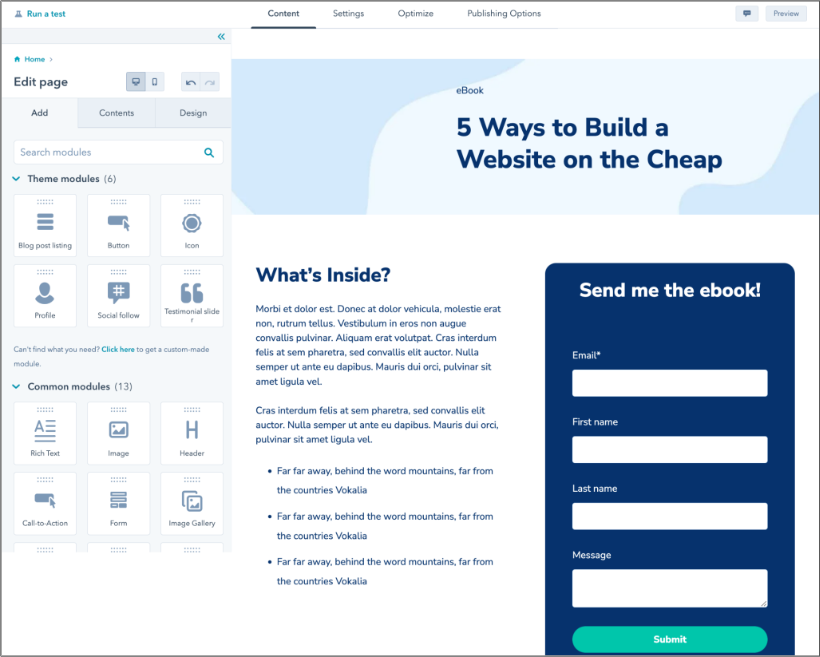
Landing pages can feel overwhelming to create. HubSpot helps marketers build, test, and optimize landing pages so they can convert more visitors into leads. With HubSpot’s landing page builder, teams can launch pages faster and connect tools like briX and Ceros to create more engaging experiences.
Free Landing Page Builder
Create and test beautiful landing pages that generate leads and look great on any device.
- Build landing pages.
- Turn visitors into leads.
- Optimize for SEO.
- And more!
![How to create a landing page with high ROI [+ expert and data-backed tips]](https://53.fs1.hubspotusercontent-na1.net/hubfs/53/%5BUse-2.webp)



![Why You Need to Create More Landing Pages [Data + Tips]](https://53.fs1.hubspotusercontent-na1.net/hubfs/53/create%20more%20landing%20pages.png)
.png)