More customers are turning to answer engines when searching for products. ChatGPT alone has 900 million active users. Marketers are building new disciplines like AEO to create content that appears in these answer engines. 
As an emerging discipline, there are many terms being used to explain how teams can rank in AI-generated responses. GEO and AEO are two that marketers encounter.
Some experts differentiate and use AEO when discussing for direct search results answers, like featured snippets. They’ll use GEO when referring to AI chatbot citations. At HubSpot, we use AEO as a term that captures all initiatives to improve visibility in answer engines. Here’s how these conversations are unfolding,
Table of Contents
- AEO vs. GEO: Is there a difference?
- AEO vs. GEO: Do you need both?
- Tactics That Drive Results in Answer Engines
- How to Measure the Impact of Both AEO and GEO
- What’s next for AEO & GEO?
- Frequently Asked Questions About AEO vs. GEO
AEO vs. GEO: Is there a difference?
AEO stands for answer engine optimization. GEO stands for generative engine optimization. Some experts use AEO to focus on direct search results like featured snippets, knowledge panels, and other SERP features. They’ll then use GEO for citations in answer engine summaries. Others use AEO as an umbrella term under which GEO practices fall.
HubSpot uses AEO for all optimization used to improve visibility in answer engines like ChatGPT, Gemini, and Perplexity. The AEO tool is built to measure what moves the needle.
Why isn’t there a general consensus of when to use GEO vs. AEO? Well, answer engines are relatively new. Right now, the industry is still learning. Marketers are still unlocking how to create content that appears in answer engines and deciding how to refer to these optimizations. So, the language varies between different marketers, brands, and experts.
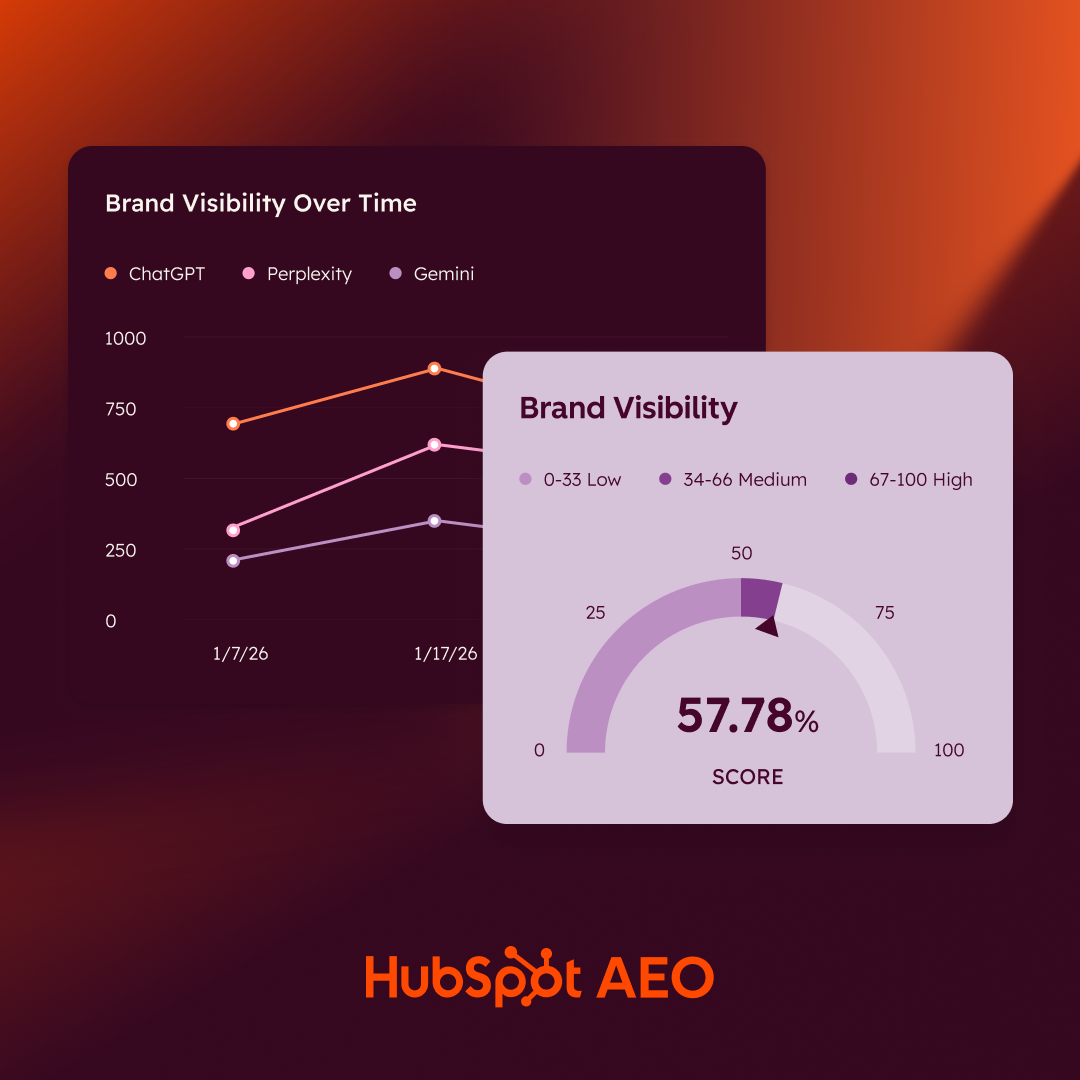
HubSpot AEO Tool
See exactly where your brand shows up in answer engines and take action to close AI visibility gaps.
- Track AI mentions.
- Analyze citations
- Monitor prompts
- Benchmark competitors
AEO vs. GEO: Do you need both?
AEO is a rapidly emerging marketing priority, especially as more people look up information in answer engines like ChatGPT. According to the HubSpot Consumer Trends Report, 72% of consumers surveyed indicated they intend to rely more heavily on AI-powered search when shopping. So, regardless of the word teams use, optimizing for answer engines is essential.
If a brand views AEO and GEO as separate disciplines, marketers must work on both. The same dual approach applies to teams that use AEO as an umbrella term under which GEO falls.
Content must be well structured and have clear entities. Marketers need to make sure that a website’s content is extractable and eligible for direct answers in search engines. So, when someone asks an answer engine for recommendations, their brand is one of the citations the model pulls into its summary.
I’ve seen the benefits for my marketing agency. I’ve had leads come in from ChatGPT and other answer engines, and those results only happened because my brand is visible in AI.
Remember: In today’s search landscape, where buyers increasingly start research in ChatGPT, Perplexity, or Google AI Overviews, relying on SEO alone is no longer enough.
Pro tip: Read HubSpot’s AEO guide.
Tactics That Drive Results in Answer Engines
Regardless of whether a team views AEO and GEO as different practices or the same, structured content helps brands appear in answer engines. So, the foundational practices improve results across the board. The brands that perform best in answer engines are the ones that build structured, answer-first content and maintain strong entity clarity across every page.
Below are five core tactics that strengthen performance.
Answer-First Content Structuring
Answer-first content structuring means leading with the most straightforward answer to a user’s question before adding supporting detail, examples, or context. Instead of burying the key point halfway down the page, writers must surface the most important point immediately in a clean, skimmable format that answer engines and generative engines can extract with zero ambiguity. Writers and search specialists must design content to provide the answer, then elaborate later.
For example, in a piece of content, there is a heading, “What is Answer Engine Optimization?”
The response, designed to perform well in answer engines, will define AEO immediately, like this:
“Answer Engine Optimization (AEO) is the practice of structuring content so search engines can extract direct, authoritative answers for featured snippets, AI summaries, and other answer-driven results.”
Writing content like this isn’t new to search. SEO specialists have been using this method of writing for years because it helps secure featured snippets or rankings in People Also Ask. But now, with answer engines pulling answers instead of links, content writers need to pay even closer attention.
Marketers should evaluate how cleanly and confidently the first one to two sentences answer the core question. That opening line is no longer just for users; it’s for the answer engines deciding whether a brand deserves to be cited.
Pro tip: Journalists have used a similar structure for decades with the inverted pyramid. Start with the headline and core facts, then layer in context, quotes, and background. Answer-first content is simply the search-optimized version of that same newsroom principle — and it’s now one of the most important practices for answer engine visibility.
Entity Management and Consistency
Entity management is the practice of defining key entities — be it people, products, or concepts. A brand, for example, is an entity. Once established, marketers control entities and ensure they remain consistent wherever they appear.
Consistent references across websites, blogs, product pages, documentation, PR, and external mentions means citations are more likely to be accurate. When information is described consistently, AI tools can reliably connect references back to the brand. Answer engines can then be more confident when deciding which brand to cite in overviews or summaries.
With answer engines pulling from thousands of sources (websites, competitor sites, Reddit, forums, UGC, reviews), inconsistent entity signals become a real risk. If a materials list is described one way on a product page but differently in a press release, AI systems may merge or misinterpret data. Entity management fixes this by making information stable and unambiguous across the web — which is essential for earning citations.
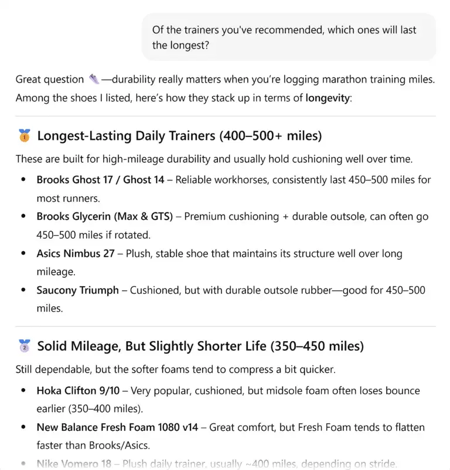
For example, if you sell running shoes, you will likely cover the shoes’ lifespan. Mentioning the sneakers’ lifespan on the product page might make sense since the entities are connected, but the manufacturer’s guarantee of the shoe’s lifespan might differ from experience.
Users on Reddit might claim they last 200 miles, others say 1,000. There’s no universal truth, but if you clearly cite the accepted industry ranges (e.g., 300–500 miles) and explain why, you give answer engines the best possible chance of repeating the correct information and citing you as the source.
Entity clarity is becoming a form of quality control in answer engines.
Unfortunately, it won’t guarantee citation. Here’s an example I found when I tested answer engines for Backlinko: A search for the lifespan of running shoes returned information stating 450–500 miles. But the actual range on the manufacturer’s website is 300–500 miles.
Quotable Insights and Data Passages
Quotable insights are short, authoritative statements or data points that answer engines can lift directly into summaries. These might be stats, expert explanations, definitions, or clear recommendations.
Pro tip: Use quotable insights in a separate paragraph, and don’t forget to answer the heading directly first. This means quotes or additional insights should come after the short paragraph that defines the main point.
Answer engines prefer clean, self-contained passages that can be cited without restructuring. Give them a “ready-made” quote; it may increase the chances of appearing in answer engine responses.
Clear definitions, strong statements and expert opinions have long been part of SEO, helping demonstrate experience, expertise, authority, and trust (E-E-A-T).
Schema and Structured Markup Implementation
Schema markup is structured data that helps answer engines understand the meaning of content — from products, FAQs, authors, how-tos, ratings, and more. It turns plain text into clearly defined entities and relationships that machines can trust. Basically, schema markup is additional code that crawlers can read.
Schema is crucial for AEO because it tells answer engines exactly what content represents. Structured markup reinforces entity consistency, which generative engines use to verify information and decide which brands to cite.
As an SEO specialist, I’ve been adding schema for years. For me, it’s non-negotiable.
Some of my most used schema types for B2B include:
- Person schema helps understand who a subject-matter expert is, including their credentials, roles, specializations, and publications. This is especially powerful for E-E-A-T because it ties authoritative content directly to a real expert.
- Organization schema defines the company as an entity, including the legal name, brand name, industry category, contact details, social profiles, and subsidiaries. It creates the “source of truth” about a company.
- FAQ schema explicitly marks up questions and answers, giving search engines and AI models a clean, structured understanding of what each section of content represents.
- Service schema defines the specific services a business provides, including what the service is, who it’s for, what problems it solves, and any related offerings.
- Product schema provides structured data about products, including specs, features, benefits, variations, materials, ratings, and more.
Reinforcement Through Repetition
Reinforcement through repetition means getting key facts, claims, and definitions repeated consistently across multiple reputable sources so answer engines start treating the brand as an authoritative source. Answer engines don’t take websites at face value; they triangulate. They look for patterns, overlaps, and repeated assertions across the web.
If only a brand’s website says a product reduces downtime by 30%, AI treats it as unverified. If 10 independent sources say the same thing, including press, partner pages, documentation, industry publications, and comparison sites, then answer engines adopt it as truth, and citations become more representative of the message brands want to share.
Pro tip: I know how it is to worry about repetition, but marketers must remember that only a small percentage of their audience sees the content they publish. Lots of variables play into this, including what the algorithm shows, when people log into their devices, and what they’re looking for at the time.
A social media post, for example, may only reach 8% of a large audience. It doesn’t hurt to post things twice, or again on another platform.
How to Measure the Impact of Both AEO and GEO
Measuring answer engine performance requires a shift away from traditional SEO metrics like rankings and traffic. So, regardless of whether a team sees AEO and GEO as separate disciples, marketers need to measure performance differently than in the SEO-only era.
Marketers now need to measure visibility within answer engines, citation accuracy, and the downstream impact on conversion quality and pipeline.
AI Visibility and Citation Coverage
AI visibility and citation coverage measures how often a brand appears in answer engine experiences like ChatGPT, Perplexity, and Gemini. Instead of tracking only clicks or rankings, this metric tells marketers whether answer engines are pulling content into their responses, summaries, and recommendations.
Plus, marketers can establish whether answer engines are mentioning a brand positively or negatively.
Looking for a high-level snapshot of where the brand is today? HubSpot’s AEO Grader is a free tool that score brands on their answer engine visibility and the sentiment behind citations. Teams that want a deeper dive can use HubSpot AEO to see how frequently the brand is mentioned and for what prompts.
Conversions and Revenue Influenced by Answer Engines
Conversions and revenue influenced measure how often answer engines contribute to the pipeline, whether through:
- Direct clicks.
- Assisted influence.
- Unclicked brand citations that steer buying decisions.
- Conversions and sales made in sessions started from answer engines like ChatGPT.
Visibility matters, but conversions and revenue will always be the ultimate benchmarks of performance. AEO is only working if it helps businesses grow. And, it’s already happening. HubSpot’s State of AEO found that 44% of marketers have made a business purchase based on brands they’ve discovered from answer engines.
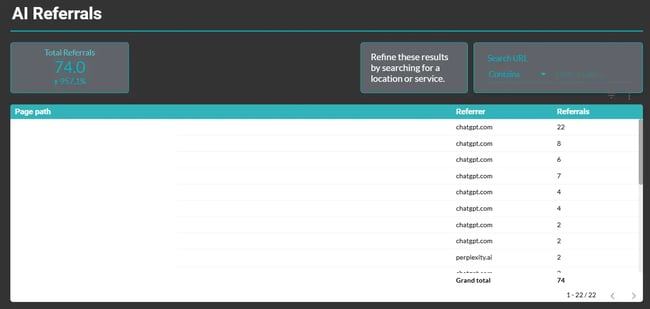
The best way to measure conversions and revenue influenced by AEO is to measure behavior on site within sessions that started with a referral from a source like ChatGPT or Perplexity.
I do this on Looker Studio. Here’s a look at my report. I show how many referrals came from AI sources:
And how many conversions took place:
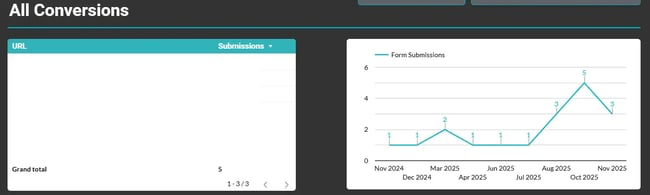
Reporting gives marketers the data they need to ask questions to sales. If marketing knows they secured a top lead, they can see whether or not it converted.
Pro tip: Qualify marketing leads by adding qualifiers on contact forms. For example, I add “budget.” From doing this, I know ChatGPT led to a 10k lead for my client.
But here’s the nuance: Not all influence is trackable.
Many users see brands inside an answer engine, don’t click in the moment, but return later through another channel. Those unclicked citations still shape decision-making, which is why conversion analysis is one of the most important AEO metrics.
When reporting, look at:
- Assisted conversions influenced by AI exposure.
- Conversions on pages that appear in answer engines.
- Conversion-rate shifts after implementing AEO updates.
- Multi-touch attribution where answer engines are part of the journey.
Lead Quality From AI-Influenced Discovery
Lead quality from AI-influenced discovery measures how well the leads generated from answer engines align with ideal customer profiles (ICPs) and whether those leads move through the funnel faster than traditional organic traffic. AEO doesn’t just expand visibility; it improves the type of visibility brands receive.
How?
Content appears in highly contextual answer engine responses. The traffic that follows is often warmer, more targeted, and already primed with problem-awareness.
Answer engine recommendations act as an intent filter. If someone finds a website through a generative engine’s answer or vendor comparison, it usually means they’re actively researching a problem you solve. That’s why AI-sourced leads often show stronger fit scores, higher qualification rates, and faster progression into the pipeline.
What to measure:
- Fit score of leads generated from pages appearing in answer engine responses.
- Sales-qualified lead (SQL) rate from answer engine sessions.
- Lead velocity and time-to-first-action (e.g., demo booked, asset downloaded).
- Topics and pages that consistently drive high-quality conversions from generative engines.
High-quality leads are one of the clearest indicators that answer-first content, structured entities, and topic clarity are working. When answer engines repeatedly recommend your brand to the right audience, your pipeline improves even before attribution fully captures the source.
Pro tip: For a sophisticated setup, use HubSpot lead scoring to compare leads influenced by answer engines with those from traditional organic search. HubSpot lead scoring allows sales and marketing teams to quickly see whether the AEO strategy is attracting the right buyers that the sales team wants and can convert.
Page Performance and User Behavior
Page performance can give marketers an idea of which pages are performing well. The more a page has sessions from answer engines, the more times it’s recommended.
Once marketing knows the top page cites, they can analyze user behavior to see how people interact with the page.
To track this, monitor sessions where the referrer is an answer engine tool.
Look at how visitors behave:
- Do they stay on the page or bounce quickly?
- Do they view multiple pages?
- Are they interacting with high-intent elements like CTAs, pricing pages, or demo forms?
- Are they triggering key events like downloads or form fills?
Combining behavior data with answer engine visibility provides a clear picture of which pages are doing the real heavy lifting and which ones deserve priority for schema enhancements, answer-first rewrites, quotable insights, entity reinforcement, or deeper optimization.
What’s next for AEO & GEO?
AEO is evolving fast. I’ve been writing about these terms for a while, and it moves so fast that sometimes, I have to make significant edits to my articles between the first draft and publication (which takes about two weeks!) because things have already changed significantly.
What I expect to define the next phase of AEO.
AI discovery will become the new “top of funnel.”
More buyers will start their research in ChatGPT, Perplexity, Gemini, and other conversational tools. We already know, thanks to HubSpot’s Consumer Trends Report, that 72% of consumers surveyed said they plan on using AI-powered search for shopping more frequently.
This means the first impression of brands may no longer be a website; it’s whatever answer engines say in response to prompts. AEO success depends on question coverage, schema, and distribution.
I think this is the biggest mindset shift marketers need to make. Your homepage isn’t the first touch anymore; AI presence is, and visibility is crucial.
SEO teams will report on AEO and GEO as much as SEO.
SEO specialists must adapt SEO reporting to include AEO. It’s becoming too important to ignore, and those who do risk falling behind.
AEO now need to be a standard component of every search audit and reporting workflow. The same way we evaluate rankings, backlinks, Core Web Vitals, and keyword visibility, we also need to measure answer engine visibility, citation frequency, entity consistency, and AI-originating sessions. If your brand isn’t appearing in generative results, that’s a performance gap, not an accident.
What this looks like in practice:
- Add answer engines (ChatGPT, Perplexity, Gemini) to your acquisition reporting.
- Track which pages answer engines are recommending — and whether those are your high-intent assets.
- Monitor AI-originating sessions as a standalone channel.
- Evaluate how often your definitions, stats, and product data appear in AI summaries.
Identify missed citation opportunities where competitors are being selected instead of you.
I built this into my clients’ Looker Studio dashboards months ago.
Once you embed AEO metrics into your reporting cadence, patterns emerge quickly — which pages earn citations, which topics attract high-quality traffic, and where you need to tighten entities or restructure content.
Pro tip: Treat answer engine visibility exactly the way you treat keyword rankings. Add AEO metrics to your monthly reporting and review them with the same rigor — that’s how you stay ahead of competitors who are still only tracking organic traffic.
If you want to understand how visible your brand is across answer engines, start with the HubSpot AEO Grader for a free, high-level snapshot. Then, use HubSpot AEO to see which citations the brand earns and how to improve performance.
Frequently Asked Questions About AEO vs. GEO
What’s the difference between AEO and GEO?
AEO is a new discipline in the marketing world, so language varies across brands and marketers. At HubSpot AEO is used to describe all initiatives used to improve answer engine visibility and citations.
How do I measure AEO performance without relying on traffic?
Track citation frequency, brand visibility, entity consistency, and the fit score of leads influenced by AI-derived surfaces. Tools like the HubSpot AEO can help track these essential metrics.
How do I get my brand cited in ChatGPT or Perplexity?
Use answer-first formatting, entity consistency, quotable passages, and schema. Then reinforce those facts across authoritative external surfaces so answer engines trust your version of the information.
How often should we refresh AEO-ready content?
At least quarterly for key pages, or whenever product updates, regulations, or competitive shifts occur. AI engines reward freshness, accuracy, and clarity.
Regardless of what you call it, optimizing for answer engines is now an essential layer of search visibility.
AEO isn’t an add-on. It’s the new foundation of brand visibility in an AI-first world. AEO wins citations in the answer engines where customers search. The marketers who adopt answer-first content, structured entities, and strong distribution will dominate modern search. HubSpot AEO can help marketers optimize their sites for the new era of search.
I’ve seen firsthand how AEO drives warm, high-intent leads. When you focus on clarity, structure, and citation-worthiness, answer engines start doing your distribution for you, and the results can be game-changing.
HubSpot AEO Tool
See exactly where your brand shows up in answer engines and take action to close AI visibility gaps.
- Track AI mentions.
- Analyze citations
- Monitor prompts
- Benchmark competitors
Seo

![SEO audits: How to conduct one that drives traffic growth [+ checklist]](https://53.fs1.hubspotusercontent-na1.net/hubfs/53/seo-audit-1-20251217-6006144.webp)
.png)