In today’s landscape, fewer buyers are clicking links when researching products. To compete, brands must be cited by large language models. Answer engine optimization helps marketers structure content so information can be indexed by AI. The result is increased visibility.

While traditional SEO tracks ranking positions and blue links, answer engines measure how often a brand is mentioned by LLMs. Tools like HubSpot AEO help teams understand when owned content is cited and how those mentions are framed in model responses.
As more users rely on direct answers instead of click-through results, strong answer engine visibility profile influences not just discovery and trust, but ultimately, conversions.
Table of Contents
- What is answer engine visibility?
- How is answer engine visibility different from organic search?
- Answer Engine Visibility: How to Start Tracking
- How to Improve Brand Visibility in AI-Generated Answers
- How to Optimize for Answer Engine Visibility Across Channels
- Improve Answer Engine visibility with HubSpot AEO
- Frequently Asked Questions About Answer Engine Visibility
What is answer engine visibility?
Answer engine visibility describes how often a brand appears in or is cited by an AI-generated answer. To measure success, teams look at how often and how accurately a brand appears within AI-generated answers across channels.
If SEO tells Google who you are, answer engine visibility tells the internet what you mean.
Think less about “where the brand ranks” and more about “how the brand is remembered.” When someone asks ChatGPT or Perplexity who makes the best CRM, does your name appear? Is it linked? And does the model describe you the way you’d want a prospect to hear it? That’s basically AI visibility.
In practice, answer engine visibility comes down to four signals:
- Mentions, or how frequently the brand appears in AI responses tied to key topics.
- Citations, or whether those responses link back to your owned content or just describe you abstractly.
- Sentiment, or whether that context reads positive, neutral, or critical.
- Share of voice, or how often the brand appears relative to competitors across a consistent prompt set.
These are the new “positions” of 2026 — invisible on a results page, but visible everywhere else that matters.
That means brand visibility has moved upstream from the SERP to the sentence. Visibility is no longer something brands “earn” once. Companies must teach AI systems about themselves over time in a way AI can understand.
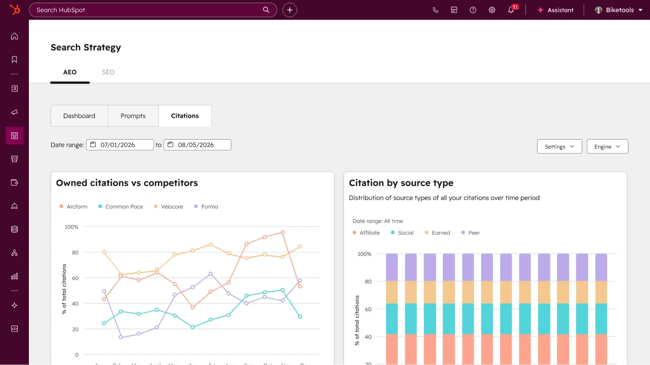
HubSpot AEO tool tracks all four of these signals across ChatGPT, Gemini, and Perplexity — giving marketers a single score that reflects how answer engines currently see their brand.
How is answer engine visibility different from organic search?
While traditional SEO focuses on ranking pages in search results, answer engines evaluate knowledge. A top-ranked article in Google can be entirely absent from AI answers if the model hasn’t associated a brand with the entities or signals it trusts.
The shift is more than theoretical. Answer engine interfaces are already reshaping how users find information:
- Pew Research found Google’s AI Overviews appeared in 18% of U.S. desktop searches in March 2025.
- Up to 60% of searches end without a click, because the answer now lives inside the interface.
- And a growing share of younger users — 31% of Gen Z, per HubSpot’s 2025 AI Trends for Marketers report — start queries directly in AI or chat tools instead of search engines
Organic search rewards relevance, backlinks, and user behavior. Answer engines reward clarity, reputation, and structured context. Instead of deciding which link to rank, large language models decide which brands to trust based on their entity presence when synthesizing their responses.
Traditional SEO vs. AEO Metrics
AEO expands which metrics matter for brand visibility. Marketers start looking at how frequently the brand is cited by AI and the sentiment of those citations. HubSpot AEO provides a way to measure performance in Answer engines — tracking the metrics that matter in this new visibility layer.
The Four Core Answer Engine Visibility Metrics Explained
1. Brand Mentions
Brand mentions are the frequency of a brand’s appearance in AI-generated responses. Mentions reflect recall, showing whether a model recognizes a brand as relevant to a topic or category.
2. Citations to Owned Pages
Citations show when an answer engine attributes information directly to a website or assets. Citations are becoming the new trust signal. Seer Interactive’s 2025 analysis found that traditional SEO strength (rankings, backlinks) showed little correlation with brand mentions in AI answers, underscoring that citation behavior is emerging as the key indicator of trust and authority.
3. Sentiment Framing
Sentiment framing captures the tone and context surrounding a brand mention. Positive or neutral framing contributes to credibility and user confidence. Negative framing may suppress engagement even when the brand is visible.
4. Share of Voice Across Prompts
Share of voice captures comparative visibility, or how often a brand is named relative to peers. AEO tools measure how often a brand appears when users ask similar questions across multiple AI tools. Tracking this monthly helps quantify “model recognition momentum.”
Why does this shift matter?
The trends in answer engine optimization are moving at an accelerated pace. ChatGPT now processes over 2.5 billion prompts per day, and industry analysts expect AI-driven search traffic to surpass traditional search by 2028. This means visibility inside AI ecosystems is becoming the new baseline for brand discoverability.
Brands are already adapting to this shift. Conrad Wang, Managing Director at EnableU, explains how his team approaches answer engine optimization (AEO).
Wang says, “Google’s AI mode gives you a query fanout that shows where it looks for answers, and we’ve found that it often pulls data from obscure, high-trust directories and best-of lists rather than the top organic search results.”
Wang’s team has a small team that audits these pages, noting what sources AI trusts. The team can then reach out to publishers to get EnableU listed.
“We know it’s working because our brand mentions in AI-generated answers for local queries have increased by over 50%, even when the click-through rate is zero,” he says.
Answer engine visibility depends on mentions, citations, and sentiment because LLMs use those signals to decide which brands to include in synthesized answers. The more consistently those signals appear, the more confidently AI systems can surface and recommend a brand across channels.
Tools like HubSpot AEO are making it possible to track these shifts systematically, rather than relying on manual prompt testing and one-off screenshots.
Answer Engine Visibility: How to Start Tracking
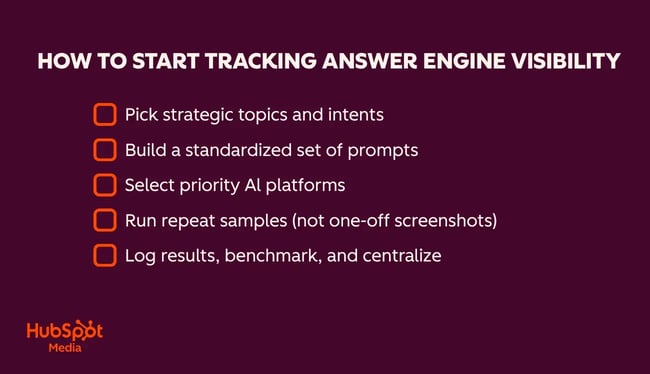
Answer engine visibility tracking measures how AI references a brand by capturing mentions, citations, sentiment, and share of voice across a defined set of prompts. The framework gives marketing teams a lightweight, governance-friendly process for improving answer engine performance over time.
1. Pick strategic topics and intents.
Start by identifying queries that actually drive revenue and influence purchasing decisions. Topics should align with existing content clusters, sales narratives, and named entities like product names, frameworks, or proprietary methodologies. Consider creating content for:
- Core product categories, like the “best B2B CRM for SMBs” or “top marketing platforms”.
- Priority use cases, like “AI marketing automation tools” or “multi-channel attribution software.”
- Comparative and evaluative prompts, like “HubSpot vs [competitor]” or “top platforms for…”
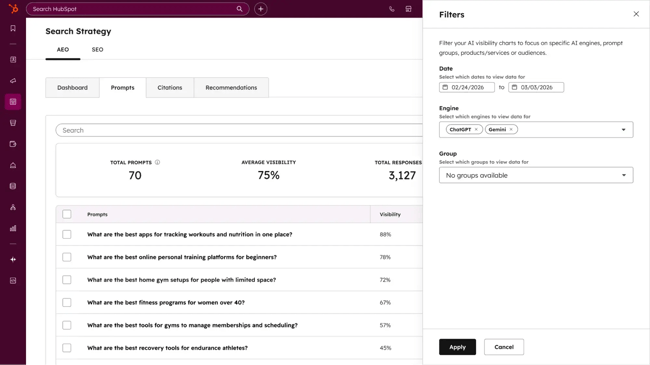
Pro tip: HubSpot AEO suggests prompts based on CRM data, helping teams identify the high-intent questions their buyers are already asking answer engines. Select 10 to 30 prompts per topic. Then, benchmark performance over time without creating unmanageable volume.
2. Build a standardized prompt set.
Standardization matters. Research published by the Association for Computational Linguistics found that even tiny changes like adding a space after a prompt can change an LLM’s response. Controlling prompts reduces noise and isolates genuine shifts in model behavior.
After defining topics, create a consistent prompt library to test engines in a controlled format. Store this prompt set in a shared Content Hub asset, internal wiki, or AEO playbook so marketing teams can test against the same questions. Include patterns like:
- “Who are the leading [category] platforms?”
- “What is the best tool for [use case]?”
- “Which platforms are recommended for [audience]?”
- “What is [brand] known for in [category]?”
Pro Tip: Inside HubSpot AEO, prompt sets can be organized into groups by product line or customer segment, making it easier to track performance for specific parts of the business.
3. Select priority AI channels.
Answer engine visibility is multi-surface. A practical baseline usually includes:
- ChatGPT for general discovery + research.
- Gemini for Google ecosystem behavior.
- Microsoft Copilot for enterprise and Microsoft 365 users.
- Perplexity for research and technical audiences.
Pro Tip: Use the HubSpot AEO Grader to establish a baseline across supported AI engines, tracking mentions, citations, and sentiment where available.
4. Run repeat samples (not one-off screenshots).
Tracking answer engine visibility is about trends, not one dramatic screenshot in Slack. An operational pattern for continued sampling looks like this:
- Run each selected prompt within each engine.
- Capture responses three to five times per engine per prompt in the same session or day.
- Repeat this process monthly (or bi-weekly during critical campaigns).
AI models don’t give the same answer twice — a consequence of their design. Running each prompt multiple times helps marketing teams spot real trends instead of chasing random noise.
5. Log results, benchmark, and centralize.
Raw answers are useless if they stay in screenshots. Teams should structure results into a simple, query-level dataset. This can live in a shared spreadsheet, a custom Content Hub reporting view, or other AI SEO tools supporting automated scoring. For each prompt and engine combination, log:
- Brand mentioned? (Y/N)
- Which brands were mentioned?
- Citations to owned pages (Count and example URLs)
- Sentiment framing (Positive/Neutral/Negative)
- Position in the answer (Early/Middle/Trailing)
- Notes (hallucinations, outdated info, mis-categorization)
Centralized answer engine visibility data can feed directly into existing HubSpot dashboards and attribution workflows. From there, marketing teams can:
- Calculate the share of voice across prompts and engines.
- Flag gaps where competitors dominate mentions.
- Prioritize content, schema, and PR efforts where visibility is weakest.
- Align insights with HubSpot reporting on content engagement and influenced pipeline.
Treat this process as an extension of existing SEO and attribution reporting. Answer engine visibility within the same operational rhythm stops being mystical and starts being measurable.
Pro Tip: HubSpot AEO centralizes this data natively — logging mentions, citations, sentiment, and share of voice across engines. No need to require a separate spreadsheet or manual tracking workflow.
How to Improve Brand Visibility in AI-Generated Answers
Large language models learn which brands to trust by observing how clearly, consistently, and credibly those brands show up online. Answer engine visibility improves when a company makes itself easy to understand, cite, and trust across every place models gather data — and that’s ultimately how to improve brand visibility in AI-generated answers.
Recent industry data shows that brands optimizing for answer engines, like ChatGPT, Gemini, and Google’s AI Overviews, are already seeing stronger engagement across social and search discovery.
In fact, BrightEdge’s September 2025 analysis found that 83.3% of AI Overview citations came from pages beyond the traditional top-10 results. This analysis suggests that structured, answer-ready content directly supports discoverability and downstream user engagement.
Start by building a foundation that AI systems can actually read. Structure content around clear entities, credible sources, and repeatable signals of authority. Then, layer in the human elements — FAQs, social proof, and community engagement — that teach large language models that the brand is both reliable and relevant.
Each step reinforces the next, creating a feedback loop between how people experience content and how answer engines describe it.
1. Build entity-based content clusters.
AI models map relationships. Building clusters around key entities — like products, frameworks, or branded methodologies — makes those connections explicit and helps answer engines retrieve accurate associations.
As John Bonini, founder of Content Brands, notes on LinkedIn, “LLMs (seem to) reward clarity. Models surface sources that show clear thinking. People remember brands that have a consistent narrative.”
That principle sits at the heart of answer engine visibility. Consistency across entity clusters and brand language teaches models how to describe a brand — not just what the brand sells.
How to do it:
- Audit existing content by entity, not just keyword.
- Interlink pillar and subtopic pages, and support them with appropriate schema (AboutPage, FAQPage, Product schema) to highlight machine-readable relationships.
- Reinforce semantic triples like Content Hub → supports → entity governance workflows.
2. Create source-friendly pages.
Pages that summarize definitions early, surface key data points, and use structured lists or tables are easier for AI systems to parse. While Google notes that there are no special technical requirements for AI Overviews, its guidance emphasizes that clearly structured, crawlable content remains essential for accurate citation.
How to do it:
- Add an “answer-first” summary directly below each heading so that both readers and AI systems can instantly capture the core idea.
- Include timestamps alongside statistics — freshness signals reliability to models that prioritize recent data.
- Replace vague transitions like “many experts say” with named sources and clear attribution to reduce hallucination risk.
It’s one thing to structure content for readability; it’s another to see how that structure actually changes visibility.
“The greatest difference was when we realized that AI engines are looking for clarity of the original source, so we made certain each article included attributable data and not just opinions,” said Aaron Franklin, Head of Growth at Ylopo. “About two weeks after adding expert quotes and inline citations to our articles (and also beginning to track), we began showing up in AI-generated answers.”
Franklin’s experience underscores what Google’s guidance implies: Clarity and attribution are structural signals that teach AI models which sources to trust.
3. Expand FAQs and conversational coverage.
FAQs mirror how people query AI — in natural language, with specific intent. Adding question-based sections improves both human readability and machine retrievability. FAQ content teaches large language models to associate a brand with clear, authoritative answers.
How to do it:
- Add three to five contextual questions per topic page that reflect common conversational phrasing.
- Use specific subjects — “content marketers,” “RevOps teams,” “small business owners” — instead of generic “you” language to create stronger semantic signals.
- Refresh quarterly based on prompt-tracking data from ChatGPT, Gemini, and Perplexity queries to keep coverage current and relevant.
In practice, structure helps AI systems recognize subject-matter expertise the same way readers do, by clustering questions, context, and verified answers.
“We optimized our top-performing content with clearer structure, FAQs, and schema markup to help AI models identify our expertise more easily. Within weeks, we saw our brand mentioned in AI-generated summaries and conversational queries on platforms like Perplexity,” said Anand Raj, Digital Marketing Specialist at GMR Web Team. “The real proof came from higher direct traffic and branded search lifts in HubSpot analytics, without a matching rise in ad spend.”
Raj’s results underscore how FAQs serve as lightweight training data for generative systems. When brands phrase answers conversationally and back them with data, models recommend them.
4. Strengthen social proof and digital PR.
Answer engines interpret external validation as a signal of authority. Independent mentions, interviews, and case studies give models — and buyers — confidence that a brand’s claims are credible and well-supported.
How to do it:
- Earn coverage on reputable industry, analyst, or review sites. Focus on both high authority domains and contextually relevant ones.
- Repurpose customer success stories into short, data-rich case snippets that answer “how” and “what changed.”
- Cite proprietary research to anchor claims in brand-owned data.
In practice, digital PR and original research produce compounding trust signals. Each mention becomes another node that AI systems can connect back to a brand, improving the likelihood of inclusion in future generative results.
“We shifted budget from generic content to publishing original research reports with quotable statistics, making our brand the primary source that AI models cite when answering industry questions,” said Gabriel Bertolo, creative director at Radiant Elephant.
Bertolo notes that validation came quickly. Within 60 days of publishing the first data study, Radiant Elephant appeared in 67% of AI responses related to key topics versus 8% before.
“We track this through monthly prompt testing and correlate it with a 3x increase in ‘attributable to AI discovery’ pipeline in our CRM,” Bertolo says.
Bertolo’s approach highlights a simple truth. Visibility follows credibility. Original data acts as a magnet for both journalists and algorithms, turning every external mention into a micro-citation that reinforces authority.
Pro Tip: HubSpot AEO tracks share of voice against competitors, making it possible to measure whether digital PR efforts are translating into stronger AI visibility relative to peers.
5. Engage in active communities.
AI models learn from public conversations. Taking part in trusted communities increases a brand’s exposure across channels that LLMs sample continuously. For instance, Semrush research found that Reddit generates a 121.9% citation frequency in ChatGPT responses, meaning it’s referenced more than once per prompt.
So, teams should have a presence on LinkedIn, Reddit, G2, and industry forums.
How to do it:
- Contribute expert insights, not product pitches. Authority grows through participation, not promotion.
- Encourage employees and advocates to join discussions as themselves, building reputational equity.
- Align engagement with Loop Marketing’s “Amplify” stage, which connects distributed brand activity across channels to measurable visibility outcomes.
Community engagement is a long but compounding game. Each authentic interaction becomes another data point, reinforcing who a brand helps and what it knows.
“Seeing that AI Overviews and Perplexity source heavily from Reddit, we’ve stopped just monitoring brand mentions and started strategic engagement,” says Ian Gardner, director of sales and business development at Sigma Tax Pro. “We‘re seeing a lot of progress in branded search from those communities, and with every model update, we’ve seen our AI citations rise.”
Gardner says Sigma Tax Pro deploys teammates to find and answer complex questions in niche subreddits and build visibility there. They post as themselves, with their own user flair, to build genuine authority, Gardner notes, “not to just drop links and spam communities—that would get them banned and destroy trust.”
Gardner’s approach reflects the new dynamic of AI-era credibility: Authority is distributed.
Conversations happening on Reddit threads and niche forums are now feeding back into LLM training data. Brands that show up consistently with useful, verifiable contributions build unignorable visibility.
Pro Tip: As community signals strengthen, HubSpot AEO’s visibility score reflects those gains over time — connecting off-site engagement to measurable changes in how answer engines reference the brand.
How to Optimize for Answer Engine Visibility Across Channels
AEO requires a channel-aware strategy. ChatGPT, Gemini, Perplexity, and Google AI Overviews each retrieve and surface content differently, weighting freshness, structure, and authority signals in distinct ways.
A blanket approach doesn’t always translate across engines, and the brands gaining traction with AI-generated answers are the ones adapting their content and distribution to match each channel's retrieval behavior without fragmenting their overall AI search strategy.
Here’s how to monitor answer engine visibility and move beyond foundational best practices.
1. Structure content for multi-engine retrieval.
Answer engines don’t read content the way humans do. They parse it into chunks, embed those chunks as vectors, and retrieve the ones that most closely match a user’s query. Content that is clearly structured is easier for models to extract and cite accurately.
Here’s the interesting part about retrievability: Ahrefs found that only 38% of pages cited in Google’s AI Overviews also ranked in the top 10 organic results. So, over 62% of cited content came from outside the top 10, with some ranking well below position 100.
That means structure, not ranking position, is what determines whether content gets pulled into an AI-generated answer. In practice, multi-engine retrievability comes down to a few structural habits:
- Lead with definitions. The first sentence under each heading should answer the question that the heading implies. Answer engines treat this as the extractable summary.
- Use labeled sections and explicit formatting. Steps, comparisons, pros/cons, and tables give models clean boundaries for chunking. Unformatted prose buried in long paragraphs is harder to retrieve.
- Mirror the format answer engines use in their answers. If the model’s output for a given query looks like a mini-guide with numbered steps and a definition, the source content that matches that structure has a higher probability of being cited.
- Maintain semantic consistency. Use the same terminology across headings, body copy, and metadata. When a brand uses three different phrases for the same concept across a single page, models lose confidence in what the page is actually about.
Pro tip: Before publishing, prompt ChatGPT, Gemini, and Perplexity with the primary question the content answers. Study the format of their responses. Then structure content to match the architecture in the top results.
For teams tracking which content structures are actually earning citations, HubSpot AEO surfaces citation analysis by content type. Teams can see whether answer engines are pulling from listicles, blog posts, product pages, or comparison content. Data can then inform structural decisions.
2. Build entity authority beyond your website.
Answer engines assess brand credibility by evaluating how consistently a brand appears across multiple places — not just on its own website. A company can publish exceptional content on its blog. But, if no external source references that brand in the same context, models treat the brand’s authority as unverified.
Each external mention becomes another node that AI systems can connect back to the brand, reinforcing its relevance to specific topics. That increases the likelihood of inclusion in future generated answers.
Peec’s recent research found that Reddit, LinkedIn, and YouTube content are among the top-cited domains within AI-generated answers. So, contributing meaningfully to these channels helps strengthen the entity signals that models evaluate when deciding which brands to trust.
Here’s how to actually build authority off-site:
- Earned media and digital PR. Guest posts, expert quotes, podcast appearances, and press coverage all create external reference points that models can cross-verify.
- Community engagement. Contributing genuine expertise in Reddit threads, LinkedIn discussions, and niche forums builds distributed authority. The key is participation, not promotion — brands that drop links without context get flagged and ignored.
- Review and comparison coverage. Appearing in third-party listicles, G2 reviews, and comparison content signals to answer engines that a brand is part of the competitive conversation, not just talking about itself.
- Consistent descriptors. Using a single, clear brand descriptor across all external channels — social bios, podcast intros, Reddit flair, bylines — reinforces the brand entity. The more consistently that language appears across surfaces, the stronger the model’s association becomes.
Kelly Jura, CXO at Qwoted, said on Found in AI, “AI is prioritizing thought leadership, people who are experts in their field, vetted credible sources. So it’s less about the noise and the volume and more about the authority.”
She added, “Getting the mention, that’s the first piece. The second piece is really promoting it after the fact and making sure people see it, putting it where people see it. Do the good work and put it where people can see it.”
In my work as a fractional content strategist, one of the first things I map for a new client is where their brand exists outside their own website. If the answer is “almost nowhere,” the entity position is weak, and no amount of on-site optimization will close that gap alone.
Distribution isn’t a nice-to-have in answer engines. It’s the mechanism that teaches models that a brand exists and is worth referencing. The brands I’ve helped build visibility for almost always start here: getting the brand mentioned in places the models already trust, before optimizing the content the brand controls.
3. Align content with AI intent clusters, not just keywords.
Large language models don’t process queries the way traditional search engines do. Instead of matching a page to a keyword, LLMs collapse queries into broader intent clusters. They group related content and predict what a user will ask next.
When a user prompts Gemini or Perplexity, the engine suggests related follow-up questions. Those follow-ups represent the model’s understanding of the full intent behind the original query.
Content that answers the primary question and addresses those adjacent questions has a meaningfully higher probability of being retrieved. This content gets cited because the model recognizes it as a comprehensive source, not just a partial match.
For content teams, this means the content strategy shifts from a single keyword to an intent cluster:
- Map the full cluster before drafting. Prompt ChatGPT, Gemini, and Perplexity with the primary question. Record every follow-up question each engine suggests. Those follow-ups define the scope of the content.
- Address implied questions explicitly. If the primary query is “best CRM for small business,” the implied questions include pricing, implementation complexity, integrations, and migration paths. Content that skips those subtopics is leaving citation opportunities on the table.
- Build content depth, not content volume. One comprehensive page that covers a full intent cluster outperforms five thin pages that each address a single variation. Models reward source density, not publishing frequency.
Prompt multiple answer engines on a topic and document the follow-up questions each suggests. Those follow-ups are the intent cluster, and the content outline should account for all of them.
Pro Tip: I use the FSA Framework (Freshness, Structure, Authority) as a mental model for this. LLMs don’t evaluate a page in isolation. Instead, they evaluate whether a source can hold context across a cluster of related questions.
Content with strong structure, fresh signals, and verified authority across the cluster gets cited. Content that answers one question but ignores the surrounding intent often gets skipped.
4. Refresh and signal freshness strategically.
Answer engines favor recently updated content, but freshness in answer engines isn’t just about volume. Marketers need to signal that a page is actively maintained and that the information it contains is current.
Content that hasn’t been touched in 12 months may still rank well in traditional search, but it’s increasingly unlikely to be retrieved as a trusted source in AI-generated answers, especially for fast-moving categories.
Here’s how to revive those freshness signals:
- Update timestamps visibly. A “last updated” date near the top of the page tells both users and crawlers that the content reflects current information.
- Add temporal context to claims. Instead of “LLMs are growing rapidly,” write “As of Q1 2026, ChatGPT processes over 2.5 billion prompts per day.” Specificity signals currency.
- Revise, don’t just republish. Updating a paragraph with new data or a clearer explanation carries more weight than changing a date and reposting. Models can detect substantive changes in indexed content.
- Add “What’s Next” or “What’s Changing” sections. Even when the core advice hasn’t changed, a forward-looking section signals that the author is actively tracking the space. This is a lightweight freshness signal that requires minimal effort.
- Use IndexNow where supported. Bing’s IndexNow protocol allows publishers to notify search engines of content updates in real time, accelerating the re-crawl cycle. For teams optimizing freshness deliberately, this shortens the lag between updates and re-indexing.
When I asked Josh Spilker, head of search marketing at AirOps, about this, he said, “You need to update your content every three to six months. And those industries include SaaS, finance, and news. The freshness window for other industries, like real estate or ecommerce and manufacturing, may be a little bit longer. And then things like travel, lifestyle, and healthcare, we saw six to nine months.”
Pro Tip: HubSpot AEO tool tracks visibility scores over time, allowing marketers to measure whether content refreshes are actually moving the needle on AI citations. When a page is updated and the visibility score shifts in the following weeks, that’s direct feedback on whether the freshness signal landed.
5. Monitor, measure, and iterate across engines.
Answer engines update their models, citation patterns shift, and content that was cited last month may not be retrieved next month. Sustained visibility requires a repeatable process for monitoring performance and adjusting strategy accordingly.
The tracking fundamentals covered earlier — standardized prompts, repeat sampling, and centralized logging — are the foundation. The next step is tracking the data and running with it:
- Run prompt sets monthly, at minimum. Track mentions, citations, sentiment, and share of voice across engines for each prompt. A monthly cadence provides enough data to identify trends without introducing noise from run-to-run variability.
- Compare performance across engines. A brand that’s frequently cited in Perplexity but absent from Gemini has a channel-specific gap. That’s likely due to structural or source distribution, not overall authority. Cross-engine comparison reveals where to focus.
- Track citation patterns by content type. If listicles are earning citations in one category and comparison pages are earning them in another, that tells content teams exactly what format to prioritize next.
- Identify decay early. A declining visibility score on a specific prompt is an early warning signal. Catching it early allows for a targeted content refresh before the brand disappears from that answer entirely.
The brands that see compounding AI visibility gains are the ones treating this as a monthly operating rhythm, not a quarterly audit.
For teams ready to move beyond manual tracking, HubSpot AEO centralizes prompt monitoring, citation analysis, competitor benchmarking, and prioritized recommendations in a single dashboard. The tool surfaces not just where a brand is visible, but why — and what to do next.
Improve answer engine visibility with HubSpot AEO
Answer engine visibility is measurable now — and HubSpot AEO shows exactly how large language models see a brand. The HubSpot AEO tool and AEO features in Marketing Hub analyze visibility across leading AI channels, like ChatGPT, Gemini, and Perplexity AI.
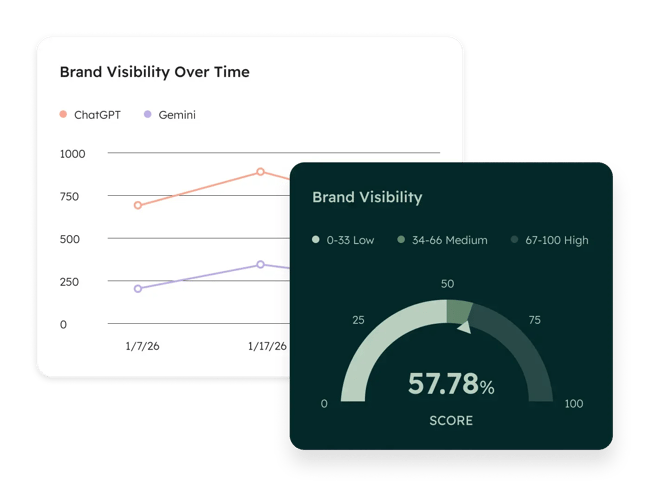
HubSpot AEO reveals how often a brand appears in AI-generated answers, how owned pages are cited, and how sentiment and share of voice compare within a category. The tool returns a visibility score, sentiment analysis, competitive positioning, and prioritized recommendations.
The result is a data-rich snapshot of visibility in AI channels, helping marketers move from guesswork to clear performance optimization. Run HubSpot AEO quarterly, or before major campaigns, to benchmark improvement and understand how AI perception changes.
The tool also aligns naturally with HubSpot’s Loop Marketing framework: The insights marketers gain from HubSpot AEO fuel the Evolve stage, turning AI visibility tracking into a continuous feedback loop of learning.
Frequently Asked Questions About Answer Engine Visibility
Are AI searches discoverable?
Yes, AI searches are discoverable. When a user prompts ChatGPT, Gemini, or Perplexity, the response often includes citations, linked sources, and brand mentions that function as a new form of organic visibility. In many cases, these answers surface brands that wouldn’t appear on the first page of a traditional search result. Discovery no longer requires a click-through from a SERP — a brand can be “found” inside a conversational answer without the user ever visiting a website.
For marketers, this also means AI-generated answers are trackable. Answer engine optimization tools, like HubSpot AEO, now surface data on which brands are being cited, how often, and in what context.
How often should we track answer engine visibility?
Track answer engine visibility monthly for optimal trend analysis, with quarterly tracking as the minimum frequency. Large language models update their training data, weightings, and response generation patterns more frequently than traditional search algorithms. Running HubSpot AEO monthly provides a clean trend line with enough data to identify meaningful movement.
Can we track answer engine visibility without paid tools?
Yes, answer engine visibility can be tracked manually with structured processes and consistent execution. Manual tracking starts with a spreadsheet and repeatable workflow: Select prompts, test across major answer engines, log mentions and citations, and review results monthly.
How do we handle AI result variability across runs?
Treat AI result variability as an expected feature instead of a problem. AI systems are “non-deterministic,” meaning two identical prompts can produce slightly different answers. The key is to examine patterns across multiple runs, rather than relying on single snapshots.
Aggregate five to ten samples per prompt and record the average mention rate, sentiment, and citation frequency. That smoothing helps separate meaningful shifts from randomness.
How do we choose the right AI visibility tool?
Choosing the right AI visibility tool depends on where a team is in its AEO maturity. For teams just getting started, the priority is baseline visibility — understanding whether the brand shows up at all, and for which prompts. A free tool like HubSpot AEO Grader provides that starting point.
For teams ready to invest in ongoing tracking, look for multi-engine coverage, citation analysis by content type, competitor benchmarking, and actionable recommendations. Tools that tie recommendations directly to content creation workflows — like HubSpot AEO — reduce the gap between knowing what to fix and actually fixing it.
How quickly can we see results from answer engine optimization?
Answer engine optimization isn’t a quick fix, but brands that start now build an advantage that gets harder for competitors to close every month. In the first 30 days, the value is in understanding where the brand stands. From there, teams can fix obvious structural gaps. Those quick wins produce initial visibility movement within weeks.
Between 30 and 90 days, deeper work starts showing up in citation data. HubSpot AEO’s weekly score tracking makes it possible to see whether optimizations are working in near real-time, rather than waiting for quarterly audits to confirm directional movement.
How do we measure ROI from answer engine visibility?
Treat answer engine visibility as a leading indicator of awareness and demand, not a direct-response channel. The measurement works in layers: Visibility metrics show whether the brand is gaining presence in answer engines. Engagement metrics connect visibility to audience behavior. Pipeline metrics close the loop to revenue.
While rarely a one-to-one correlation, visibility trends almost always precede awareness gains. By integrating with HubSpot’s reporting tools, like AEO, teams can tie AI visibility trends to measurable outcomes, such as influenced contacts, content-assisted opportunities, and pipeline from AI discovery sources.
How do we connect answer engine visibility to pipeline and revenue?
Connect answer engine visibility to pipeline by treating visibility as a leading indicator of awareness and demand. When answer engines mention a brand more frequently, that recognition often appears downstream in branded search volume and higher click-through rates from comparison queries.
For example, if a brand mention rate in AI answers rises from 10% to 20% over a quarter, the team should track whether branded traffic or demo requests followed the same trajectory. While rarely a one-to-one correlation, visibility trends almost always precede awareness gains.
Should we optimize for all AI channels equally?
Brands should not optimize for all channels equally. Prioritize based on where the target audience actually researches and makes decisions.
- ChatGPT is a priority AI channel to monitor, as it has the broadest user base and is typically the highest priority for general product research and comparisons.
- Perplexity skews toward research-heavy, technical, and professional audiences.
- Gemini is increasingly embedded in Google’s ecosystem.
- And Microsoft Copilot matters most for enterprise audiences in Microsoft 365 environments.
Pick two or three engines where the target audience is most active, build prompt sets for those, and track consistently. Expand coverage as the team builds capacity and as citation data reveals channel-specific patterns.
Do we need llms.txt or special files for AI channels?
No, llms.txt or special AI-specific files are not currently necessary or widely supported. Unlike web crawlers that honor robots.txt, AI systems don’t currently follow a universal “robots.txt for models.” While some companies are experimenting with llms.txt, adoption remains voluntary and inconsistent.
Instead, focus on structured transparency: schema markup, clear source attribution, and accessible licensing signals. These make content easier for models to identify and cite, which is the practical goal llms.txt tries to achieve.
Turning Answer Engine Visibility Into a Growth Engine
Answer engine visibility has become the next arena for brand discovery — and improving answer engine visibility is now a core part of how brands protect and grow their share of demand. The teams that learn to track how LLMs describe them and connect that data to revenue are already shaping the narratives of their industries.
HubSpot AEO makes that visibility measurable. Content Hub turns findings into structured, answer-ready content. And Loop Marketing closes the loop by translating insights into continuous iteration: create, test, evolve, repeat.
I’ve watched this shift unfold firsthand. Marketers who started measuring their AI visibility six months ago already understand how AI defines their categories and where they need to intervene. The takeaway is simple: AI will describe your brand whether you measure it. The advantage goes to the teams that make sure models tell the right story.
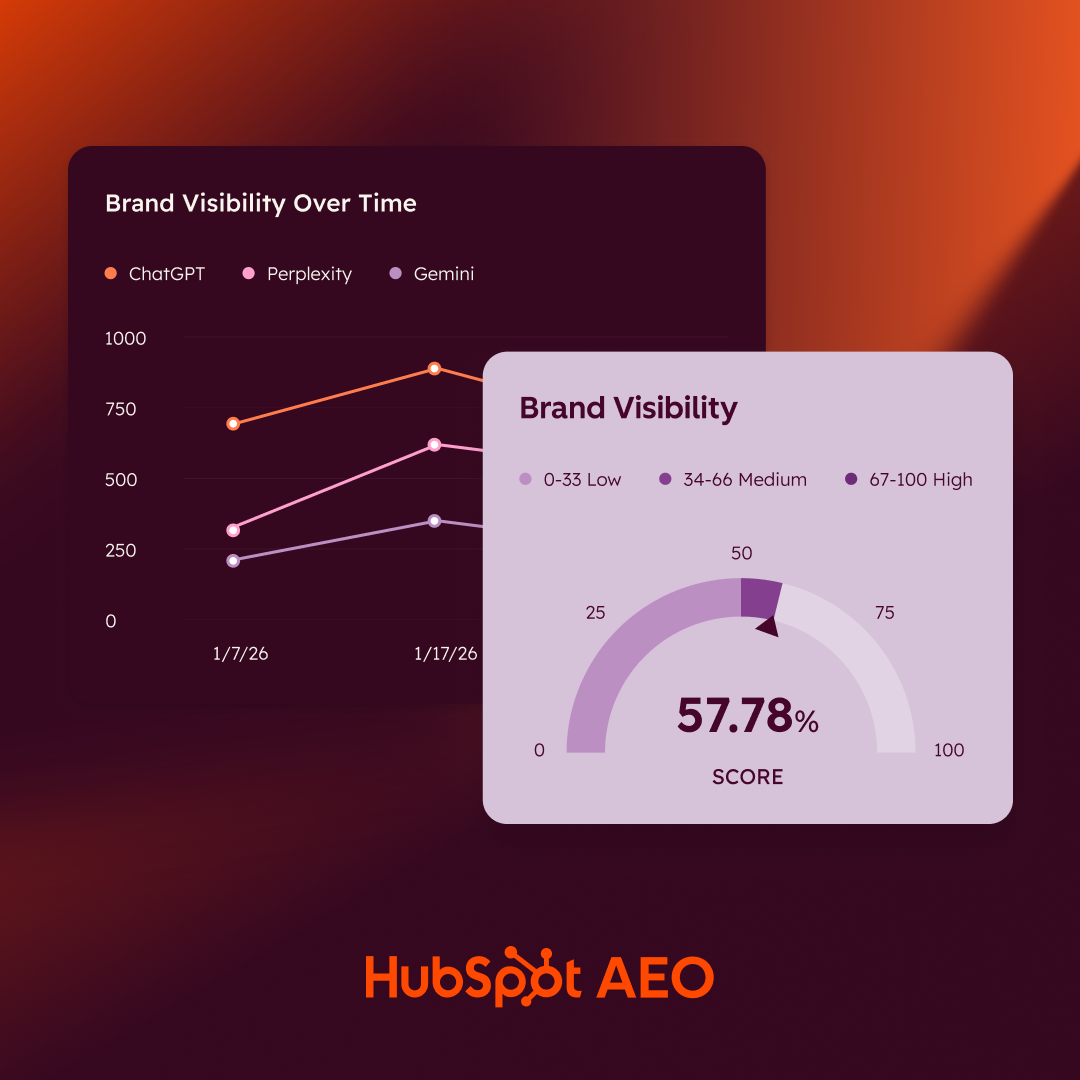
HubSpot AEO Tool
See exactly where your brand shows up in answer engines and take action to close AI visibility gaps.
- Track AI mentions.
- Analyze citations
- Monitor prompts
- Benchmark competitors
Ai Engine Optimization