While traditional search engines still dominate, there’s no ignoring that people are increasingly turning to AI tools like ChatGPT to answer their questions.
As a marketer, the shift toward AI-powered search tools like ChatGPT caused a bit of a professional identity crisis for me. Before 2024, I spent the better part of a decade focused on topping search engine result pages, and, frankly, I was great at it. But this change demands a new approach for digital marketers like me. Luckily, answer engine optimization best practices build on a foundation I already know.
This guide breaks down the most important AEO best practices marketing teams need to know, plus how to measure success and convince your leadership team it’s worth the investment.
Ready to see where your brand actually shows up in AI answers? HubSpot AEO helps teams track citations, monitor prompts, and close visibility gaps all in one place.
Table of Contents
- What is answer engine optimization (AEO)?
- Why Answer Engine Optimization Matters More Than Ever
- Answer Engine Optimization Best Practices
- Common AEO Challenges
- Technical AEO Checklist
- FAQs About AEO Best Practices
Free AEO Guide: HubSpot's Guide to AI Engine Optimization
Navigate the AI revolution with proven strategies to optimize your content for AI visibility.
- How answer engines rank and choose content
- Practical templates and checklists
- AEO strategies that convert 27% of AI traffic to leads
- Real examples from HubSpot's AEO implementation
Download Free
All fields are required.
Form not available
What is answer engine optimization (AEO)?
Answer engine optimization (AEO) is the practice of writing and formatting content so that AI-powered systems like Google AI Overviews, ChatGPT, and Perplexity can easily extract and cite it in answers. The goal is to become the source AI systems turn to when answering user questions. Unlike traditional SEO, which optimizes for search rankings and website traffic, AEO focuses on citations and direct answer visibility.
You may also hear related terms like “generative engine optimization” (GEO) or “AI search optimization.” At HubSpot, we wrap all of these under the AEO blanket, as the emphasis is on the answer, not just the engine that delivers it.
Want a quick snapshot of how your brand performs today? HubSpot’s AEO Grader gives you a free assessment. Then, AEO features in Marketing Hub Pro and Enterprise help you map user questions, structure content for quick answers, add schema markup, and track brand visibility over time.
How Is AEO Different From SEO?
Understanding how AEO differs from SEO is critical for developing a cohesive strategy, so let’s break down the key differences.
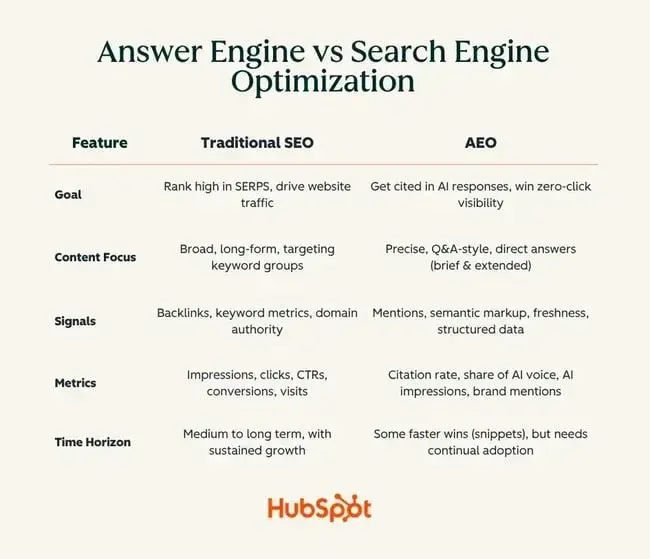
When someone uses a traditional search engine, they get back a list of links to explore at their own pace. In other words, the search engine gives you the resources to find your answer, and SEO helps brands show up in that list.
Answer engines work differently. They skip the list of resources and go straight to the answer. AEO is about being the source those engines trust enough to name and cite in those answers.
To illustrate, let’s say I search for the very scientific question: “What are the best action movies of all time?” A traditional search engine like Google would return a bunch of different resources (websites, videos, even forum responses) that it believes could offer the information I’m looking for.
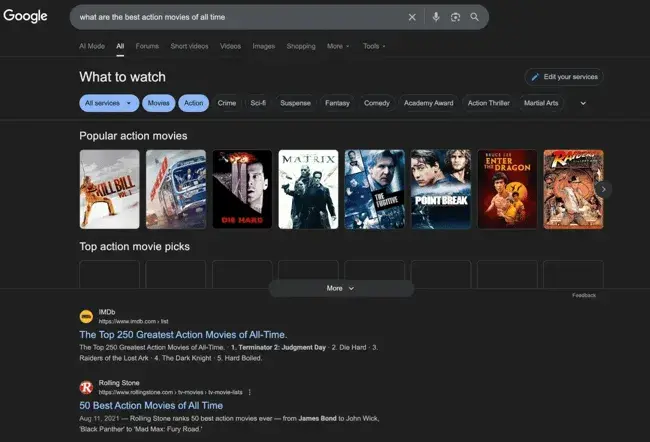
To appear here, marketers would target keywords, build backlinks, secure a spot at least on page one, and track impressions, click-through rates, and organic sessions. (All that good stuff I used to tackle.)
Featured Resource: 9 SEO challenges brands face in 2026 [HubSpot Blog data]
In contrast, if I ask ChatGPT for the best action movies of all time, it gives me a list compiled from many sources rather than simply linking to some pages for me to check out.
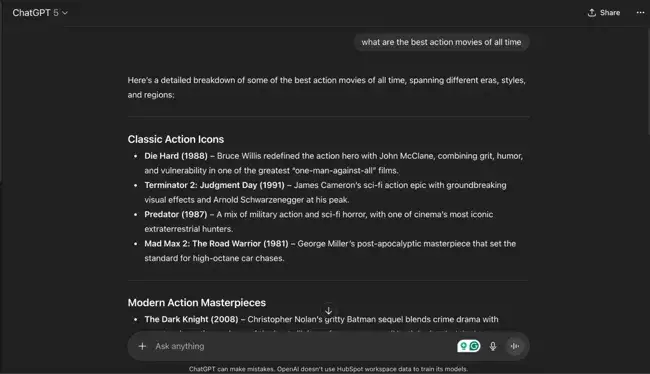
To appear in AI’s answers, marketers need to turn to a host of AEO best practices. But this also benefits search engine optimization.
AEO helps brands appear in featured snippets, knowledge panels, voice searches, and the “popular action movies” carousel at the top of our example.
AEO and SEO work together in many ways like this. We’ll unpack this more in the next section.
Featured Resource: The essential SEO tutorial for thriving in the age of AI-driven search
Tools like HubSpot AEO help marketers identify how their brand appears in AI-generated answers. From there, teams can uncover gaps in visibility and optimize content specifically for citation in answer engines.
Why Answer Engine Optimization Matters More Than Ever
While AI has its share of critics, AEO is far from a trend. It’s becoming a non-negotiable for marketers for two main reasons.
Buyer search behavior is changing.
AI is fielding questions from “How should I reply to this text?” to “What are the best tools for SMB social media?” In fact, according to HubSpot research, 42% of buyers use AI search as part of their evaluation process, and it’s a top predictor of purchase intent.
On top of that, 79% of those who already use AI for search believe it offers a better experience than traditional search.
Traditional search engines are changing.
Even chatbots aside, traditional search engines are implementing AI features to compete and stay relevant as the world shifts from a click-based to an answer-based economy.
SparkToro found that 68% of U.S. Google searches now end without a
click. And that’s just Google. BrightEdge reports that AI Overview coverage grew 58% year-over-year from February 2025 to 2026.
If brands are not appearing in relevant answers, they’re likely already out of consideration.
The upside? AEO complements traditional SEO — it doesn’t compete with it. Both draw on the same foundation of strong content, domain credibility, and smart internal linking. The difference is that AEO reorients those strengths toward content that AI systems can confidently excerpt and cite.
Dig deeper into the benefits of answer engine optimization here.
Free AEO Guide: HubSpot's Guide to AI Engine Optimization
Navigate the AI revolution with proven strategies to optimize your content for AI visibility.
- How answer engines rank and choose content
- Practical templates and checklists
- AEO strategies that convert 27% of AI traffic to leads
- Real examples from HubSpot's AEO implementation
Download Free
All fields are required.
Form not available
Answer Engine Optimization Best Practices
SEO and AEO are not competing strategies. They actually work together and share many of the same best practices. Think of AEO as a new layer on your existing SEO strategy, not a separate program competing for resources.
With AEO features built into HubSpot Marketing Hub, teams can track AI visibility natively in HubSpot, connect those insights to campaigns, and measure performance over time.
1. Focus on questions and user intent.
AEO is question-and-answer-focused by design. The more directly your content answers what people are actually asking, the more likely an AI system is to cite it.
Start by building a clear inventory of the questions your audience asks at every stage of their journey. Pull from sales conversations, Google’s “People Also Ask” boxes, and query data from Google Search Console.
Then, map those questions to funnel stages:
- Awareness-stage questions need educational, jargon-free answers.
- Consideration-stage questions require comparisons, frameworks, and proof points.
- Decision-stage questions demand specifics about implementation, pricing, and support.
Once you have your list, audit existing content for gaps. Research each question in both search engines and AI tools to see where competitors currently appear.
Marketers who focus on directly answering questions, structuring content for extraction, and building authority across channels will be best positioned for success — see how leading brands are doing this in answer engine optimization case studies.
Pro tip: Track your question inventory in a shared spreadsheet or CRM. Note which questions are covered, which are in progress, and which represent gaps competitors might be filling first.
AEO features in Marketing Hub Pro and Enterprise let you pair your question inventory to larger campaigns for a more connected strategy.
2. Structure content for direct answers and extraction.
Answer engines don’t read articles linearly. They scan for answer-like structures or short paragraphs after questions, numbered steps, comparison tables, and decide if that content directly addresses a user’s query. This is why learning AEO page structure is so important.
To optimize for this behavior, lead every key section with a 40- to 60-word direct answer that fully addresses the question. Then, expand with supporting details, using bullet points, lists, and tables to improve readability. Well-structured content helps algorithms and humans quickly extract the most valuable information.
This content structuring approach is similar to how marketers target featured snippets in Google, which we’ll explore further in the next section.
Beyond the opening answer, adopt reusable content block patterns that answer engines recognize:
- Definition blocks for terminology
- Step-by-step blocks for processes
- Pros and cons blocks for evaluations
- Comparison tables for side-by-side analysis
These patterns act as semantic signals that help AI systems identify what type of information a page provides.
Pro tip: HubSpot Content Hub helps teams templatize these patterns and maintain editorial consistency at scale. HubSpot AEO can also surface which content formats and answer structures are most likely to be cited, so you can double down on what’s working.
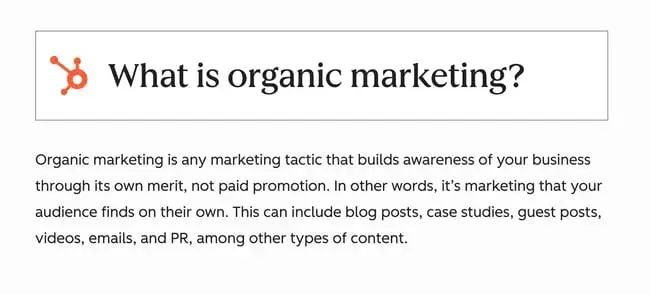
Here’s an example of a definition box from one of my HubSpot articles on organic marketing:
3. Use schema to signal content to answer engines.
Schema markup is structured data added to HTML that explicitly tells search and answer engines what your content represents. It’s the difference between Google guessing that a page is a how-to guide and Google knowing for certain that it is.
Focus on these core schema types for AEO impact:
- FAQPage schema: Use on pages with question-and-answer pairs. Helps Google surface content in rich results and gives answer engines clear associations to extract.
- HowTo schema: Apply to instructional content, marking each step, its position in the sequence, and any images or warnings.
- Article schema: Tag editorial content with headline, publish date, author, and organization. Establishes freshness and authority signals.
- Speakable schema: Add to key sections so voice assistants can prioritize them when reading answers aloud.
- Organization schema: Implement sitewide to clarify brand identity, logo, and social profiles for consistent entity recognition.
CMS SEO tools in platforms like HubSpot let you templatize schema across content types so teams don’t have to hand-code for every post. You can set up templates for blog posts, guides, FAQs, and product pages, among other things, and the schema is applied automatically with clean, crawlable HTML.
4. Win featured snippets and “People Also Ask” placements.
Featured snippets and “People Also Ask” (PAA) boxes are some of Google’s most visible answer formats. They also serve as training signals for how AI Overviews select and present information.
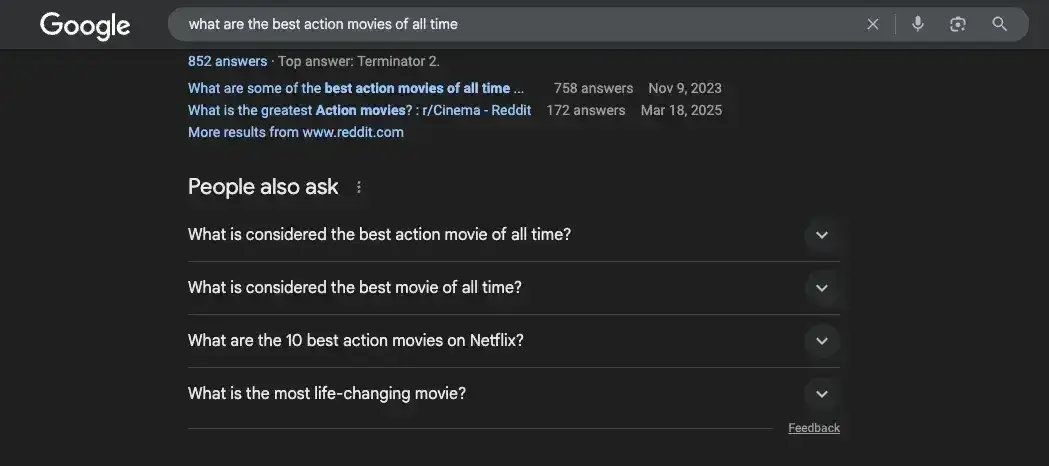
BrightEdge found that pages with structured data are cited 2.1x more often in AI Overviews — and snippet wins are one of the clearest indicators that Google already treats your content as authoritative.
To win featured snippets:
- Format answers to match the existing snippet type. If Google shows a numbered list, write one. If it’s a paragraph, lead with a concise paragraph.
- Mirror the question wording in your H2 or H3 heading. If the PAA question is “How do you calculate ROI?” your header should match that phrasing exactly.
- Place the answer high on the page — ideally within the first two scrolls.
- Use the inverted pyramid approach: answer first, then provide context, examples, and related information for readers who want to go deeper.
Pro tip: Every quarter, open an incognito browser, search your primary keywords, and document the PAA questions that appear. Then, prioritize updating existing high-authority pages to target new PAA questions rather than creating new content. Google favors established pages for snippets, so enhancing what already ranks often delivers faster results.
HubSpot AEO helps track which pages are earning featured snippets and AI citations so you can double down on what’s working.
Free AEO Guide: HubSpot's Guide to AI Engine Optimization
Navigate the AI revolution with proven strategies to optimize your content for AI visibility.
- How answer engines rank and choose content
- Practical templates and checklists
- AEO strategies that convert 27% of AI traffic to leads
- Real examples from HubSpot's AEO implementation
Download Free
All fields are required.
Form not available
5. Prioritize credibility.
Recent research found that content including citations, statistics, and quotes from authoritative sources is 30% to 40% more visible in AI search results. Supporting claims with evidence and keeping information up to date strengthens both accuracy and visibility.
Here’s how to build credibility signals into every piece of content:
- Format content for easy skimming with bullet points, tables, and short paragraphs.
- Support all claims with data. Include data-driven insights and expert citations. Even better: publish original research.
- Rely on trusted, authoritative sources.
- Update existing content regularly with new data and insights. Freshness matters.
Pro tip: HubSpot AEO helps monitor how credibility signals affect your brand’s presence across AI-generated answers, so you can see what’s moving the needle.
6. Build brand consensus across channels.
Answer engines favor brands that are consistently mentioned across reputable platforms like industry publications, high-quality forums, and academic or government sources. A coordinated distribution strategy ensures your expertise shows up wherever both audiences and AI systems are paying attention.
Related: AEO Strategy for B2B: 9 Tactics to Increase B2B Answer Engine Visibility
Off-site authority isn’t just about backlinks. Reddit and Quora now appear in 14% of all AI Overviews — a 340% increase compared to 2024, according to Semrush. This increased visibility makes authentic participation in relevant communities and multi-channel distribution more valuable than ever.
A multichannel distribution strategy might include:
- Publishing thought leadership on LinkedIn to reach peers and establish executive visibility.
- Creating educational video content for YouTube. Transcripts are crawled by AI systems and often contain more depth than blog posts.
- Participating authentically in relevant Reddit communities and Quora discussions. These platforms are increasingly cited by AI as sources of real user sentiment.
- Pitching byline articles to industry publications with strong editorial standards. Third-party endorsements signal authority far more than content published only on owned channels.
- Creating original research and data visualizations. A survey or benchmark report becomes a link-worthy asset that gets cited across the web.
- Establishing a repurposing workflow. A single piece of research can become a LinkedIn post, a YouTube video, a contributed article, a Reddit discussion, and a Quora answer — each tailored to the platform and audience.
- Assigning a content distribution owner. This person will be responsible for adapting core assets and tracking where they’re shared. Include PR angles and thought leadership opportunities in the planning. Speaking engagements, podcast interviews, and media mentions all contribute to the authority signals that answer engines evaluate.
Pro tip: HubSpot’s Content Remix turns a single piece of content into multiple formats in one click.
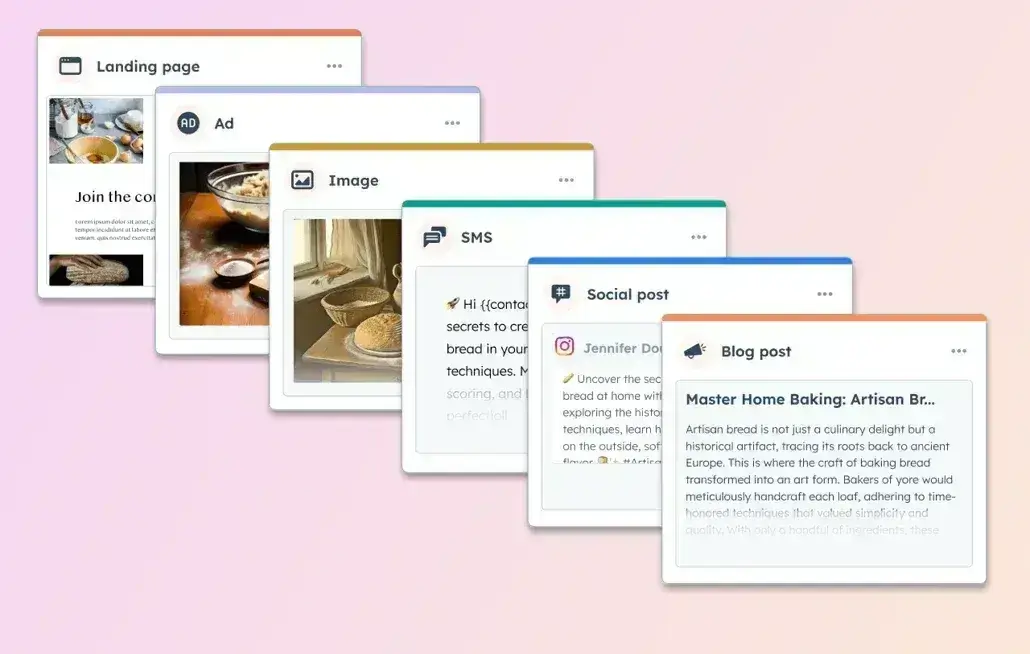
Marketing Hub automation can then orchestrate cross-platform distribution at scale, scheduling posts, tracking engagement, and measuring which channels drive the most referral traffic back to your owned content.
7. Optimize for voice search.
When someone asks their smart speaker a question, the assistant typically cites one source. You want your brand or content to be that cited source.
Voice assistants like Alexa, Siri, and Google Assistant prioritize short, conversational answers that can be easily read aloud. Here’s how to optimize for that:
- Write answers in spoken-friendly language. Avoid jargon, long dependent clauses, and ambiguous pronouns. Instead of “It enables seamless integration,” write “HubSpot’s API enables seamless integration.”
- Use Speakable schema markup to tell voice assistants which paragraphs are concise, self-contained, and ready to be read aloud.
- Test voice queries on Alexa, Siri, and Google Assistant regularly to evaluate your visibility.
- Label FAQs, definitions, and key takeaways with Speakable markup in your CMS so content teams know which sections are voice-optimized.
8. Lean into localization for voice.
Voice and AI search frequently surface nearby businesses — even for seemingly general queries — making localization especially valuable for small business AEO efforts. If your local data is incomplete or inconsistent, you’re invisible in these high-intent moments.
Cover your bases with these steps:
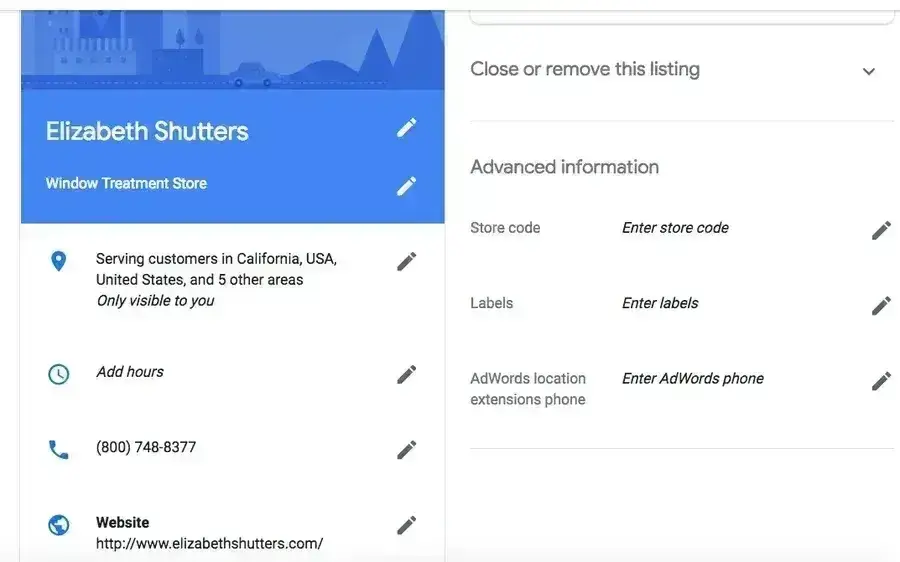
Optimize your Google Business profile.
Verify that your contact info matches your website exactly. Add complete business hours, high-quality photos, and all relevant categories. Write a keyword-rich description that includes the services and questions customers actually search for.
Related: Google My Business Guide: Complete Overview & Expert Tips
Build a review strategy.
Ask satisfied customers to share their experience and respond promptly to every Google review — positive or negative. Review volume and recency are strong ranking signals for local AI results.
Create local landing pages for each service area.
Even for a single-location business, dedicated pages for specific service areas give AI systems clear geographic and service signals to extract. Use consistent name, address, and phone number (NAP) formatting across all pages.
Audit local data across all platforms.
Contact and business information should be the same across all platforms. Look for consistency across the brand’s Google Business Profile, Apple Maps, Bing Places, the website, and even Mapquest (yes, they’re still around!). Voice queries like “What time does [business] close?” pull from structured sources. Inconsistent data confuses customers and AI systems alike.
Common AEO Challenges
Executives resist investing in visibility without clicks.
The biggest barrier to AEO success isn’t technical: it’s organizational. Getting buy-in from executives who are used to measuring success in clicks and conversions requires a mindset shift.
Solution: Frame AEO as brand awareness and category leadership, not traffic generation. Explain how website traffic is no longer the single indicator of a brand’s actual prevalence. AI-driven visitors convert on average 4.4x higher than standard organic visits; that’s a number worth putting in front of leadership. Competitors who own AI visibility today will own mindshare tomorrow.
Attribution and ROI are unclear.
AI citations don’t generate sessions in Google Analytics, so traditional tracking breaks down.
Solution: Build a hybrid measurement framework that combines traditional and AEO metrics. HubSpot Marketing Hub offers tools for both SEO and AEO, helping teams track performance across both. Also, survey new customers about how they first heard of your business — increasingly, answers will reference AI tools like ChatGPT.
It is hard to track AI citations.
Solution: HubSpot AEO tracks where and how your brand appears across AI-generated answers — which queries trigger visibility, which platforms cite your content, and where opportunities exist. For teams without a dedicated tool, periodically test key queries across major AI platforms and log whether your brand appears. It’s less scalable, but it still reveals patterns in what gets cited.
Free AEO Guide: HubSpot's Guide to AI Engine Optimization
Navigate the AI revolution with proven strategies to optimize your content for AI visibility.
- How answer engines rank and choose content
- Practical templates and checklists
- AEO strategies that convert 27% of AI traffic to leads
- Real examples from HubSpot's AEO implementation
Download Free
All fields are required.
Form not available
Content teams lack capacity to retrofit everything.
Solution: Prioritize ruthlessly. Start with your top 20 highest-traffic pages and the 20 pages that rank on page one but don’t yet win snippets. Add schema and answer-first formatting to these pages first. HubSpot AEO can help prioritize this effort by surfacing which pages have the highest potential to gain AI visibility with optimization.
Technical AEO Checklist
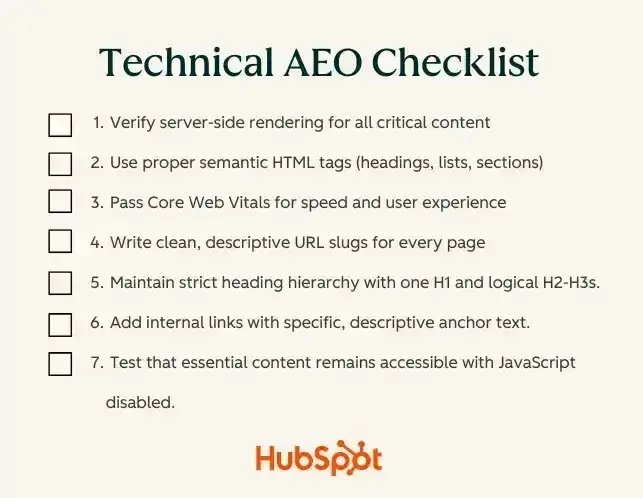
Before delving into content strategy, ensure the technical foundation is solid. Use this seven-item checklist to confirm your pages are crawlable, readable, and structurally sound for AI systems.
|
# |
Check |
What to do |
|
1 |
Server-side rendering |
Ensure all critical content is in the HTML when the page first loads — not populated by JavaScript. Crawlers need to see actual text, not empty divs. |
|
2 |
Semantic HTML tags |
Use proper H1, H2, H3 tags in a logical hierarchy. Wrap lists in <ul> or <ol>. Use <article> and <section> to clarify page structure. |
|
3 |
Core Web Vitals |
Pass Google's thresholds: LCP under 2.5s, FID under 100ms, CLS under 0.1. Compress images and minimize render-blocking resources. |
|
4 |
Clean, descriptive URLs |
Use URLs like /blog/what-is-aeo — not /blog/post-47293. A URL should describe what's on the page without anyone clicking it. |
|
5 |
Heading hierarchy |
One H1 per page. Use H2s for major sections, H3s for subsections. Never skip heading levels or use headings just for styling. |
|
6 |
Descriptive internal links |
Use specific anchor text like "AEO best practices" — not "click here." Internal links help AI systems map your content relationships. |
|
7 |
JavaScript accessibility check |
Disable JS and check whether essential content is still visible. If it disappears, crawlers and assistive tech can't access it either. |
Pro tip: HubSpot AEO helps identify structural and optimization gaps that may prevent content from being properly understood by AI systems. Clarity improves citations.
FAQs About AEO Best Practices
How long does it take to see results from AEO?
Most teams see early wins within four to eight weeks, with meaningful momentum building over six to twelve months. The timeline depends on your starting point and speed.
- Month 1: Map key audience questions, audit existing content, and implement schema on high-priority pages.
- Weeks 6–8: Early visibility gains appear — featured snippets, PAA placements, and occasional mentions in AI-generated answers.
- Months 3–6: Momentum builds as more answer-optimized content is published.
- Months 6–12: Measurable business impact emerges, including pipeline growth influenced by answer engine visibility.
Do we need schema on every page?
No. Prioritize pages that fit FAQPage schema first, followed by Article, Speakable, and Organization. Product and service pages can also include relevant schema types like Product, Service, or LocalBusiness. HubSpot’s CMS makes adding schema automatic with templates — no hand-coding required.
How can we track AI citations without a new platform?
You don’t need expensive software to start. A simple spreadsheet and consistent manual process can go a long way — log key queries, test them across AI platforms, and track whether your brand appears.
To complement this, use tools you likely already have: Google Search Console for snippet and PAA visibility, and GA4 to monitor branded search traffic. For a more complete picture, HubSpot AEO shows where your brand appears in AI-generated answers and whether those appearances are positive, negative, or neutral.
Will AEO replace SEO?
No. AEO and SEO are complementary, not competitive. SEO remains foundational — answer engines discover your content through organic rankings and domain authority. Strong SEO fundamentals are a prerequisite for AEO success. Invest in both.
What’s the best way to keep AEO content fresh?
Assign ownership. Every piece of AEO-optimized content should have someone with subject-matter expertise responsible for keeping it accurate and up to date. Set a review schedule based on content type: high-velocity topics (tool comparisons, industry news) need quarterly reviews, while evergreen content may only need annual updates.
Monitor PAA boxes and AI-generated answers for new questions. Update existing pillar pages to include them rather than creating new articles. HubSpot AEO and manual audits can identify citation drops so you can refresh pages with updated data and reclaim visibility.
Don’t sleep on answer engine optimization best practices.
AEO isn’t a replacement for SEO — it’s an evolution of it. The same fundamentals that have always driven strong content performance apply here, just applied with answer engines in mind.
Marketers who focus on directly answering questions, structuring content for extraction, and building authority across channels will be best positioned to show up where decisions increasingly begin. Because at the end of the day, that’s what great marketing has always been about.
Tools like HubSpot AEO and the AEO features in Marketing Hub Pro and Enterprise give teams the visibility and data they need to measure success in this new landscape — and continuously improve how your brand shows up in the answers that matter. Get started with the HubSpot AEO Guide to start putting these practices into action today.
Editor's note: This post was originally published in October 2025 and has been updated for comprehensiveness.
Free AEO Guide: HubSpot's Guide to AI Engine Optimization
Navigate the AI revolution with proven strategies to optimize your content for AI visibility.
- How answer engines rank and choose content
- Practical templates and checklists
- AEO strategies that convert 27% of AI traffic to leads
- Real examples from HubSpot's AEO implementation
Download Free
All fields are required.
Form not available
AEO

-What-We-Learned-from-Analyzing-10+-Brands-With-High-AI-Search-Citations-1-20260826-304258.webp)
![Using LinkedIn for AEO: How marketers can use social media to improve their AI visibility [experiment]](https://53.fs1.hubspotusercontent-na1.net/hubfs/53/AEO-for-LinkedIn-piece-1-20260826-6108454.webp)
-1.png)
![Scrunch AI alternatives compared: Features, pricing, and fit [2026]](https://53.fs1.hubspotusercontent-na1.net/hubfs/53/scrunch-alternatives-1-20260812-5006620.webp)