

In today’s landscape, a marketing audit has never been more crucial. The competition is fierce, and with AI improving every day, it’s difficult to tell what the future will bring. If you haven’t revisited your marketing strategy for a few years, or you’re seeing some key metrics drop, it’s time to roll up your sleeves and get to the bottom of it. That’s what a marketing audit will help you with.
![Download Now: Free Marketing Plan Template [Get Your Copy]](https://no-cache.hubspot.com/cta/default/53/aacfe6c7-71e6-4f49-979f-76099062afa0.png)
This guide takes a closer look at marketing audits, the best time to conduct one, and a few best practices to pull one off.
What is a marketing audit?
A marketing audit is a systematic review of marketing performance across every channel, campaign, and investment a business runs. It evaluates what’s working, what isn’t, and where the biggest gaps sit so marketing leaders can make informed decisions about strategy and resource allocation.
The key word is systematic. Unlike a quick performance review or a campaign postmortem, a marketing audit follows a repeatable framework that covers every major channel and function. That consistency is what makes the findings reliable and enables year-over-year comparisons. A marketing audit can cover the entire marketing operation or focus on a single area, such as:
- A digital marketing audit
- An SEO audit
- An AI search visibility audit
- A social media audit
- An email marketing audit
Each review typically follows a marketing audit checklist, but the scope depends on the business question being asked. A VP of Marketing reviewing full-funnel performance will run a different audit than a demand generation manager diagnosing a drop in paid conversion rates.
What is included in a marketing audit?
A comprehensive marketing audit typically covers the following components:
- Campaign performance. Results from active and recent campaigns across every channel, measured against the goals set at launch.
- Channel effectiveness. Performance across SEO, paid, email, social, content, and AEO, including which channels are driving pipeline and which are underperforming relative to spend.
- KPIs and metrics. Progress against the specific benchmarks marketing is accountable for — traffic, MQLs, CAC, conversion rate, customer lifetime value, and return on ad spend.
- Customer journey. How prospects move from first touch to closed deal, where drop-offs occur, and whether marketing and sales hand-offs are working.
- Competitive analysis. How the brand stacks up against competitors in search rankings, messaging, paid presence, and AI visibility.
- Market research. Reveals even deeper insight into customer needs, preferences, motivations, and behaviors.
- Resource allocation. Where time, headcount, and budget are being spent, and whether that distribution matches the channels driving the highest return.
- Tech stack and data infrastructure. Whether the tools in use are delivering connected, trustworthy reporting or creating silos.
- SWOT analysis. Outlines the strengths, weaknesses, opportunities, and threats to a marketing strategy.
Why This Evaluation Matters
Marketing audits matter because marketing has fragmented. Without a structured review, decisions get made from partial data. Budget follows the channels that are easiest to measure, not the ones driving the most growth.
The rise of AI answer engines has made this worse. A marketing audit that doesn’t include AEO visibility is missing a channel where competitors may already be winning. Tools like HubSpot AEO and the free AEO Grader give marketers an immediate read on how their brand shows up across major answer engines. These tools offer a practical starting point for the AEO portion of any digital marketing audit.
From there, a full review connects that visibility data back to the rest of the marketing operation — content, social, earned media, and paid — so the audit reflects how discovery actually works today.
The business value of running a marketing audit is straightforward: it replaces assumptions with evidence. For marketing leaders trying to defend budget, prove ROI, or make the case for a strategic shift, that evidence is what moves the conversation forward.
Benefits of Conducting a Marketing Audit
A marketing audit delivers value in five specific areas: stronger ROI, smarter resource optimization, sharper competitive intelligence, lower risk and better governance, and more confident planning.
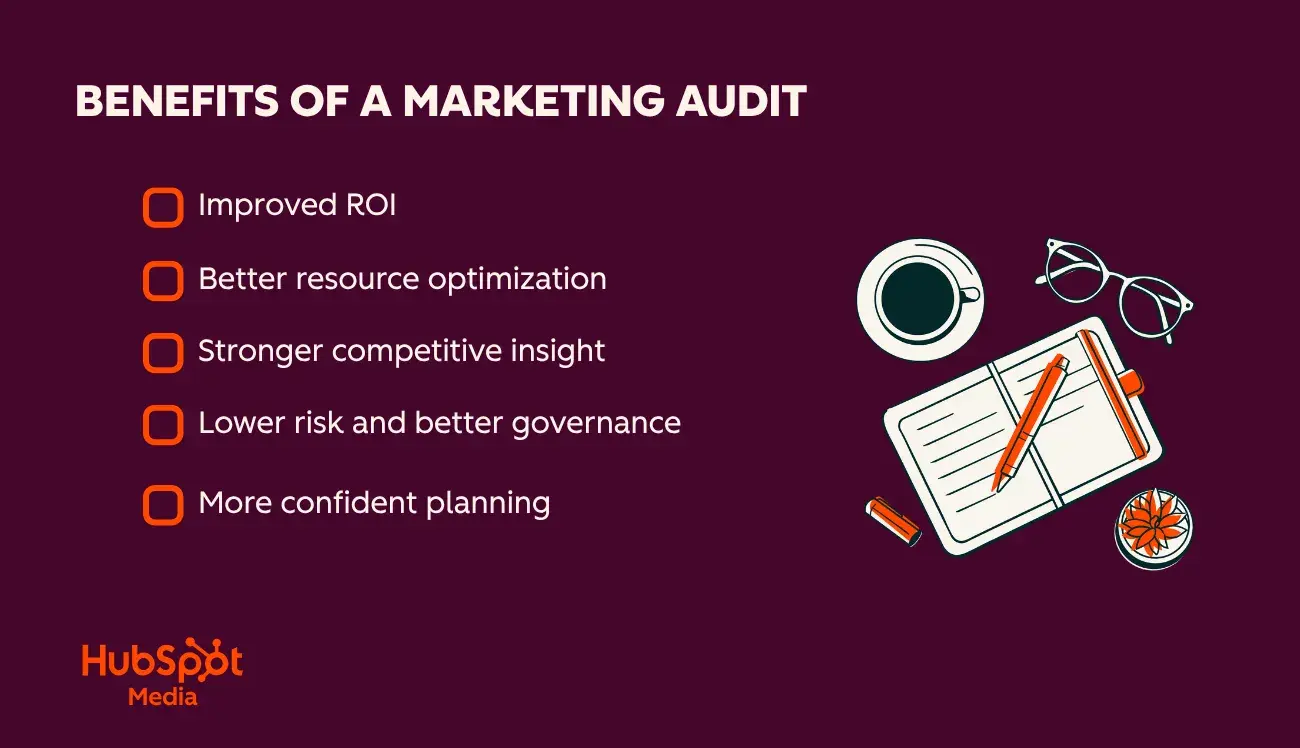
1. Improved ROI
A marketing audit directly supports ROI improvement by identifying which activities generate returns and which don’t. According to HubSpot’s 2026 State of Marketing Report, ROI ranks third among marketers’ metrics (31%), behind lead quality (39%) and lead-to-customer conversion rate (34%).
Audits reveal whether a given marketing operation is aligned with where the returns actually are — or whether budget is flowing to channels that look active but don’t contribute to revenue.
2. Better resource optimization
Marketing audits reveal where time, headcount, and budget are producing returns and where they aren’t. Audits also reveal gaps in measurement cadence. Only 44% of marketers analyze campaign performance weekly, meaning most teams make optimization decisions based on monthly or quarterly data. A structured audit process creates the framework for more frequent review without adding operational drag.
3. Stronger competitive insight
Marketing audits that include competitive benchmarking give marketing leaders an external reference point for internal performance. Internal data explains how marketing is performing, while competitive benchmarking explains whether that performance is strong or weak in context.
This matters more now because AI is reshaping the competitive landscape. Nearly 30% of marketers reported decreased search traffic as consumers turn to AI tools. Brands that don’t audit their AI visibility against competitors won’t know whether they’re showing up in answer engine responses or being left out entirely.
4. Lower risk and better governance
A structured marketing audit reduces the risk of decisions being made from incomplete or misleading data. Nearly 20% of marketers say adopting a data-driven marketing strategy is one of the biggest challenges they face in 2026.
Catching broken attribution, expired tracking, or inconsistent segmentation during a scheduled audit is significantly cheaper than catching them after a campaign underperforms or a regulatory issue surfaces. The governance benefit is simple: audit-backed decisions are easier to defend and harder to cut.
5. More confident planning
Marketing plans built on audit findings and real customer data are stronger than plans built on assumptions. Eighty-seven percent of marketers using HubSpot reported their strategies were effective, compared to only 52% of marketers without a CRM.
An audit gives marketing leaders the evidence to make prioritization calls defensibly, whether the conversation is with a CFO, a board, or an executive team debating where the next dollar of marketing spend should go.

Free Marketing Plan Template
Outline your company's marketing strategy in one simple, coherent plan.
- Pre-Sectioned Template
- Completely Customizable
- Example Prompts
- Professionally Designed
Download Free
All fields are required.
Form not available
Who does a marketing audit?
It’s common for companies to outsource marketing audits to a third party. This is for a few reasons.
Firstly, it’s time-consuming. For brands that do not have a large team with the time to dedicate days, if not weeks, to market research and internal data analysis, working with an external partner might be the way to go.
Secondly, an audit needs to be as objective as possible. If a team has been responsible for a lot of the existing marketing strategy, it might be hard to examine it without bias.
Third-party firms also have more experience conducting audits, and that experience really matters. They’re often better equipped to identify best practices and opportunities for improvement and may have access to specialized tools, technologies, and research capabilities.
This doesn’t, however, mean that a marketing team cannot do an audit on its own. If they have time and resources (i.e., people), give it a go.
Alternatively, Jacob Barnes, founder at FlowSavvy, suggests a mixed approach. “Outsource your analysis from time to time. External audits can reiterate that your in-house team is on track and making the right moves. It also helps to reduce any biases in the assessments or conclusions,” he told me.
Pro tip: If conducting an audit internally, this market research kit can provide a great starting point.
How to Do a Marketing Audit
A marketing audit works best when it follows a repeatable process. The five steps below walk through how to scope the audit, review each digital marketing channel, interpret the data, benchmark against competitors, and turn findings into a prioritized action plan.
1. Define your audit scope and goals
Every marketing audit starts with a clear scope. The team running the audit needs to decide whether the review will cover the entire marketing operation or focus on a specific area. Specific areas can include a digital marketing audit, SEO audit, social media audit, email marketing audit, or a single campaign.
Scope is driven by the business question. A marketing director diagnosing a 25% drop in trial signups will build a different audit than a VP of Marketing preparing for annual planning. Once the scope is set, the next step is defining measurable goals and KPIs. “Improve social media performance” is not a goal. “Increase TikTok follower growth from 50 to 200 per month” is.
What the experts say: Arham Khan, founder and CEO at Pixated told me that they did an audit for an ecommerce brand whose product pages were getting decent traffic, but conversions were down. The team knew immediately where the gap was: the product pages needed work.
“After our CRO experts took a detailed look, we identified the problems. Their product descriptions read like bad novels, and the ‘buy’ buttons got lost in the clutter. We took things back to basics and simplified it. Punchy product descriptions replaced the waffle, we brought the product images into focus, and made those call-to-action buttons impossible to miss,” said Khan.
The results spoke for themselves: product page views jumped 28%, and conversions climbed 32% in just a few weeks.
Pro Tip: Document the scope, goals, and KPIs in a one-page brief before any data collection begins. This prevents scope creep and gives every finding a clear yardstick to be measured against.
2. Review your key digital marketing channels
The core of a digital marketing audit is a channel-by-channel review. Each channel has its own performance metrics, its own benchmarks, and its own common failure modes. The goal is to evaluate each one on its own terms before looking at how they connect.
Website & SEO Performance
SEO and website audits review:
- Organic traffic trends
- Keyword rankings
- Technical SEO health
- Page speed
- Mobile usability
- User flow
- Landing page conversion rates
The review should identify which pages are gaining or losing rankings, which technical issues are blocking indexing or crawling, and which high-intent pages are underperforming on conversion. Tools like Google Search Console, Google Analytics, and Semrush are standard for this step.
Best for: Diagnosing traffic declines, identifying content refresh opportunities, and confirming that the technical foundation of the site is sound.
AEO Performance
An AEO audit reviews AI visibility, citations, and share of voice across major answer engines. The review should measure:
- How often the brand is cited in ChatGPT, Perplexity, and Gemini responses to buyer-relevant prompts
- Which competitors are appearing on those same prompts
- Which content types and domains AI engines are pulling from.
A brand that ranks well on Google but is invisible on answer engines is losing a growing share of the buyer journey.
Pro tip: An AI search visibility audit is not the same thing as an SEO audit. The two audits evaluate different signals — SEO looks at ranking factors like backlinks, keywords, and technical health, while an AEO audit looks at citation frequency, source diversity, and share of voice across answer engines. Conflating them leads to blind spots.
I saw this firsthand while auditing a personal brand. After identifying the gaps in AI visibility and executing targeted improvements, brand citations in answer engines climbed from 20% to 74% before stabilizing at 60% — a lift that wouldn’t have surfaced in a standard SEO audit.
Pro Tip: The HubSpot AEO Grader provides a fast read on brand visibility across major answer engines at no cost, which makes it a practical entry point for this section of the audit. For a deeper review, HubSpot AEO tracks prompts over time, surfaces citation data, and generates specific recommendations for improving visibility.
Content Marketing Analysis
A content audit evaluates which pieces of content are driving traffic, engagement, and conversions and which are underperforming. The review should cover:
- Funnel coverage
- Competitor gaps
- Engagement metrics
- Conversion contribution
- Refresh opportunities for content that has lost rankings or become outdated
What we like: Pairing content performance data with AEO citation data. Content that earns AI citations is often different from content that ranks on Google, and the overlap reveals the highest-leverage pieces to invest in.
Featured Resource: How Content Audits Help the HubSpot Blog Age Backwards
Social Media Metrics
A social media audit reviews engagement, reach, audience growth, referral traffic to the website, and conversion impact for each active platform. The review should also include a competitor scan, more specifically:
- Which platforms competitors are most active on
- What content formats are driving their engagement
- Where the brand has an opportunity to differentiate
Native platform analytics and a social media management tool are typically sufficient for this step.
What the experts say: Will Hatton, founder & CEO of The Broke Backpacker, thinks that competitive analysis is a must. “Think of it as having your rival’s playbook. You can see their keywords, what type of content they are creating, and which social media platforms they are getting the most hits on,” says Hatton.
He added that you might notice one of your competitors is crushing it on Instagram with their stunning display of travel photos. And that is a very big clue that you can take full advantage of.
Email Marketing Performance
An email marketing audit covers:
- List health
- Segmentation
- Open rates
- Click rates
- Conversion rates
- Automation performance
- Deliverability
- Compliance with regulations like GDPR and CAN-SPAM.
The review should identify where subscribers are dropping off in nurture sequences, which segments are most engaged, and whether list hygiene practices are protecting sender reputation.
Pro Tip: Look at lifecycle stage performance, not just aggregate metrics. A 22% open rate across the full list may hide the fact that top-of-funnel emails are performing at 35% while mid-funnel nurture is collapsing at 8%.
Paid Advertising ROI
A paid advertising audit reviews:
- Cost per click
- Cost per acquisition
- Return on ad spend
- Conversion rates
- Audience and creative performance
- Landing page alignment
- Budget allocation across channels.
The review should flag campaigns with rising CPA or declining ROAS, creative fatigue, and any mismatch between ad messaging and the landing page experience. Budget shifts often come out of this step — moving spend from underperforming channels to those with proven returns.
3. Gather, organize, and interpret the data
Once each channel has been reviewed, the findings need to be consolidated in one place. Comparing trends across sources, time periods, and funnel stages is where most of the strategic insight surfaces. A traffic decline alone is a data point, but a traffic decline paired with rising CPA and falling email engagement is a trend worth acting on.
A centralized dashboard or summary table makes this step manageable. HubSpot’s Marketing Analytics & Dashboard Software consolidates campaign, website, email, and social data in one view, which simplifies cross-channel comparison. Teams without a unified reporting tool often rebuild this step in a spreadsheet by exporting metrics from each platform into a single file.
Pro Tip: Compare at least three time periods: the current quarter, the same quarter last year, and the trailing 12 months. Single-period snapshots hide seasonality and obscure whether a decline is a trend or a blip.
4. Benchmark against competitors
Internal data explains how marketing is performing. Competitive benchmarking compares marketing performance against competitors and explains whether that performance is strong or weak in context. A 3% conversion rate looks fine in isolation, but looks different when a direct competitor is converting at 7%. A competitive benchmark should cover:
- Keyword rankings
- Messaging and positioning
- Site UX
- Paid offers and promotions
- Email nurture tactics
- Social engagement
- AEO citation share
For AEO citation share specifically, HubSpot AEO‘s Competitor Analysis shows which prompts are citing competitors instead of your brand and how your share of voice compares across ChatGPT, Perplexity, and Gemini. This is the one benchmark on the list that’s hardest to measure manually and most valuable to track with a dedicated tool. The other six can be assessed with standard SEO and analytics platforms; AEO citation share requires purpose-built visibility tracking.
What the experts say: Daniel Vasilevski, director and owner at Bright Force Electrical, told me that the practice he always follows during every audit is benchmarking the marketing performance against competitors. “Without that, there is no way to know if our efforts are working or if we are falling behind,” he said.
“If we see that competitors have stronger rankings in local search, higher engagement on social media, or better ad conversion rates, we know exactly what to work on. Without these comparisons, decisions are made blindly, and that may lead to wasted marketing spend,” Vasilevski added.
Pro tip: The review should also confirm that the competitors being benchmarked are the right ones. For instance, an early-stage SaaS company comparing itself to enterprise incumbents will reach conclusions that don’t apply to its actual market position.
5. Prioritize actions and build your plan
The final step turns audit findings into a prioritized action plan. Recommendations should be grouped into four buckets:
- Quick wins. High-impact, low-effort fixes that can be executed in the next 30 days.
- Strategic improvements. Larger initiatives that require more resourcing but address root causes — rebuilding a nurture sequence, overhauling site architecture, or launching an AEO program.
- Testing opportunities. Hypotheses worth validating before a full investment, such as a new paid channel or a content format the brand hasn’t tried.
- Measurement fixes. Reporting gaps, tracking issues, or attribution problems that need to be resolved so future audits produce cleaner data.
Each recommendation should have an owner, a deadline, and a defined success metric. Without those three elements, audit findings become a document that gets filed and forgotten instead of a plan that gets executed.
Free Marketing Plan Template
Outline your company's marketing strategy in one simple, coherent plan.
- Pre-Sectioned Template
- Completely Customizable
- Example Prompts
- Professionally Designed
Download Free
All fields are required.
Form not available
Marketing Audit Example: SaaS Company Case Study
To illustrate how an audit surfaces specific, actionable findings, here’s a real marketing audit example focused on a single audit type: an AEO audit. Clark shared the details of an AI search visibility audit she conducted for a SaaS brand in the AI-powered presentation software category.
Challenge
The business problem: a growing share of buyers were researching tools through AI, and the brand was invisible in that channel.
The brand had strong product fundamentals — clear website copy, a competitive feature set, and content covering the expected category topics. Despite that, the brand rarely appeared when users asked AI answer engines for presentation software recommendations. Competitors with lower domain authority were consistently being cited instead.
Audit Process
The audit reviewed how ChatGPT, Gemini, and Perplexity were interpreting and recommending presentation software in response to real user prompts. The review covered:
- Prompt testing. A range of natural-language queries, from broad discovery prompts to audience-specific, use-case-driven questions.
- Citation analysis. Which tools appeared in AI-generated answers, how they were described, and which sources AI engines were pulling from.
- Competitive comparison. How clearly each competitor communicated its target audience and core use case, and how consistently that positioning appeared across the web beyond the company’s own website.
Key Findings
The audit surfaced three findings that ran counter to traditional SEO assumptions and affected marketing performance.
- Domain authority was not the deciding factor. Competitors with weaker backlink profiles were being cited more often. AI engines weren’t rewarding global authority; they were rewarding contextual clarity.
- Clarity beat breadth. The brands appearing most consistently in AI answers anchored themselves to specific audiences and use cases. The audited brand’s positioning made sense to human readers but was too broad for AI systems to confidently match to specific prompts.
- Off-site signals reinforced trust. Competitors with higher AI visibility had consistent positioning across blogs, social channels, and third-party content. That repetition helped AI systems form stronger associations between the brand and specific buyer needs.
Results and Actions
The audit produced a prioritized action plan focused on two changes: tightening the brand’s positioning around specific audiences and use cases, and reinforcing that positioning consistently across channels beyond the website.
The broader takeaway: In this case, the audit didn’t recommend building more content or earning more backlinks. It recommended saying the same specific thing, in the same specific way, across every surface where AI engines might encounter the brand.
Marketing performance, like AI visibility, compounds when signals are clear and consistent. Marketing audits, whether for AEO performance or paid advertising ROI, give marketers a clear understanding of what needs to change and when. Tools like HubSpot AEO can help teams know where their brands are — or aren’t — showing up in AI-generated answers and give actionable strategies to fix those gaps.
When Should You Conduct A Marketing Audit?
Marketing audits work best when they follow a predictable cadence, with flexibility to run additional reviews when specific triggers surface. Most marketing teams benefit from a three-tier cadence: a full annual audit, quarterly channel mini-audits, and monthly or campaign-based reviews for fast-moving programs.
1. Annual full audits
A full marketing audit once a year covers every channel, KPI, and investment area in a single comprehensive review. An annual audit is the right moment to step back from quarterly execution pressure and evaluate the full marketing operation. This includes channels that aren’t actively reported on in weekly or monthly reviews.
2. Quarterly channel mini-audits
Quarterly reviews focus on a single channel or function. One quarter might cover an SEO audit; the next, a social media audit; the next, an email marketing audit. This cadence prevents any single channel from drifting out of alignment between annual reviews and keeps findings small enough to act on quickly.
3. Monthly or campaign-based reviews
Fast-moving programs — paid advertising, active campaigns, and AEO visibility — change quickly enough to warrant monthly reviews. AEO performance in particular can shift as AI engines update their models and as competitors publish new content, which means a quarterly cadence may be too slow for teams that depend on AI-driven discovery.
4. Trigger-based audits
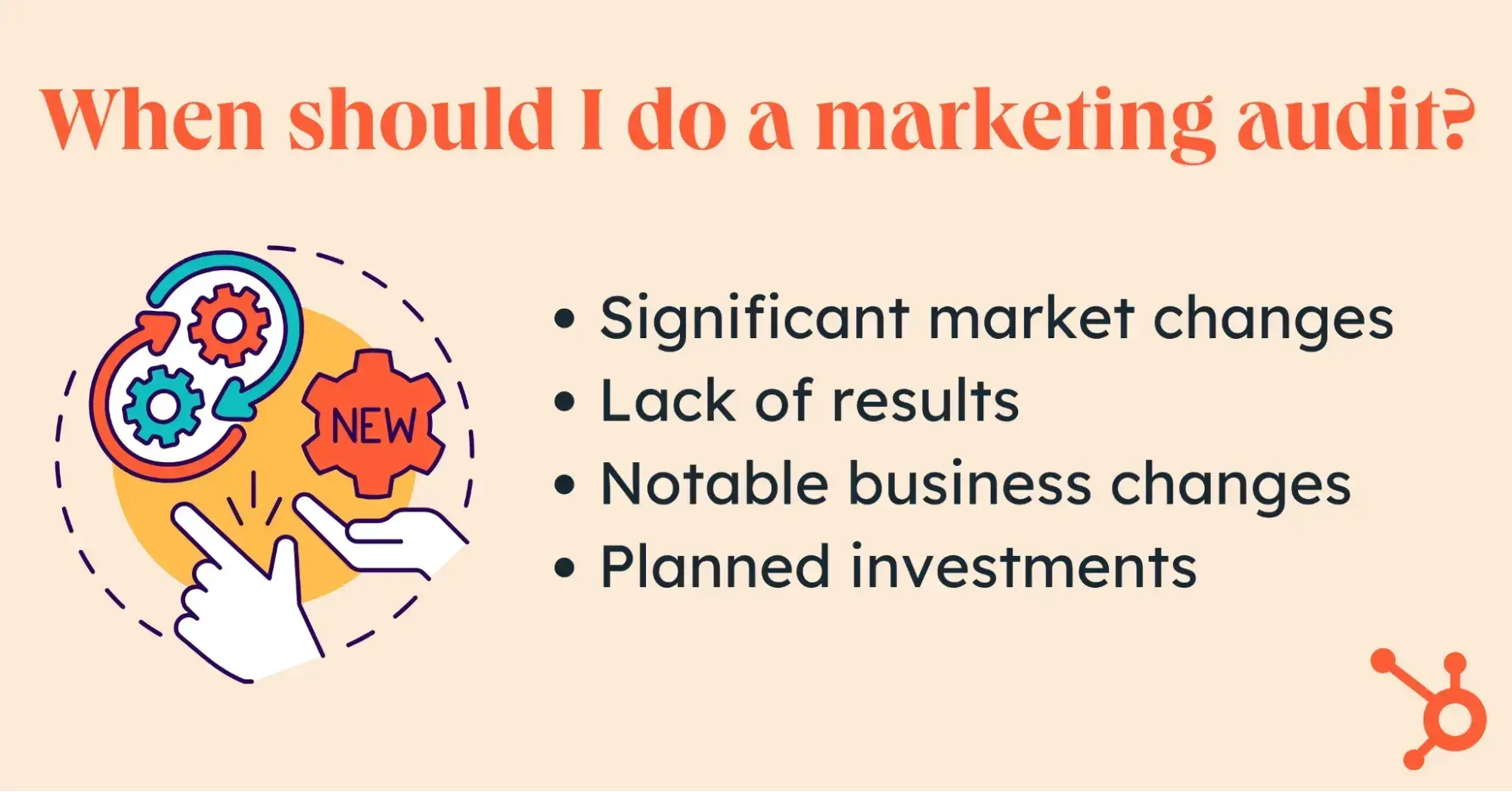
Beyond scheduled reviews, certain business events should prompt an immediate audit regardless of cadence. Performance decline is the clearest trigger — a sustained drop in traffic, conversions, or pipeline signals that something in the marketing system has broken and needs diagnosis. Other triggers include:
- Significant market changes. This could look like a new competitor entering the space, a platform algorithm update, or a shift in buyer behavior.
- Business changes, such as a merger, acquisition, rebrand, or repositioning.
- Planned investments, like a product launch, a new channel expansion, or a major budget increase that needs a baseline before execution.
- Leadership transitions. A new CMO or VP of Marketing often runs an audit in the first 90 days to establish an accurate picture of the team’s starting position.
Pro Tip: The marketing teams that catch performance issues earliest are the ones with unified reporting. HubSpot’s Marketing Analytics & Dashboard software consolidates traffic, conversion, and campaign data in one view. This makes trigger conditions easier to spot before they become quarterly problems.
How to build an audit cadence that sticks
The difference between an audit cadence that gets followed and one that gets abandoned is ownership. The goal is not to audit constantly, but to audit often enough that findings are still actionable when they surface. Each audit tier needs:
- A named owner.
- A standing time on the calendar.
- A defined deliverable.
Marketing Audits Should Be a Recurring Thing
Remember: no strategy is set in stone. Just because something brought results for a few months doesn’t mean it will work equally well a year — or even three months — from now. As the business environment changes, so should the marketing strategy.
That’s why I think running a marketing audit is vital, especially if you’re seeing a performance drop. The audit doesn’t always have to be robust. You can focus on one specific problem only.
The good news is that the more frequently you audit your existing strategy, the fewer issues you’ll find — and the faster you’ll be able to resolve them.
Editor’s note: This post was originally published in May 2023 and has been updated for comprehensiveness.
Free Marketing Plan Template
Outline your company's marketing strategy in one simple, coherent plan.
- Pre-Sectioned Template
- Completely Customizable
- Example Prompts
- Professionally Designed
Download Free
All fields are required.
Form not available
Marketing Strategy


-Dec-04-2025-05-17-34-7864-PM.webp)




![The state of inclusive marketing in 2025 [new data + expert insight]](https://53.fs1.hubspotusercontent-na1.net/hubfs/53/inclusive-marketing-report.webp)
![How marketers are navigating a possible recession (and advice about what you should do during it) [new data]](https://53.fs1.hubspotusercontent-na1.net/hubfs/53/image12-May-27-2025-02-18-19-8390-AM.png)