Although AI is changing how people search, the future of SEO is promising. SparkToro’s analysis of 332 million Google queries found that just over half of all Google searches are informational, meaning the user is asking questions. Then, a third are navigational, meaning the user is trying to get to a specific website, page, or brand.

But, it’s not a leap to assume a future where answer engines handle informational and discovery phases. Semrush’s research finds that informational searches mostly have AI Overviews (AIO) within the SERPs, and Responsive’s report, Inside the Buyer’s Mind finds that most B2B buyers start their vendor discovery through web searches (33%) and generative AI (32%).
Reassuringly for traditional SEO, Google’s search query volume grew 11.3% year-over-year even as AI tools surged in adoption. This suggests that the two search formats are expanding the market together rather than fighting over searches.
This article brings together data and insights from trusted sources and SEO experts at Semrush, Search Engine Journal, HubSpot, and beyond to map out where search is heading so you can futureproof your SEO.
Table of Contents
- The Current State of AI in Search: Setting the Stage for SEO’s Future
- How to Adapt Your SEO Strategy for an AI-Powered Future
- Frequently Asked Questions About the Future of SEO
The Current State of AI in Search: Setting the Stage for SEO’s Future
The search landscape has shifted faster in the past 18 months than in the previous decade, and understanding where things stand today is the foundation for any smart SEO strategy.
The Rise of AI-Powered Search
AI-powered search is growing at unprecedented rates. But while this is happening, Google is still performing. First Page Sage shares data that Google Search has almost 500% more active users, 5.3 billion users, compared to ChatGPT’s 900 million users. Plus, Google Search still maintains the majority share of search with 77.9%.
The table at Stat Counter Global shows Google’s (blue line) continued dominance alongside ChatGPT’s (green line) growth:
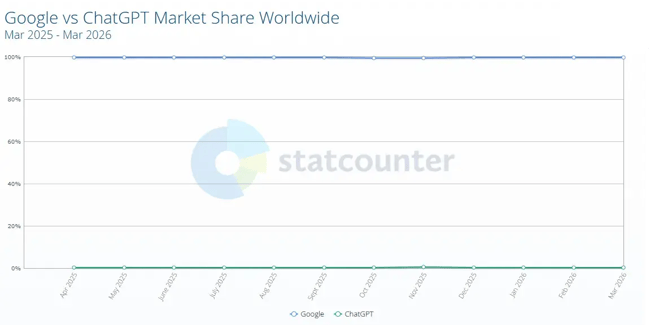
At first glance, Google’s overwhelming market share makes it difficult to see the impact of answer engines. But look closer, and the shift is there.
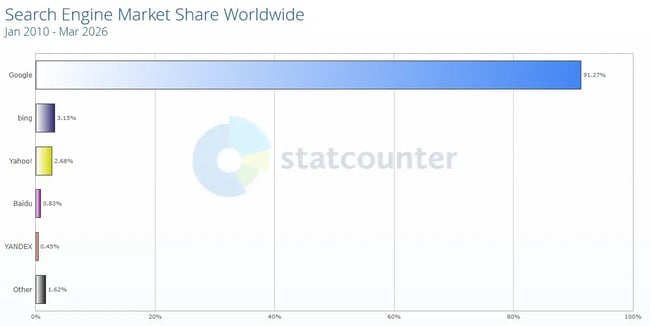
For years, Google consistently held over 90% of the search market. That changed in March 2025, when its share dipped below 90% for the first time. While still dominant, this marks a meaningful shift.
In fact, AI-powered search has achieved what traditional competitors (such as Bing or Yahoo) failed to do over decades: erode Google’s market share.
What the SEO Experts Say
Mark Williams-Cook had previously shared his thoughts on the rise of AI and the future of SEO. Back in 2025, Williams-Cook predicted that we were near the peak of where we’re going to be with Large Language Models (LLMs), and the data above suggests he was right.
Williams-Cook is the director of Candour and founder of AlsoAsked. He’s well-respected and well-known on LinkedIn for his contributions to SEO, which include his unsolicited SEO tips, updates newsletter, Core Updates, and the Search with Candour podcast.
Williams-Cook said, “In terms of the hype cycle, I feel we’re near the peak of where we are going to be with LLMs now. There are a couple of realities that are starting to hit home.”
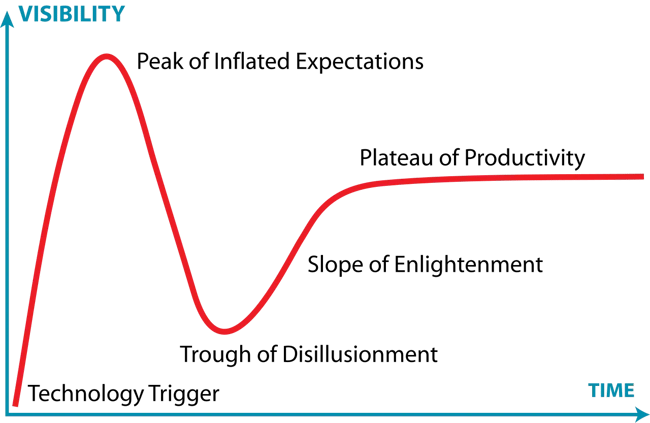
In his comment, Williams-Cook references the Gartner Hype Cycle, a framework used to track how emerging technologies are adopted, from early excitement to real-world adoption. The cycle can apply to evolving SEO and answer engine trends.
The hype cycle outlines a predictable pattern.
- Innovation trigger: A new technology emerges and sparks intense interest.
- Peak of inflated expectations: Bold claims, media attention, and early wins create the sense that it will change everything overnight.
- Trough of disillusionment: Reality sets in. Limitations become clear, and enthusiasm drops as expectations correct.
- Slope of enlightenment: Practical use cases emerge, understanding deepens, and adoption becomes more strategic.
- Plateau of productivity: The technology finds its place, becoming embedded in workflows and delivering consistent, measurable value.
There is data to support that this is true, and answer engine adoption is settling.
Data from Datos’ State of Search report shows answer engine share growing, then settling at around 1.34% to 1.54%.
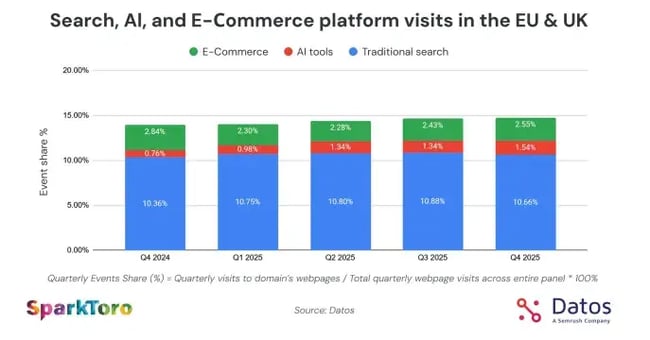
Rand Fishkin, SparkToro’s co-founder and CEO, says, “Every quarter that growth slows/plateaus makes me less certain that the prognostications of AI’s ‘takeover of everything’ will ever come to pass.”
With buyers now using both Google and answer engines, it seems we’ve reached the plateau of productivity stage of the hype cycle, and now SEO-cum-AEO specialists need to optimize for each form of search.
Google’s AI Evolution
Google’s response to the rise of answer engines includes two primary features: AI Overviews and AI Mode, which are reshaping how users interact with Google.
AI Overviews are AI-generated summaries that appear at the top of Google’s search results, synthesizing answers from multiple sources before a user clicks anything. AI Overviews change how users discover and consume search results.
Here’s what AI Overviews look like:
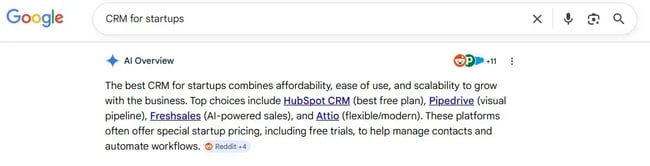
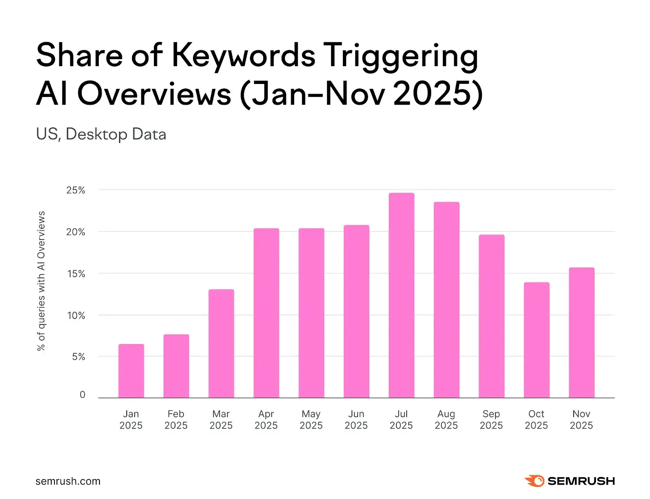
Google launched AI Overviews in May 2024, and by the end of 2025, they were present for 15.69% of queries, according to Semrush’s analysis of 10M queries.
AI Mode makes the search experience even more AI-oriented. Google launched it to all US users in May 2025. AI Mode is a dedicated search experience powered by Gemini.
Here’s what AI Mode looks like:
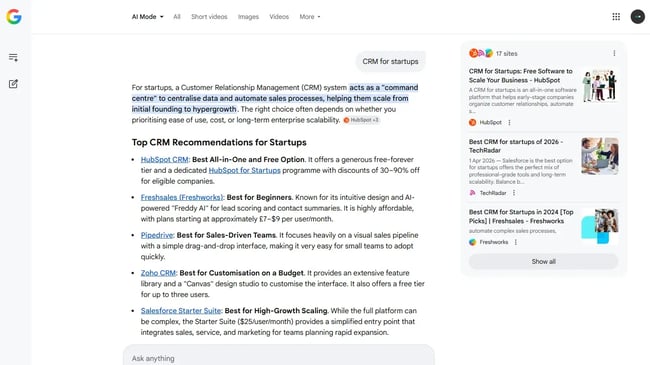
These AI-powered search features cause zero-click searches because users are fulfilled by the AI result and no longer need to click a website. Zero-click searches reduce the share of searches that result in website visits.
As a result, marketers need to know what’s going on within answer engines as well as traditional search.
This is where tools like HubSpot AEO come in. HubSpot AEO supports the practical evaluation of answer engine visibility. It’s built specifically for this new era of AI-powered search. It analyzes how well content performs in AI-generated answers.
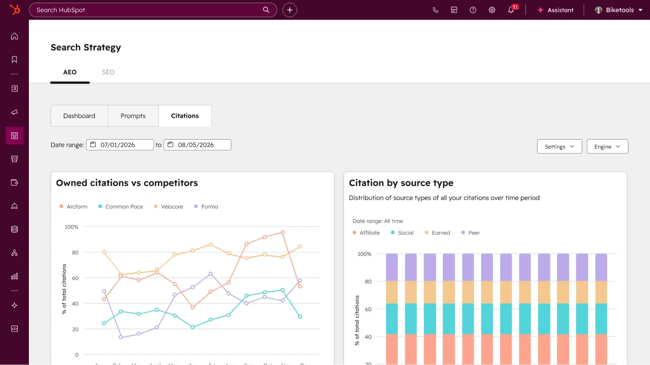
The tool splits findings between three major answer engines:
- Gemini.
- ChatGPT.
- Perplexity.
As Google continues to reshape the search experience around AI, optimizing for traditional SEO alone is no longer enough.
What This Means for SEO Today
Strategies are evolving into optimization for both traditional search and answer engines. The SEO AI impact on brands is clear: a single-channel SEO strategy is no longer enough.
SEO in 2026 and beyond means building visibility across traditional search engines — like Google and LLMs like ChatGPT, Perplexity, and other answer engines.
It means understanding the differences between AEO and SEO.
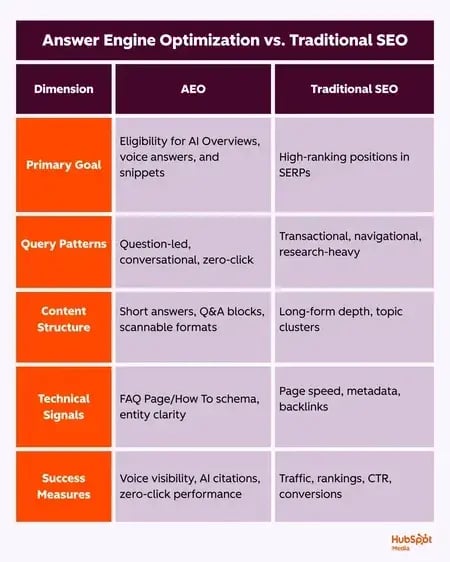
What the SEO Experts Say
Daniel Foley Carter is a highly respected SEO expert with over 26 years of experience across all areas of the industry. He’s the director at the digital agency Assertive, as well as the director of SEO Audits, known for its in-depth audits that go beyond SEO to include metrics like user engagement. He also leads SEO Stack, a tool designed to enhance the power of Google Search Console.
When asked about the future of search marketing and AI, Foley Carter says, “With the advent of machine learning and AI, we’re seeing faster and more impactful progression in the SEO space.”
Foley Carter explains that Google’s stranglehold on the search market and the fact that it has the largest index of documents on the planet, it’s primed to lead progress in search. We know that competing engines such as ChatGPT and BING have pushed forward Google’s integration of AI into search.
As search becomes more conversational, Foley Carter notes, the way people interact with information is already starting to shift—something we’re seeing with tools like Google’s AI Overviews (AIOs) and emerging conversational search features.
With both technology and user behavior evolving, the strategies behind search optimization will need to adapt as well. SEO as a skill has shifted to optimize for LLMs, too. It’s no longer just about ranking well in traditional search. It’s about showing up in AI-generated results and being seen as a credible, high-quality source.
“With LLMs growing, we’re going to see a paradigm shift in a lot of industries, but, fundamentally, end users’ needs need to be met with good quality results, whether they are AIOs or traditional search results,” Foley Carter says. “Subsequently, being present in both is going to be crucial to maintain traffic and to drive conversions/revenue.”
While this may sound like a steep change, he ensures that SEO will continue to incorporate the fundamentals for crawlers. However, the field will also rely more heavily on trust signals and content types more likely to be used in AIO generation or citing.
My take: All this said, the fundamentals of search haven’t changed as much as it sometimes feels. Strong E-E-A-T signals, high-quality content, and clean technical SEO remain the foundation for both traditional search rankings and AI citations.
HubSpot Marketing Hub is already reshaping the relationship between SEO and AEO.
AEO is embedded directly into Marketing Hub Pro and Enterprise. Marketers can move from identifying a gap to publishing a solution in the same workflow. If the data shows that a website isn’t being cited for a high-intent query, then content teams can immediately create the content needed to compete without leaving the environment where the insight originated.
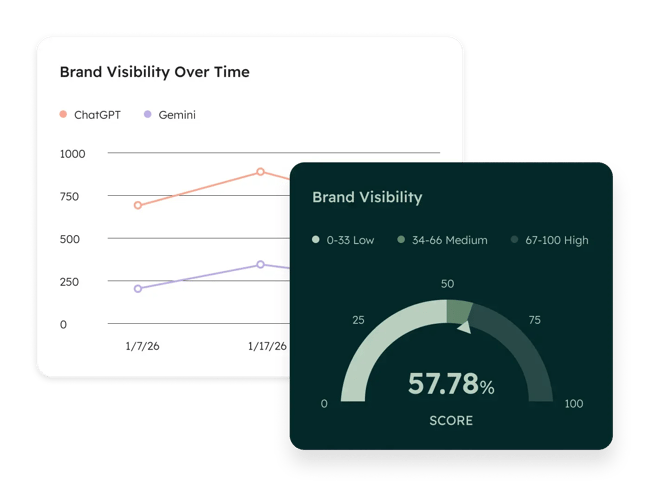
Because Marketing Hub is part of the HubSpot ecosystem, its AEO insights are informed by CRM data. That means tracked prompts, recommendations, and content created are all grounded in actual audience, product, and pipeline insights (not generic industry assumptions). Over time, that context sharpens AI outputs and marketing strategies.
AI causes concerns about trust and accuracy.
The rapid growth of answer engines comes with a significant caveat that every marketer needs to understand: AI systems hallucinate, and they do so confidently.
For those who don’t know, ‘hallucination’ refers to irrelevant, false, and/or inconsistent content generated from LLMs. Naturally, it reduces trust and, if unnoticed, could be catastrophic for businesses. Hallucinations can:
- Add false information into decision-making. If an AI confidently generates incorrect data (e.g., market stats, product specs, or legal details), teams may act on it as if it were fact. That can lead to flawed strategies, misinformed investments, or poor business decisions.
- Damage brand credibility. AI tools have conflated different brands and show defamatory content or reviews about the wrong business.
- Create compliance and legal risks. In regulated industries (finance, healthcare, legal), hallucinated information could cause misleading claims, incorrect advice, or breaches of compliance, potentially leading to fines or liability.
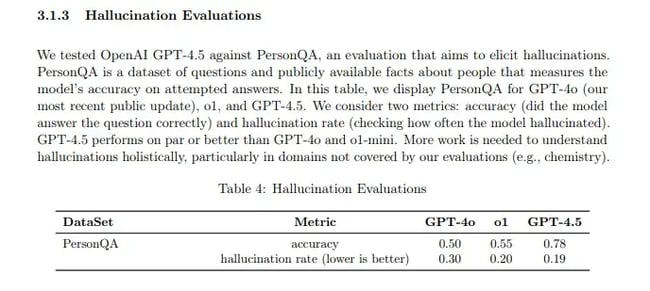
Hallucinations remain an unsolved challenge. In OpenAI’s PersonQA benchmark (designed to trigger false answers), GPT-4.5 performs on par with or slightly better than earlier models like GPT-4o. However, hallucinations still occur at a rate of 0.19.
Here’s a snippet from the report:
Mark Williams-Cook notes that hallucinations are a problem within answer engines. He says, “While LLMs can be useful, the danger is that the public at large has no idea how these tools are working, and we’ve been trained at large to ‘trust’ Google and others as a brand for many years. When we hear ‘AI’, a lot of people will automatically think it is something ‘intelligent’, rather than a very fancy predictive text.”
According to Williams-Cook, the byproduct of generating likely text so confidently is that it sounds so believable. Studies have shown that not only are LLMs wrong a staggering amount of the time, but they are confidently wrong.
The takeaway from SEO and AEO specialists? It’s very easy to publish falsities using AI. So, marketers (and everyone) must review every word of AI-generated content.
Marketers can work in collaboration with AI using tools like Breeze AI inside HubSpot Marketing Hub. Working in collaboration means that AI content feels less like a content-generating tool and more like a co-creation or enhancement layer.
Instead of prompting a disconnected AI tool and hoping for the best, Breeze operates inside the same environment where your content, campaigns, and customer data already live. That context changes everything and enhances output.
When generating a blog post, social campaign, or email, its output is informed by the brand’s CRM, existing assets, brand voice, audience segments, and more. The result isn’t just faster output, but an output that’s grounded in the business and its truth.
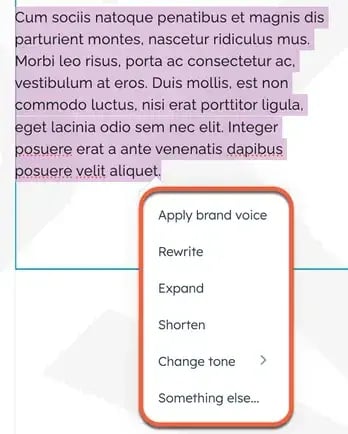
Plus, with Breeze AI, human writers and editors can work with the AI in real-time, refining and editing as they go. With this, editors spot and remove hallucinations and falsities immediately. Editors can sense-check outputs against data, existing content, and trusted sources, all in one place.
By combining AI-assisted creation with real-time human oversight, it allows marketers to move quickly without sacrificing credibility. Rather than outsourcing thinking to AI, it’s just accelerating workflows, while staying close enough to catch errors, sharpen insights, and ensure published content is genuinely worth citing.
How to Adapt Your SEO Strategy for an AI-Powered Future
The good news about answer engines is that the most effective AEO strategies build on SEO fundamentals already in place. What scales are high-impact areas of focus? Here are some ways SEO teams can future-proof their SEO strategies.
Structure Content for AI Understanding
The way your content is written and organized directly affects whether AI models can understand, trust, and cite it. The goal with writing for AI is to fulfill audience searches while writing for algorithms. It’s also important to ensure content reads well on the page and that sites maintain an excellent user experience (UX), designed for humans first.
This guide on UX in the future of SEO is worth reading.
Here are some key focus areas to ensure AI can cite your content.
Content must be available in a site’s HTML.
AI crawlers “understand” HTML, so any content that should be cited in AI must be visible in the HTML of a website. This is generally best practice anyway, but occasionally, content that’s visible on a page is unavailable to AI crawlers because it renders through JavaScript. Unlike AI crawlers, Google crawlers render JavaScript.
Implement structured data.
Schema markup is written directly into your page’s HTML, which is exactly what makes it so powerful for AI. Because schema lives in the page’s code, AI systems can find and cite it, just like your on-page content.
Structured data also helps search engines and AI systems interpret page meaning. Anything declared in schema, such as organization name, the company address, opening hours, author credentials, a product’s price and availability, an FAQ answer, is available to be surfaced by an AI system.
Studies confirm that pages with good structured data are more likely to be featured in AI Overviews. A controlled experiment by Molly Nogami and Ben Tannenbaum found that schema quality influenced visibility in AI Overviews. Three near-identical pages were tested:
- One with well-implemented schema.
- One with poor schema.
- One with none.
The results? The page with high-quality, properly structured schema appeared in an AI Overview and achieved the strongest organic rankings. Read the full study here.
Lead with the answer.
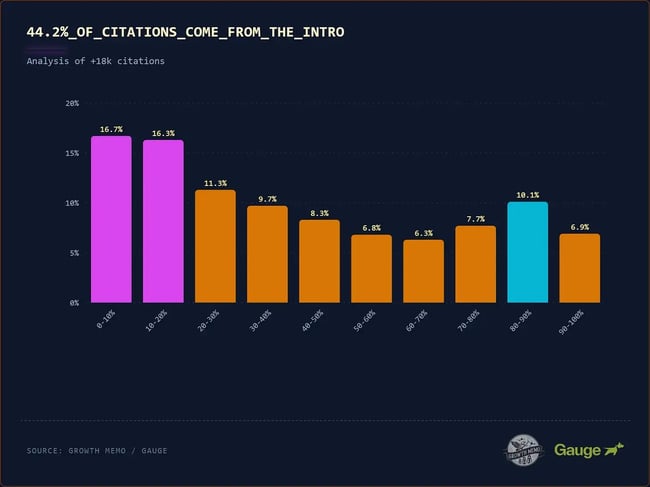
AI systems heavily favor content that states its key point upfront. Research shows that 44.2% of all LLM citations come from the first 30% of a piece of text.
Content writers should open each section with a direct one-to-two sentence answer before expanding into detail. Think of it as writing for both the skimmer and the deep reader simultaneously.
Even better? Get key details as high up your content as possible, even into the intro if possible.
Be explicit about entities.
AI models build understanding through named entities such as people, organizations, places, products, and concepts. Name things clearly and consistently throughout your content. If you’re referencing your brand, a product, or an expert, use the same name every time rather than relying on pronouns or vague references.
Use clear, scannable formatting and semantic HTML.
Structured content consistently outperforms dense prose, even for human writers. Clear heading hierarchies (and semantic HTML, such as H1, H2, H3), bullet points, numbered lists, comparison tables, and FAQ sections all perform well in AI-generated results. Semantic HTML improves content clarity for both users and machines.
Pro Tip: Avoid using headings for styling alone, as these headings provide structure to your content for crawlers.
Stay human.
Thinking about SEO and AEO strategy is important, but it’s even more important not to forget the human elements that contribute to content quality.
As AI-generated content floods the web, human-written, human-reviewed content is becoming more valuable, not less, and the evidence is already showing up in how Google ranks and attempts to reward helpful content, which the documentation describes as “reliable information that’s created to benefit people, and not content that’s created to manipulate search engine rankings.”
Yannick Van Noy, founder and CEO of Alpha Strategy & Marketing, has a great story to illustrate the importance of human-written content in an AI world. Van Noy and his team had an article to edit. The article was already ranking on page one, rank one, but they wanted to keep the article updated. The team turned to AI to research the topic, but of course, with their article ranking page one, rank one, all the AI could do was regurgitate his own article back at them.
The AI didn’t have new data to add anything insightful. The topic was already covered, so new insights needed to be added by a human.
Van Noy says, “If anything, blogs, news articles, and how-to guides remain a foundation for AI responses. The future will be about knowing which tool fits the job: AI for context-heavy, layered questions, and search engines for everything that’s already been well-documented and indexed,” he explained.
HubSpot’s Senior Director of Global Growth Aja Frost goes further, arguing that the type of content that performs best is already changing: Google is prioritizing first-person, credible, personality-driven content in direct response to the flood of low-value AI output.
HubSpot blogger Erica Santiago is already living this shift.
“For years, most companies I wrote for required me to write in their brand‘s voice,” HubSpot Blogger Erica Santiago recalls. “I never had to dive into my own experiences or pepper in my own sense of humor. It was all very clinical, detached. And that was the tone of most branded listicles and articles I’d find in my own search results as well.”
But she says she’s already seeing and experiencing a shift as AI gains more traction in SERPs.
“I wrote an article recently for HubSpot about email marketing trends, and I ended up citing marketing emails in my own personal inbox to ensure I was writing perspective-driven content that AI couldn’t emulate,” she says.
Santiago explains, “Now, when I read branded content, I notice writers are citing their own unique experiences and injecting their personality as well.”
Frost also told me that she no longer distinguishes between SEO and editorial. For a post to rank, it needs to meet certain criteria for both.
She says, “That means looking at every piece of content and asking, ‘How do we make this a really unique, compelling piece of content that you can’t find anywhere else on the web?’ And ‘how can we ensure it‘s written by someone who has unique expertise on the topic?’”
Expand your digital footprint.
When it comes to answer engines, a wider presence across the web earns citations in AI-generated answers. Here’s an example of HubSpot appearing within an AI recommendation, sometimes with its own brand and content, but alongside third-party credibility:
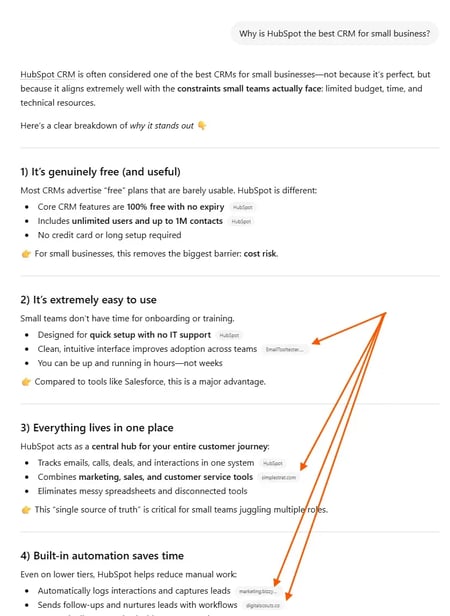
Your website alone is not enough, and it wasn’t enough for traditional SEO. PR and third-party credibility are incredibly important. For Google and traditional search engines, third-party credibility and PR resulted in backlinks and, therefore, increased authority. With AI systems, third-party credibility helps because the system creates responses about a brand based on everything they can find across the entire web.
To expand a brand’s digital presence:
- Write for publications beyond your own blog. Guest articles, contributed pieces, and expert commentary in industry publications all build the kind of third-party mentions that AI systems treat as credibility signals.
- Collaborate with influencers, especially those who create long-form content. A podcast appearance or a YouTube feature generates indexed, citable content that associates your brand with your area of expertise.
- Appear on lists, directories, and in roundups. Being named in “best of” lists, industry directories, and expert roundups gives AI systems multiple independent data points that reinforce who a company is and what it does.
- Conduct original research and make your site the primary source for new data. This is one of the highest-value activities a brand can invest in. Original data attracts backlinks, press mentions, and citations — from both humans and AI systems — because it gives everyone else something to reference.
- Double down on podcasts, newsletters, and social media. These channels build audience relationships that don’t depend on search algorithms, while simultaneously generating content that can be indexed and cited.
- Record videos and make sure transcripts are available. Transcripts make video content indexable and citable. If your elevator pitch or key brand message lives only in a video with no transcript, AI systems can’t easily surface it.
Optimize for Multiple Discovery Channels
Being found on Google is no longer the whole game. Your audience is searching on TikTok, asking ChatGPT, using voice assistants, and discovering brands through Instagram before they ever open a browser tab.
A modern SEO strategy needs to account for all of it. Social search is already reshaping discovery.
HubSpot’s Erica Santiago has seen this shift first-hand: “I don’t Google things nearly as much as even just a year ago. Just the other day, I looked up ‘Best platform sandals for the summer’ on TikTok and found so many new brands I ended up following. I even bought a pair directly from one brand’s Instagram.”
For marketers optimizing for social search, three tactics make the biggest difference:
- Include relevant keywords and hashtags in your posts and in your bio.
- Make your username simple and easy to search for.
- Create content that links back to your website, so discovery on social translates to owned traffic.
HubSpot’s Aja Frost sees this channel shift as a strategic imperative, not a nice-to-have: “At HubSpot, we are dramatically increasing our investment in other types of media, like video, podcasts, newsletters, and types of media that will be far less affected by the changes in search happening on Google.”
Voice search deserves dedicated attention. Voice search and visual search expand the scope of optimization beyond text-based queries.
According to DataReportal, 30% of internet users aged 16-64 worldwide use voice assistants each week. What’s more, 45% of Americans report using voice search on their smartphones.
Voice queries are conversational and question-led, which means your content needs to match that register. Practically, that means:
- Targeting long-tail, question-based keywords using “how,” “what,” “where,” and “why.”
- Optimizing for featured snippets, which voice assistants frequently pull answers from.
- Ensuring your site is fast and mobile-optimized, since most voice searches happen on mobile devices.
My take on voice queries: Voice SEO hasn’t taken off as much as anticipated based on predictions for it over the last decade or so. I believe voice search will still have its day, and significantly so.
From experience, I think voice search is still used for shorter requests, but voice assistants like Gemini, available on mobile phones, smart homes, and Alexa devices, will have a significant impact on voice search adoption for more complex queries over the next few years. As AI tools mature and perform better with natural language processing, I think voice search will become more widely adopted.
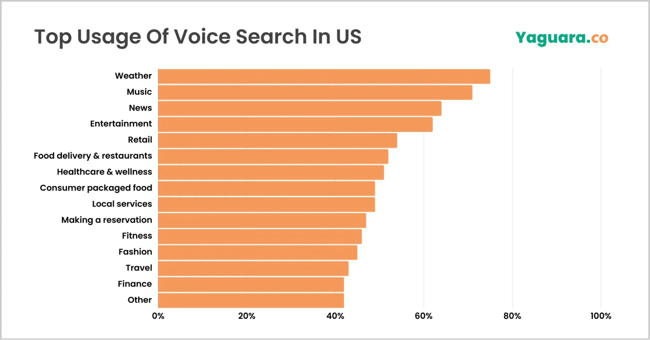
Data from Yaguara.co finds that voice search is most popular for searching for weather, music, and news.
Answer engines like ChatGPT and Perplexity are now discovery channels in their own right. As we covered earlier, answer engine users convert at significantly higher rates than traditional organic visitors, making visibility commercially meaningful, not just a vanity metric.
Of course, marketers can also leverage AI to improve AI visibility. Kyle Byers, director of organic search at Semrush, told me there are innumerable ways marketers can leverage AI.
As he puts it, “AI is incredibly powerful and flexible in what it can help marketers accomplish—from purpose-built tools like our own ContentShake (AI content generator app) and SEO Writing Assistant to general chat-based interfaces like ChatGPT, Bing Chat, and Google’s Gemini.”
AI can also help marketers optimize their websites. Here are some of the ways Byers suggests marketers leverage AI for web optimization:
- Conversion copywriting. (“Act as a tech-savvy small business owner who is shopping for accounting software. Grade the following landing page headlines on a scale of 1 to 10 based on how likely they are to make you want to try or purchase my product, then draft five new headline ideas that would be more compelling.”)
- Rephrasing content. For example, simplifying a long paragraph or sentence to meet an 8th-grade reading level. Or rewriting content to make it more unique, to strike a different tone, or to follow your brand’s style guide.
- Getting “unstuck” with content writing. (“Help me finish the following paragraph.”)
- Brainstorming additional angles to add to your content. (“Act as a sales manager who wants to develop an internal training program to improve your team’s sales skills. What important subtopics or angles are missing from the following content, which you would want to learn more about?”)
- Quickly drafting a list of 10 possible title tags and meta descriptions for a given webpage.
- Generating Schema markup. (“Generate FAQPage Schema markup for the following FAQs.”)
- Generating tags for different languages/locations.
- Translating content from one language to another.
- Generating regular expressions (for example, using Google Search Console or Google Analytics).
- Generating new robots.txt rules will also help understand existing robots.txt rules.
He adds, “AI tools can be amazingly powerful if used correctly. Just keep in mind that they’re just that: tools. Use them to leverage your expertise—not to replace it.”
Continue building trust.
Marketers can never expect to generate the right leads and close deals unless there’s an abundance of trust. Online, trust is somewhat measurable with E-E-A-T.
I spoke with Katie Morton, Search Engine Journal’s senior managing growth editor, to learn her tips for increasing trustworthiness.
She told me, “Since Experience, Expertise, and Authoritativeness support Trust, it’s best to look at the whole of the E-E-A-T concept rather than focusing on any single aspect of the acronym.”
That said, Morton points out that Google’s Search Quality Rater Guidelines specifically call out the following three points to increase Trust:
- E-commerce sites with secure online payment systems and reliable customer service.
- Honest product reviews meant to inform rather than solely to drive purchases.
- Accurate content about Your Money or Your Life (YMYL) topics to prevent harm.
For companies looking to increase trustworthiness, it’s important to address all aspects of E-E-A-T. Here are her suggestions.
Expert Authors
Source content from authors with direct experience, a depth of knowledge, and expertise in the topic they are writing about. Anyone could Google a subject and write an article about it, but if the writer isn’t a subject matter expert, this doesn’t establish E-E-A-T.
Having recognized experts and authorities in your industry as authors on your site can boost the credibility of your website and brand. On your website, provide bios of your authors and content creators that include their expertise, experience, and credentials.
Here’s what the HubSpot bio page looks like:

Accurate Content from Trusted Sources
Publish truthful and well-researched content that cites credible sources. Support claims via the experience and expertise of the author’s first-hand knowledge, with research and statistics from trustworthy sources, or both.
Originality and Value
Ensure that your content is original, substantial, comprehensive, and provides valuable insights. Content that provides value to users is more likely to be shared. When a piece of content gets positive attention through shares and backlinks, it can lend a sense of authority when your content is cited as a trusted source.
Morton adds, “It takes a lot of effort to create content that establishes E-E-A-T, but the results are well worth it. If you follow these suggestions, you will also create Helpful Content, which Google strongly encourages.”
This can help serve both your business and your audience while establishing a positive brand reputation.
Track new metrics.
SEO has always evolved, and an evolving marketing strategy means that marketers must track metrics that represent the current search landscape. With the rise of AI, measurement shifts from traffic volume alone because impressions and click-through rates only tell part of the story.
Robust marketing reports now need visibility into how often a brand appears in AI-generated answers, how much traffic those appearances drive, and whether that traffic converts.
AI referral traffic is a natural starting point. Referral traffic is also a highly meaningful metric for any business because it shows actual traffic to the site from AI sources and not just visibility, though tracking visibility is important, too.
Begin tracking your AI-driven traffic right now using Kyle Rushton McGregor’s Looker Studio AI traffic tracker, which breaks down how much of your inbound traffic originates from AI tools like ChatGPT, Perplexity, and Google’s AI Mode. Setting this up early offers baseline data to benchmark against as answer engine adoption continues to grow.
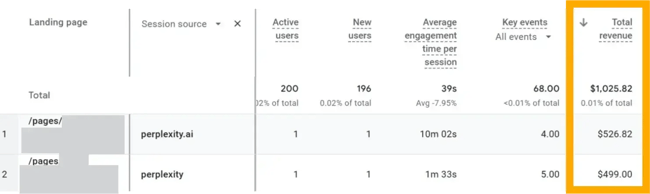
Beyond traffic, track assisted conversions, sales, or sign-ups from users who landed on a page via an AI tool. The landing page report below illustrates exactly this: showing the page the user arrived on, the session source, and the total revenue generated. This kind of attribution makes it possible to tie answer engine presence directly to business outcomes.
For a broader view of your presence, HubSpot AEO Grader shows how large language models perceive and represent your brand across answer engines. It returns a visibility score, sentiment analysis, competitive positioning, and recommendations — giving you a clear baseline for where your brand stands today.
Together, these tools provide the measurement framework to treat AI visibility not as an afterthought, but as a core part of your reporting.
Frequently Asked Questions About the Future of SEO
Will SEO exist in 5 years?
Yes. SEO will likely exist in five years, but it will look different. As AI reshapes how search engines surface and synthesize information, SEO is evolving to encompass visibility across AI-generated answers, not just traditional blue links.
Is SEO going to be replaced by AI?
No. AI is changing SEO, not replacing it. AI tools are being used to automate parts of the process, but human strategy, brand authority, and expert content are more important than ever. In fact, as AI Overviews and AI Mode pull answers from trusted sources, the brands that have invested in strong SEO foundations are the ones being cited.
What Is the 80/20 Rule for SEO?
The 80/20 rule in SEO means that 20% of your efforts will drive 80% of your results. In today’s landscape, that 20% increasingly points to expert-led content, domain authority, and technical accuracy—the three signals that both traditional search engines and AI models rely on most when deciding what to surface and cite. Focus there first.
The Next Evolution of SEO
From speaking with experts, one thing is clear: AI is here to stay, and with it comes a new dawn of SEO.
The reality, though, is that this shift may not be as scary as it seems. Good SEO is what keeps LLMs updated, and people are still using Google significantly more than any other search channel. The fundamentals—expertise, trust, and quality content—haven’t been replaced.
What has changed is the value of visibility across channels, spanning traditional search rankings, AI Overviews, AI Mode, and LLM citations. Keeping track of and acting on it is where the right tools make the difference.
Get started with integrated tools like HubSpot’s Marketing Hub and Content Hub. HubSpot Content Hub and Marketing Hub help teams optimize content in one connected system. Marketers move from spotting a visibility gap to publishing content that fills it — all in one place. And with HubSpot AEO, see exactly how LLMs are representing your brand right now and where to focus next.
As a content creator long-trained in the art of writing for SEO, I’m personally energized by this search evolution. It will require businesses to recalibrate and put innovative, human-first perspectives ahead of rote, cut-and-dry content.
Editor’s note: This post was originally published in January 2023 and has been updated for comprehensiveness.
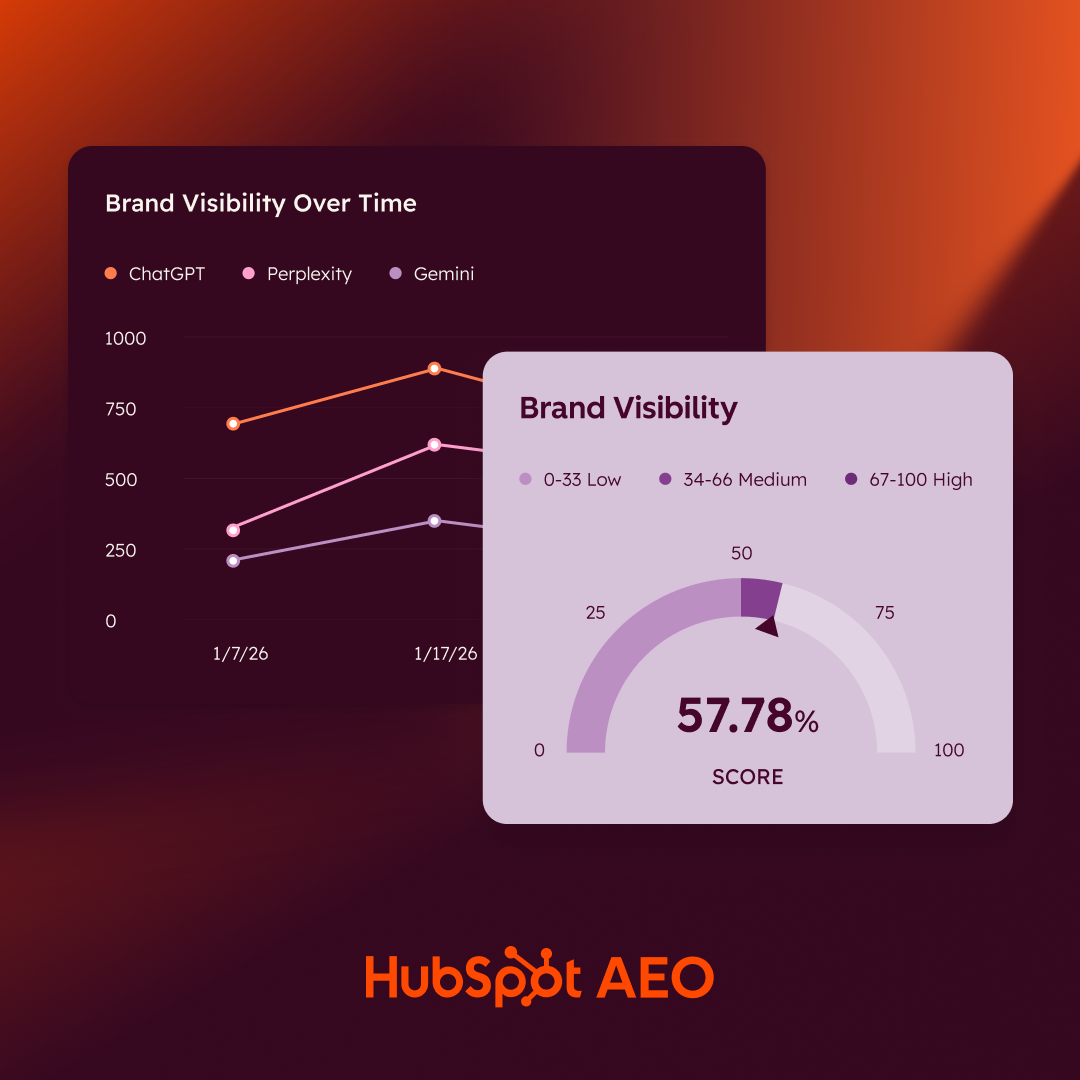
HubSpot AEO Tool
See exactly where your brand shows up in answer engines and take action to close AI visibility gaps.
- Track AI mentions.
- Analyze citations
- Monitor prompts
- Benchmark competitors
Aeo
![How HubSpot became the #1 CRM in AI search [A case study]](https://53.fs1.hubspotusercontent-na1.net/hubfs/53/How-HubSpot-became-the-%231-CRM-in-AI-search.png)