.png?width=112&height=112&name=Image%20Hackathon%20%E2%80%93%20Horizontal%20(45).png)
Sales excellence has never been harder to achieve. Only 28% of sales reps hit their annual quota in 2024 — the lowest figure in six years, according to Salesforce’s State of Sales report.
Across nearly 18 years of selling and advising teams — from IBM to early-stage tech companies — I have watched the same pattern repeat. Organizations that treat sales excellence as a culture problem outperform those that treat it as a quota problem.

This post breaks down what sales excellence looks like in 2026, how to measure it without falling back on vanity metrics, and the operating system that gets a sales org from “hitting quota sometimes” to “going above it.” Experts from G2, Northpass, impact.com, and Articulate Marketing share their tips.
Table of Contents
- What is sales excellence?
- How should you determine sales excellence?
- Sales Excellence Examples
- How to Measure Sales Excellence
- How to Achieve Sales Excellence
- Frequently Asked Questions About Sales Excellence
- Building Sales Excellence That Lasts
What is sales excellence?
Sales excellence is the consistent ability for teams to meet and exceed growth targets while delivering a buying experience customers want to repeat. The term describes both an outcome (predictable revenue) and a discipline (the repeatable behaviors that produce it).
Sales excellence has two layers. The quantitative layer covers revenue, quota attainment, and pipeline efficiency. The qualitative layer focuses on how reps and buyers feel throughout the process. Teams that focus on only one tend to plateau quickly.
.png)
Sales Performance Review Template
Evaluate your reps' performance to goal, quarterly improvement, and areas of improvement to focus on.
- A metric-based template for tracking achievement to goal for revenue, deals, etc.
- A manager-evaluation and self-evaluation for essential soft skills on the job.
- An action items section to outline areas of improvement for each quarter.
Download Free
All fields are required.
Form not available
Achieving sales excellence comes down to three factors:
- The first is a precise understanding of the target customer.
- The second is a sales team trained to meet that customer’s standards.
- The third is a leadership system that rewards the right behaviors — not just the right numbers.

How should you determine sales excellence?
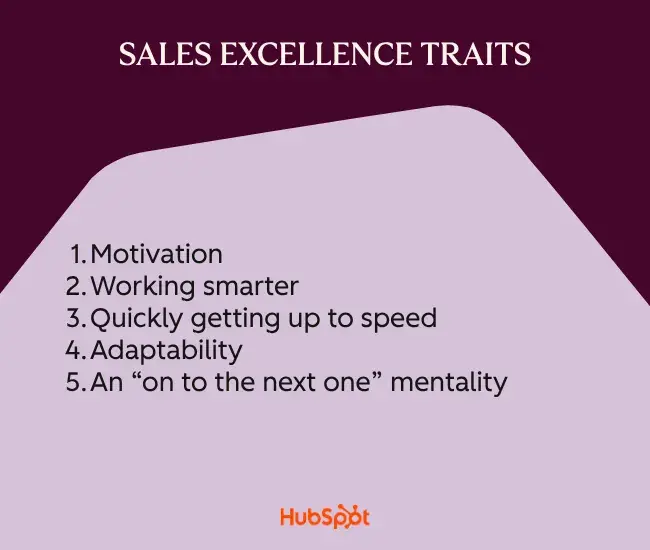
Determining sales excellence requires looking past raw quota attainment. Instead, managers should evaluate reps against five durable traits that show up across industries:
- Motivation.
- Working smarter.
- Quickly getting up to Speed.
- Adaptability.
- An “on to the next one” mentality.
1. Motivation
Motivation is the driving force behind sales excellence. Excellent salespeople are ambitious and dedicated. Reps book the extra meeting, work the prospect that everyone else has written off, and treat ownership of their numbers as non-negotiable. Without motivation, every other component of excellence breaks down.
Motivation is also what separates reps who use process as a crutch from reps who use process as a multiplier. The best ones take initiative on outreach, follow-up, and self-improvement without waiting to be told.
In my own career, the reps I have seen reach the top consistently were never the ones with the cleanest demos or the most polished decks. They were the ones who chose to make one more dial when the day was already over. Motivation, in my experience, is the single trait that I would hire for.
2. Working Smarter
Motivation needs to be applied effectively, or it burns out. Excellent reps know how to manage their time, selectively apply effort to the highest-leverage activities, and walk away from prospects that will never close. Working smarter is the discipline of saying no to low-probability deals.
Practically, this shows up as reps who structure their day around energy. That means prospecting in the morning when focus is sharpest, deal work in the afternoon, and admin batched into one window so the CRM stays current.
Excellent sales reps:
- Know how to manage their time.
- Selectively apply their effort to the highest-leverage activities.
- Strategically structure their day around the rhythm of buyers.
- Understand when a deal is not worth the effort.
- Push to maximize their time and effort, not just their output.
Pro tip: Reps using Sales can use AI to work more efficiently. Prospecting agent makes research faster, allowing teams to automate pre-call prep.
3. Quickly Getting Up to Speed
True sales excellence shows up at every point in a rep’s career — including the first 90 days. One of the clearest signals of an excellent new hire is how quickly they ramp up from onboarding to a full workload, without needing the manager to hand-hold every deal.
A fast ramp spares the company time, training cost, and missed-quarter risk. Sales leaders can evaluate a new rep’s excellence by asking the following diagnostic questions:
- How long did it take for them to learn the ropes?
- Did they take the initiative to learn the ins and outs of the product on their own?
- Could leadership be hands-off and still expect them to figure out the sales process?
Personally, I have built ramp programs that compressed time-to-first-deal from six months to under ten weeks by replacing static onboarding decks with shadowed live calls and a written playbook of objections. The reps who closed inside that window were almost always the ones promoted within a year.
4. Adaptability
Excellent sales reps never assume last year’s playbook will work this quarter. They test new messaging, adapt to market shifts, and treat their craft as a living system.
Not every experiment lands. Adaptable reps stay current with new strategies. They test AI-assisted research, multi-threaded discovery, and asynchronous follow-up. Falling behind buyer behavior costs more than trying something that flops.
5. An ‘On to the Next One’ Mentality
Excellent reps are not afraid to fail. They take rejection on the chin, treat every botched call as a data point, and refuse to sulk into a slow week. When a deal collapses, they analyze the loss, identify where it went sideways, and design a behavior change before the next pipeline review. Specifically, excellent reps:
- Analyze their performance with objective evidence (call recordings, deal notes, CRM trails).
- Try to identify where the deal actually broke down.
- Do everything in their power to avoid making the same mistake twice.
When the same issue keeps surfacing, an excellent rep does not keep it private. Excellent salespeople escalate to a manager, a peer, or a sales enablement lead and ask for help fast — because reputation in sales is built over years and burned over quarters.
To better understand what sales excellence means, let’s look at some examples.
Sales Excellence Examples
Sales excellence shows up in the small, observable behaviors that compound across a quarter. The list below captures the most reliable indicators that a rep — or an entire team — is operating at an excellent level.
- An excellent sales rep meets revenue targets quickly and consistently across multiple quarters.
- An excellent sales rep ramps to a full workload after a short onboarding window.
- An excellent rep follows up on high-quality leads within agreed-upon SLAs, even when the calendar is full.
- An excellent rep is prepared and diligent in every customer interaction, with research that goes beyond surface-level firmographics.
- An excellent rep is coachable, accepts constructive feedback without ego, and turns coaching notes into measurable behavior change.
- An excellent rep is committed to honing their technique and remains open to changes in the buyer journey or the tech stack.
- An excellent rep advocates for the customer internally and protects the long-term relationship over the short-term win.
Beyond raw quantitative metrics, these examples help sales leaders identify the qualitative bar they want every rep to hit.
Sales Performance Review Template
Evaluate your reps' performance to goal, quarterly improvement, and areas of improvement to focus on.
- A metric-based template for tracking achievement to goal for revenue, deals, etc.
- A manager-evaluation and self-evaluation for essential soft skills on the job.
- An action items section to outline areas of improvement for each quarter.
Download Free
All fields are required.
Form not available
How to Measure Sales Excellence
Measuring sales excellence requires three categories of metrics: performance, productivity, and proficiency, plus a layer of qualitative measurement that captures the behaviors numbers cannot.
Each category answers a different question about whether reps are producing revenue Mike Head, former chief revenue officer of impact.com, recommends narrowing focus to a small number of core sales metrics that actually predict performance. Reviewing those metrics regularly reveals which reps are performing best and whether the organization as a whole is achieving sales excellence.
Focus on “talk ratios, question rates, and consistent top-of-funnel activity levels,” Head suggests. “If you’re best in class on those metrics, you’re always at the top of the leaderboard.”
Some qualities of sales excellence resist easy measurement. Those traits include “curiosity, coachability, and discipline,” Head says. However, the behaviors can be developed by “listening to your calls, practicing your pitches, and constantly refining your skills.”
Pro tip: Sales Hub dashboards allow managers to pull together reports to see how their team is performing. When performance dips, leaders can make adjustments.
Sales Performance
Sales performance metrics measure whether reps are meeting the revenue targets set by the business. These are the outcome-level numbers that the CFO, board, and head of revenue care about — and they should sit at the top of any sales excellence scorecard.
Key sales performance metrics to track:
- Total revenue against quarterly and annual quota.
- Average customer lifetime value (CLV).
- Customer acquisition cost (CAC).
- Year-over-year growth, broken down by segment and channel.
- Percentage of sales reps attaining 100% of quota.
These metrics together show whether the team is hitting its objectives — and where the distribution of performance is concentrated. A team where the top three reps carry 70% of the number is not the same team as one where ten reps are clustered around quota, even if total revenue is identical.
Sales Productivity
Sales productivity metrics tell sales leaders how efficiently reps are converting time into pipeline and revenue. They sit between activity (raw effort) and performance (closed revenue), revealing the leverage points where small changes can make a big difference.
According to Salesforce’s most recent State of Sales report, reps spend roughly 30% of their week on actual selling activities. This means roughly 70% of each workweek is spent on administrative tasks, internal meetings, and manual CRM updates. Measuring how that 70% is spent is where productivity gains live.
Sales productivity metrics worth tracking include:
- Percentage of time spent on selling activities versus admin.
- Number of sales tools used daily (and how many are actually adopted).
- Percentage of high-quality leads followed up with inside SLA.
- Average response time to inbound and outbound replies.
- Pipeline coverage ratio per rep.
Tracking productivity at the rep level helps distinguish between reps who are working hard and those who are working effectively. The two are not the same.
Sales Proficiency
Sales proficiency metrics measure how skillfully a team closes deals. These metrics highlight where reps need coaching, where the playbook is breaking down, and where ramp programs are failing to do their job.
Key sales proficiency metrics include:
- Time to quota attainment.
- Time to first deal.
- Time spent in sales onboarding sessions.
- Time to ramp to full quota.
- Time to productivity for new hires.
Context matters here. Only 28% of sales reps hit annual quota in 2024, according to Salesforce — and 91% of organizations missed quota expectations that same year, per QuotaPath research. A meaningful portion of that gap is a proficiency problem, not a motivation problem. Reps are not receiving sufficient reinforcement to retain what they learn: research on the forgetting curve shows that up to 79% of sales training content is forgotten within 30 days and 84-90% within 90 days.
Mike Buscemi, director of SMB at G2, says his organization invests heavily in its people’s growth to improve sales proficiency.
“We discuss career aspirations and drivers on a quarterly basis, so we can help everyone achieve their goals,” Buscemi says. “We celebrate the small wins such as booking a meeting, helping a teammate on a call, and sharing great messaging or decks.”
In my consulting practice, I have seen proficiency improve fastest when companies do weekly micro-coaching, monthly skill drills, and quarterly recertifications. The training event is dead. Continuous training is what separates teams that hit quota from teams that don’t.
Qualitative Metrics
Qualitative metrics capture the parts of sales excellence that numbers cannot. They include preparation depth, cross-functional collaboration, customer-advocacy behavior, and the ability to navigate ambiguity. These metrics are slower to measure but more predictive of long-term performance.
As Travis Nardin, the director of sales at Northpass says, it’s not just about meeting number-based goals. There are also attributes that contribute to sales excellence that managers can’t measure with numbers.
“Aside from any sales reps crushing their quotas, I believe that sales excellence can be measured qualitatively through the following: preparation, intellectual curiosity, cross-functional collaboration, and diligence,” Nardin says.
Rewarding qualitative skills — celebrating how a rep approaches the sales process or how they build strong relationships with prospects — helps the entire team aspire to sales excellence.
For example, consider preparedness.
“The best reps I’ve worked with take the time to prepare — and over-prepare, frankly. That means they thoroughly understand a prospect’s business and how the product being sold can impact a prospect’s key performance indicators (KPIs) for the better,” Nardin adds. “Without the appropriate level of preparation, conversations simply aren’t productive, since it’s hard to articulate value creation.”
How to Achieve Sales Excellence
Achieving sales excellence requires building the right combination of processes, people, and programs — and then keeping that combination current as buyer behavior and tooling evolve. The highest-leverage starting points for sales leaders are setting the culture, creating a coaching system, and building the right tech stack.

1. Create a strong sales culture.
A strong sales culture is the operating environment that makes excellent behavior the default. It is built on clearly articulated values, hiring filters aligned with those values, and weekly rituals that reinforce them. Without a strong culture, even great individual reps get stuck.
Defining the company’s mission and values is step one. Sales leaders then need to translate those values into observable behaviors — what “customer-first” actually looks like on a discovery call or what “high standards” actually looks like in a forecast meeting. The translation work is where most culture initiatives stall.
Hiring is the next leverage point. It is important to recruit reps that match the organization’s ethos. That starts with a clear rubric that helps hiring managers spot those traits.
“When we hire talent, we look for three main attributes: drive, grit, and adaptability,” Buscemi says. “These things manifest themselves through someone’s ability to do the right things when no one is looking. Behaviors can be observed in a person’s focus, their attitude when they hear no, and the ability to course-correct when things get challenging with a book of accounts.”
“Drive can easily be measured with accurate sales reporting nowadays,” he adds, “but grit and adaptability are more nuanced and show up in how the salesperson … perseveres by finding creative ways to change their approach, process, and strategy.”
Buscemi also points out that managers can watch for which employees are eager to hear best practices from their peers and are open to implementing change. Willingness to learn can help predict long-term performance.
From my own experience, the strongest sales cultures had one trait in common: Leaders modeled the behavior they wanted. If the leader prepared obsessively for QBRs, reps prepared obsessively for discovery calls. Culture, in sales, is transmitted by example far more than by deck.
2. Focus on actionable sales training and continuously coach reps.
Continuous, actionable sales training is the system that converts hired potential into sustained performance. One-time onboarding does not guarantee performance; only spaced reinforcement and weekly coaching produce lasting behavior change.
A few best practices when it comes to sales training include:
- Scheduling regular training updates to keep material fresh. Include product updates, messaging changes, and industry changes, so reps have everything they need to succeed.
- Investing in consistent coaching and one-on-one mentorship. Depending on the company, this could look like call reviews, role-play scenarios, and peer reviews.
- Building a feedback loop, where reps see their own call recordings and self-coach against a rubric before the manager weighs in.
Nardin mentors his company’s sales reps by first understanding their personal goals and work needs.
“I first encourage my teammates to identify their personal motivation that drives them to be successful,” he says.
From there, Nardin offers the following tips:
- Treat prospects to coffee to learn more about what makes them tick.
- Listen to the recordings of top performers’ calls.
- Establish meaningful relationships with key internal stakeholders.
- Structure the calendar to allow for periods of diligent, deep work.
Sales Performance Review Template
Evaluate your reps' performance to goal, quarterly improvement, and areas of improvement to focus on.
- A metric-based template for tracking achievement to goal for revenue, deals, etc.
- A manager-evaluation and self-evaluation for essential soft skills on the job.
- An action items section to outline areas of improvement for each quarter.
Download Free
All fields are required.
Form not available
3. Choose new sales technology carefully.
The right sales tech stack removes friction from the work reps already do. The wrong stack requires constant context switching and manual dashboard updates. Selecting tools should start with the workflow the team needs to support, not the feature list the vendor wants to demo.
To get started, consider building the stack around these categories:
- A customer relationship management (CRM) platform, like HubSpot, as the system of record.
- Sales enablement software, like Sales Hub, for content, playbooks, and onboarding.
- Business intelligence software for reporting and forecasting.
- Sales engagement and sequencing software for multi-channel outreach.
- Conversation intelligence and AI assistants for call analysis and CRM automation.
HubSpot Sales Hub, paired with HubSpot’s AI agents, is a CRM-native option that consolidates several of these categories into one platform.
Onboarding and training sessions should be built for every tool added, with quick-reference guides so reps can self-serve when they get stuck. Software should also reinforce sales and marketing alignment, because misalignment between the two functions is one of the most reliable drags on excellence.
“‘Two people divided by a common language.‘ It may be true of Brits and Americans, but it’s also true of sales and marketing,” says Matthew Stibbe, CEO of Articulate Marketing. “If you can find and define a common vocabulary with definitions for things like MQLs, SQLs, and clear targets and SLAs, you can measure performance more effectively across the whole funnel.”
In my advisory work, I have seen B2B teams collapse multi-vendor stacks into a single CRM-native suite and recover 8-10 hours per rep per week. The recovered hours go straight back into selling. That kind of consolidation is one of the highest-leverage moves a revenue leader can make in 2026.
It is also worth noting that the modern buying committee has grown. Gartner research from 2024 found that 74% of B2B buyer teams demonstrate unhealthy conflict during the decision process, and complex deals now involve 6 to 10 stakeholders on average. Excellent reps and the systems that support them are designed for this reality.
Frequently Asked Questions About Sales Excellence
What is sales excellence?
Sales excellence is the consistent ability of a sales team to meet and exceed growth targets, while delivering a customer experience worth repeating. Teams that focus only on the numbers tend to plateau; teams that build the underlying habits see real gains.
How do you measure sales excellence?
Sales excellence is measured across performance, productivity, and proficiency metrics, plus a qualitative layer that captures buyer sentiment. The most reliable scorecards combine leading indicators, like talk ratios and top-of-funnel activity, with lagging metrics like closed-won revenue and win rate.
What separates a good sales rep from an excellent one?
Good sales reps hit their number in good quarters. Excellent reps hit it across multiple cycles, including the bad ones. Excellent reps are motivated, work efficiently, ramp fast, and adapt. The clearest difference shows up in how each handles a loss — a good rep moves on, while an excellent rep dissects the deal, identifies the inflection point, and changes behavior before the next pipeline review.
How do you build a culture of sales excellence across a team?
Building a culture of sales excellence starts with defining values, translating them into observable behaviors, and hiring against a rubric that screens for drive and adaptability. From there, leaders need to model the behavior they want. Those habits are reinforced through weekly call reviews, public recognition, and compensation.
Building Sales Excellence That Lasts
Sales excellence is no longer optional. The teams that will win over the next two years are the ones that treat excellence as an operating system — culture, coaching, and tooling working together — rather than a slogan.
The reps who go above and beyond should be rewarded for it. The leaders who build the system that produces those reps deserve the same recognition. To start measuring rep performance against goals, download HubSpot’s free Sales Performance Review Template. Then, track your performance with Sales Hub.
Editor's note: This post was originally published in October 2020 and has been updated for comprehensiveness.
Sales Performance Review Template
Evaluate your reps' performance to goal, quarterly improvement, and areas of improvement to focus on.
- A metric-based template for tracking achievement to goal for revenue, deals, etc.
- A manager-evaluation and self-evaluation for essential soft skills on the job.
- An action items section to outline areas of improvement for each quarter.
Download Free
All fields are required.
Form not available
Sales Management




![A Field Guide to Sales Performance Evaluations [Free Template]](https://53.fs1.hubspotusercontent-na1.net/hubfs/53/saleseval%20(1).webp)