
.png?width=112&height=112&name=Image%20Hackathon%20%E2%80%93%20Vertical%20(45).png)

Let’s be honest: nobody likes paying for something before they know it’s actually worth it. That’s the whole reason the freemium model exists. As a business model, freemium lets people use a core product for free and only pay when they want more, quietly shifting the job of “convincing you it’s good” from a company’s marketing budget to the product itself. Plus, according to new data from First Page Sage, a typical SaaS free-to-paid conversion rate is 2% to 5%, with stronger performers at 8%+, further proving that moderate conversion rates don’t have to mean low revenue.

In this guide, I’ll break down how it all works — from the freemium pricing strategy behind it, to where the model fits in the customer journey, to how tactics like gamification nudge free users toward paying. I’ll also compare freemium to close cousins like the subscription business model and weigh when free versus paid access actually makes sense for your audience.
Let’s dig in.
What is the freemium model?
The freemium model is a business and pricing strategy that combines a free and a paid tier within the same product. (To define freemium simply: it’s “free” plus “premium.”)
So, when people ask what a freemium model is, the short answer is simple: it’s a product you can use for free with no end date, plus paid plans layered on top for more.
More specifically, freemium is a set of rules that determines which capabilities remain free and which sit behind a paywall. The freemium business model shows up most often in:
- SaaS and online tools
- Mobile and free-to-play games
- Streaming, media, and audio
- Cloud storage and productivity apps
You’re likely asking yourself, “Okay, this is great, but where is the freemium model often viable?” Well, it works best wherever the cost to serve one more free user is low, and the product gets more valuable as more people use it. (More on this later, by the way.)
.png)
Free Sales Pricing Strategy Calculator
Determine the best pricing strategy for your business with this free calculator and template.
- Cost-Plus Pricing
- Skimming Strategy
- Value-Based Pricing
- And More!
Download Free
All fields are required.
Form not available
Freemium Model: Key Takeaways
I’ve synthesized the most important takeaways about the freemium model below for your convenience. Take a look:
- Freemium definition: A free tier with no expiration date, plus paid upgrades for more features, usage, or support.
- How it works: Free access lowers the barrier to entry, and a slice of those users upgrade to paid.
- Biggest risk: Feature balance (give away too much and no one upgrades; give away too little, and no one signs up).
Ultimately, the main goal of a freemium acquisition model is to lower your business’s customer acquisition cost (CAC). Eliminating sign-up costs lowers the barrier to entry and reduces your spend on paid marketing and sales.
Basically, instead of buying attention, you:
- Focus on building trust and showing the value of your product to free-tier users, even with fewer features.
- Let users reach the limits of the free account and decide to invest in a premium plan for advanced access.
- Convert people who already know your value, so they aren’t taking a risk on a product they’ve never used.
Overall, this is where nurture infrastructure earns its keep, keeps free users engaged after signup, and moves them toward an upgrade. (For example, HubSpot uses Marketing Hub to attract visitors and nurture free users toward an upgrade, so the free tier isn’t just sitting idle between sign-up and conversion.)
How the Freemium Model Works
A freemium model works by attracting users with free access and converting some to paid plans.
In short, the mechanics are a journey, not a single moment. (People sign up for free, reach a value, bump into a limit, and decide an upgrade is worth paying for.)
Mapping that path is how you turn a large free base into revenue.
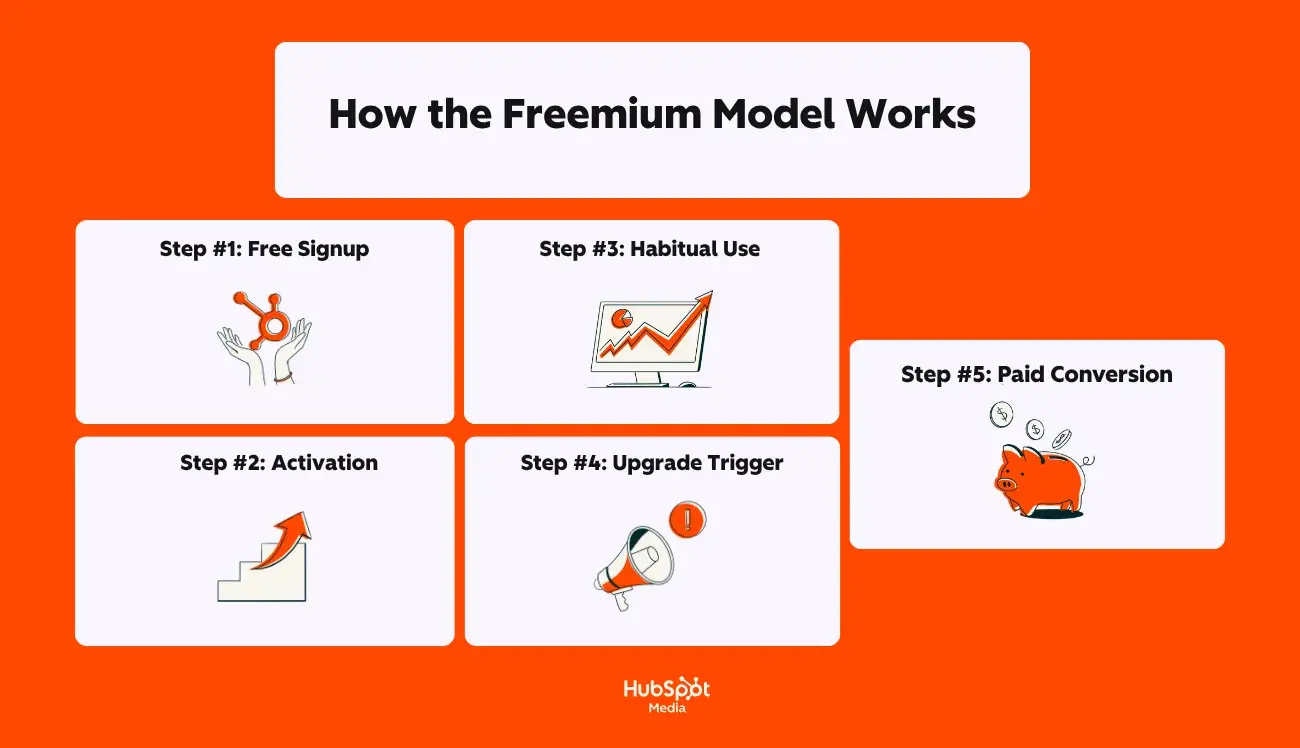
Now, with this context in mind, here’s a brief breakdown of the typical user journey from free signup to paid conversion:
- Step 1: Free signup. No payment and minimal friction, so the barrier to entry stays low.
- Step 2: Activation. The user reaches the first value (also known as the “aha” moment that proves the product works).
- Step 3: Habitual use. Regular usage builds trust and makes the product part of a workflow or routine.
- Step 4: Upgrade trigger. The user hits a feature, capacity, or usage limit that blocks something they now want to do.
- Step 5: Paid conversion. The user upgrades to remove the limit, already convinced of the value.
Pro tip: Expect the conversion step to be the bottleneck, but this is why the model pays off at scale, and why tracking which free users show intent matters more than total signups. To nurture those high-intent free users toward an upgrade, use HubSpot’s Marketing Hub.
Types of Freemium
Here’s the thing about the freemium model: There’s no single freemium structure.
This is the case because most products use one of five major variations to draw the line between free and paid.
Feature balance — or how much value you give away versus hold back — determines whether the free tier is valuable enough to attract users and limited enough to drive upgrades.
The type you choose is how you strike that balance.
To help you assess which model could be the best option, I created this chart:
Also, I’ve got one teensy tiny note regarding the limited-time structure: limited-time access borders on a free trial, since the free experience obviously expires.
However, true freemium keeps a free tier available indefinitely. (The limited-time variation is the exception; anything else is the rule.)
This range is also why freemium works better for some businesses than others. The cost to serve one more free user is low, and value grows with use; this is also why so many companies with freemium models are software, media, and app businesses.
Pro tip: Pick the single limit that maps most directly to value. It could be a seat cap for collaboration tools, a storage cap for file products, a usage credit for AI tools — whatever. A limit users understand converts far more reliably than a vague paywall.
(Also, the soft paywall is the most flexible of the five. It lets you tune exactly how much free access drives word-of-mouth before the paywall appears.)
Pros and Cons of the Freemium Model
Before committing, it’s necessary to weigh the pros and cons of the freemium model, focusing on its main benefits and trade-offs.
Pros of the Freemium Model
First and foremost, I think the pros of the freemium model are hard to argue with. Take a look:
- Low-friction products acquire a large initial base that you can nurture into paying customers.
- The product’s intrinsic value drives acquisition, lowering CAC.
- Even non-converting free users can generate revenue through ads.
Cons of the Freemium Model
On the flip side, the cons of the freemium model are definitely worth keeping on your radar.
They’re as follows:
- Free users aren’t guaranteed to convert (and most won’t).
- When too much value is revealed, users have no reason to upgrade. But give away too little, and they leave before sticking around to see it through.
- Free users create support, infrastructure, and onboarding costs, so a large free base is never truly free to maintain.
Overall, the freemium model can absolutely support sustainable growth, but only when the free tier is engineered to convert and retain users.
Freemium vs. Free Trial
Both models let the product sell itself, but they convert users in fundamentally different ways.
Here’s a side-by-side comparison:
The core difference? The Freemium model differs from the free trial because the free tier has no fixed expiration date. Vice versa, a free trial differs from a freemium model because it provides temporary access to a fuller product experience.
In plain terms: freemium trades depth for time; a free trial trades time for depth, and that single tradeoff drives every practical difference between the two.
When a Free Trial Works Better
- The product delivers clear, demonstrable value within days. With a free trial, no extended nurture is needed.
- You’d rather not carry a large non-converting base. Once a trial ends, users either pay or churn.
- Full-access exposure drives higher engagement. This is because free-trial users tend to extract the maximum value before the trial ends.
When Freemium Works Better
- No time pressure at signup means users explore until they’re genuinely ready to pay. Plus, no credit card at signup means no reason to bounce.
- The product embeds into daily workflows over time, raising switching costs and deepening retention. Once it’s part of the routine, leaving means starting over.
- A large free base fuels word of mouth. Done right, even non-paying users can grow your reach.
Freemium vs. Free Trial: How to Choose
Pick freemium when your cost to serve a free user is low and value compounds with use; this is also where the freemium model is most often viable. Pick a free trial when your product proves its value quickly, and you want higher-intent signups from the start.
And you don’t have to choose just one: Some companies with freemium models run a hybrid approach, pairing a free-forever tier with a time-limited trial of premium features (say, a free plan plus a 14-day Pro trial).
Pro tip: HubSpot’s Smart CRM maintains a customer database that unifies user data across teams, so you can see how trial users and free-tier users actually convert rather than guessing.
How to Optimize Your Freemium Conversion Rate
The whole point of a freemium model is to convert free users into paid subscribers, so your freemium conversion rate is the metric that decides whether the model works.
To improve it, I suggest starting with knowing where you stand:
- Typical: For most B2B SaaS, freemium conversion rates are in the low single digits. Usually, only a small slice of free users ever upgrade to paid.
- Strong performers: Highly-rated products convert at a notably higher rate, driven by strong onboarding, clear ROI signals, and tiered pricing.
With that in mind, here are five solid ways to lift your conversion rate.
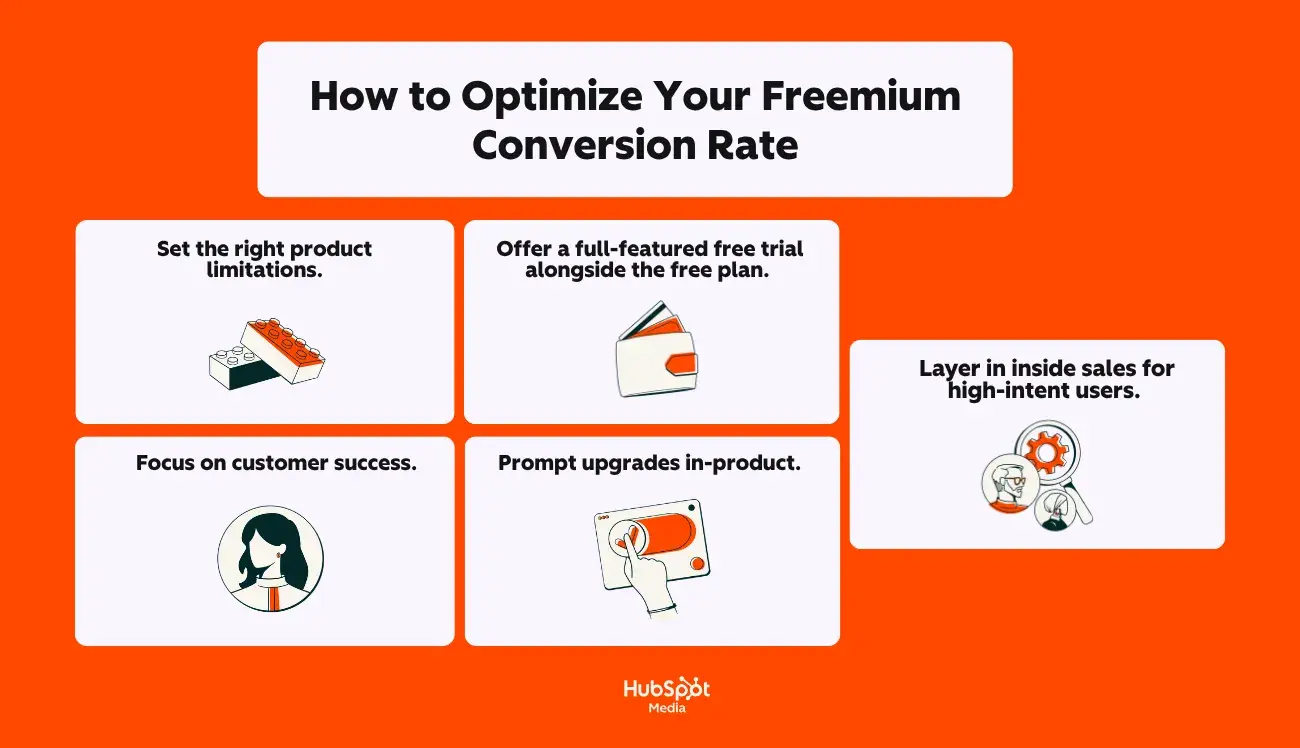
1. Set the right product limitations.
If your goal is to drive upgrades, you have to decide carefully what to give away and what to gate.
Feature balance becomes a non-negotiable. This balance determines whether the free tier is valuable enough to attract users and limited enough to drive upgrades.
To successfully strike that balance, monitor how free users actually use the product to find where value clusters, then tune the gap so your most-wanted capabilities sit just behind the paywall.
2. Offer a full-featured free trial alongside the free plan.
If feature gating alone doesn’t work, to strengthen the pull toward paid, offer an experience the customer can’t refuse.
The best way to do that? By pairing a limited free-forever plan with a full-feature trial, new users can experience the full product before committing.
When the full-feature trial ends, and access reverts to the free tier, the value of premium features becomes clear, nudging users toward an upgrade.
3. Focus on customer success.
For freemium to succeed, users must reach value fast. Optimize onboarding to shorten time-to-value at signup.
To set users up for success, rely heavily on:
- Welcome sequences
- In-app prompts
- A searchable knowledge base
- Responsive support
When combined, these touchpoints increase the odds that a free user will upgrade.
4. Prompt upgrades in-product.
It’s expected that user won’t infer your paid value on their own. So, make the upgrade path explicit at the point of friction.
To prompt those upgrades, use:
- In-app notifications at feature limits
- Upgrade CTAs inside onboarding and support messages
- Behavior-triggered emails when a user nears a usage cap
5. Layer in inside sales for high-intent users.
Sometimes, for enterprise B2B products, a light-touch sales motion increases conversion rates for your highest-value accounts.
I recommend scoring users based on usage signals (e.g., nearing limits, adopting many features) and enriching with third-party data to surface revenue potential, then routing qualified accounts to a rep.
Pro tip: HubSpot’s Sales Hub manages pipelines and automates outreach, so high-intent free users reach a decision-making conversation at the right moment.
Frequently Asked Questions (FAQs) About the Freemium Model
Is freemium free?
Yes and no — the free tier is genuinely free with no expiration date, but it isn’t the whole product.
A freemium model combines a free tier and a paid tier, with the free plan covering core features.
Typically, the following features require a paid upgrade:
- Advanced capabilities
- Additional capacity
- Priority support
The key point is that you can use the free version indefinitely without ever paying.
What’s the difference between free and freemium?
A fully free product stays free forever, with no paid version, and it either monetizes in another way or barely at all.
A freemium product pairs free access with paid upgrades, so a freemium business primarily generates revenue from:
- Subscriptions
- Usage-based pricing
- Ads
- Add-on
Is ChatGPT a freemium model?
Yes. ChatGPT offers a free plan alongside paid tiers, including Plus at $20/month and Pro at $100/month, so the freemium model attracts users with free access and converts some of them to paid plans.
What’s an example of a freemium model?
Recognizable freemium brands include:
For example, Spotify used the freemium model to reach 675 million monthly active users in Q4 2024.
Additionally, HubSpot is among the companies with freemium models, too. Marketing Hub is HubSpot’s marketing software that attracts and nurtures leads, and Sales Hub is HubSpot’s sales software that manages pipelines and automates outreach. Both have free tiers.
Freemium is just one path through the SaaS lifecycle; the right pricing model really depends on your product, audience, and goals.
The freemium model is definitely worth thinking about.
I’ll end with this, reader: freemium can seriously boost your product’s acquisition potential while keeping your costs low, because the product does the convincing instead of your marketing budget.
But it only works if you get the balance right. Give away too little, and people never see the value; give away too much, and they’ve got no reason to pay.
The sweet spot is a free tier that’s genuinely useful and leaves folks wanting more, which means the whole thing lives or dies on how well you understand your customers and how they actually get value from what you’ve built.
Keep your eyes on that, and design your free plan to convert. Once you’ve nailed that, freemium can absolutely support real, sustainable growth for your business.
Editor’s note: This post was originally published in November 2018 and has been updated for comprehensiveness.
Free Sales Pricing Strategy Calculator
Determine the best pricing strategy for your business with this free calculator and template.
- Cost-Plus Pricing
- Skimming Strategy
- Value-Based Pricing
- And More!
Download Free
All fields are required.
Form not available