.png?width=112&height=112&name=Untitled%20design%20(98).png)
This guide explains how nonprofit website builders work, how they differ from general platforms, and how to evaluate options based on donor growth, operational efficiency, and long-term.
Table of Contents
- What is a nonprofit website builder?
- Features That Grow Donors on Nonprofit Websites
- How to Build a Nonprofit Website in 5 Steps
- How We Evaluated the Best Website Builder for Nonprofits
- Best Website Builders for Nonprofits: Our Picks
- Frequently Asked Questions About Nonprofit Website Builders
- Building a Nonprofit Website
What is a nonprofit website builder?
A nonprofit website builder that helps organizations manage a website without requiring extensive technical expertise. In addition to tools for publishing content, nonprofit-focused platforms often support online donations and supporter engagement.
A general website builder or CMS can handle many of the same basic tasks, but nonprofits may benefit from a specialized solution. Donation flows need to be easy to find and use, and staff should be able to make updates without relying on a developer. Choosing a platform that supports these needs can make it easier for nonprofit teams to maintain the site while turning more visitors into long-term supporters.
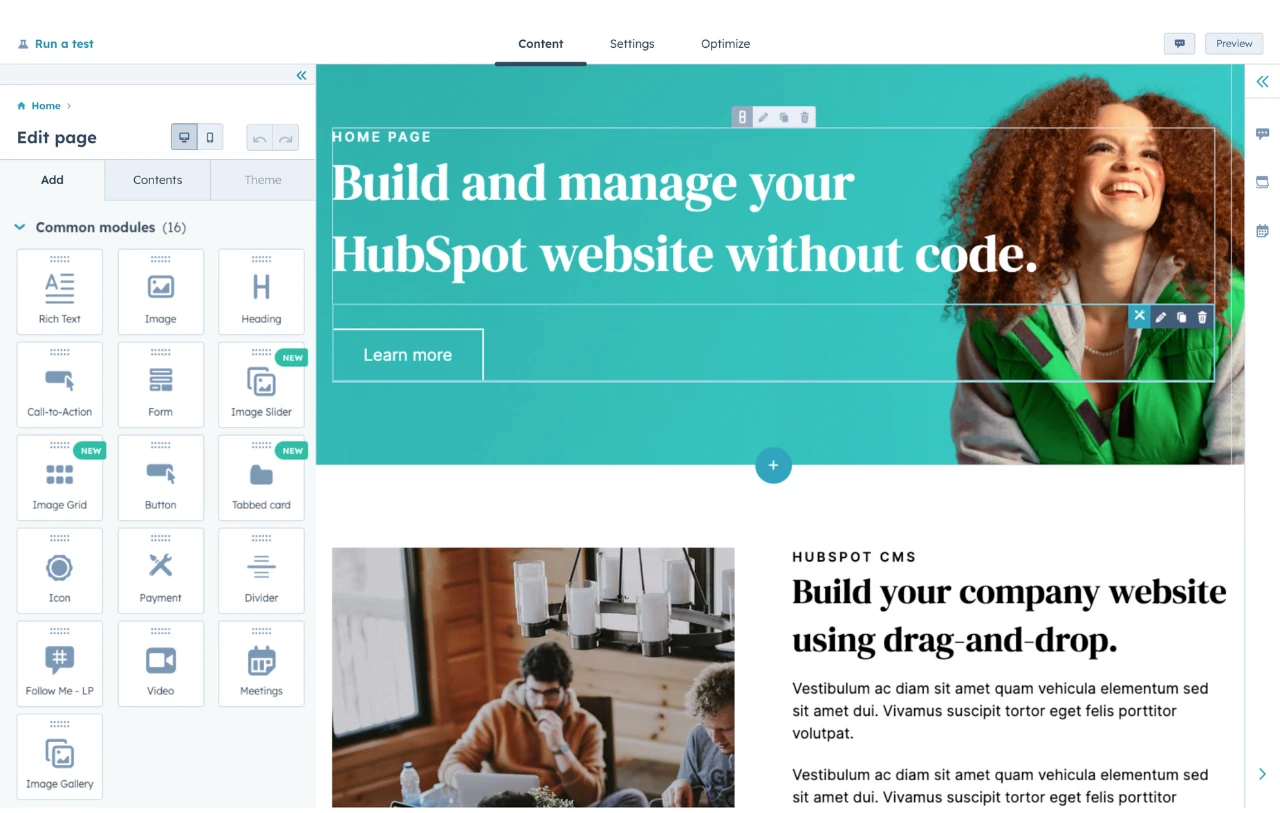
HubSpot's Free Website Builder
Create and customize your own business website with an easy drag-and-drop website builder.
- Build a website without any coding skills.
- Pre-built themes and templates.
- Built-in marketing tools and features.
- And more!
Features That Grow Donors on Nonprofit Websites
Nonprofit websites convert more donors when the giving process is frictionless, engagement is relevant, and fundraising data connects directly to follow-up actions. Donor growth depends on connected systems rather than isolated donation forms. When donation activity and supporter data live in separate tools, teams lose visibility into what drives giving and what happens after someone donates.
Good website design supports both first-time donations and repeat giving. Clear donation paths bring in new donors. Connected data keeps the relationship going after that first gift. Over time, donor history shapes outreach strategy, reporting accuracy, and campaign planning.

Donation Flows That Reduce Friction
Low-friction donation flows increase gift completion by removing confusion and payment barriers at high-intent moments. Clear calls to action, simple forms, and confirmation messaging reinforce donor confidence right when it matters most.
Multi-step forms and unclear payment options increase drop-off. Nonprofit website builders should support recurring giving and confirmation receipts. Beyond that, more folks make donations on their phones. A mobile-friendly experience is essential.
HubSpot Content Hub supports donation-ready page creation with integrated forms that connect directly to HubSpot CRM. Every completed gift automatically updates a donor’s contact record without manual data entry.
Pro tip: Tie every donation feature to a follow-up action. Donation flows should automatically trigger data capture, acknowledgments, and next-step communication.
CRM-Connected Forms and Donor Data Capture
CRM-connected forms capture donor information at the moment of engagement and store it in a system that teams can act on. This connection supports personalization, reporting, and lifecycle tracking.
Linking donation records to contact profiles enables segmentation and attribution. CRM connectivity turns website interactions into operational data that teams can act on, for outreach and follow-up.
HubSpot CRM connects directly to Content Hub forms. Donor submissions update contact records and feed into the right segments automatically.
Email and Automation for Donor Nurturing
Email and automation platforms handle post-donation communication and ongoing engagement, triggering behavior-based outreach without manual effort. Thank-you emails, campaign updates, and renewal reminders all depend on accurate data flow. Automation creates consistent follow-up tied to actions visitors take on the site.
HubSpot Content Hub connects email workflows to donor activity through HubSpot CRM, so updates are triggered automatically based on where each supporter is in their giving journey.
SEO and Content Tools for Nonprofit Discovery
Search engines and AI tools pull from your nonprofit’s website to answer questions about your cause. How well content gets found depends on structure and consistency.
Search-optimized blog content, program updates, and FAQ content reach new supporters by directly answering what they’re searching for. Discovery improves when teams organize content around defined topics, maintain consistent structure, and refresh pages as programs evolve. Established nonprofit SEO practices emphasize keyword alignment to improve visibility across regions and missions.
HubSpot Content Hub makes it easier to publish content in a structured way that supports long-term discovery. The platform manages pages, metadata, and approvals. Teams can easily follow best practices as their content volume grows.
Accessibility and Governance Controls
Accessibility and governance aren’t afterthoughts — they keep experiences inclusive and reduce compliance risk. Features like strong contrast, clear structure, keyboard navigation, and readable templates make giving easier for everyone.
Not every member of your team will need the same website permissions. Governance features that control who can publish, edit, or approve content on the site.
HubSpot Content Hub supports permission-based governance and accessible templates. This lets teams control who publishes content while maintaining consistency across donation pages and high-visibility program content.
How to Build a Nonprofit Website in 5 Steps
1. Choose the right platform and domain.
Choose a website builder that aligns with the organization’s technical resources, budget, fundraising goals, and existing tools. Platforms with drag-and-drop editing can make ongoing updates easier for teams without dedicated developers. Content Hub offers a visual, drag-and-drop builder and an AI website generator that work for teams with all levels of technical knowledge.
The domain should be short, recognizable, and closely aligned with the organization’s name. A .org domain can also help reinforce that the site belongs to a nonprofit organization.
2. Select a mobile-responsive template.
Choose a template that automatically adapts to the user’s screen size. A significant portion of nonprofit website traffic can come from mobile devices. Pages, navigation, forms, and donation buttons should remain easy to use on smaller screens.
Templates can also provide a starting point for branding and page structure. HubSpot Content Hub, for example, offers customizable responsive website themes and templates. Nonprofit teams can launch a site without designing every page from scratch.
3. Build essential pages before launch.
A nonprofit website should provide enough information for visitors to understand the organization’s mission and decide how to support it. Essential pages typically include:
- A homepage, which introduces the organization’s mission and provides clear paths to donate, volunteer, or learn more.
- An about page that explains the organization’s history, mission, leadership, and impact.
- Programs or services pages that show how the organization addresses its cause and who benefits.
- An impact page, which highlights outcomes, stories, reports, and other evidence of the organization’s work.
- A donate page that provides a clear, trustworthy path to making a contribution.
- Contact that gives visitors a straightforward way to get in touch.
4. Add donation and engagement tools.
Once the core pages are in place, add tools that turn website visitors into supporters. Other useful tools can include email newsletter signups, volunteer forms, event registration, social sharing, and membership or gated-content features. Donation forms should be:
- Easy to find.
- Simple to complete (keep them as short as possible, as longer forms can reduce completion rates).
- Optimized for mobile devices so that visitors can donate from anywhere.
Connecting these tools to a CRM can also help nonprofit teams keep supporter information organized, so they can build stronger relationships over time. HubSpot Content Hub’s Memberships feature, for example, can create gated areas for donors, volunteers, or members.
5. Check accessibility before publishing.
Before launch, review the website for common accessibility issues. Check color contrast, keyboard navigation, image alt text, heading structure, link labels, form fields, and video captions. Pages should also work with screen readers and remain usable when text is enlarged.
Accessibility should be treated as part of the website-building process rather than a final checklist. Testing the site with accessibility tools and, when possible, people who use assistive technologies can help identify problems.
Then, test the website across common browsers and mobile devices. Verify every form and donation link. Make sure analytics tools are working before publishing. Most payment processing solutions allow organizations to test donation forms with sample payments before going live.
How We Evaluated the Best Website Builder for Nonprofits
The evaluation focused on how well each platform supports fundraising, ease of use, and long-term scalability for nonprofit teams. Criteria emphasized donor experience, integrations, accessibility, cost transparency, and content visibility.
Donation capability and CRM integration carried significant weight. Platforms that support recurring gifts, confirmation messaging, and reliable payment processing perform better during high-intent moments. CRM integration matters because donor data needs to flow straight into systems built for reporting. Builders that keep donation activity siloed limit insight.
Cost and staffing constraints also matter. Many teams operate with limited technical resources. Platforms that reduce setup time, maintenance effort, and developer reliance scored higher. Licensing is just part of the cost. Plugins, integrations, training, and upkeep add up too. Teams comparing a free website for nonprofit use can use HubSpot’s guide to free website builders as a baseline for where limits tend to show up.
The evaluation also covered accessibility and SEO readiness. Accessibility features make sure the site can be used by everyone. Search readiness improves visibility in both traditional search and answer engines. HubSpot AEO Grader helps nonprofit teams test whether pages are structured for AI search and future discovery, making it a useful tool for teams, no matter how they build their sites.
HubSpot's Free Website Builder
Create and customize your own business website with an easy drag-and-drop website builder.
- Build a website without any coding skills.
- Pre-built themes and templates.
- Built-in marketing tools and features.
- And more!
Best Website Builders for Nonprofits: Our Picks
HubSpot Content Hub

HubSpot Content Hub is a unified CMS that manages content, visibility, and donor-facing pages in one system. It supports nonprofits that want flexibility without heavy technical overhead.
Nonprofit teams can create and manage pages without heavy developer support while connecting website activity, forms, and supporter interactions to HubSpot CRM. With Content Hub, teams can easily manage pages and donor relationships in the same system.
HubSpot for Nonprofits also gives eligible 501(c)(3) organizations 40% off HubSpot’s full suite of products, making a professional website and donor management platform accessible on a nonprofit budget.
Key Features
- Drag-and-drop website builder
- AI website generator
- Customizable website themes and templates
- Built-in forms connected to HubSpot CRM
- Marketing automation and supporter segmentation
- Memberships for gated donor, volunteer, or member content
- Analytics and content optimization tools
- AI tools for marketing, agents, and more
- 40% discount for eligible 501(c)(3) organizations through HubSpot for Nonprofits
What We Like
- Structured workflows that support consistent publishing and approvals.
- Centralized page management that reduces coordination overhead.
- A scalable foundation for discovery and content quality.
HubSpot also includes an AI website generator inside Content Hub, which builds a site from your answers to a few prompts. Just plug in your organization’s details, mission, and goals. The AI content writer helps teams create and optimize content directly within the platform.
Pricing: Organizations can get started with a permanently free plan. From there, paid plans include Starter (from $7 per month), Professional (from $450 per month), and Enterprise (from $1,500 per month). Registered nonprofits can get 40% off the listed prices.
Best for: Nonprofits that want a scalable platform with strong content workflows, integrations, and long-term flexibility.
Morweb

Morweb is a nonprofit-focused website builder centered on simplicity and fundraising functionality. It fits organizations that want fast setup and built-in tools. Teams can build donation pages and promote events with pre-made templates.
Key Features
- Built specifically for nonprofits
- Basic live editor (though not as flexible as many other platforms)
- Membership functionality
Pricing: Starter, $149/month; Grow, $199/month; Engage, contact for pricing; Enterprise, contact for pricing
Best for: Small to mid-sized nonprofits looking for a purpose-built nonprofit platform focused on fundraising, events, and simple page management, though with less overall flexibility than some other platforms.
Springly

Springly combines website building with membership and community management. That combo works well for engagement-driven organizations. Donations, events, and memberships live right alongside your website content. Community-first platforms can support recurring giving when membership operations and communications stay consistent.
Key Features
- All-in-one nonprofit platform
- Integrated CRM, accounting tools, memberships, and more
- Basic website builder
- Pre-made nonprofit website themes
Pricing: Springly’s paid plans are based on the number of contacts in an organization: Serenity (from $45 monthly for up to 250 contacts) and Professional (from $119 per month for up to 250 contacts). There’s also a basic free plan.
Best for: Nonprofits that want an all-in-one platform with a focus on memberships, events, and/or community-driven fundraising.
Wix

Wix is a general-purpose website builder that includes tools for nonprofits. While it’s not specifically made for nonprofits, Wix offers dedicated donation modules and a form builder. Teams can also use the HubSpot integration to connect Wix with their CRM.
Key Features
- Nonprofit website templates
- Drag-and-drop editor
Pricing: While there is a free plan, most organizations will need the $29/mo Core plan, as the free plan is fairly limited. Wix doesn’t offer its own nonprofit pricing, but it does have a partnership with TechSoup to offer discounted rates to eligible customers.
Best for: Nonprofits looking for a low-cost website builder with simple editing and built-in donation support.
Squarespace

Like Wix, Squarespace is another general website builder that can work well for nonprofit websites. While it’s not as feature-rich as some other platforms, Squarespace can handle the essential features that most nonprofits need in a website builder. That includes dedicated donation blocks and even management tools.
Key Features
- Nonprofit website templates
- Drag-and-drop editor
Pricing: Squarespace doesn’t offer long-term nonprofit pricing, so organizations will need to go with the published prices.
Best for: Nonprofits wanting a design-focused option for storytelling and branding, though with less robust tools for fundraising and supporter management.
WordPress

WordPress is a general CMS offering extensive customization through themes and plugins. It supports nonprofits that want full control.
Donation functionality often relies on third-party plugins, adding flexibility and maintenance complexity. WordPress suits organizations that can manage integrations while pursuing advanced content strategies.
Key Features
- Open-source CMS
- Pre-made nonprofit website themes
- Multiple drag-and-drop editor options
- Large library of plugins for donations and other key nonprofit functionality
- Integration with the HubSpot CRM
Pricing: WordPress software is open source and free, but total costs include hosting, premium themes, and plugins; annual costs vary widely depending on the stack.
Best for: Nonprofits with technical support or agency partners that want maximum customization.
Frequently Asked Questions About Nonprofit Website Builders
What is the best website builder for a nonprofit?
The best website builder depends on the organization’s budget, technical resources, and fundraising needs. A drag-and-drop builder can be a strong choice for small teams without dedicated developers. Larger nonprofits may prioritize customization, integrations, and governance features. HubSpot Content Hub combines website-building tools with CRM and marketing capabilities, making it worth considering for organizations of all sizes.
Is Wix free for nonprofits?
Wix offers a free website plan. However, there are limitations that can make a nonprofit website seem less professional. Free sites use a Wix-branded subdomain rather than a custom domain and display other Wix branding.
Can we accept recurring donations?
Yes. Many nonprofit websites can accept recurring donations through integrated donation forms or third-party fundraising platforms. Recurring giving lets supporters automatically contribute on a schedule. When evaluating donation tools, nonprofits should check whether recurring payments are supported, which payment methods are available, and what processing fees apply.
How do we migrate an existing site without losing SEO?
A website migration can preserve much of an existing site’s search visibility when handled properly. Before launch, create a list of existing URLs, copy relevant title tags and meta descriptions, and set up permanent 301 redirects for pages whose URLs change. Internal links, XML sitemaps, canonical tags, and analytics should also be reviewed after the new site goes live.
What hidden costs should we plan for?
The advertised website builder price is not always the total cost of running a nonprofit website. Depending on the platform, additional expenses can include payment processing fees, premium templates, plugins, hosting, domain registration, CRM integrations, and third-party donation tools. Ongoing maintenance can also add costs. Comparing a platform’s total cost can give nonprofit teams a more realistic picture of the budget.
Building a Nonprofit Website
The best website builder for nonprofits is one that turns attention into action and action into long-term donor relationships. Platforms that connect fundraising, content, and donor data make it easier to measure impact.
HubSpot Content Hub stands out for nonprofits that need one system to manage all their work. Teams evaluating readiness for AI search and future attribution can use HubSpot AEO Grader to assess whether their site structure supports how answer engines cite nonprofit content.
Editor's note: This post was originally published in March 2026 and has been updated for comprehensiveness.
HubSpot's Free Website Builder
Create and customize your own business website with an easy drag-and-drop website builder.
- Build a website without any coding skills.
- Pre-built themes and templates.
- Built-in marketing tools and features.
- And more!
CMS