-Mar-14-2025-05-55-40-8841-PM.png?width=112&height=112&name=Featured%20Image%20(1)-Mar-14-2025-05-55-40-8841-PM.png)

Anyone who’s ever paid a utility bill can appreciate the upside of usage-based billing: You don’t pay for what you didn’t use. AI credit-based pricing follows a similar logic — but unlike your electric bill, a good software vendor will give you tools to cap spend, set alerts, and forecast costs before they hit your invoice.

With the right strategy, this shift can work in your favor. Credit-based pricing models grew 126% in 2025 among the top 500 SaaS and AI companies, according to an analysis by PricingSaaS. Understanding the forces behind that growth gives budget holders a strategic advantage when evaluating vendors, negotiating contracts, and forecasting costs.
If you’ve read our buyer’s guide to credit-based AI pricing, you already know what credit-based pricing is and how to evaluate it. This post tackles the why. Find out the economics behind the shift and get expert tips for budgeting for and navigating credit-based pricing.
Table of Contents
- The Economics Driving the Shift from Seat-Based Pricing
- What This Shift Means for Buyers and Budget Holders
- How to Prepare Your Budget for Usage-Based AI Pricing
- Red Flags When Vendors Pitch Credit Models
- Credit-Based AI Pricing: The Way Forward
The Economics Driving the Shift from Seat-Based Pricing
To understand why credit-based pricing is taking over, you need to understand what makes AI fundamentally different from traditional software, and why the old pricing models break down.
1. AI is both expensive and wildly variable to run. Flat pricing can’t account for either.
Vendors can’t absorb unlimited AI usage under a flat fee because AI actions require computing resources. But the exact cost also varies enormously by task: According to AI evaluation platform Galileo, citing agent leaderboard data, complex AI agents (such as those that call external tools) use 5-20 times more tokens than a simple AI chain. The cost gap between “summarize this email” and “research this prospect, draft outreach, and schedule follow-up” can be huge, even within the same platform.
“A basic understanding of token processing costs is absolutely critical,” says Jennifer Lendler, who helps CFOs evaluate AI solutions in her role as founder of Alea Advisors.
“CFOs don’t need to be IT experts, but what they do need to understand are the principles behind the input and the output costs, which are at the core of what these models cost,” she adds. “Every model has a slightly different cost for the tokens of the input side, meaning the documents you’re uploading or the queries you’re giving it, and then a different cost for what it produces, the output.”
Credits solve two problems at once: They let vendors price proportionally to the cost of delivering each task, and they ensure customers pay for the value they receive.
Microsoft’s Copilot Credits illustrate the variability: A generative answer costs two credits, but tenant graph grounding costs 10. Simpler tasks stay cheap; expensive ones are priced accordingly.
-Mar-14-2025-05-55-40-8841-PM.png?)
Free AI Agents Playbook
This practical guide reveals where to start, which applications deliver real value, and how to implement agents that transform workflows without replacing jobs.
- Marketing Workflow Automation
- Sales Acceleration System
- Operational Excellence
- Implementation Blueprint
Download Free
All fields are required.
Form not available
2. Seat-based pricing penalizes AI vendors for boosting customers’ efficiency.
Another reason software vendors are shifting to AI credits is that they started hitting a wall: The better AI makes each user, the fewer seats a company needs. If an AI agent handles the volume of three human reps, a team can cut seats, and vendor revenue drops despite delivering more value. And the problem gets worse as AI agents go fully autonomous, resolving support tickets, qualifying leads, and processing invoices with no human logging in at all.
Seat-based pricing has no mechanism to charge for that. Credits, however, realign the incentive: Revenue scales with the work AI does, not headcount.
3. Credit-based pricing can also be more cost-effective for buyers.
Of course, there’s an upside for buyers, too. In the old seat-based pricing model, if your organization paid for 50 AI seats but only 10 people were power users, 25 were light users, and 15 never logged in, you wasted money. Credits tie spend to actual consumption, so a light user costs proportionally less than a heavy one, and you don’t end up paying for seats you don’t use.
Since most vendors are moving to hybrid models (a subscription fee plus AI credits), you still get stable platform access without committing to capacity you may never need.
What This Shift Means for Buyers and Budget Holders
The move to credit-based pricing isn’t just a vendor-side phenomenon. It changes the buyer-vendor relationship in ways that budget holders need to understand.
Cost predictability shifts from fixed to managed.
Under seat-based pricing, your AI costs were a line item you could set and forget — and that was the problem. You knew exactly what you’d pay each month, but you had little visibility into what your team actually used. Credit-based pricing introduces variability but also visibility, and that requires a different approach to budgeting.
This doesn’t mean costs are unpredictable. It means predictability becomes something you actively manage rather than something you get by default. The vendors that are doing this well provide dashboards, usage alerts, and spending caps that give you real-time visibility into where your credits are going.
The buyer-vendor relationship becomes more transparent.
There’s a silver lining to credit-based pricing: transparency. Lendler points out that credit models “can be actually more transparent” than seat-based ones because they force visibility into how the software is really being used — down to which features are useful and how many people are engaging with it.
At renewal time, instead of guessing at utilization rates, you can point to actual consumption patterns (where AI is delivering real value and where it isn’t), which gives you concrete leverage in vendor negotiations.
Budgeting requires a mindset shift — but it’s a healthy one.
Lendler, who is also a HubSpot customer, describes her experience transitioning to HubSpot Credits: “It is a change. It’s a shift because, in the past, it was just sort of a tier and then extra features, and you’re good to go. But with this, you really need to have a bit of a mind shift to say, ‘I have all of these credits. What am I going to use them for?’”
Her approach: Start with what you want to accomplish, not what the credits cost. “ I don’t really think about the credits at the beginning,” she says. “I think about what I want to do, and then I sort of see how the credits fall into that.”
After an initial period, she recommends a review: “Say, ‘All right, this is how I’ve set it up. These are the things that I want to do, and these are the credits it requires — and does it match what my needs are right now?’”
This is a more disciplined approach to software spending than the old model demanded. But Lendler sees that as a feature, not a bug: “It sort of forces me to say, ‘Oh, am I using this? Am I really pushing the limit on this?’ And I think that’s a good discipline for everybody to have.”
Free AI Agents Playbook
This practical guide reveals where to start, which applications deliver real value, and how to implement agents that transform workflows without replacing jobs.
- Marketing Workflow Automation
- Sales Acceleration System
- Operational Excellence
- Implementation Blueprint
Download Free
All fields are required.
Form not available
How to Prepare Your Budget for Usage-Based AI Pricing
If your organization is evaluating credit-based AI tools for the first time, here are the questions to ask internally before you start comparing vendors:
- What are our highest-value AI use cases? Identify the two or three workflows where AI will have the most impact. This determines which credit consumption patterns matter most for your budget.
- How variable is our expected usage? A support team fielding seasonal ticket spikes will have a very different credit profile than a content team generating a steady volume of blog drafts each month. Map the variability before you size a commitment.
- Who will own AI spend visibility? Credit-based pricing requires ongoing monitoring — not just a set-it-and-forget-it purchase order. Make someone responsible for tracking usage and bumping up (or down) credits depending on how much is being consumed.
- Do we have baseline usage data? If you’re adopting AI for the first time, you won’t have historical consumption to reference, which is a frustrating place to be in. For that, Lendler recommends starting with a short-term contract “to look at your usage and then adjust the contract prices after you have a bit of a track record.”
- What’s our tolerance for overage risk? Some organizations prefer the certainty of prepaid credits (you can’t spend more than you buy). Others prefer the flexibility of pay-as-you-go with spend caps. Know your CFO’s appetite before you evaluate pricing pages.
Red Flags When Vendors Pitch Credit Models
Not all credit-based pricing is created equal. As you evaluate vendors, watch for these warning signs:
- Vague “unlimited AI” claims. There’s no such thing as unlimited AI compute. If a vendor claims unlimited credits, find out what’s actually constrained (rate limits, feature restrictions, model quality downgrades for heavy usage, etc.). The constraint is there; it’s just hidden.
Think of it like mobile phone plans that advertise unlimited data. In reality, restrictions are often buried in the fine print, such as throttling (slowing speeds) once you reach a data cap.
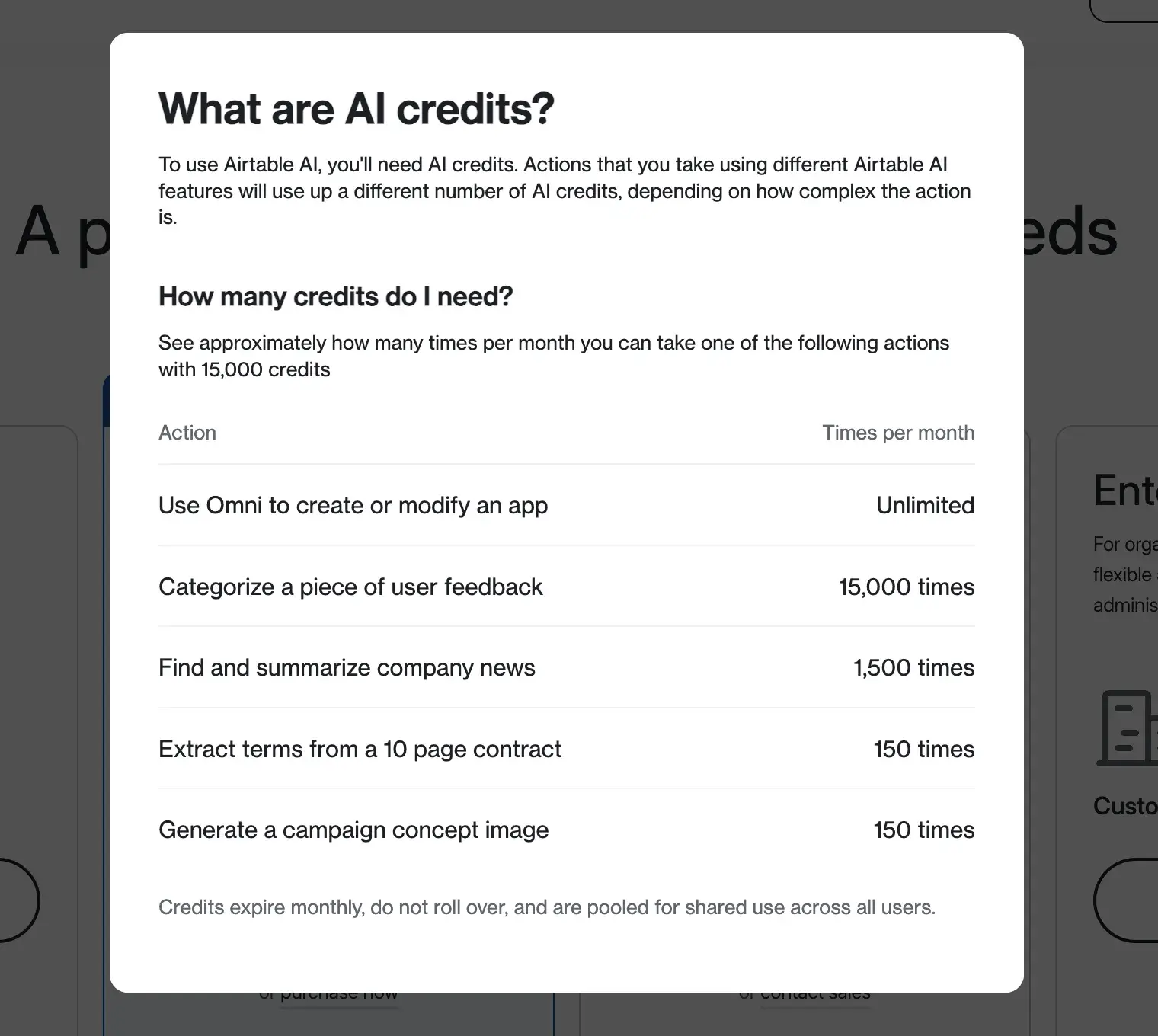
If the vendor offers subscription tiers with included credits, calculate how far that will actually get you. A starting allotment of a few hundred credits per month might sound reasonable in the abstract, but it can disappear fast once you map it to real usage. - Opaque credit definitions. If a vendor can’t clearly explain what one credit buys in terms of specific actions, it’ll be extremely difficult for you to budget credits. You should be able to map credits to concrete workflows before committing.
Green flag: Airtable makes credit calculations clear with this helpful breakdown of exactly which tasks a customer can take (and how often) if they subscribe to the Team plan, which includes 15,000 credits.
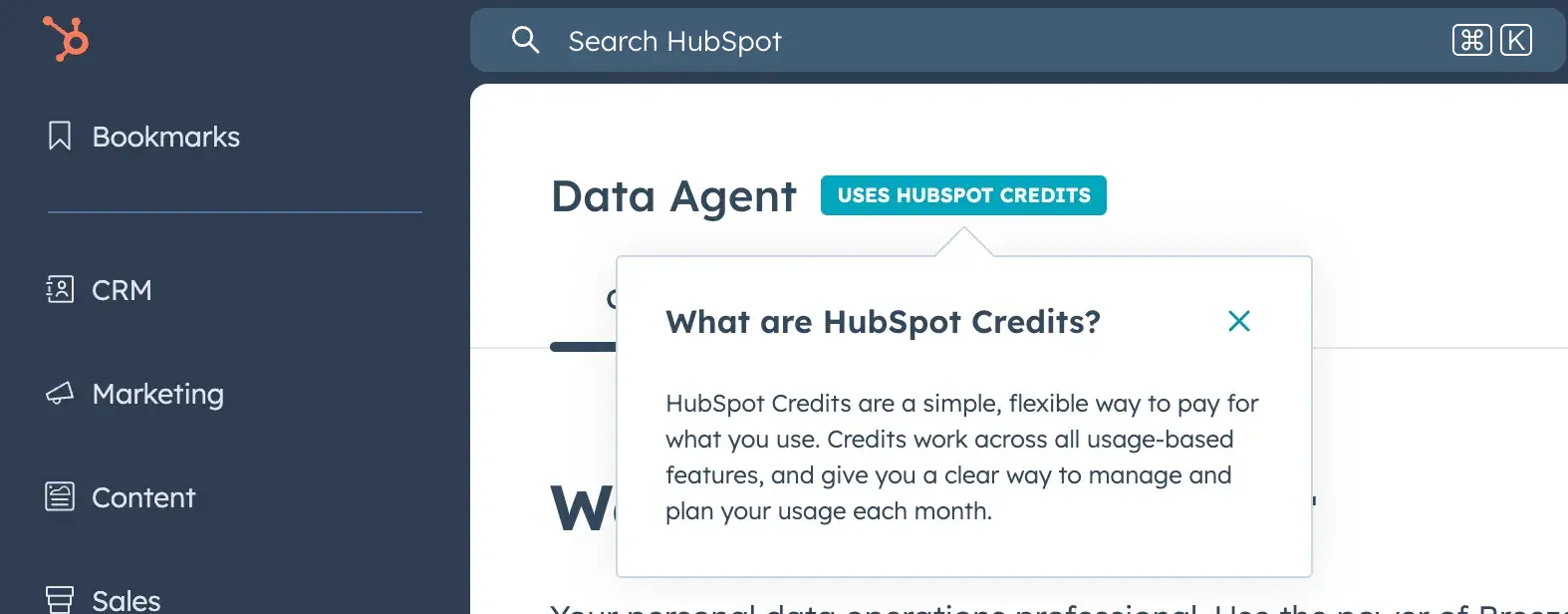
- No spend visibility tools. Ask what tools will be provided to help you forecast and control spend. A vendor that sells you credits but doesn’t provide dashboards, alerts, or spending caps is offloading the risk management to you.
Green flag: Even something as simple as vendors labeling which features use AI credits, and which don’t, can help customers manage spend. Here’s an example of how HubSpot handles it within its platform:
- No path to right-size. If you overcommit and your usage consistently falls below your tier, can you adjust? Look for vendors that offer true-up mechanisms, flexible tiers, or the ability to renegotiate mid-term.
Credit-Based AI Pricing: The Way Forward
Credit-based pricing isn’t just a phase. IDC forecasts that “by 2028, pure seat-based pricing will be obsolete as AI agents rapidly replace manual repetitive tasks with digital labor, forcing 70% of vendors to refactor their value proposition into new models.”
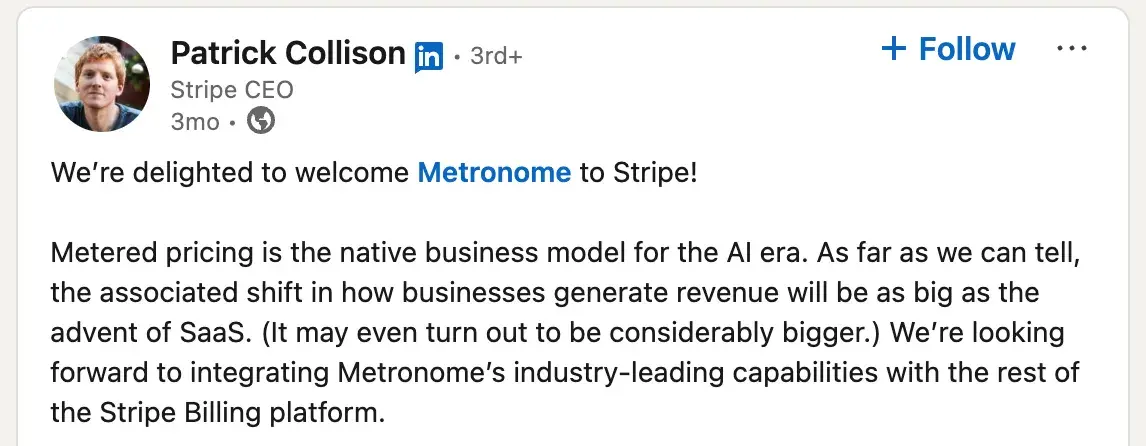
In December 2025, Stripe signaled its own conviction by acquiring usage-based billing platform Metronome for a reported $1 billion, with CEO Patrick Collison calling metered pricing “the native business model for the AI era.”
For budget holders, this means adapting how you think about software costs, shifting from fixed line items to managed variable spend. The good news is the same transparency that makes credit pricing feel unfamiliar also gives you better data, more negotiating leverage, and a clearer picture of where AI is (and isn’t) earning its keep.
The vendors worth buying from are the ones making this transition easier, not harder. Look for clear credit definitions, robust spend controls, and a willingness to work with you on right-sizing your commitment.
Free AI Agents Playbook
This practical guide reveals where to start, which applications deliver real value, and how to implement agents that transform workflows without replacing jobs.
- Marketing Workflow Automation
- Sales Acceleration System
- Operational Excellence
- Implementation Blueprint
Download Free
All fields are required.
Form not available
Artificial Intelligence