
If brands aren’t tracking who’s earning those citations and how, they’re making content and SEO decisions without half the picture. This guide walks through how to run an AEO competitor analysis from scratch — what to measure, which tools to use, and how to turn findings into content that closes the gap.
Table of Contents
- What is AEO competitor analysis?
- Why AEO Competitor Analysis Matters Now
- How to Run an AEO Competitor Analysis
- AEO Competitor Analysis Metrics
- AEO Competitor Analysis Tools
- Turning AEO Competitor Insights Into Actions
- Frequently Asked Questions About AEO Competitor Analysis
- Start benchmarking your AI visibility.
What is AEO competitor analysis?
AEO competitor analysis is the process of identifying which brands, pages, and sources answer engines cite in AI-generated responses, and benchmarking your brand’s visibility against those competitors across the same queries.
“AEO” stands for Answer Engine Optimization: the practice of structuring content so that AI platforms like ChatGPT, Perplexity, Google’s AI Overviews, and Gemini surface it as a trusted answer.
AEO competitor analysis extends that practice outward. Instead of just optimizing your own content, you’re systematically tracking who else the engines are citing, why, and what gaps you can close.
The key difference from traditional competitive research: traditional SEO competitor analysis tracks keyword rankings and backlinks. AEO competitor analysis tracks citation rate, answer share, entity coverage, and QA depth across AI-generated answers. The units of measurement differ because the competition differs. You're essentially fighting to be the source that an LLM trusts.
HubSpot AEO Tool
See exactly where your brand shows up in answer engines and take action to close AI visibility gaps.
- Track AI mentions.
- Analyze citations
- Monitor prompts
- Benchmark competitors
Why AEO Competitor Analysis Matters Now
Answer engines cite, they don’t rank.
Google’s AI Overviews push organic blue links further down the page, often below the fold. For high-intent queries — “what’s the best CRM for startups,” “how do I calculate customer lifetime value” — the AI answer is what most users actually read. A competitor that’s consistently cited in those answers and you’re not is gaining purchase influence before a prospect ever visits your website, regardless of where you rank.
Your organic search competitors aren’t necessarily your AI search competitors.
This is one of the most common gaps in AEO competitive research. The brands, publishers, and third-party sources that appear in AI answers for your target queries often don’t overlap with the companies you track in Google ranking reports. Industry publications, Reddit threads, analyst sites, and niche comparison platforms frequently earn AI citations that direct competitors don’t. You need to run your own queries to see who actually shows up instead of assuming it mirrors your SEO competitive set.
AEO visibility influences buyers earlier in the process.
Brands that appear consistently in AI answers for buying-stage queries — “best [category] software,” “how to choose a [tool],” “[brand A] vs [brand B]” — shape purchase decisions before a prospect ever fills out a form. Teams tracking AEO competitor data are also using it to identify support and FAQ opportunities, owning AI-generated answers to common customer questions before those questions reach the support queue.
Pro tip: Learn more about how answer engine search is reshaping demand.
How to Run an AEO Competitor Analysis
![how to run an aeo competitor analysis, discover, benchmark, diagnose, act, measure]](https://53.fs1.hubspotusercontent-na1.net/hubfs/53/aeo-competitor-analysis-1-20260902-5355828.webp)
Step 1: Identify your AI search competitors.
Before you can benchmark against competitors, you need to know who they are in AI search specifically. Run 10–15 of your highest-priority queries across ChatGPT, Perplexity, and Google AI Overviews. Note every brand, domain, and source that appears in the answers. You’re looking for patterns: which domains come up repeatedly, which content types get cited, and whether industry publications or third-party sites are appearing more often than direct competitors.
This step often surfaces surprises. A mid-tier industry blog might be earning more AI citations than your top-ranking direct competitor. A comparison review site might own several of your consideration-stage queries. Once you know who’s actually showing up, you can decide who to benchmark against.
Step 2: Collect priority questions that answer engines must resolve.
Build a query set: a representative list of questions your audience asks that answer engines are likely to resolve with a generated answer. These should span the full funnel:
- Awareness-stage questions — “What is [category]?” / “How does [process] work?”
- Consideration-stage questions — “Best [tool type] for [use case]” / “[Brand A] vs [Brand B]”
- Decision-stage questions — “How much does [product] cost?” / “Is [brand] right for [company type]?”
- Support and FAQ questions — Common issues customers search for after purchase
Pull questions from your existing keyword research, customer support tickets, sales call transcripts, and “People Also Ask” boxes in Google. Starting with 10–15 priority prompts gives you a practical, actionable baseline. For HubSpot users, AEO features in Marketing Hub Pro and Enterprise automatically suggest prompts to track based on your business, customers, and competitors.
HubSpot AEO Tool
See exactly where your brand shows up in answer engines and take action to close AI visibility gaps.
- Track AI mentions.
- Analyze citations
- Monitor prompts
- Benchmark competitors
Step 3: Test queries across chatbots and AI Overviews.
Run each query manually or with an AEO tool across multiple answer engines: ChatGPT, Perplexity, Google AI Overviews, and Gemini. For each query, record:
- Which sources are cited (URLs and domain names)
- Which brands are mentioned by name, even without a citation link
- The structure and format of the answer (list, paragraph, table, step-by-step)
- Whether your brand appears at all
Manual testing across 50+ queries on four platforms isn’t sustainable at scale, which is where AEO tools become important. But starting with manual testing on your top 10–15 queries builds intuition for why certain content gets cited that dashboards alone won’t give you.
With HubSpot AEO, you can automatically track prompts across ChatGPT, Perplexity, and Gemini, seeing which responses cite your brand, which cite competitors, and how visibility changes over time.
Step 4: Extract cited sources and entities.
For each query, document every cited source and named entity. You’re building a map of:
- Which competitor domains are cited most frequently (citation rate by domain)
- Which specific pages or content types win citations (blog posts, documentation, landing pages, research reports)
- Which entities are consistently mentioned (brand names, product names, organizations)
Look for patterns. If a competitor’s blog consistently earns citations while their product pages don’t, that tells you something about what content format LLMs prefer for that query type. If a source you hadn’t considered a competitor is appearing for your core queries, that’s a new competitive threat worth tracking.
Step 5: Map competitors by topic cluster and answer share.
With citation data collected, organize it by topic cluster rather than just by competitor. Calculate a rough answer share for each brand: the percentage of queries in a topic cluster where that brand is cited.
This map reveals two things:
- Where competitors dominate. Topic clusters where a rival has high answer share and you have low or none — these are your priority gap areas.
- Where the field is open. Topic clusters where no brand dominates — these are fast-mover opportunities where strong content could quickly establish citation authority.
Here’s an example benchmarking table:
Step 6: Diagnose why competitors win.
Don’t just identify that a competitor wins citations. Diagnose why.
For each competitor page that consistently earns citations, analyze:
- Content format. Is it a listicle, a long-form guide, a FAQ page, a comparison article?
- QA structure. Does the page directly answer the question in the first 1–2 sentences, then provide supporting detail?
- Entity clarity. Does the page clearly state what the brand or product is, who it’s for, and what problem it solves?
- Freshness. When was the content last updated? LLMs tend to favor recently updated content for fast-moving topics.
- Schema markup. Does the page use FAQ, HowTo, or other structured data?
- Backlink authority. Is the page well-cited by other authoritative sources?
The most useful diagnostic question to ask yourself: If I were a language model trying to answer this question, would this page give me a clear, trustworthy, complete answer?
HubSpot AEO generates prioritized, plain-language recommendations from this analysis, with clear next steps so teams can move from insight to action.
AEO Competitor Analysis Metrics
Different tools and vendors use different terminology for AEO metrics. Here’s how to define them consistently for your own analysis:
For a deeper look at how these metrics fit into a broader AEO measurement framework, including how to track them over time, see our full guide to AEO metrics.
Answer Share and Citation Rate
Answer share is the foundational AEO competitive metric: the percentage of queries in a defined set where your brand is cited. It’s the AEO equivalent of organic market share.
Track answer share at three levels:
- Overall — across your full query set
- By topic cluster — to identify where you’re winning and losing
- Over time — to measure whether content investments are improving visibility
Citation rate is the rate behind answer share. High citation rate on a small number of pages may indicate over-reliance on a few content assets. Broad citation rate across many pages signals stronger topical authority.
Entity Coverage and QA Depth
Entity coverage measures whether your brand, products, and key topics are explicitly recognized and described correctly by answer engines. Test this directly: ask ChatGPT or Perplexity “What is [your brand]?” / “What does [your brand] do?” / “Who uses [your product]?” Vague, incomplete, or inaccurate answers signal an entity clarity problem that will suppress citations across your full query set.
QA depth measures how completely your content answers the specific questions in your query set. Score both your content and competitors’ on a simple rubric: Does the page answer the question directly in the opening section? Does it cover follow-up questions and edge cases? Is the answer structured for easy extraction with headers, bullets, or numbered steps?
Connecting AI Visibility to Pipeline
Pipeline attribution for AI answers requires a combination of methods because AI-generated answers don’t always produce trackable clicks. A practical multi-method approach:
- Referral reporting. Check GA4 or HubSpot referral sources for traffic from Perplexity, ChatGPT, and other engines on pages that appear in cited answers.
- Landing page analysis. Track engagement patterns on your highest-cited pages to understand how AI-referred visitors behave differently from organic visitors.
- Self-reported attribution. Add “How did you hear about us?” as a form field and include “AI search” or specific engines (ChatGPT, Perplexity) as options. This captures influenced pipeline that never generates a tracked click.
- CRM source fields. Use custom contact and deal source fields in your CRM to flag AI-attributed first touches. Over time, this builds a longitudinal dataset that correlates AEO content investments with contact and deal creation.
- Assisted conversions. Look at assisted conversion paths in your reporting to see whether AI-cited content appears in multi-touch journeys that end in conversion, even when it isn’t the last touch.
HubSpot AEO connects AI visibility tracking to CRM data, enabling you to tie answer engine performance to contacts, pipeline, and revenue within the same reporting system. You can explore how to build this view in HubSpot AEO Insights.
AEO Competitor Analysis Tools
1. HubSpot AEO (Ongoing Monitoring and Action Planning)
Best for: Marketing teams that want to connect AI visibility insights to execution, CRM data, and pipeline reporting in a single system.
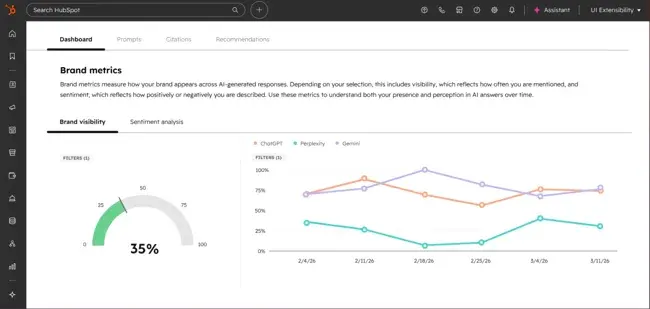
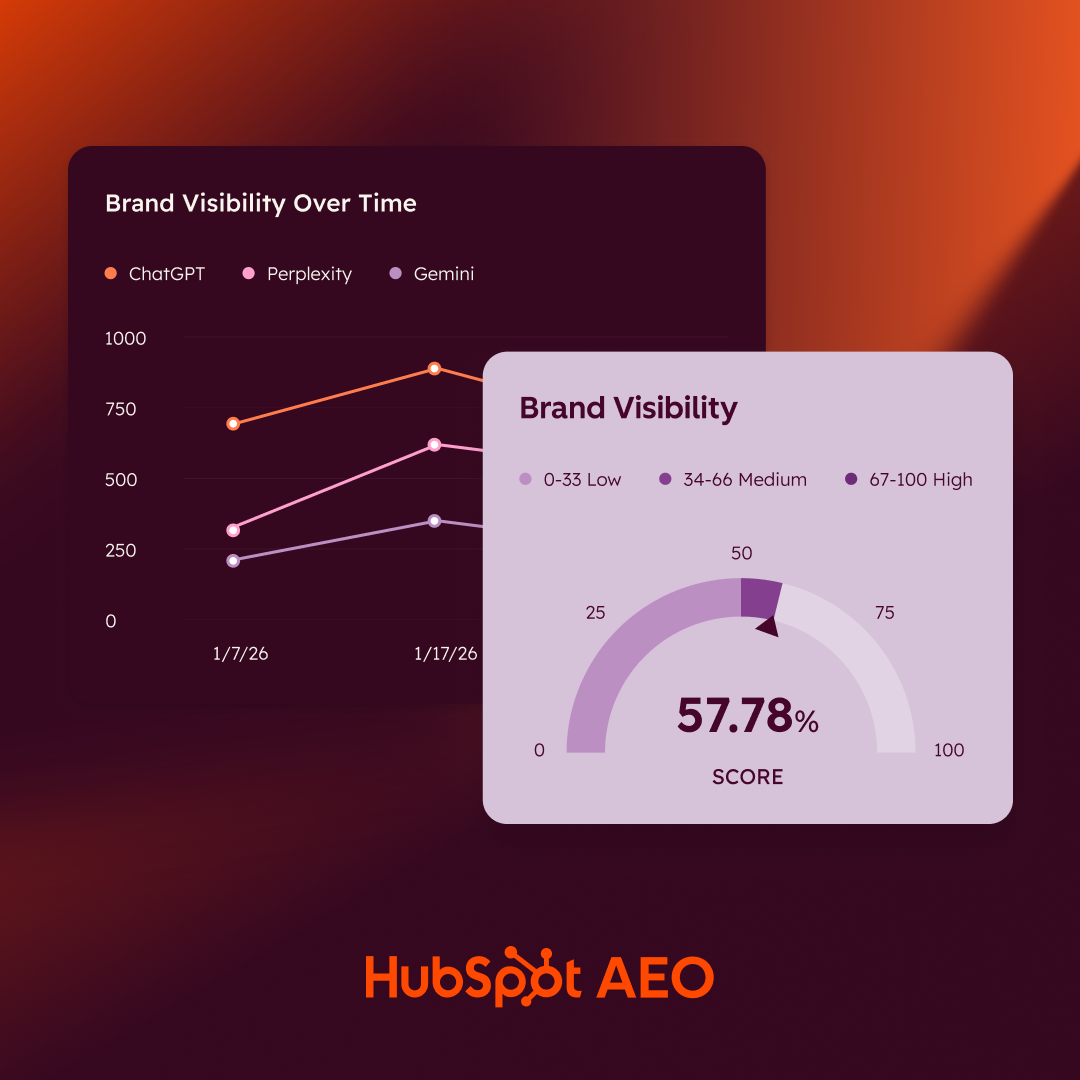
HubSpot AEO gives marketers a continuous view of how their brand appears across ChatGPT, Perplexity, and Gemini at the prompt level — showing exactly which prompts cite your brand, which cite competitors, and where you’re completely absent. It translates that visibility data into plain-language recommendations with clear next steps.
Because it’s connected to HubSpot CRM, the tool automatically suggests the most relevant prompts based on your company’s industries, competitors, and customer segments. It also connects visibility data to contact and pipeline reporting, so you can tie AEO performance to actual business outcomes rather than just impressions. Teams that use both Marketing Hub and Content Hub can take AEO recommendations and brief or publish content directly from the same platform.
What I like: HubSpot AEO doesn’t just surface gaps — it shows marketers exactly where they’re losing ground to competitors and provides a prioritized, plain-language action plan they can use right away.
HubSpot AEO Tool
See exactly where your brand shows up in answer engines and take action to close AI visibility gaps.
- Track AI mentions.
- Analyze citations
- Monitor prompts
- Benchmark competitors
2. HubSpot AI Search Grader
Best for: Marketers benchmarking AI visibility for the first time, or anyone who wants a fast competitive snapshot without ongoing tooling.
![ai share of voice tools, hubspot aeo grader]](https://53.fs1.hubspotusercontent-na1.net/hubfs/53/aeo-competitor-analysis-2-20260902-1195149.webp)
HubSpot's AI Search Grader is a free tool that benchmarks your brand’s visibility across major answer engines relative to competitors. It gives you a snapshot of your share of voice across key prompts, along with insight into how your brand is being described in those answers.
Use it as your starting point before investing in ongoing monitoring. It takes no setup and no prior AEO experience, and gives you a clear read on whether visibility gaps exist and where to focus first. Then, you can use a tool like HubSpot AEO for more in-depth action planning.
What I like: It provides a quick, low-friction way to understand how often a brand appears in AI answers and how it stacks up against competitors, without requiring any setup or prior AEO experience.
3. Perplexity
Best for: Quick qualitative spot-checks.
Running priority queries directly in Perplexity gives marketers a fast, free view into what sources are being cited and how answers are structured. Perplexity shows citations inline, making it easy to identify which competitor URLs are earning placement.
Pro tip: Use Perplexity’s “Focus” modes (Web, Academic, Writing) to test how answer sources vary by query context.
4. ChatGPT with Browse
Best for: Testing conversational and mid-funnel queries.
ChatGPT’s browsing mode surfaces citations for current queries. It’s particularly useful for testing consideration-stage and comparison queries (“best X for Y” formats), where brand mentions in AI answers have the highest purchase influence.
5. Ahrefs
Best for: Pairing traditional SEO data with AEO insights.
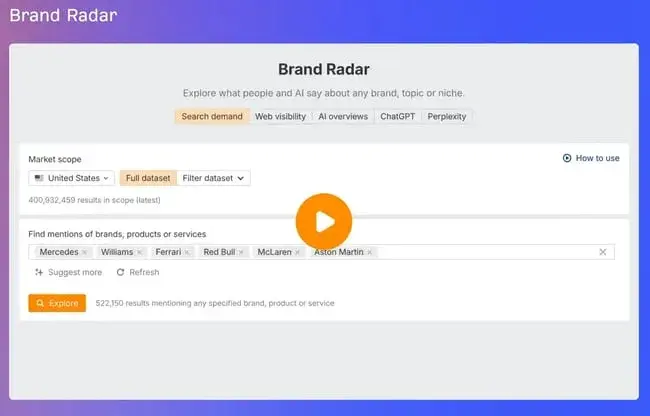
Traditional SEO tools remain valuable for diagnosing why certain pages earn AI citations — backlink authority, on-page optimization, and topical authority signals all contribute to LLM citation patterns.
Use Ahrefs to audit competitor pages that consistently earn citations, and identify the SEO factors that may be reinforcing their AI visibility.
Turning AEO Competitor Insights Into Actions
Once your analysis is complete, translate findings into a prioritized action list. The highest-impact actions that consistently surface from AEO competitive analysis:
-
Create direct-answer content for high-gap queries. If a competitor earns citations on 8 out of 10 queries in a topic cluster and you earn 0, the fastest path to closing that gap is publishing purpose-built QA content that directly answers those questions. Structure it with a clear question as the H2, a direct answer in the first 1–2 sentences, and supporting detail below.
-
Update and restructure existing pages. Many citation wins come from reformatting existing content rather than creating new pages. Add direct answers, FAQ sections with schema markup, and clearer entity statements to pages that are already indexed and authoritative.
-
Build entity disambiguation content. If LLMs give incomplete or inaccurate answers about your brand, publish an authoritative “What is [Brand]?” page with structured entity information. Reinforce entity signals across your site and in third-party sources (Wikipedia, Crunchbase, press coverage).
-
Prioritize topic clusters where answer share is low but competitor content is weak. Not every gap requires competing with a dominant rival. Clusters where no competitor has strong AEO content are the fastest paths to establishing citation authority.
-
Add comparison and “best for” content. Comparison queries (“X vs. Y,” “best [tool] for [use case]”) are high-intent and frequently answered by LLMs. If competitors are winning these queries and you’re not, comparison content is a high-priority gap to close.
-
Strengthen internal linking between high-performing and low-performing pages. LLMs index topical authority signals across a domain. Pages that aren’t earning citations may benefit from stronger connections to your most-cited content.
-
Submit updated content to Google for re-indexing. For pages you’ve updated to improve QA depth or entity clarity, use Google Search Console to request re-indexing so updated signals are picked up quickly.
-
Run your analysis on a monthly cadence. AEO competitive dynamics shift as competitors publish new content and as LLMs update. Monthly snapshots of your priority query set and answer share benchmarks are necessary to detect changes before they compound.
Frequently Asked Questions About AEO Competitor Analysis
How do I identify my AI search competitors?
Run your 10–15 highest-priority queries across ChatGPT, Perplexity, and Google AI Overviews and record every brand and domain that appears in the answers. Your AI search competitors are the brands, publishers, and sources that appear consistently — not the list you’ve been tracking in your SEO ranking reports. These two sets often don’t overlap. Direct competitors may be absent from AI answers while industry publications, review platforms, and niche blogs earn regular citations.
How often should you run AEO competitor analysis?
A full analysis — running your complete query set, documenting citations, and updating benchmarks — works well on a monthly cadence for most teams. For competitive markets or during active content campaigns, biweekly monitoring of top-priority query clusters is worth the investment. AI citation patterns can shift meaningfully after a competitor publishes new content or after a model update, so regular snapshots matter in a way that traditional SEO rank tracking doesn’t require as often.
How do you attribute pipeline impact from AI answers?
Pipeline attribution for AI answers requires multiple methods because AI-generated answers don’t always generate trackable clicks. Use referral reporting in GA4 or HubSpot to capture direct traffic from AI platforms, add answer engines as a self-reported attribution option on forms and in sales conversations, and monitor branded search and direct traffic trends as a proxy for AI-influenced awareness. Custom CRM source fields and assisted-conversion reporting help build a longer-term picture of how AEO investments connect to contact and deal creation.
What’s the best way to structure QA content for LLM citations?
The format most consistently cited by LLMs is a direct-answer structure: the target question appears verbatim (or near-verbatim) as an H2 or H3; the first 1–3 sentences provide a complete, direct answer; supporting detail, examples, and nuance follow in clearly organized subsections. FAQ schema markup reinforces this structure for Google’s AI Overviews. HowTo schema works similarly for process-oriented content. Avoid burying the answer in lengthy preambles — LLMs favor content that gets to the point immediately.
When should you prioritize AEO over traditional SEO?
AEO and traditional SEO are complementary — the same content quality signals that drive rankings (authority, depth, structured formatting, freshness) also drive AI citations. If your analytics show declining organic click-through rates despite stable or improving rankings, that’s a signal that AI answers are intercepting clicks for your target queries. In that scenario, investing in AEO content structure and citation optimization is likely to have a higher return than chasing additional ranking improvements. For any query type where AI Overviews or LLM answers are already the dominant result, AEO should be your primary optimization lens.
How do I choose an AEO analysis tool?
Start with the HubSpot AI Search Grader to get a free baseline of your current visibility before investing in ongoing tooling. If you’re ready for continuous monitoring with competitor benchmarking, prompt tracking, and action recommendations, HubSpot AEO connects those insights directly to your CRM and content workflows. For manual spot-checks, Perplexity and ChatGPT with Browse are free options that give you direct access to citation data. Purpose-built tools like Genrank suit teams that want automated tracking across large prompt sets.
Start benchmarking your AI visibility.
AEO competitor analysis gives you a direct view into how brands are actually recommended at the moment a buyer is researching a decision. Instead of optimizing for rankings alone, you can now measure citation rate, answer share, and entity coverage — and understand exactly why competitors are getting cited while you aren’t.
The workflow is straightforward: identify your actual AI search competitors, build a query set across the funnel, benchmark visibility, diagnose citation gaps, act on the highest-priority content changes, and remeasure.
Start with the free HubSpot AI Search Grader to benchmark where you stand today. For ongoing monitoring, competitor analysis, and prioritized recommendations connected to your CRM and content tools, explore HubSpot AEO.
Editor’s note: This article was originally published in May 2026 and has since been updated for comprehensiveness.
HubSpot AEO Tool
See exactly where your brand shows up in answer engines and take action to close AI visibility gaps.
- Track AI mentions.
- Analyze citations
- Monitor prompts
- Benchmark competitors
AEO
![AEO checker tools that measure answer engine visibility [2026]](https://53.fs1.hubspotusercontent-na1.net/hubfs/53/aeo-checker-1-20260903-3858273.webp)
![Scrunch vs. Peec AI: Choosing the right AEO tool [2026]](https://53.fs1.hubspotusercontent-na1.net/hubfs/53/Copy%20of%20Featured%20Images_Blog%20Title%20Templates%20(8).png)

-What-We-Learned-from-Analyzing-10+-Brands-With-High-AI-Search-Citations-1-20260826-304258.webp)
![Using LinkedIn for AEO: How marketers can use social media to improve their AI visibility [experiment]](https://53.fs1.hubspotusercontent-na1.net/hubfs/53/AEO-for-LinkedIn-piece-1-20260826-6108454.webp)
-1.png)