.png?width=112&height=112&name=Image%20Hackathon%20%E2%80%93%20Vertical%20(46).png)

Alignment means that marketing and sales share data, goals, and processes. And misalignment is costly: it causes poor lead handoffs, inconsistent messaging, and missed revenue. Yet, most sales and marketing teams work in silos by default until they’re intentionally brought together.

Sales and marketing should be like the leads in a buddy cop movie: Sales is the grizzled veteran, marketing is the hot-headed rookie, and there’s huge potential if they could just figure out how to work together. This narrative would be less common if marketing and sales alignment was understood, enabled, and automated.
HubSpot’s 2026 State of Sales Report found that improving alignment was one of sales leaders’ top priorities for the year, tied with AI implementation and sales coaching at 20% each. This guide breaks down the key signs of sales and marketing misalignment, proven ways to fix it, and best practices for sales enablement.
Table of Contents
- What is marketing and sales alignment?
- Signs of Marketing and Sales Misalignment
- 5 Ways to Fix Marketing and Sales Alignment
- Frequently Asked Questions About Marketing and Sales Alignment
- Why Marketing and Sales Alignment Matters
What is marketing and sales alignment?
Marketing and sales alignment means marketing and sales share goals, data, definitions, and processes. Alignment requires connected tools and teams to ensure that:
- The right data is shared with the right people
- Marketers and sales reps are using that data to achieve a shared goal.
Alignment is sometimes referred to as smarketing: a collaborative approach that unites marketing and sales, representing the modern flywheel sales cycle. HubSpot coined the term smarketing in the early 2000s and has championed alignment through its Smart CRM, SLAs, and alignment templates.
.png)
Free Marketing & Sales SLA Template
Align Sales & Marketing goals with this free template.
- Goals
- Initiatives
- Accountability
- Communication
Download Free
All fields are required.
Form not available
Key Alignment Markers
Alignment is multifaceted, which means there’s no single metric that can confirm whether or not marketing and sales departments are aligned. Keep an eye out for these five markers that signal teams are working in tandem:
- Shared goals that ensure that sales and marketing leaders are allocating resources to the same top priority, not investing in competing or even counterproductive priorities.
- Shared KPIs that help marketing and sales measure success using the same numbers instead of tracking progress with different definitions or focusing on their own independent funnels.
- Shared tech/CRM visibility that gives marketing and sales a single source of truth on lead and deal data, so neither team is working from old or incomplete information.
- Consistent messaging that promotes the same value proposition, instead of buyers hearing misaligned product pitches.
- A clear MQL-to-SQL handoff, which offers a fast and effective process by giving both teams an agreed-upon, specific threshold for when a lead is ready to move from marketing to sales.
Software is a driving factor in whether or not teams hit these markers. HubSpot’s Smart CRM gives marketing and sales one shared view of contact and deal data. From there, Lead Scoring and Sales Playbooks help keep KPIs and messaging consistent across both teams. Then Deal Pipeline (pictured below) gives marketing teams clear visibility into how their leads progress after handoff.

Signs of Marketing and Sales Misalignment
According to HubSpot’s 2026 State of Sales Report, better sales and marketing alignment ranks among the top challenges sales leaders report facing today, cited by 23% of respondents. How can leadership identify when the relationship between sales and marketing is at risk? I'll break down the four common signs of misalignment below.
1. Marketing only cares about MQLs.
Marketing qualified leads (MQLs) and lead quality are marketers’ top-tracked KPI according to HubSpot’s 2026 State of Marketing Report. Meanwhile, customer acquisition cost (CAC) is the top team-level metric for sales leaders according to the 2026 State of Sales Report.
That makes for a massive discrepancy in departmental goals — one that burdens sales more than marketing. Troy Arias, Marketing Operations Manager at Daxko, says, “If your marketing team is solely focused on an MQL metric, it’s a huge barrier to alignment between departments.”
Ranking contacts by Lead Scoring helps fix this: marketing hands off MQLs based on engagement and fit signals that sales actually cares about, instead of raw lead volume.
2. There’s no consistent interdepartmental sync.
A unified sales and marketing strategy relies on constant communication. Yet, many teams still work in silos. Team members need to meaningfully interact with each other on a consistent basis, sharing data and building a mutual understanding of how the other department operates. Some examples include:
- Feedback: The sales team needs to be able to discuss the results it’s seeing from the leads marketing is passing along.
- Messaging: Both teams have to understand each other’s respective plans and strategies when it comes to messaging.
- Collaboration: When planning specific campaigns, both departments need to know what to expect from each other.
3. Marketers never ask how to make selling easier.
HubSpot’s 2026 State of Sales Report found that, despite marketers churning out content, 46% of sales leaders feel that selling is just as hard or harder than it was two years ago. Marketing teams should be asking how their content can make selling easier and improve the conversion rate of MQLs. This moves the relationship beyond data flow and hand-offs towards improving the company’s sales process and pipeline.
Marketers are in control of the early stages of any smarketing efforts, so the onus is often on them to initiate discussions on how to improve the process. If the marketing team tries to better understand how the sales team is handling the MQLs it passes along, it can adjust its efforts to help make the sales process better.
4. Sales builds its own content in a silo.
Marketing teams are often tasked with creating content to support sales efforts — including case studies, presentation decks, and one-pagers. That kind of collateral, known as sales content, is different from marketing content.
Where marketing content is more general and attention-grabbing, sales content is more pointed and brand-specific. That said, the term “sales” in “sales content” is a bit misleading — marketing departments often have a significant role in creating that kind of collateral. And if marketers have no place in that process, the departments probably aren’t on the same page.
Marketers are generally better-equipped to create content — it’s a core marketing function — so if the sales department is monopolizing that role, it might mean there’s some tension or a lack of communication between teams.
5 Ways to Fix Marketing and Sales Alignment
Forrester’s State of Customer Obsession Survey found that organizations with very high levels of strategic/operational alignment reported 1.9x higher revenue than organizations with no alignment. Aligning marketing and sales happens through intentional decisions: open communication, shared KPIs and processes, unified tech, consistent messaging, and collaboration.
1. Get teams listening to each other.
Even though sales lives downstream from marketing, both departments need to have a comprehensive understanding of the sales process. What is the typical sales cycle length? What happens on a sales call? What are the most common buyer objections? If marketing teams don’t know, their role in the sales funnel is weaker.
Without mutual understanding, neither department can make the kind of thoughtful, actionable recommendations needed to improve each department’s role in hitting revenue goals.
Exercise: One way to measure this alignment between sales and marketing teams is to have them both listen and learn until they can thoroughly explain both sides of the sales process in full. This can help teams develop the empathy, knowledge, collaboration skills, and strategic vision necessary to bring the departments together.
For example, I’ve seen marketing members talk to sales and be unable to guess the three most common objections that come up in sales discussions. This is something that a single conversation can begin to remedy.
2. Set shared KPIs and an SLA.
Shared KPIs matter because collaboration between sales and marketing gets muddied when each team measures or defines success differently. Some KPIs that marketing and sales should share include MQL-to-SQL conversion rate, closed-won bookings, and pipeline generated. Comparing KPIs can also quickly highlight points of frustration. For example, the marketing team might be focusing on social media impressions or follower growth, despite new followers often being slow to convert to SQLs.
A service-level agreement (SLA) defines shared expectations for lead handoff and follow-up. SLAs benefit both marketing and sales teams by giving each department a clear, mutually agreed-upon plan, so no lead sits unclaimed and no team is left guessing what the other expects from them.
3. Unify your tech stack around a single CRM.
A customer relationship management (CRM) tool is what makes alignment between sales and marketing possible; it’s the backbone of B2B sales and marketing efforts. A shared CRM:
- Logs all sales and marketing data.
- Tracks the customer through the entire buying process (plus support).
- Hosts SLAs.
- Tracks leads (both marketing leads and sales leads).
- Measures marketing campaign performance.
- Routes MQLs to available sales representatives.
- Shows both teams where a deal sits in the pipeline.
- Offers the same reporting to marketing and sales leadership.
Some CRMs, like HubSpot’s Smart CRM, also include AI-powered sales and marketing automation tools built directly into that shared data, so teams aren’t piecing together patchwork tools to manage workflow.
4. Push for consistency in goals, data, and messaging.
Once sales and marketing are aligned, leadership must promote and sustain consistency. This requires teams to operate with an understanding of the same ultimate goals, data, and message.
The first step is constant contact between both technology and team members:
- Technology: A CRM maintains that both sales and marketing have access to the same data as a reference point for their mutual and individual efforts.
- Team: Routine team syncs between sales and marketing to keep both teams on the same page in terms of goals, messaging, and day-to-day operations.
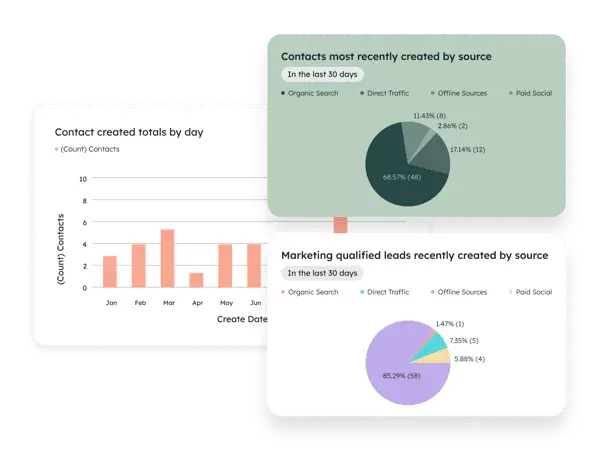
Marketing Hub’s Analytics and Dashboards show marketing and sales the same view of which channels and content are actually driving qualified pipeline, so both teams are working from one updated dataset.
5. Loop sales into content marketing
With marketing teams churning out more and more content, it’s essential to audit what’s actually converting to sales and not focus on vanity metrics. If marketing wants to help sales, marketing also needs to involve them in the content process.
Sales reps understand what matters to prospects at every stage of the customer journey, which makes them invaluable to content creation. Sales insights can spark great marketing ideas. See a few in the table below.
These are all real examples that I’ve seen when sales and marketing talk about what they’re experiencing. Looping sales into the content process lets them steer subject matter in a productive direction and give both departments a stake in the other’s work.
If you’re ready to put that into practice, these tips and tricks can help you get there.
Frequently Asked Questions About Marketing and Sales Alignment
What is the alignment of marketing and sales?
The alignment of marketing and sales refers to the two departments sharing processes, goals, definitions, and data. This alignment is also referred to as “smarketing.” According to HubSpot’s 2026 State of Sales Report, better sales and marketing alignment is cited as a top challenge by 23% of sales leaders, showing that many teams have yet to realize this desire.
What are the benefits of sales and marketing alignment?
The benefits of aligned sales and marketing teams include unified data, faster handoffs, consistent messaging to prospects, and clearer accountability when both teams are measuring the same KPIs. When sales input shapes marketing content, teams also produce stronger content that can generate more leads and shorten the sales cycle.
How do you align sales and marketing teams?
Leadership aligns sales and marketing teams through shared CRM data, goals, KPIs, and frequent, open communication between teams. A CRM is the foundation of this process, since it’s what makes shared data and reporting possible.
Why Marketing and Sales Alignment Matters
Achieving sales and marketing alignment has a direct impact on revenue performance. There are many strategies leaders can employ to get there. But they’re all underlaid by one fundamental strategy: creating an environment that encourages collaboration and fostering a consistent, fluid interchange of ideas and strategies between departments.
Editor’s note: This post was originally published in June 2014 and has been updated for comprehensiveness.
Free Marketing & Sales SLA Template
Align Sales & Marketing goals with this free template.
- Goals
- Initiatives
- Accountability
- Communication
Download Free
All fields are required.
Form not available

![Service Level Agreements: 7 Steps to Writing an Effective One [+ Examples]](https://53.fs1.hubspotusercontent-na1.net/hubfs/53/service-level-agreement-1.jpg)