Welcome to Creator Columns, where we bring expert HubSpot Creator voices to the Blogs that inspire and help you grow better.
If you’re worried about declining organic traffic, I’m going to share some good news in this post. As the founder of an SEO agency that has helped some of the top brands in the world use Google to drive millions of visits, I can appreciate concerns around the SEO AI trends of the past couple of years.
![Free AEO Grader: See Your Brand's Visibility in Answer Engines [Free Tool]](https://no-cache.hubspot.com/cta/default/53/d4233c10-60b6-46d7-9852-c71dde8507b6.png)
It’s painful to watch your hard-earned traffic decline, but here’s the silver lining: Users haven’t stopped searching for information — they’ve just started searching in new AI-driven places. That means that as SEOs, we have a golden opportunity to do what we’ve always done best: show up where our ideal customers are looking. It’s just that now they’re increasingly looking to AI answer engines like ChatGPT, Claude, and Gemini, as well as Google’s AI integrations.
Don’t believe me? Here are just some of the major SEO/AI stats from the past year:
- Nearly half (49%) of marketers say that organic traffic has declined due to AI answers. (HubSpot State of Marketing 2026)
- Forty-three percent of Google Search results with AI Overviews result in zero clicks, compared to roughly 34% without AI Overviews. (Semrush)
- Google’s AI Mode reached 100 million monthly active users within two months of launching. (Google)
In this article, we’ll dive deep into the trends happening in the SEO industry and the role that AI is playing in the constant shifts within the market.
Table of Contents
- How AI Search Is Disrupting Traditional SEO
- AI Content Creation: Balancing Automation with Authority
- Optimizing for AI-Powered Search: AEO and Beyond
- The future of SEO: AI search is here to stay.
How AI Search Is Disrupting Traditional SEO
The Rise of AI-Powered Search Platforms
How often do you use Google alone now to solve problems or ask your burning questions? Chances are, you bring in ChatGPT, Gemini, or Claude to help you out, too. Here are some usage statistics to illustrate just how popular AI search has become:
- ChatGPT: According to OpenAI’s latest count, ChatGPT had over 900 million weekly active users as of February 2026.
- Perplexity: The AI-powered answer engine received 780 million queries in May 2025 alone, according to CEO Aravind Srinivas, as reported by TechCrunch.
- Microsoft Copilot had 150 million total users (commercial and consumer) according to a Microsoft spokesperson, as told to TechCrunch in January 2026.
- A study published in February 2025 found that 27% of Americans used AI chatbots instead of traditional search engines.
That shift in search behavior is worth paying attention to if you want to stay relevant in 2026. HubSpot AEO shows you exactly how your brand is appearing across ChatGPT, Perplexity, and Gemini right now: how often you’re cited, how you compare to competitors, and where the gaps are. Before diving into strategy, it’s worth knowing where you actually stand.
Google’s AI Integration: AI Overviews and AI Mode
For over two decades, Google Search was pretty straightforward: A user typed in a few keywords, and Google served up relevant results via blue links on a page (maybe with a featured snippet or rich content like thumbnails thrown in.)
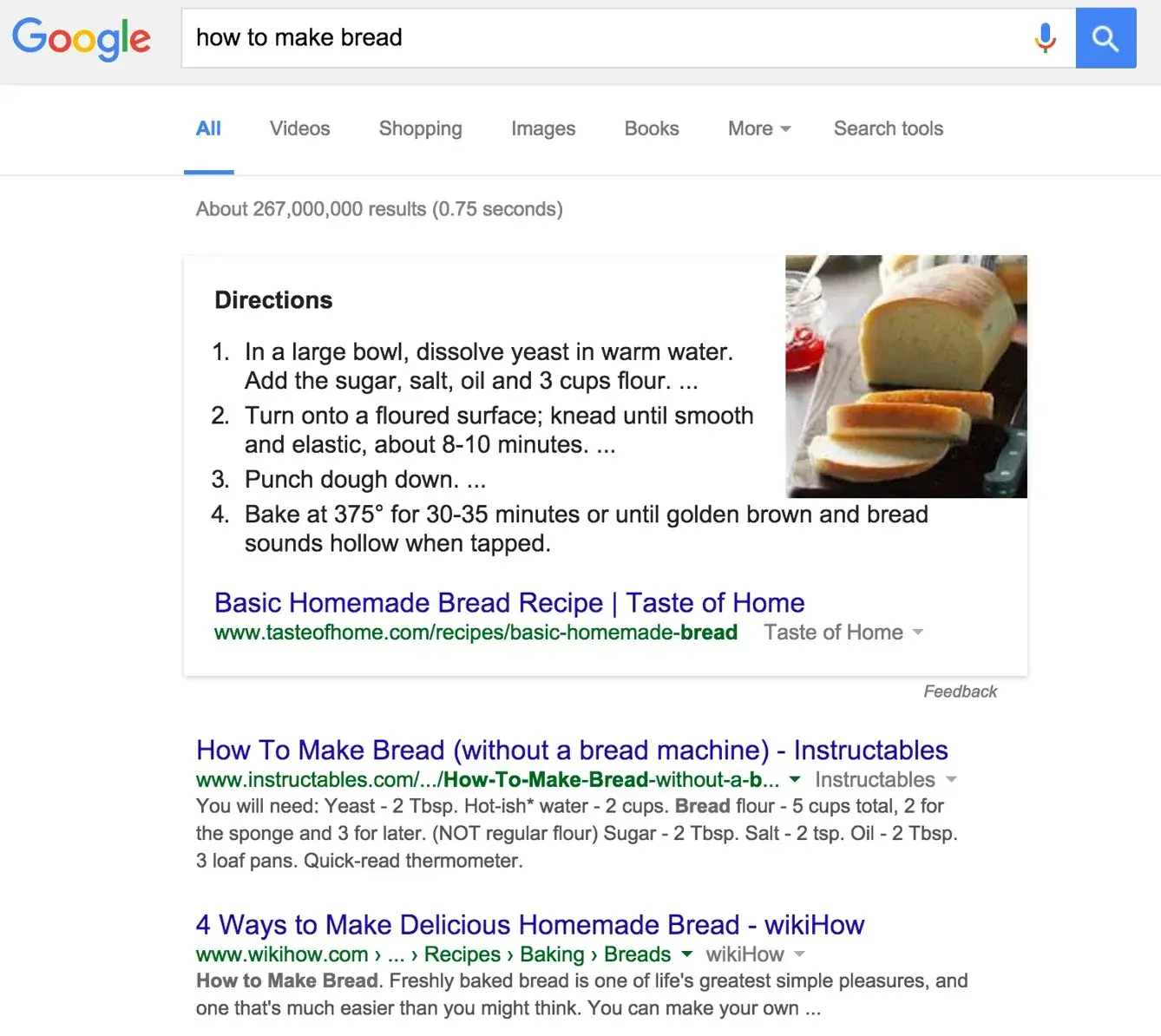
Here’s an example of a pre-AI Google Search for “how to make bread.” There’s a featured snippet listing recipe steps, followed by the classic blue links for the top webpage results.
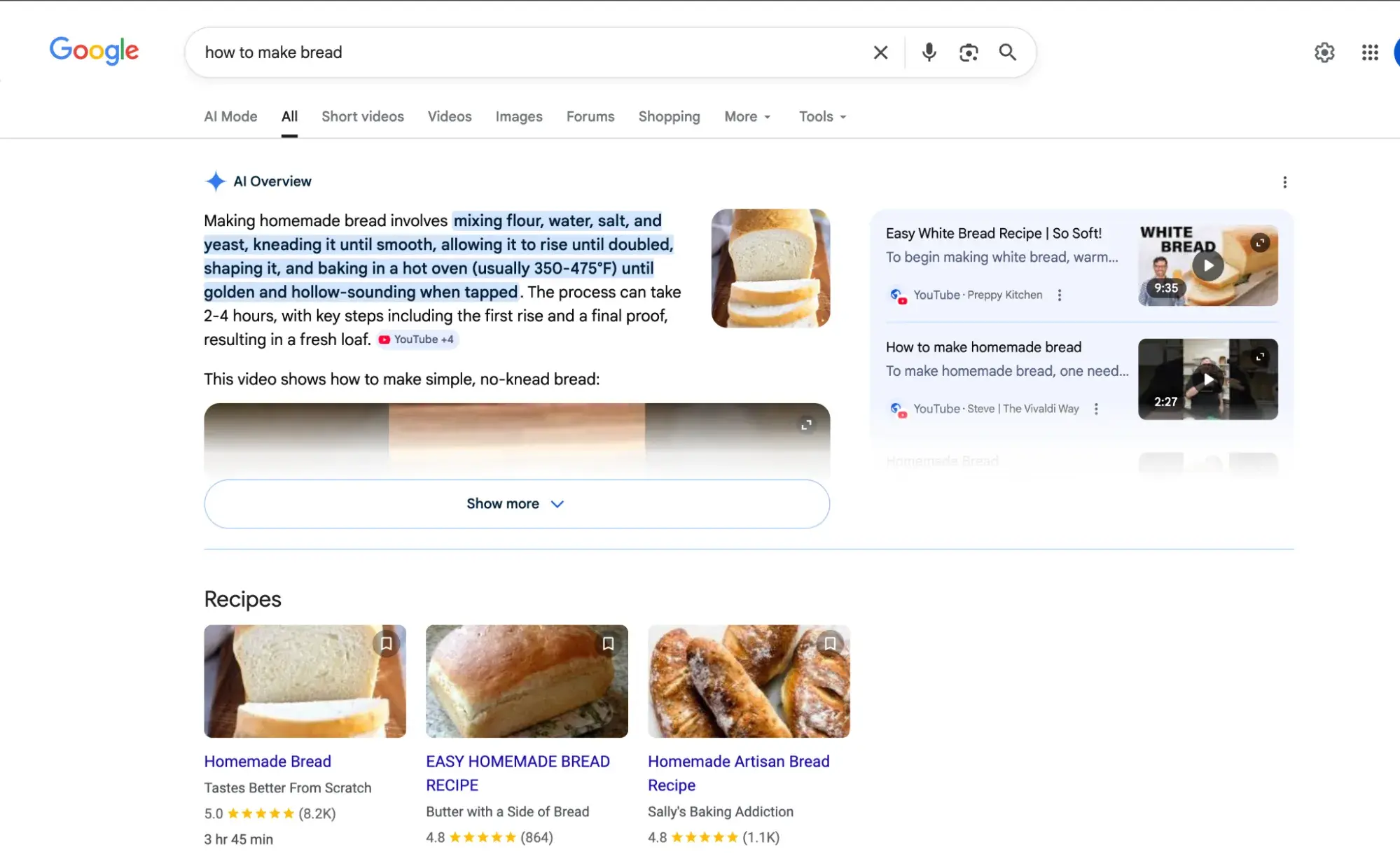
But in May 2024, Google introduced AI overviews, kicking off the era of “zero-click search.” Semrush estimates that about 43% of Google Searches with AI Overviews result in no clicks, compared to roughly 34% without AI Overviews. Here’s what it looks like if you Google “how to make bread” as of March 2026. Notice the prominent AI Overview in place of where a featured snippet used to be.
Then, in May 2025, Google started rolling out AI Mode to U.S. users. Here’s how “how to make bread” looks when you use Google’s AI Mode. It’s akin to a ChatGPT conversation, complete with a chatbox where you can ask follow-up questions. You can see how users don’t even need to click through to a website when all they have to do is ask the AI. Semrush estimates that 92-94% of searches made in Google’s AI Mode result in no clicks at all.
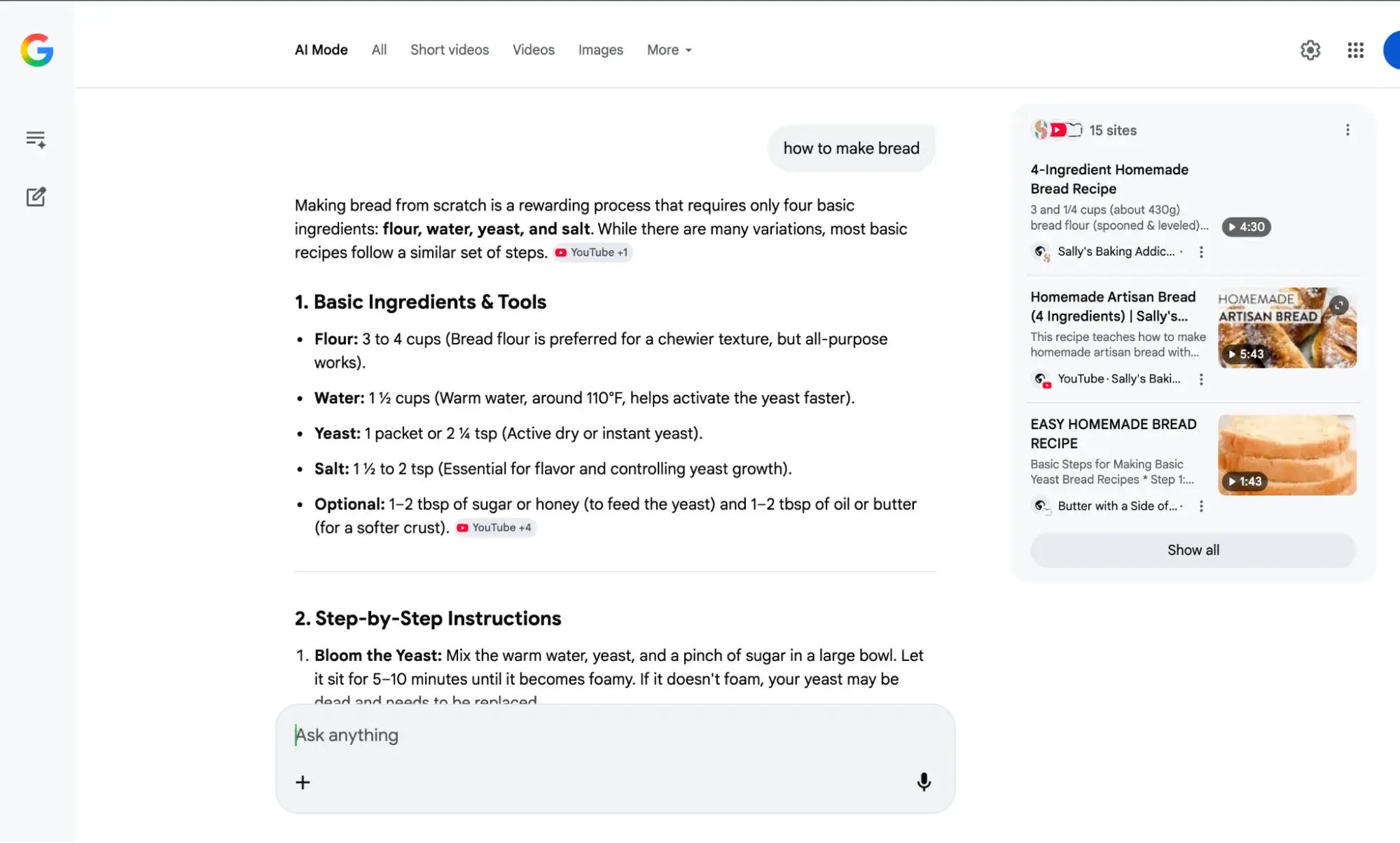
By July 2025, Google CEO Sundar Pichai shared that AI Overviews had surpassed 2 billion monthly users across 200 countries and territories, while AI Mode had surpassed 100 million in the U.S. and India.
With the drastic decline in clicks, one thing is clear for SEO professionals: We’ve got to stop measuring success in clicks and visits alone, and start focusing on metrics that matter in AI search: mentions and citations.
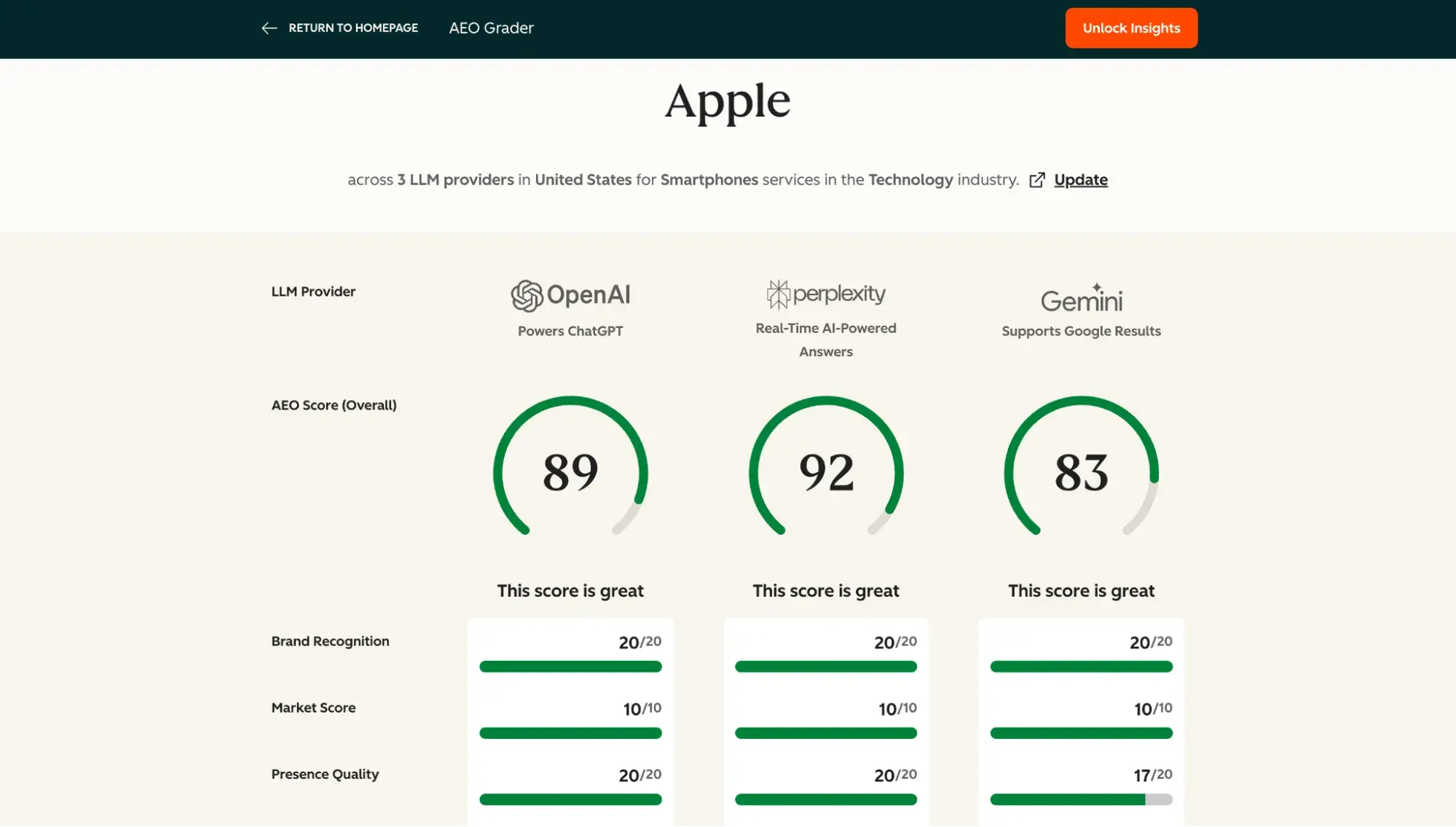
Pro tip: Not sure how you stack up in AI search? HubSpot’s free AEO Grader gives you a snapshot of your AI visibility. Just enter your URL and get a detailed report on how ChatGPT, Perplexity, and Gemini see your brand.
The Shift from Keywords to Conversational Queries
There’s another change we’re going to have to get used to: We’re no longer just targeting keywords; we’re targeting queries too. The ChatGPT-style prompts that consumers are using today make the long-tail keywords of yesteryear look laughably brief.
In this AI search era, what used to be a quick Google search term of “best website builders for small business” has become “What’s the best website builder for my small lawncare company with 10 employees and no developers or designers? Also, give me a cost comparison and a pros/cons list.”
LLM chatbots and Google’s AI Mode allow users to do something they’ve never been able to do before: have entire conversations about a topic by asking follow-up questions.
What this means for SEOs: Our content needs to be more comprehensive by covering the subtopics that query fan-outs might search for. Instead of targeting a single keyword, we need to target multiple subtopics that are relevant to the main topic.
AEO Grader
Learn how leading answer engines like ChatGPT, Perplexity, and Gemini interpret your brand.
- Understand your competitive landscape
- Discover your brand perception in AI results
- Maximize performance with data-driven insights
- And more!
AI Content Creation: Balancing Automation with Authority
Eighty percent of marketers use AI to create content, according to HubSpot’s State of Marketing 2026 report, which begs the question of how to do so without sacrificing quality or accuracy.
Let’s walk through a guide on how to use AI to further your SEO goals — not hurt them. But first, it’s important to understand just how mainstream AI-generated content has become.
The Quality Debate: AI vs. Human Content
In 2024, when my SEO agency surveyed marketers on what they thought about AI-generated content, more than 40% said that they thought AI was worse than humans at creating content:
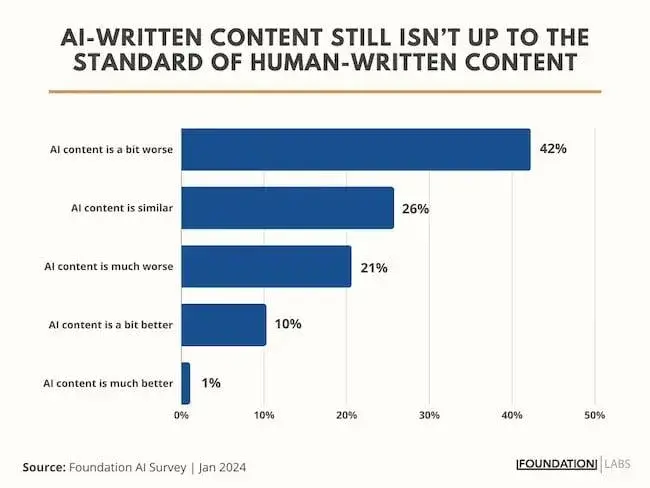
But the truth is more nuanced: Many studies show that, when unaware of how the content was created, most people actually prefer text written by AI over text written by humans. This happened in a 2023 MIT study, a 2024 Semrush survey, and a 2024 Bynder survey.
In my opinion, those studies highlight that AI content is not the problem. Clearly, AI can produce content that humans deem worthy of reading (at least, when they don’t know that AI created it). What humans really care about is the content’s usefulness, originality, and accuracy — all aspects that can be ensured by expert human review.
That doesn’t mean AI should replace humans. It’s my belief that the best workflow for teams using AI to create content is one that is inclusive of real human editors who review a piece before it goes live.
Building an AI-Enhanced Content Workflow
Here’s a diagram of the modern AI content marketing workflow that I believe is needed today. In this approach, humans are still implementing the upfront research and identification of core elements of the content but then allowing AI to support the development of a draft.
I’ll walk you through each step in more detail below the graphic.
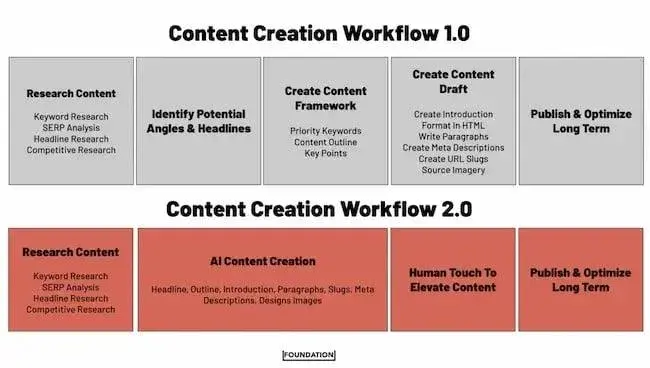
Step 1: Conduct thorough research.
As a content marketing agency, we have access to a combination of writers, editors, strategists, and designers who all have unique experience and expertise.
When a client comes to us looking to achieve a certain goal, the strategy team works closely with SMEs to develop plans that incorporate everything from SERP analysis to keyword research to guide the stories that will be written, recorded, and published.
Step 2: Use AI to assist with first drafts.
In our experience, AI tools like HubSpot’s Free AI Blog Writer are great for getting an initial draft and outline developed. Once the draft is completed by the AI, a human expert can be assigned to the content for edits and revamp it to make something great.
The integration of AI into SEO workflows heralds a new era of productivity and efficiency. According to Nielsen Norman Group, generative AI systems improve employee productivity by more than 66%. The increase in productivity for more technical jobs like computer coding was even greater than that, as seen below.
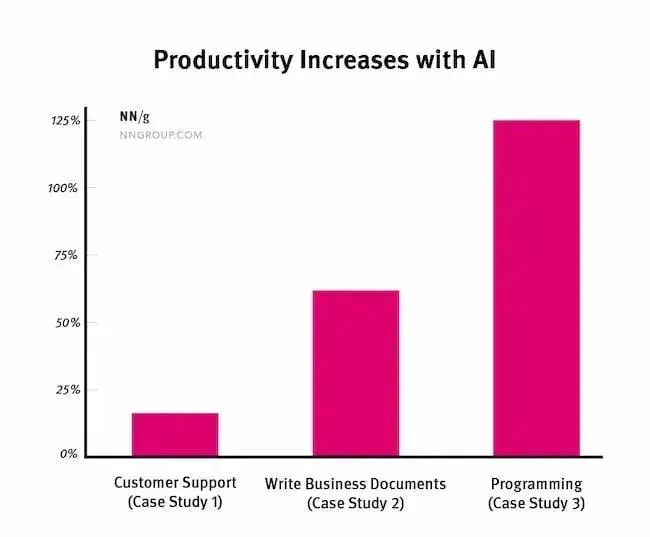
This shift means that SEO experts, writers, and marketers who understand AI can do more than those who avoid it. Breeze by HubSpot provides marketers with a suite of different AI tools that will help them accelerate their productivity levels and efficiencies in hours.
Step 3: Bring in human experts to elevate the content.
Here’s where I believe real human editors bring the true value to AI-assisted content. Your team must review everything that AI generates before it gets published. AI is prone to hallucination, and it can’t always capture your unique voice or insight. Have a human review for voice and tone, fact check for accuracy (especially if statistics and research are involved), and add the unique perspectives that only humans can bring.
Step 4. Publish and continue to optimize.
After you hit publish, it’s not over, as every SEO pro knows. You’ll still need to monitor the important metrics, which now include AI search metrics like brand mentions/citations and share of voice. (I talk more about AI search performance metrics below.) Then, you’ll need to consistently update it over time to stay fresh for both traditional and AI search.
HubSpot’s SEO tools are integrated with the CMS so you can analyze and optimize content in one place.
Google’s Response to AI Content Proliferation
As AI-generated content increased significantly after the launch of ChatGPT in November 2022, the quality of content in the SERP declined. More and more complaints were posted daily on channels like X and LinkedIn, suggesting that AI was ruining the search experience for users and that more people were moving their search queries to Reddit, TikTok, and Quora.
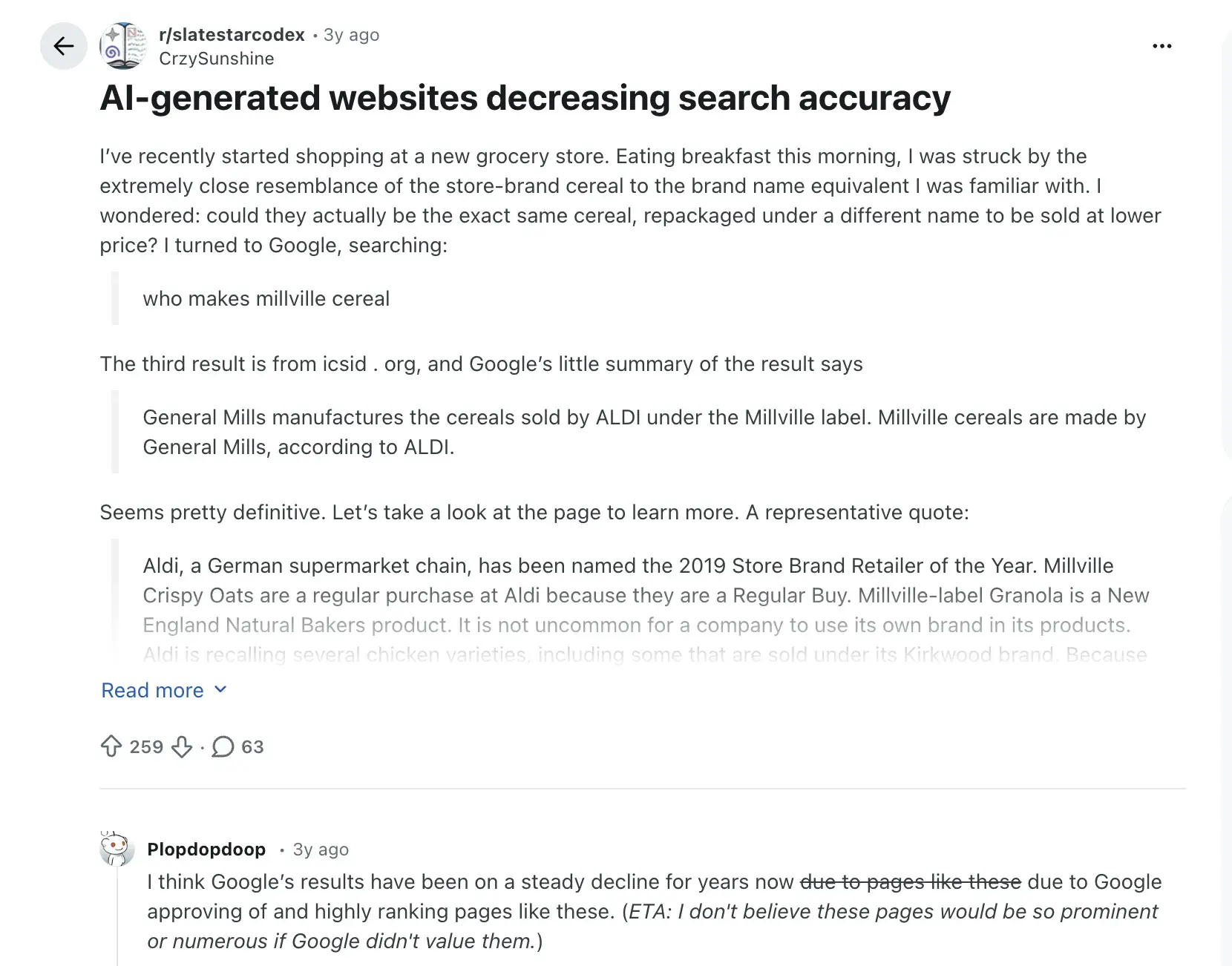
As a result, Google rolled out algorithm updates targeting sites that filled the internet with spam and low-value content.
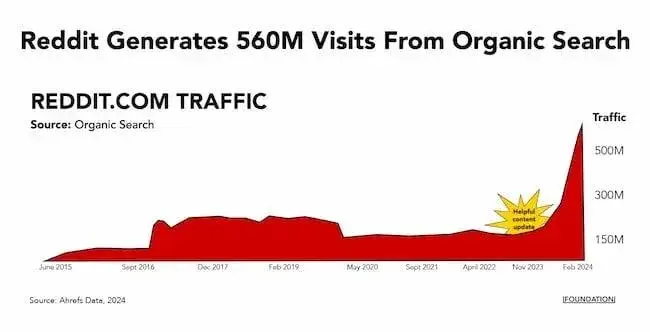
In September 2023, Google’s Helpful Content Update took place, and the rise of Reddit domains in the SERP skyrocketed in just a few weeks:
Now, let’s be clear: Google does not prohibit the use of generative AI, but its guidelines do prohibit the use of generative AI to create spammy content. Here’s exactly what the search giant says in its Google Search Central documentation (last updated December 2025):
“Generative AI can be particularly useful when researching a topic, and to add structure to original content. However, using generative AI tools or other similar tools to generate many pages without adding value for users may violate Google’s spam policy on scaled content abuse.”
Since 2023, Google has continued to make major moves to combat AI slop, including a major core update in March 2024 that cracked down on “scaled content abuse.” Importantly, at the same time as that update, Google reiterated its stance on AI-generated content, stating, “Our long-standing spam policy has been that use of automation, including generative AI, is spam if the primary purpose is manipulating ranking in Search results.”
Most recently, Google rolled out a spam update in March 2026, targeting spammy, low-value content. This was followed by a March 27th core update.
Google is steadily tightening its enforcement against low-effort AI content while making it clear that AI-assisted content is perfectly fine when it meets quality standards.
Optimizing for AI-Powered Search: AEO and Beyond
Now that you see the weight of these latest SEO AI trends, it’s time to tackle optimizing your content for AI-powered search.
Understanding Generative Engine Optimization (GEO)
Generative engine optimization (GEO), also known as answer engine optimization (AEO), is the practice of making content that AI answer engines are more likely to extract from and cite. (If you’re new to AEO, start with an AEO audit to benchmark your current visibility.) These answer engines include Google AI Overviews, ChatGPT, Perplexity, and Claude. GEO is kind of SEO 2.0, but instead of optimizing for traditional search engines, you’re optimizing for AI search. In short, AI search engine optimization is about earning visibility in these AI-powered results.
GEO is a concept that was studied and submitted for review in November 2023 by Pranjal Aggarwal, along with peers from Princeton and IIT Delhi. HubSpot prefers the term “AEO.”
The top-performing optimizations cited in the Princeton/IIT Delhi report for GEO efforts included:
- Quotation additions
- Statistic additions
- Fluency optimization
- Cited sources
- Technical terms
- Authoritative comms
The beauty of these findings is that, overall, they’re aligned with best practices for good SEO content. The shift here is simply reassuring the importance of creating high-quality content and making an effort to create content with research, data, experts, and insight.
AEO Grader
Learn how leading answer engines like ChatGPT, Perplexity, and Gemini interpret your brand.
- Understand your competitive landscape
- Discover your brand perception in AI results
- Maximize performance with data-driven insights
- And more!
Key Optimization Strategies for AI Visibility
With AI-powered search, marketers and SEOs now have the ability to influence large language models so that when a prospect asks ChatGPT a question, their brand shows up in the answer. Here are some AEO strategies worth implementing to improve your chances of getting cited:
1. Answer directly and early.
There’s a reason journalists have the motto “don’t bury the lede.” Humans want the most important information upfront, and it turns out, so does AI.
Studies show that content placed earlier in a webpage tends to get cited more by AI. Growth advisor Kevin Indig analyzed 1.2 million ChatGPT answers and found that content that appears in the first 30% of a text is more likely to be cited by ChatGPT. In fact, 44.2% of ChatGPT citations came from the first 30% of the article. “To win in the AI era,” Indig writes, “you need to start writing like a journalist.”
Further, a CXL analysis of over 100 Google AI Overview citations found that 55% of AIO citations came from the first 30% of the text, while only 21% came from the bottom 40%.
These studies prove correlation, not causation, but I still think it’s wise to say what you mean up front, keep it clear, and save the explainers for after you’ve delivered the answer.
For example, instead of writing, “According to HubSpot’s State of Marketing 2026, 80% of marketers use AI for content creation,” write, “Eighty percent of marketers are using AI to create content, according to HubSpot’s State of Marketing 2026.”
2. Write in semantic triples.
Semantic triples are sentences that follow this pattern: Subject + verb + object. Example: “HubSpot (subject) is (verb) a unified customer platform (object).”
Semantic triples help AI engines understand what your brand is, what it does, and how it relates to other things, giving AI a clean answer it can drop right into a response.
And the research supports this. Indig found that cited passages were nearly twice as likely to use clear definitions (statements structured as “X is” or “X refers to”) compared to content that wasn’t cited. Clear language beats convoluted sentences. For example, instead of writing, “With advanced automation and email tools, HubSpot is a major player in the marketing software industry,” it’s better to be clear and direct: “HubSpot sells marketing software with advanced automation and email tools.”
It also helps to be specific with names, so the AI knows exactly who you’re referring to. Indig’s analysis showed that heavily cited text averaged 20.6% proper nouns, compared to just 5-8% in typical writing. So instead of “It automates marketing campaigns,” write, “HubSpot automates marketing campaigns.”
3. Add FAQs.
You’ve probably noticed lots of blog posts these days tack on an FAQ section at the bottom. That’s because this creates easy “chunks” for AI engines to pull quick answers from. It’s even better if you use schema markup to enhance these sections, which we’ll talk about below.
Even though the studies above show that AI citations tend to come from early in a page, CXL’s study found that FAQ blocks were an exception — they drove a “meaningful share” of citations from the bottom of a page because each Q&A pair can stand on its own and is easy for AI to extract.
Additionally, Product Hunt recently shared that adding FAQs to a category page 10X’d its ChatGPT citation rate and roughly doubled its Google AI Overview citations. A caveat, though: The Product Hunt team acknowledged that they later realized the ChatGPT citation jump coincided with a model update, so they can’t actually establish causation there. The doubling of Google AIO citations, though, is a strong signal that the FAQs helped.
4. Insert schema markup.
Schema markup is code that helps crawlers understand the structure of your content.
It’s become an AEO best practice to include schema markup on your pages. And at least one small study from Search Engine Land showed potential for this practice. It compared three webpages: one with good schema, one with poor schema, and one with no schema at all. The only one that got an AI Overview was the page with good schema. And notably, the poor-schema page actually ranked for more keywords in traditional search but still never triggered an AI Overview. The study authors are careful to call their findings “promising, but inconclusive,” so we can’t treat this as proof. Still, it reinforces what we already know: making your content easier for machines to parse is rarely a bad idea. (For a deeper dive, see how AI is transforming technical SEO.)
So what types of schema should you prioritize? Check out HubSpot’s AEO best practices guide to learn the most impactful ones for AI visibility.
5. Take control of your external narrative.
If ChatGPT has seen your brand mentioned in industry publications, cited in research, discussed in Reddit threads, and referenced on authoritative sites, it has a much stronger reason to treat your content as credible than if you exist only on your own domain.
What we’ve seen at my agency is that even reaching 5% citation share from your own domain is impressive. Even in that best-case scenario, third-party domains will drive 95% of your brand’s citations.
So what does this look like in practice? Here are some moves worth making:
- Publish original research. The GEO research paper found that adding statistics to content improved AI visibility by up to 40% — and original data is the kind of content no one else can publish.
- Earn coverage in industry publications. BrightEdge found that across all major AI engines, anywhere from half to three-quarters of citations originated from third-party sources outside the major platforms, like trade publications, niche expert sites, and topic-specific resources. Whether it’s a contributed article, a quote in someone else’s piece, or a feature in an industry roundup, these placements put your brand on domains AI is already pulling from.
- Get on the “best of” lists in your category. As I wrote in a recent post on LLM visibility, one of the most under-executed plays is doing outreach to get added to listicles that are already showing up in AI answers in your category. If you’re not on those lists, you have a gap you need to close.
- Show up on the platforms AI pulls from. Reddit’s partnerships with Google and OpenAI mean its forum contents have influenced major AI systems. And according to Bluefish data reported by Adweek, YouTube has beaten Reddit as the most-cited social platform in AI answers, showing up in roughly 16% of LLM answers compared to 10% for Reddit. Content from LinkedIn can also show up in LLMs. If your team isn’t actively participating in these spaces, you’re missing out on a huge opportunity to influence AI-generated answers.
- Build out your review site profiles. G2, Capterra, Clutch, and TrustRadius may not carry huge trust signals for AI, especially for product recommendation and comparison queries. Make sure your profiles are complete, current, and actively collecting reviews.
Measuring AI Search Performance
SEO looks at metrics like rankings, clicks, and organic traffic. GEO cares about brand mentions, citations, and share of voice in a marketing landscape that’s increasingly “zero click.” Similarweb found that while AI platform usage increased in 2025, AI referral traffic remained the same. That’s because AI platforms are giving direct answers, reducing the need for users to click through to get more information from websites.
So if people are using AI more and clicking less, we need new metrics to support SEO AI trends. Here are popular AEO metrics worth tracking:
- AI Overviews. How many AI Overviews does your website snag in Google?
- Brand mentions. Does your brand get named in AI answers, such as from ChatGPT?
- Citations. Do AI answer engines cite your content?
- Share of voice. Is your brand winning in AI search compared to your competitors? To calculate share of voice, take the number of times your brand gets mentioned, divide it by all brand mentions across you and your competitors, and you’ve got your percentage. If your competitors are getting named in 70 out of 100 AI answers and you’re only in 30, that’s a 30% share of voice.
- Brand sentiment. When AI does cite or mention your brand, is it negative, positive, or neutral?
Pro tip: Tracking these AEO metrics manually isn’t scalable. A dedicated tool like HubSpot AEO can monitor your brand visibility score, track prompts relevant to your business, and provide a list of actionable recommendations to start improving your answer engine visibility. And if you subscribe to HubSpot Marketing Hub Pro or Enterprise, AEO can use CRM data to inform even smarter prompts.
The future of SEO: AI search is here to stay.
The future of SEO is bright — but it looks wildly different from the clicks-driven, Google-centric search of yesteryear. The best companies and marketers will view these SEO AI trends as the beginning of a new age. We’re going to see shifts and volatility in SEO for the next few years, and it will be increasingly important for brands to monitor how AI is impacting SEO, user behavior, and technology at large.
Yes, Google’s AI Overviews and AI Mode shook up the SERPs in 2024 and 2025, but the way the search engine results page looks is likely to continue to change in the next 10 years. If there’s one thing I can be confident about, it’s that change in this industry is not only here — it’s going to keep happening.
My advice to marketers, brands, and businesses is to stay on top of the trends. Subscribe to newsletters (like Foundation Labs), YouTube channels (like Marketing Against The Grain), and podcasts (like Create Like The Greats) talking about these subjects on the regular.
Follow the industry experts who are sharing information as they learn it. Study the trends, and be intentional about creating things that are valuable for the internet.
Do these things, and I’m confident that you will ride whatever chaotic wave comes our way in the next few years. Buckle up. It’s going to be a fun yet rewarding ride.
AEO Grader
Learn how leading answer engines like ChatGPT, Perplexity, and Gemini interpret your brand.
- Understand your competitive landscape
- Discover your brand perception in AI results
- Maximize performance with data-driven insights
- And more!

![SEO audits: How to conduct one that drives traffic growth [+ checklist]](https://53.fs1.hubspotusercontent-na1.net/hubfs/53/seo-audit-1-20251217-6006144.webp)
![How HubSpot became the #1 CRM in AI search [A case study]](https://53.fs1.hubspotusercontent-na1.net/hubfs/53/How-HubSpot-became-the-%231-CRM-in-AI-search.png)