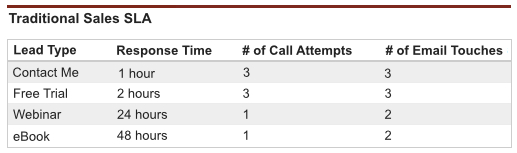

The right RevOps tools help teams stay organized. Reps have a single source of truth, and the opportunity to automate the operational work that keeps teams from selling. This guide breaks down what RevOps tools do, how to evaluate them, and how to build a stack that works.
Table of Contents
-
What are RevOps tools, and how do they work across the customer lifecycle?
- Why RevOps Tools Matter for Alignment, Data Quality, and Predictability
- RevOps Tools Categories You Actually Need
- Where AI and Agents Fit in RevOps Tools
- How to Choose RevOps Tools With a Buyer’s Framework
- Common RevOps Tooling Challenges and How to Avoid Them
- Frequently Asked Questions About RevOps Tools
- Unify your customer and revenue data with HubSpot.
What are RevOps tools, and how do they work across the customer lifecycle?
Revenue operations or RevOps tools connect go-to-market (GTM) data, teams, and workflows in one place. The goal is to give revenue teams a shared view of the customer journey, automate repetitive tasks, and turn that data into insights they can act on. RevOps tools act as connective tissue between marketing, sales, customer success, and finance, so every team works from the same information.
To understand how RevOps tools work, reps need to understand the three layers build into the software system:
- The data layer. This layer ingests, cleanses, and centralizes raw customer and revenue data. Information is gathered from CRMs, data warehouses, and Customer Data Platforms (CDPs) into a single source of truth for all teams. The foundation of a RevOps stack is clean data that every report and forecast can be built on.
- The workflow and automation layer. This layer manages lead routing, enforces governance rules, triggers automated email sequences, and passes clean customer context between the tools different teams use — without manual human effort. This frees up reps and managers to focus more on actual selling and retention.
- The intelligence layer. This layer sits on top of data and workflows to provide forecasts and recommendations. The intelligence layer leverages AI to score accounts, identify churn risks, forecast pipeline health, and suggest the “next best action” for frontline reps.
Read: A Guide to RevOps for Startups
Free Sales Software
Built for productivity, powered by relevance.
- Sales Automation
- Call Tracking
- Lead Prospecting
- And More!
How RevOps Tools Synchronize the Customer Lifecycle
RevOps tools operate continuously across the customer lifecycle to ensure that handoffs between teams are frictionless. Here’s how they drive value at each phase.
- Attract and capture (Top of Funnel): At the beginning of the customer lifecycle, RevOps tools focus heavily on data alignment. These tools capture intent data and enrich anonymous website traffic with firmographic details. RevOps tools can then automatically route high-value accounts to the correct rep or territory the moment interest is shown.
- Engage and convert (Middle of Funnel): As a prospect moves into an active sales cycle, RevOps tools switch to workflow execution. Deal rooms, conversational intelligence software, and CPQ (Configure, Price, Quote) engines help reps move deals forward faster and close with error-free contracts.
- Retain and expand (Bottom of Funnel): Post-sale, the focus shifts to data intelligence. RevOps tools track product usage data, customer support tickets, and contract milestones. If usage drops, the system triggers an early warning alert for customer success. If usage spikes, the system automatically flags the account as a prime candidate for an upsell or expansion campaign.
Why RevOps Tools Matter for Alignment, Data Quality, and Predictability
RevOps tools matter because they fix problems that compound as a company grows. For example, a ten-person startup can run revenue operations on shared spreadsheets and good memory. But, a hundred-person company cannot. RevOps tools carry the weight of that scale, and they do it in three areas: data alignment, data quality, and predictability.
Eliminating Silos to Create True Alignment
When sales, marketing, and customer success teams use disconnected tools, they end up optimizing for their own siloed goals. RevOps tools break down these walls by giving all teams a shared source of truth.
Consider a lead handoff. In a siloed stack, marketing might pass a lead over to sales and consider their job done. But, the rep may not see the full engagement history. The rep starts the call blind, making the prospect repeat what they already told marketing. The whole interaction feels disjointed.
With integrated RevOps tools, the rep gets an automatic alert about the new lead, along with the full record of what the prospect has already discussed. That way, the rep picks up the conversation where marketing left off.
Safeguarding Data Quality Automatically
Bad data is a productivity killer. When reps have to manually deduplicate records, guess phone numbers, or cross-reference outdated spreadsheets, they spend less time selling. RevOps tools solve this by automating data governance to keep information clean and ready to use.
Instead of making a rep research a lead who just signed up for a free trial, the data layer already has full context on the prospect. Within seconds, the RevOps tool fills in the CRM record with the company’s annual revenue, tech stack, and employee count. Duplicate information is also removed. As a result, frontline teams spend their time acting on reliable data instead of cleaning it up.
Turning Volatility Into Revenue Predictability
Leaders need to know what revenue is coming and when. Guesswork doesn’t hold up in a board meeting. To help teams see what’s ahead, RevOps tools use historical data and machine learning to predict how much revenue the business can expect.
For example, instead of a sales manager guessing whether a major deal will close this quarter, the RevOps intelligence layer looks at actual buyer behavior. The tool scans conversational intelligence transcripts, tracks how often the prospect replies to emails, and reviews past deal velocity. The system can then note which deals are healthy and which ones are at risk.
Read: Why your B2B company should explore a revenue operations strategy
RevOps Tools Categories You Actually Need
Building a RevOps stack doesn’t mean buying a different tool for every problem. Instead, it means understanding what the finance and sales teams need, then picking a tool that aligns.
Here’s a breakdown of the core RevOps tool categories you need, along with how HubSpot fulfills each function.
1. Customer Relationship Management (CRM) Platform
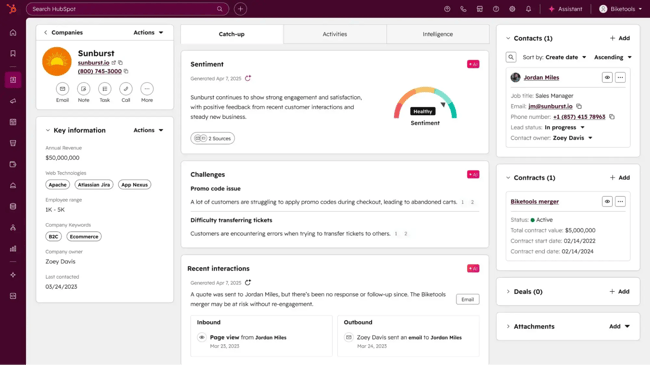
The CRM is the central operating system of your business, acting as a single source of truth. The CRM stores every account record, contact profile, and historical interaction across the entire organization.
How HubSpot Helps: Smart CRM
HubSpot’s Smart CRM organizes contacts, companies, deals, and tickets in one shared record. Because it sits at the center of the platform and connects to all other Hubs, any update one team makes is immediately visible to all others.
2. Data Quality and Integration Platforms
These platforms are responsible for keeping customer and revenue data clean and connected to other platforms across the organization.
- Integration tools sync records between software apps, so a change in one system reflects in the others.
- Data quality tools handle data enrichment, deduplicate redundant contacts, and keep external databases and your central ecosystem in sync.
Without data quality and sales tools, teams would waste budgets on dead-end leads. Customer support reps would lack the context they need to prevent frustrating client experiences, and executives would make strategic decisions based on flawed reports.
How HubSpot Helps: Data Hub
HubSpot’s Data Hub handles both integration and data quality. Its data sync keeps records aligned across 100+ apps with real-time, two-way syncing, so a phone number updated in one tool updates everywhere.
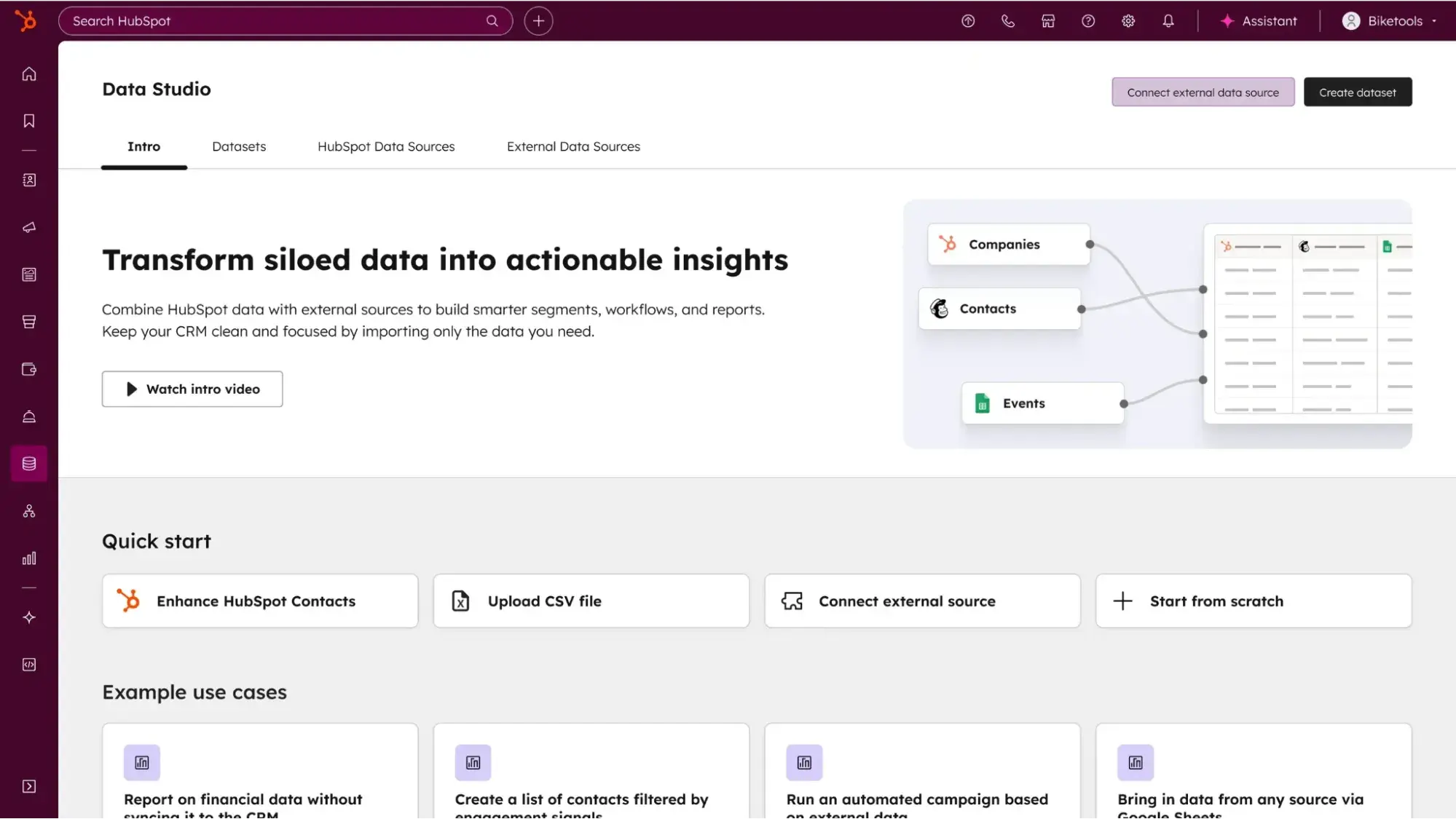
HubSpot’s data quality software uses AI to flag duplicates, fix formatting, and enforce field rules automatically. For teams running a warehouse, Data Hub also syncs with Snowflake and BigQuery.
3. Analytics, Reporting, and Revenue Intelligence
This category turns raw activity into decisions. Analytics and reporting tools track pipeline, conversions, operational efficiency, and revenue trends, while revenue intelligence surfaces what’s working and what isn’t. RevOps teams use tools in this category to answer the questions leadership actually asks, like where deals stall and which channels bring in revenue.
How HubSpot Helps: Dashboard & Reporting Software
HubSpot’s analytics and reporting tools track customer interactions, measure campaign performance, and compile business data into visual dashboards. Teams can make custom reports that define relationships across multiple objects — like linking marketing spend to actual closed-won revenue — that standard reports can’t capture.
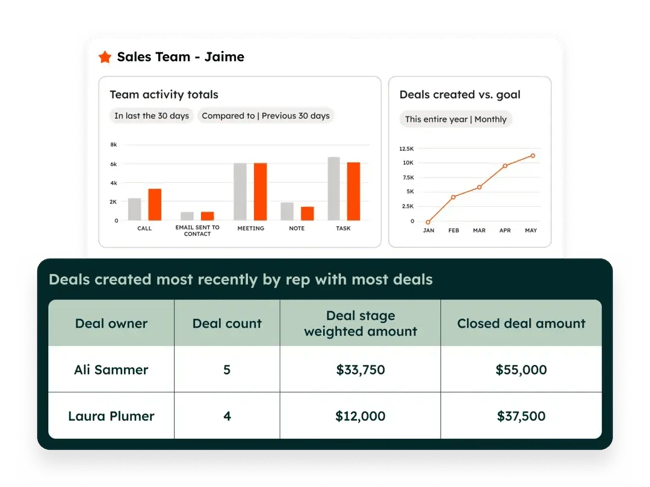
The software also provides executive-ready dashboards that track team velocity, pipeline health, and lifecycle attribution. Because every report pulls from the same Smart CRM, the numbers stay consistent across departments.
4. Pipeline, Deal Intelligence, and Forecasting
These tools focus on the health of your active sales cycles. Pipeline tools show which deals are in play and which ones are stuck (and where). Deal intelligence platforms analyze buyer behavior to flag churn risk. Forecasting software projects which deals will close and when. Together, they replace gut-feel predictions with something managers can defend to the C-suite.
How HubSpot Helps: Pipeline Management and Forecasting Software
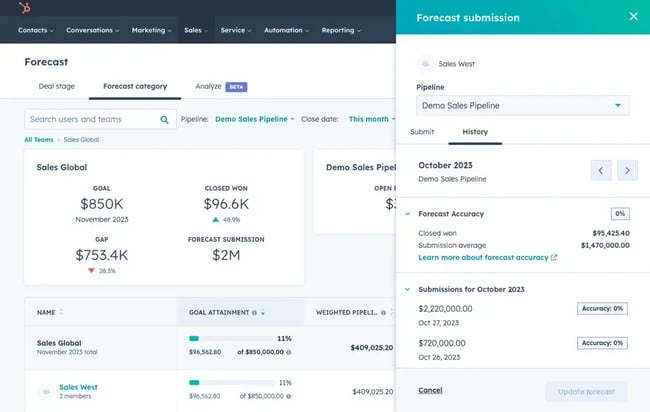
HubSpot’s Sales Hub provides a pipeline management tool that gives reps and managers a clear view of every deal by stage. Updates are automated as deals move. This allows sales teams to prioritize hot leads and close more deals. Sales Hub also has a forecasting software that tracks active sales pipelines and deal activity to predict future revenue.
Free Sales Software
Built for productivity, powered by relevance.
- Sales Automation
- Call Tracking
- Lead Prospecting
- And More!
5. Sales Engagement and Enablement
Sales engagement tools optimize a rep’s daily execution. They handle outreach at scale, manage personal tasks, automate follow-up sequences, and keep essential content readily accessible during active conversations.
Sales enablement tools, on the other hand, keep reps equipped with the right content and playbooks to engage buyers effectively. This category helps reps spend more time selling and less time on manual admin.
How HubSpot Helps: AI Features in Sales Hub
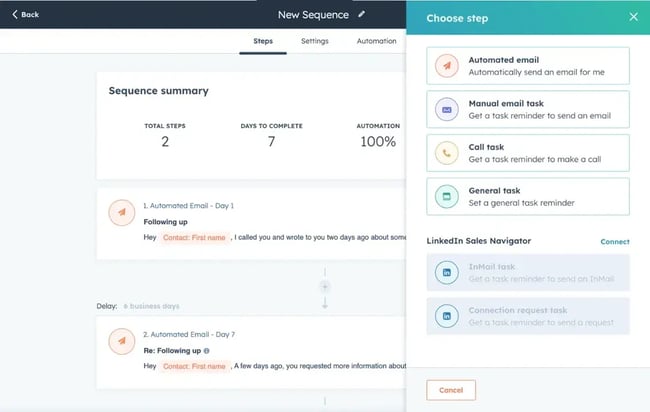
HubSpot’s sales automation software handles email sequences, task reminders, and personalized follow-up so reps can stay on top of outreach without typing each email by hand.
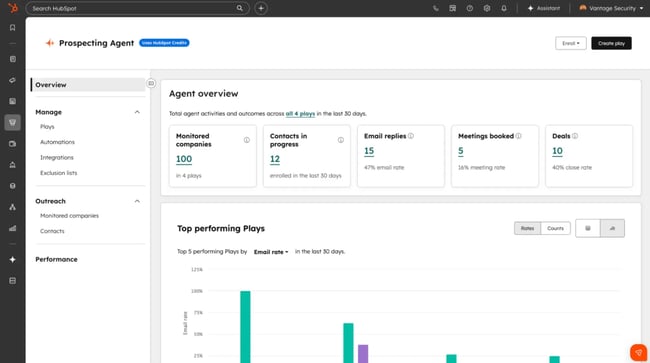
Prospecting Agent takes automation further by researching target accounts. The AI agent monitors buying signals, like funding rounds and new hires, then drafts personalized outreach inside the CRM. Reps review and approve before anything sends, so the AI handles the legwork while the rep maintains control.
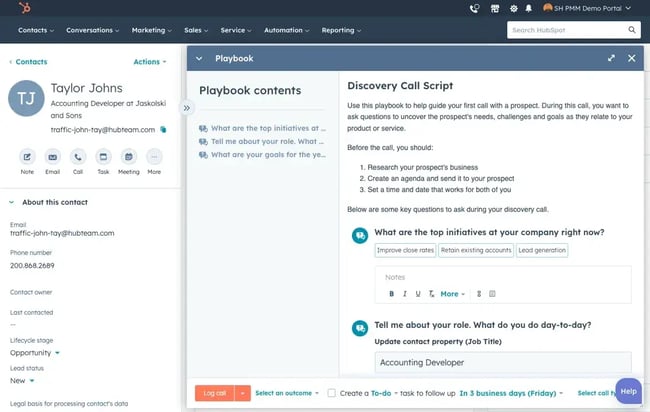
Additionally, Sales Hub features like snippets, templates, and playbooks are embedded directly within the contact record. Reps get interactive scripts and collateral to guide their prospects smoothly through the buying process.
6. Marketing Automation and Attribution
Marketing automation tools nurture leads through multi-channel campaigns (email, SMS, social media, etc.). Then, attribution tools connect revenue back to the marketing that produced it. RevOps teams need automation and attribution to prove which campaigns drive pipeline. Marketers can also provide context for each lead that is handed off to the sales team.
How HubSpot Helps: Marketing Hub and Multi-Touch Attribution
HubSpot Marketing Hub automates lead nurturing workflows across email, social media, and digital ads. Built-in multi-touch attribution reporting maps the entire buyer journey, showing exactly how initial website visits, content downloads, and marketing interactions impact sales.
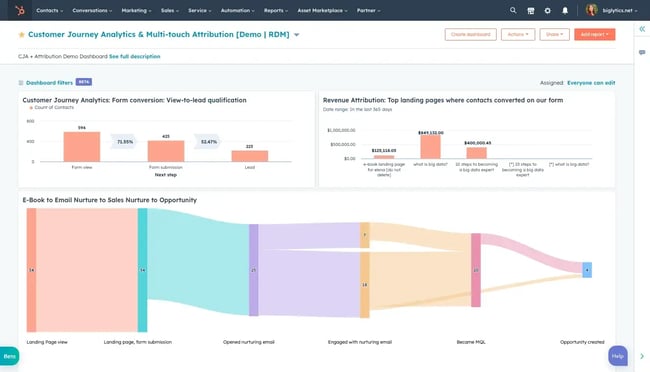
Because marketing and sales teams share the same CRM, a lead’s full engagement history carries forward when it reaches a rep.
Read: What is Marketing Automation? A Beginner’s Guide
7. Customer Success and Service Operations
Revenue doesn’t stop at the closed deal. Post-sale, service and success tools manage customer needs. These tools help manage tickets, customer onboarding, and renewals. Service reps also get visibility into account health throughout a customer’s lifetime.
How HubSpot Helps: Service Hub and Customer Agent
HubSpot Service Hub centralizes support tickets, customer conversations, feedback surveys, and support workflows into one system. Service Hub integrates natively with HubSpot CRM.
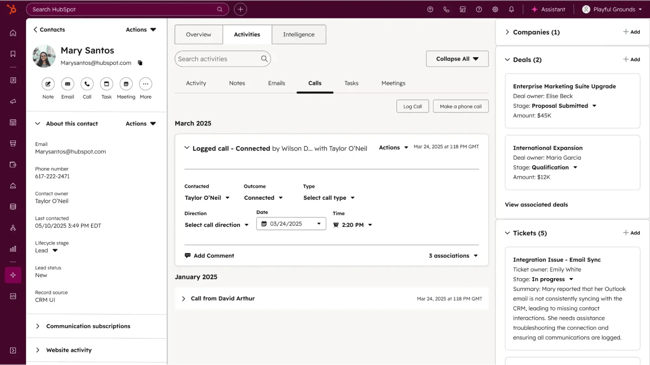
Customer Agent is embedded in Service Hub. The AI system can handle routine support conversations across channels and resolve a majority of them on its own. Human reps can then focus on higher-stakes accounts. RevOps teams can also build automated workflows that alert account managers the moment a support ticket stays open too long, so they can respond quickly.
8. Commerce, CPQ, and Billing Coordination
This category closes the loop between a signed deal and collected revenue. CPQ tools handle configure-price-quote so reps can generate error-free quotes fast, and billing tools manage invoices, subscriptions, and payments.
How HubSpot Helps: Revenue Hub
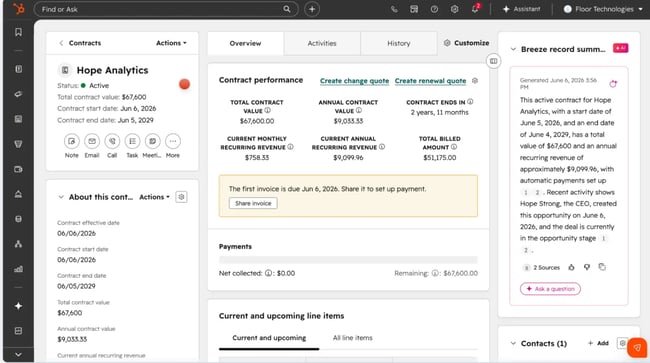
Reps can use HubSpot’s CPQ tool to generate custom, branded quotes and send them out for secure e-signature. Once approved, Revenue Hub processes the payment immediately, connecting your front-office sales cycle to your back-office finance systems.
Where AI and Agents Fit in RevOps Tools
AI is now a standard part of most RevOps stacks, handling the repetitive work that eats up a team’s time. AI helps in four ways:
- Predictive AI. This AI analyzes historical data to forecast what’s likely to happen next. In RevOps, this powers lead scoring, deal risk flagging, and revenue forecasting.
- Perceptive and conversational AI: This AI translates messy, unstructured human communication into structured data that machines can read. Perceptive AI transcribes sales calls, tracks buyer sentiment, scans emails to update deal stages, and analyzes website behavior to flag high-intent accounts.
- Generative AI. Generative AI acts as a digital assistant that speeds up everyday tasks for human reps. They often come in the form of Assistants, like Breeze Assistant, which can draft personalized outreach emails, summarize a contact’s history, and answer questions about product features. However, reps have to review the results and decide whether to use them as is, tweak them, or discard them entirely.
- Autonomous AI agents. These agents don’t just flag problems or draft copy, but independently execute complete, end-to-end operational workflows. In other words, they’re a tireless extension of the GTM operations team, working 24/7 to handle the tasks the team needs them to.
HubSpot Agent Hub is a prime example. Here are a few autonomous agent options for RevOps teams:
- Prospecting Agent. This agent autonomously researches target accounts, watches for real-time buying triggers, builds tailored contact lists, and drafts personalized outreach sequences.
- Customer Agent. This agent operates around the clock, drawing directly from your internal knowledge base to resolve customer support tickets, answer product questions, and troubleshoot issues. Customer Agent routes a conversation to a human specialist when their expertise is required.
- Data Agent. This agent works in the background, merging duplicate contact records, populating missing firmographic details, and cleaning up formatting anomalies across your entire CRM.
- Specialized Agents. To scale pipeline generation, Agent Hub features over 15 additional application-specific options — such as Blog Research Agents, Deal Loss Agent, and Customer Health Agent.
Teams can also build their own agent. They simply give the agent a goal and a set of rules, and the agent carries out the steps to reach that goal.
Free Sales Software
Built for productivity, powered by relevance.
- Sales Automation
- Call Tracking
- Lead Prospecting
- And More!
How to Choose RevOps Tools With a Buyer’s Framework
Choosing the right RevOps software goes beyond finding the tool with the most robust feature set. The goal is a system that fits the business strategy and scales without breaking. The five steps below walk through how to evaluate and build that stack.
Step 1: Start with strategy, data model, and governance.
Before looking at any software vendors, the team needs to understand exactly how the business makes money and how internal data needs to flow. Buying a tool to fix a broken, undefined process will only make operational problems worse. Here’s what to work through:
- Name the problems in order. List the specific issues the stack needs to solve, like weak forecasting or messy handoffs, and rank them. This keeps the search focused on actual business gaps instead of feature lists.
- Define your critical metrics. Map out exactly how the business defines a marketing lead, a sales opportunity, and a customer churn risk, so everyone agrees on the terminology.
- Map the data model. Draw a simple map showing the core objects the business runs on (contacts, companies, deals, tickets), how they relate to one another, and which teams need access.
- Set governance rules. Decide who owns which fields, how records get created, and what “clean data” means for the team. Also establish who has permission to edit records, create custom properties, or delete data.
Read: Data Governance (DG): A Straightforward Guide
Step 2: Prioritize the platform core before point solutions.
Teams should settle on their central platform first before adding specialized point solutions. This minimizes the risk of tool sprawl and saves your team from dealing with disconnected tools. At this stage, the team should:
- Choose the CRM first. This is the system of record that stores customer and revenue data, and connects workflows across multiple teams. Get this right, and the rest of the stack has a stable base. HubSpot offers a CRM built for collaboration.
- Check what the CRM offers before buying extra tools. Many CRMs, like HubSpot, handle reporting, workflow automation, and forecasting well enough that a separate tool isn’t needed. This can save costs and prevent tool overlap.
- Add point solutions only for real gaps. When the platform genuinely can’t do something the team needs, that’s when a specialized tool earns its place. For example, if the CRM doesn’t have conversation intelligence or forecasting, the team can integrate it with Gong to provide those functions.
Step 3: Test integrations, data syncing, and identity resolution.
The point of a RevOps tool is to unify processes and information across several departments. So, teams should check that the tool they’re evaluating can connect to the rest of their tech stack. Data must be able to flow seamlessly back and forth across all systems without creating duplicates or lagging. During evaluation, the team should:
- Confirm true two-way syncing. Check that the tool syncs with the central platform (the CRM) and that updates flow in both directions. A one-way sync leaves one system out of date.
- Test with real data, not a demo account. Run a trial of the tool with the team’s actual customer records. This shows how the tool will behave in the real world.
- Check identity resolution. Make sure the tool can recognize when records across systems refer to the same person or company. Without this, the same customer can show up as three different contacts in the CRM.
- Avoid custom code traps: Favor tools that offer native, plug-and-play integrations over solutions that require the team to build and maintain expensive custom API connections.
Step 4: Prove time savings and adoption.
It’s easy to get distracted by stunning reporting dashboards during a sales demo. However, if frontline sales reps or customer success managers find the tool confusing, they won’t use it, and data quality will suffer. To pressure-test time savings and product adoption, the team should:
- Run a frontline trial. Have a small group of active reps test the software in their daily routines to see if it actually makes their jobs faster. Track how long a task like lead research or CRM updates takes before and after the tool.
- Watch adoption during the trial. See whether reps and managers use the tool without being reminded to. Low adoption in a trial usually means low adoption after purchase.
- Focus on active adoption. Look for software with clean, intuitive interfaces that require minimal training so your team can hit the ground running.
Step 5: Build a six-month roadmap with clear milestones.
Rolling out everything at once tends to overwhelm the team and lead to integration mistakes. Instead, the team should break the deployment down into manageable milestones over a six-month period.
- Month one (the foundation): Focus entirely on setting up the technical integration, mapping data fields correctly, and ensuring that data governance rules are working.
- Months 2 to 3 (pilot and adjust): Roll the tool out to a champion user group (could be one to three people from each department), collect their constructive feedback, and tweak the workflows to match their real-world needs.
- Months 4 to 6 (scale and optimize): Launch the software to the entire organization, run comprehensive team training sessions, and begin building out advanced AI automation and predictive analytics features.
Common RevOps Tooling Challenges and How to Avoid Them
1. Tool Sprawl
Tool sprawl happens when a team keeps adding software until the stack becomes a tangle of overlapping tools. It usually creeps in one purchase at a time — a tool for this, a tool for that — until no one can say what each one does or whether it’s even needed. To avoid this:
- Audit the stack regularly. Once or twice a year, list every tool, what it does, and who uses it. Any tool nobody can justify is a candidate to cut.
- Check the core platform first. If the CRM already handles a task, use it instead of adding a separate tool for the same thing.
- Require an operational gap for every purchase. Make “what can’t we already do?” the first question before any new tool gets approved.
2. Duplicate Metrics
When different tools measure, calculate, and store metrics independently, the team ends up with multiple versions of the truth. This erodes trust in the data. And, when people stop believing the numbers, they go based on vibes, which defeats the purpose of having RevOps tools at all. To avoid this:
- Define each metric once. Agree on a single definition for core metrics like “qualified lead” or “active deal,” and document it, so every team uses the same one.
- Report from one source where possible. Establish your primary CRM platform as the definitive, ultimate source of truth for all revenue metrics.
- Assign an owner to each metric. Give someone responsibility for how each metric is defined and calculated, so there’s a clear answer when definitions diverge.
3. Brittle Integrations
Brittle integrations are connections between tools that break easily or need constant fixing. They often work fine at setup, then fail when one tool updates, a custom property changes, or data volume grows. Inflexible integrations create “data drift,” where information in one system stops matching the information in another. To avoid it:
- Prioritize native integrations over custom ones. Built-in connections between tools tend to hold up better than patched-together workarounds, and they’re easier to maintain.
- Assign a platform administrator. When custom connections are required, assign a dedicated platform administrator to monitor integration health and test updates.
- Test integrations with customer data first. Run actual records through the connection to see where it strains. A clean demo account won’t show the problems that real data does.
- Check that syncs are still running. Integrations often fail without warning, so schedule regular checks or turn on alerts to catch a broken integration early.
Frequently Asked Questions About RevOps Tools
How are RevOps tools different from sales operations tools?
Sales operations tools focus on the sales funnel, handling pipeline management, quota tracking, and rep productivity. RevOps tools span the entire customer lifecycle, unifying data across sales, marketing, and customer success so all teams work from the same source.
When should I choose a revenue operations platform over multiple point tools?
Choose a RevOps platform when data fragmentation and tool sprawl hurt adoption. If the team wastes hours jumping between tabs or cleaning broken integrations, it’s time to center the stack around a core CRM. Point tools make sense when a team needs specialized features that the CRM lacks. Most teams do best with a strong CRM connected to a few targeted tools to close those gaps.
What is the best way to measure ROI from RevOps tools?
Measure ROI by tracking outcomes, not activity. Look for a verifiable increase in selling time, faster deal velocity, higher lead-to-opportunity conversion rates, and reduced overhead from consolidating redundant software.
Where do AI agents fit without creating risk?
AI agents work best on high-volume, repetitive tasks, like account research, data enrichment, and routine support. To limit risk, run agents on clean data, give them access to a pre-approved knowledge base, and require human approval for anything customer-facing or irreversible. Be sure to deploy agents to a small segment first before expanding to the full team.
In what order should I buy RevOps tool categories?
Start with a scalable CRM and integrated data layer as the foundation. Next, add marketing automation and sales engagement tools to drive pipeline execution. Finally, layer on revenue intelligence, forecasting, and billing coordination once baseline data flows cleanly. Teams can simplify this process by choosing an all-in-one platform like HubSpot, which covers all of these functions in a single connected ecosystem.
Unify your customer and revenue data with HubSpot.
HubSpot’s Smart CRM stores every contact, company, deal, and ticket in a single shared record and connects to the rest of the HubSpot ecosystem. Every team works from the same source of truth instead of reconciling information across disconnected tools.
Breeze Assistant and Agent Hub are embedded across these products. Breeze Assistant helps with day-to-day tasks, like drafting emails, summarizing records, and surfacing next steps. Agent Hub handles higher-volume work in the background, so revenue teams can focus on the work that needs their judgment.
Free Sales Software
Built for productivity, powered by relevance.
- Sales Automation
- Call Tracking
- Lead Prospecting
- And More!
Marketing and Sales Alignment
![Modern sales orgs are leaning into marketing behaviors — here's what that means for you [new data]](https://53.fs1.hubspotusercontent-na1.net/hubfs/53/sales-team-marketing-behaviors-1-20251117-5976195.webp)



.jpg)
.jpg)