Most sales objections sound straightforward, but they’re usually not. When a prospect says, “It’s too expensive,” they may be worried about risk, implementation, timing, internal buy-in, or whether the outcome is worth the investment.

Responding to the words alone often misses the real concern driving the objection. That challenge has become more pronounced as buyers do more research before speaking with sales.
In HubSpot’s 2025 State of Sales report, 74% of reps said AI makes it easier for buyers to research independently, while 36% said a growing part of their job is helping buyers feel confident about a decision.
Successful reps identify what’s behind an objection before responding. This guide shows you how to diagnose the concern beneath an objection, then walks through 44 common sales objections and practical ways to handle them.
What is a sales objection?
A sales objection is a concern a prospect raises that prevents them from buying or advancing in the sales process. It signals that more of the buying process needs to be addressed than the seller first anticipated, not that the deal is dead.
Most objections trace back to a perceived lack of money, authority, need, or trust. Prospects tend to hold back for a predictable set of reasons. They are reluctant to engage with a sales rep when they:
- Lack a defined mandate or the authority to act on a salesperson’s offer.
- Don’t feel prepared or informed enough on the topic to have a meaningful conversation.
- Have had negative experiences with salespeople before, with the seller’s company or elsewhere.
- Feel overwhelmed by a pitch full of technical jargon or industry-speak.
- Are wary of a high-pressure, drawn-out sales process with an unfamiliar (or even familiar) vendor.
- Work in a matrixed organization with complex or rigid buying and approval processes.
- Have real or perceived concerns about the cost, commitment, or inflexibility of the solution.
- Doubt the solution can deliver the value the pitch or marketing promises.
Daunting as they look, these objections can be worked through with practice and a repeatable approach.

Free Sales Objection Handling Guide
An easy-to-use guide full of templates, best practices, and strategies for salespeople and managers looking to close deals.
- Data-backed behaviors top sellers use to combat pushback
- How to write effective meeting invitations
- A three-step objection handling framework
- And More!
Download Free
All fields are required.
Form not available
What is objection handling?
Objection handling is the process of working through a prospect’s concern so the sales conversation can move forward. Handled well, an objection is a buying signal rather than a dead end: a prospect engaged enough to raise one is telling the rep exactly what stands between them and a decision.
That makes objection handling a trust exercise as much as a closing tactic. Handled well, working through an objection surfaces what the prospect actually needs, and it clears the blocker before it hardens late in the deal.
As a long-time sales and business development professional, I’ve always treated objections as guideposts: they tell me exactly what a prospect needs to move forward. The reps I saw win consistently weren’t the ones with the best comebacks. They were the ones who got curious first.
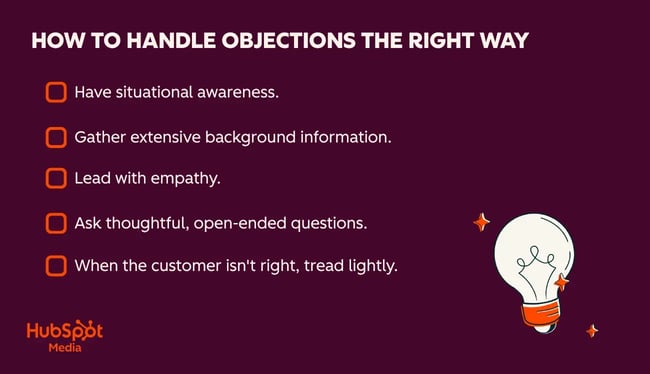
How to Handle Objections the Right Way
If the framework is the sequence, this is the mindset that makes it work. Good objection handling, under pressure, looks like this: the rep slows down, asks one question, and listens before answering. That posture protects trust and keeps a stalling deal moving. It’s the habit that separates reps who win from reps who argue.
Buyers are more open to someone they feel understood by, which is why a clarifying question outperforms a counterargument almost every time. The common objection handling mistakes that backfire are predictable. Underachieving reps tend to:
- Concede defeat immediately and disengage from the prospect.
- Argue their case defensively without probing for the source of the objection.
- Pressure the prospect by sowing fear, uncertainty, and doubt (FUD).
- Make derogatory statements about a competitor the prospect uses or is considering.
- Reach for tired tactics like discounts or false claims instead of a consultative approach.
These approaches confirm a prospect’s worst assumptions and burn whatever trust a rep has built. The behavioral pattern is consistent. Strong reps slow down after an objection and maintain a steady pace; weaker reps speed up into defensive monologues. The work is to build the opposite habits.
Have situational awareness.
Situational awareness is reading where you are in the process, what kind of deal this is, and what the prospect actually needs. There’s no single cure-all formula, so matching your response to those circumstances is the whole game.
I’ve learned from making situational-awareness mistakes a couple of times. Once I admitted to a customer that I’d been so busy chasing other opportunities that I hadn’t checked in with them in a while. They told me their feelings were hurt that I’d deprioritized them. I paid far closer attention to account farming after that.
Gather extensive background information.
Background research is what makes situational awareness actionable. A rep should research the prospect’s company and, to a degree, the specific individual, aiming to answer questions like:
- What challenges is the customer or prospect currently facing?
- What are their near- and long-term goals?
- What issues do their industry peers encounter?
- What is their decision-making authority?
- Which parts of the company’s operations do they work with day-to-day?
- What obstacles and restrictions does someone in their position typically face?
Uncovering these insights puts a rep in a far better position to handle objections tactfully.
As I mentioned, I learned the hard way that customers need to be reminded, through regular follow-up, of how much you value their business. Your other priorities aren’t material to their needs.
Lead with empathy.
Leading with empathy means keeping the prospect’s interests in view, not just the close. Most strong salespeople like solving problems for buyers, and prospects tend to return that focus with trust and, eventually, signed contracts.
Ask thoughtful, open-ended questions.
Asking thoughtful, open-ended questions is how a rep gets to the root of a prospect’s pain points, and in turn the objections they raise. Avoid questions that warrant only a “yes” or “no,” and don’t be afraid to use silence. Letting buyers air their thoughts brings their real concerns to the surface, where you can meet them with calm confidence.
When the customer isn’t right, tread lightly.
When a prospect’s objection isn’t justified, the move is to tread lightly rather than correct them head-on. Telling a prospect their objection isn’t warranted can derail a relationship quickly; acknowledging the concern first, then explaining how doing business would look keeps the conversation open.
An IT manager at a local government once told me they’d never do business with my company, a large Canadian telco, because we were too big to offer personalized service. I had testimonials from his peers across the country who’d had the same reservation and were pleasantly surprised. That reassured him, and I landed his business.
Pro tip: Keep a running list of customer success stories, testimonials, and third-party data that address common objections like cost, flexibility, or ROI. Authentic, quantifiable examples of your product’s impact do more than any rebuttal.
The Objection Handling Framework
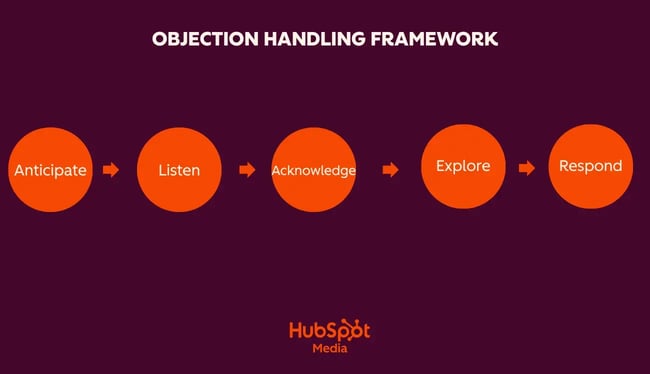
The objection handling framework runs in five steps:
- Anticipate.
- Listen.
- Acknowledge.
- Explore.
- Respond.
Listen, Acknowledge, Explore, and Respond are taught by Carew International as LAER: The Bonding Process. Anticipating likely objections before the call is the prep step that makes the loop work, so a rep walks in ready rather than reacting cold.
The framework works because it forces a rep to understand the concern before answering it. The order is deliberate: each step earns the right to the next. In fact, the biggest obstacle to overcoming objections is answering the stated objection instead of the real one, and skipping ahead to a response is exactly where this framework keeps reps honest.
The framework forces diagnosis before response. The Explore step, the one most reps rush past, is where average reps lose deals and top reps win them.
Step 1: Anticipate.
Anticipating means preparing for the objections you’re most likely to hear before the call, so none of them catch you cold. The more consistently you prepare, the more you learn about what holds buyers back, and the sooner you can raise and resolve a concern before the prospect even voices it.
On preparing before the loop begins: Laura Youngblom, former president and chief revenue officer at Sell It, notes that by consistently preparing for potential objections, a rep learns more about what’s holding customers back and can eventually predict the objections before they come up.
Step 2: Listen.
Listening means letting the prospect finish their entire concern without interrupting or building a rebuttal in your head. Active listening shows the prospect you take their concern seriously, and it gives you the raw material you need to diagnose what’s really going on.
“The adage ‘people buy from those they know, like, and trust’ is still true. Buyers want (and expect) a personalized sales experience. How you present yourself and your product either builds that trust — or gives your competitors a foot in the door,” comments Mark Tanner, co-founder of Qwilr.
Step 3: Acknowledge.
Acknowledging the objection shows the prospect that their concern was heard and is valid, which lowers their defenses. A short restatement or a sincere “that’s a fair concern” does more to build trust than an immediate counterargument, because agreement keeps the conversation open while disagreement shuts it down.
“Not pretending you have all the answers and being genuine in communicating when you don’t know something helps build trusting and reliable relationships,” says Sami Malik, CEO of Linear Health, a founder-led sales expert. Youngblom adds that “when you disagree, you stop the flow of communication, but when you agree, their defenses come down.”
Step 4: Explore.
Exploring means using follow-up questions to uncover the real issue beneath the stated objection. The strongest reps meet an objection with a question rather than a rebuttal, because a question surfaces the real concern while a counterargument hardens it. A price objection often hides a different concern, such as whether the buyer can justify the decision internally, and only exploration surfaces it.
It’s also the hardest step to execute. When a prospect pushes back, and the deal feels at risk, the instinct is to defend or discount right then. Asking a question instead runs against that instinct at the exact moment it’s loudest, which is why the move has to be practiced before it runs clean on a live call.
Step 5: Respond.
Responding comes last, only after you understand the actual objection. A strong response is a tailored answer built around the concern the prospect actually has, not the one they first stated. Responding to the wrong objection could make the situation worse.
Step 6: Try the 4 P’s of objection handling.
Another option is to follow the 4 P’s:
- Pause.
- Probe.
- Provide.
- Proceed.
This framework is a lighter alternative that follows the same logic:
- Pause before reacting.
- Probe to surface the real concern.
- Provide a tailored value-based response.
- Proceed once it’s resolved.
It mirrors the three-step objection handling process many teams already run, and it suits reps who want a model light enough to run live without losing the diagnose-before-you-respond discipline.
Free Sales Objection Handling Guide
An easy-to-use guide full of templates, best practices, and strategies for salespeople and managers looking to close deals.
- Data-backed behaviors top sellers use to combat pushback
- How to write effective meeting invitations
- A three-step objection handling framework
- And More!
Download Free
All fields are required.
Form not available
Why Objection Handling Matters
Objection handling matters because unaddressed concerns compound. The longer an objection goes unspoken, the more deeply it roots, and the harder it becomes to overcome late in the deal.
Unstated objections are the most dangerous of all, because a rep can’t address a concern the prospect never names. Ebsta and Pavilion’s 2024 B2B Sales Benchmarks found that 61% of lost deals were attributed to buyer indecision.
Objections are also buying signals. A prospect engaged enough to raise a sales objection is still in the conversation, which is why strong reps treat overcoming objections as part of the work instead of something to avoid. A rep can surface concerns early by periodically asking questions like “Do you have any concerns about X?”, “Are there any obstacles that would stop you from buying X?”, or “What happens if this problem doesn’t get addressed over the next few months?” Each turns a silent risk into something workable.
Pro tip: HubSpot Sales Hub Playbooks surface objection-handling scripts, competitive battlecards, and talk tracks directly in HubSpot Smart CRM contact record during a call, so reps respond from a tested answer instead of improvising under pressure.
Types of Sales Objections
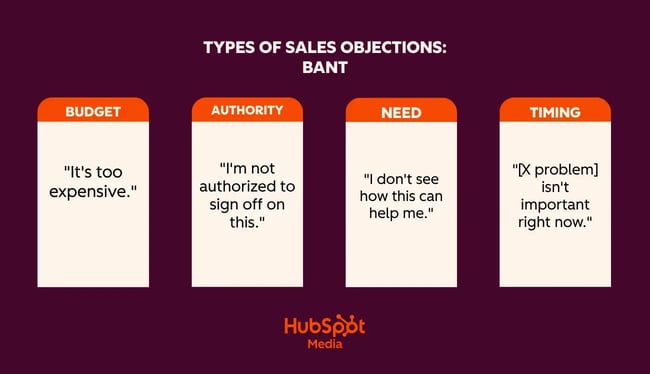
The four main types of sales objections are budget, authority, need, and timing, often remembered as BANT. Most objections map to one of these four, and naming the type quickly points a rep toward the right response.
The objections usually come from a reasonable place: the prospect feels they can’t buy right now. But those “lacks” are often misplaced, and a prepared rep can usually work around them.
Budget
Budget objections are about price, and they’re the most common type a rep hears, because every purchase carries financial risk. The way through is to reposition the product’s value so the conversation becomes one of risk versus reward. When the upside is clear enough, it justifies the cost. A budget objection usually sounds like “It’s too expensive” or “we don’t have the funds for this.”
Authority
Authority objections surface when the prospect doesn’t have the power to approve the purchase on their own. Rather than pressing a contact who can’t sign, the move is to identify the real decision-maker and help the champion build the internal case. An authority objection usually sounds like “I’m not authorized to sign off on this” or “I can’t sell this internally.”
Need
Need objections arise when the prospect doesn’t yet see how the product helps them, which is usually an opening to learn more rather than a dead end. Open-ended, layered questions qualify the prospect and surface a fit the rep can then demonstrate. A need objection usually sounds like “I don’t see how this can help me.”
Timing
Timing objections come down to urgency: the prospect frames the problem as something that isn’t a priority right now. The job is to figure out whether the timing concern is genuine or a brush-off by asking the prospect to elaborate on competing priorities, then listening for concrete reasons versus vague excuses. A timing objection usually sounds like “[X problem] isn’t important right now.”
How to Overcome Sales Objections
Knowing how to overcome objections in sales is a repeatable process, not a set of memorized comebacks. The seven steps below work for any objection because they prioritize understanding the concern before responding to it, and they give reps a consistent way to handle pushback they’ve never heard before.
1. Practice active listening.
Let the prospect share their concern fully before you respond. Listen to understand, not to reply. Avoid interrupting, and give the prospect space to voice their objections freely. Active listening keeps you from answering the wrong objection and signals that you take the concern seriously.
2. Repeat back what you hear.
Restate the objection in your own words to confirm you understood it. Paraphrasing clarifies the concern for you and makes the prospect feel heard, which builds trust and often surfaces a deeper issue the prospect hadn’t fully stated.
3. Validate your prospect’s concerns.
Acknowledge the concern as reasonable before you address it. Acknowledgment lowers resistance. When a prospect feels heard, their defenses drop, and they stay open to what comes next.
Validation doesn’t mean talking down your product or recommending a competitor; it means empathizing so the prospect stays open. If a buyer worries about implementing your software into a complex system, for example, you might say you understand the concern, then point to a tech team experienced with similar transitions.
4. Ask follow-up questions.
Use open-ended questions to keep the prospect talking and to uncover the real driver behind the objection. Avoid questions that can be answered with a simple “yes” or “no,” and don’t be afraid to use silence. The more the prospect explains, the more you have to work with.
5. Leverage social proof.
Share a relevant story of a similar customer who had the same concern and went on to succeed. For B2B sellers, a case study or a peer-company result, including a competitor’s success after overcoming a similar objection, is often more persuasive than any direct rebuttal.
6. Set a specific date and time to follow up.
If a prospect needs time, give them space, but pin down a concrete next step before the call ends. A specific follow-up date keeps the deal moving and prevents a soft “maybe” from quietly dying.
7. Anticipate sales objections.
Track the objections you hear most often and prepare responses in advance. When you can predict the pushback, you’re far less likely to be thrown, and you can address concerns proactively before the prospect even raises them, especially the most common objections during prospecting.
Modern enablement makes the tracking part easier. Conversation intelligence tools that record and analyze calls surface the objections coming up most often, so teams prepare for real patterns instead of guesses. HubSpot’s Conversation Intelligence inside Sales Hub does this, and structured role-play still helps: take turns with another rep posing common objections, answering, and giving each other feedback.
Pro tip: HubSpot Sales Hub AI Guided Selling surfaces customer and deal data, buyer activity, and recommended talking points before a call, so reps walk in already prepared for the objections a given account is likely to raise.
Common Sales Objections and How to Respond
The most common sales objections fall into five groups:
- Price and budget.
- Competition.
- Authority and ability to buy.
- Need and fit.
- Brush-offs.
The 44 objections below pair each with a response you can adapt — they’re the common prospect objections reps hear most. But the words a prospect uses are only a surface signal, and the same words can hide different concerns, so the responses land only once you’ve named what’s really blocking the deal. Each group opens with the concerns those objections usually mask: read that first, use the framework’s Explore step to confirm which one applies, then tailor the wording to your prospect and product.
Persistence is part of the job. Most deals take several follow-ups to close, yet many reps stop after the first attempt. Having a diagnosed response ready is what keeps a rep in the conversation long enough to close.
Pro tip: Store your best responses as battlecards in HubSpot Sales Hub Playbooks so the right talk track appears in the contact record the moment an objection comes up on a live call.
Sales Objections About Price and Budget
Price and budget objections are the most common a rep will hear, even from prospects who fully intend to buy, because every purchase carries financial risk. The move is almost always to shift the conversation off price and back to value.
Stated as cost, these objections usually signal one of three things: the value isn’t clear yet, the financial risk feels bigger than the upside, or the buyer can’t justify the spend internally.
1. “It’s too expensive.”
The moment a rep starts treating price as the selling point, they reduce themselves to a transactional middleman. Instead, talk about the product’s value. This response reframes the conversation from cost to value without conceding on price.
Try responding this way: “I’d love to unpack [product’s] features and how it can help with the issue of [prospect problem] you shared with me. I can also share a case study of how another business in your industry [realized measurable ROI].”
2. “We don’t have the funds for this.”
The prospect’s business might not be generating enough cash at the moment to afford your product. If there’s a long-term upside, offer to keep in touch, monitor their growth, and help them get to a place where your offering fits. Alternative financing, subscription tiers, or phased implementation may also put it in reach.
Try responding this way: “I understand. Allow me to explain our other offerings that may be a better fit for your current growth levels and budget.”
3. “We don’t have any budget left this year.”
This is a variation of the “no money” objection. What the prospect is really flagging is a cash-flow issue. If there’s a pressing problem, it needs solving eventually. Help them secure budget from executives now, or arrange a follow-up early in their next fiscal cycle.
Try responding this way: “Let’s schedule a follow-up call for when you expect funding to return. When do you think that may be?”
4. “We need to use that budget somewhere else.”
Sometimes the budget is allocated for something else. It’s the rep’s job to make the product a priority that deserves budget now. One way to do that is to share case studies of similar companies that had a positive outcome, like money savings or strong ROI.
Try responding this way: “We had a customer with a similar issue, but by purchasing [product], they were actually able to increase their ROI and assign some of their new revenue to other parts of the budget.”
5. “I don’t want to get locked into a long-term contract.”
A prospect with genuine interest who balks at contract terms is usually hesitant for cash-flow reasons. Workarounds often exist. Find out whether you can offer month-by-month or quarter-by-quarter terms instead of a year-plus commitment up front.
Try responding this way: “I understand. Let’s talk about some different contract terms and payment schedules that I can offer you. Perhaps these would be a better fit.”
Sales Objections About the Competition
Competition objections aren’t dead ends. A prospect already evaluating or using a competitor has recognized a need.
The move is to supplement, not attack. Disparaging the incumbent only makes the prospect defensive. What they usually signal is a need the current vendor isn’t fully meeting, or the prospect wouldn’t be talking to you. For more responses, see competitor objection responses.
6. “We’re already discussing this project with [Vendor X].”
A prospect already working with a competitor can be a gift — much of the education is done. Probe the relationship, listen for complaints your product could solve, and resist the urge to disparage the competitor. Highlight your strengths and service differentiators, factually and respectfully.
Try responding this way: “Why did you choose [vendor]? What’s working well? What’s not? Allow me to explain how [product] is different.”
7. “I’m locked into a contract with a competitor.”
This can seem like a deal-killer but is often workable if your team can offer competitive upgrades. The wording usually signals a feeling of being trapped. See if there’s a way to offset the cost of breaking a contract early or demonstrate ROI. Ask questions to learn whether they’re actually happy or itching to switch.
Try responding this way: “How is your relationship with [competitor]? I can work with my manager to see if there’s a way we can help ease the cost and effort of upgrading to our solution.”
In software sales, I liked positioning a migration from a competitor as an upgrade. It only worked when I could show how my solution was uniquely better for that prospect.
8. “I can get a cheaper version of your product somewhere else.”
Find out what you’re dealing with. Are you in a competitive situation where the prospect is driving up discounts, or do they think a cheaper product does everything they need? If the former, lay out your best discount, emphasize what makes the product superior, and walk away if they push lower. If the latter, highlight the differences and emphasize the overall worth.
Try responding this way: “What are the points of differentiation between [product] and your other option? What gives you the most value and support?”
9. “I’m happy with [Competitor X].”
Even a happy prospect is worth a conversation. Find out why they value the relationship, and identify vulnerabilities where you can build a case that your offering delivers more.
Try responding this way: “That’s great. What components of the product or relationship are you most satisfied with? I’d love to learn more and see how we compare.”
10. “Competitor X says [false statement about your product].”
Faced with a false claim, calmly respond with, “That’s not true,” then pause. Be ready to explain how things really are, but don’t rush. A composed correction satisfies most buyers. If they’re still unsure, they’ll ask, and you can offer more detail.
Try responding this way: “We manufacture our products in Canada, not Thailand. I have a map of our factories and distribution routes if you’d like to see it.”
Sales Objections About Authority or Ability to Buy
Authority objections mean that the rep may not be talking to the person who can actually say yes. The goal is to find the real decision-maker, or equip the current contact to sell internally.
11. “I’m not authorized to sign off on this purchase.”
No problem. Ask who the right person is, and redirect from there.
Try responding this way: “Who is the right person to speak to regarding this purchase? Can you redirect me to them, please?”
12. “I can’t sell this internally.”
Selling is the rep’s job. Ask what objections they anticipate and help them build the business case. A reusable “business case in a box” (a short deck or email covering your value proposition, success stories, and offerings) takes the pressure off your champion.
Try responding this way: “What objections do you think you’ll face? Can I help you prepare the business case for your meeting with your decision-makers? I may have some enablement materials I can share to help.”
13. “[Economic buyer] isn’t convinced.”
If you’ve already coached your contact and they still can’t win over the decision-maker or get you access, it may be time to walk away rather than keep butting heads with someone who’ll never see the value.
Try responding this way: “That’s too bad. If anything changes, please don’t hesitate to contact me. I’d love to help you get your team onboard.”
14. “We’re being downsized/bought out.”
When a company is in turmoil, buying processes usually stall, and there’s rarely anything a rep can do. Wrap the relationship professionally so the prospect is likely to restart the conversation once things settle, possibly from a new company.
Try responding this way: “Thank you for your time and for speaking with me regarding this product. If you’re ever in need of [product or service], please don’t hesitate to contact me.”
15. “There’s too much going on right now.”
Ask the prospect to explain what their competing priorities are at the moment. If they can’t, it’s likely a brush-off worth pressing on. If they can, set a follow-up, send helpful resources, and be ready to explain why waiting might cost them.
Try responding this way: “I understand. What are some of your competing priorities? I’d love to schedule a follow-up call for when your calendar clears up.”
16. “I’m part of a buying group.”
Buying groups let independent companies pool purchases for better pricing. If you’re not on the approved-supplier list, you may win them by matching the group’s cost and delivery terms, though that can erode margins, so check with management. Dig into the membership details to decide whether it makes economic sense.
Try responding this way: “Are there limits on whom you can buy from? What price are you currently receiving? What companies belong to your buying coalition?”
Free Sales Objection Handling Guide
An easy-to-use guide full of templates, best practices, and strategies for salespeople and managers looking to close deals.
- Data-backed behaviors top sellers use to combat pushback
- How to write effective meeting invitations
- A three-step objection handling framework
- And More!
Download Free
All fields are required.
Form not available
Sales Objections About Need and Fit
Need-and-fit objections are often requests for information in disguise, including the credibility and “I’ve never heard of you” concerns that come down to trust. Treat them as openings to qualify the prospect and demonstrate value, and disqualify honestly when the fit genuinely isn’t there.
17. “I’ve never heard of your company.”
Treat this as a request for information and offer a quick summary of your value proposition.
Try responding this way: “We’re a company that sells ad space on behalf of publishers like yourself. I’d love to speak with you about your revenue model and see if we can help.”
18. “We’re doing great in X area.”
Ask a few clarifying questions and qualify a little further.
Try responding this way: “What are your goals? How much progress has been made?”
19. “Our business doesn’t experience the challenges you describe.”
This objection is often a brush-off or a sign that the prospect hasn’t recognized a problem yet. You may find they truly don’t need your product, but don’t take it at face value.
Try responding this way: “Interesting. Do you have any business goals or challenges that you are struggling to address that I might be able to help you with?”
20. “X problem isn’t important right now.”
Sometimes a simple “Oh?” gets a prospect talking. Listen for real reasons versus platitudes. Excuses can mean they recognize the problem and are rationalizing inaction. Capitalize on that and instill urgency.
Try responding this way: “Tell me more about that. What are your current priorities?”
21. “I don’t see what your product could do for me.”
Another request for information dressed as an objection. Reconfirm the goals or challenges you’ve discussed and connect them to specific problems your product solves.
Try responding this way: “Interesting. Can you share what specific challenges you’re facing right now? Perhaps [product] presents a solution we have yet to discuss.”
22. “I don’t understand your product.”
If a prospect can’t grasp the product at all, that’s a warning sign. Ask which aspects are unclear and try explaining differently, or bring in a technician or product engineer. Strip out jargon and acronyms that might be muddying the pitch.
Try responding this way: “What aspects of the product are confusing to you? I’d love to connect you to a customer success technician or product engineer to help you better understand how we can help you.”
23. “I’ve heard complaints about you from [company].”
Rather than getting defensive, thank them for the feedback and follow up with an offer to add value. That builds credibility and trust, and a positive experience tends to reshape their opinion.
Try responding this way: “Thanks for sharing that feedback with me. I’ll pass it along to [relevant department]. While we’re on the phone, would you be interested in hearing a few tips for improving your average invoicing turnaround time?”
24. “We don’t have the capacity to implement the product.”
This can be a roadblock if implementation requires headcount or diverted resources. Ask whether you offer services that add implementation capacity and deliver results without new hires.
Try responding this way: “I hear you, and I want [product] to add value, not become a burden. What are your current day-to-day responsibilities? I’d love to explain how [product], once onboarded, can alleviate some of those problems without requiring additional staff overhead.”
25. “Your product is too complicated.”
Find out whether the prospect is confused about specific features or genuinely out of their depth. If the former, remind them they’ll have customer service support and help with implementation. If it’s the latter, you may need to disqualify.
Try responding this way: “What features are confusing to you? Our customer success team can help you tailor the experience to the way you do business, and our support team is available around the clock for implementation and beyond.”
26. “You don’t understand my challenges. I need help with Y, not X.”
Make the prospect feel heard. Restate your understanding of their situation, align, and move forward. A lot of friction dissolves simply by rephrasing the prospect’s own words.
Try responding this way: “Sorry I got that wrong. Would you allow me to restate my understanding of your challenges, and correct me again if I’m still missing anything important? I assure you I’ll make it worth your time.”
27. “You don’t understand my business.”
If you sell to a specific industry, show that you’ve worked with similar companies and solved similar problems. If you simply made a wrong assumption, own it. Candor earns respect.
Try responding this way: “Sorry, I assumed X was true, but it looks like that doesn’t apply to your business. Can you tell me a little more about how it works for your business?”
28. “Your product doesn’t have X feature, and we need it.”
Suggest a supplementary product that works alongside yours. If the missing feature is a genuine must-have you can’t solve, it’s time to disqualify and move on.
Try responding this way: “Have you checked out [partner or conjoining product]? It’s a good fit with ours and can be used alongside it to solve for Y.”
29. “We’re happy the way things are.”
Maybe so, but it’s more likely that there’s a challenge somewhere. See if you can find a problem that your product can solve, and then move forward or move on based on their answers.
Try responding this way: “That’s great! Can you tell me how you’re currently solving for X?”
30. “I don’t see the potential for ROI.”
This objection is a sign you’ll need a formal pitch built on the prospect’s internal numbers or customer case studies. Nothing sells like hard numbers.
Try responding this way: “I’d love to show you. Can we schedule a time for me to explain our product’s potential to deliver a high ROI to you and your team?”
31. “X is just a fad.”
You may hear this when your product introduces a concept new to the prospect’s industry. Show them testimonials or case studies that prove the ROI. If you’re pioneering a practice, show that it works.
Try responding this way: “I understand why you may think that. Let’s schedule a time for me to walk through how our product helped other businesses like yours find success with X, and why it’s here to stay.”
32. “Your product doesn’t work with our current [tools, setup].”
This can be a deal-breaker if the buyer is committed to existing solutions, but sometimes your product replaces those tools, or a workaround exists. Ask questions to find out.
Try responding this way: “Which tools are you currently using? How integral are those tools to your [strategy]? What do you like and dislike about your existing platform?”
33. “Your product sounds great, but I’m too swamped right now to handle [implementation, rollout].”
Prospects are often put off by the effort of switching, even when the ROI is real. Empathize, prove you’re trustworthy, then dig into the cost of their current situation and calculate what they stand to gain in time, efficiency, or money.
Try responding this way: “I understand. It typically takes our customers [X days/weeks] to get fully up and running with [product]. How many minutes a day do you spend on [task]?”
Sales Objections That Are Actually Brush-Offs
Brush-offs are vague attempts to end the conversation, not authentic objections. The skill is distinguishing a real stall from a true no, and pressing gently for the reason underneath. The real objection is unspoken, so the job is to surface what’s actually behind the deflection before responding. When a prospect asks for “more time” or says they’ll think it over, a question usually surfaces what’s really going on.
34. “Click.“
If a prospect hangs up, don’t sweat it. Try a different person and approach, or wait a few seconds and call back. The right move depends on how the conversation was going.
Try responding this way: “Sorry, looks like we got disconnected! Do you have a few minutes?”
35. “I’m busy right now.”
Almost everyone is busy. Explain that you don’t need or want a full conversation, just a quick chat about whether moving forward is even a good fit.
Try responding this way: “I don’t want to take up too much of your time. Can we have a quick chat about your challenges with X and how [product] may help?”
36. “I’m not interested.”
It’s far too early for a prospect to know whether they’re interested on that initial prospecting call.
Try responding this way: “Some of our clients weren’t initially interested either, but when I showed them they could realize [X benefit], they changed their mind. Can your business afford to pass up this opportunity without exploring it?”
37. “Just send me some information.”
This is a great opening to segue into qualification questions.
Try responding this way: “I’d be happy to send you some materials, but I want to make sure they’re relevant to you. What are you interested in learning about?”
38. “Call me back next quarter.”
This is often a vague brush-off offered in the hope you’ll disappear, including the seasonal “call me after the holidays“ version. Ask questions to find the real motivation before agreeing to fade away.
Try responding this way: “I’ll touch base next quarter. Before we hang up, I’d love to get a sense of how your next quarter will go. Do you feel you’ll get the go-ahead from your superiors?”
39. “How did you get my information?”
Don’t get defensive. Remind the prospect they filled out a form, signed up at an event, or that you came across their site and wanted to connect.
Try responding this way: “I came across your website in my research and believe that [product] would be a great fit for you.”
40. “I hate you.”
Prospects rarely say this outright, but if you and a prospect just don’t click, consider handing off to a colleague before the company loses the deal. The benefit is that this particular situation has nothing to do with your product’s value.
Try responding this way: “I’m sorry you feel that way. Can I introduce you to my colleague [name] to continue the conversation? She’s very knowledgeable about how businesses like yours can [overcome the challenges] we discussed, and she has great relationships with executives like yourself.”
41. “I’m not responsible for making these decisions.”
This signals the prospect doesn’t have, or doesn’t believe they have, the authority to discuss business challenges, and doesn’t want to be pressured into decisions above their pay grade.
Try responding this way: “Thanks [name] for letting me know you don’t have decision-making authority here. Who on your team handles these decisions? Can you introduce me, or could you and I have a preliminary, no-pressure conversation? I think [solution] could help your team [achieve a defined benefit].”
42. “Does your product do X, Y, and Z?”
A common hurdle that keeps an SDR from converting the lead, but it usually means the prospect is interested. Use it to end on a good note and set up a follow-up with a specialist.
Try responding this way: “I’m glad you asked that. I think it’ll be helpful to schedule a time when we can discuss this and other questions with a specialist. When is a good day and time to talk?”
43. “Sorry, I have to cancel. I’ll get back to you with a better time.”
People don’t like to say “no,” which shows up as ghosting, procrastination, and requests for more time. A negative-reverse approach calls out the lack of interest and lets the prospect admit the answer is “no” without getting too negative.
Try responding this way: “Typically, when someone cancels and says they’ll get back to me, it means they’re just not interested right now. Is it fair for me to assume that’s the case?”
44. “Hello, you’ve reached [Prospect’s Name] ...”
If a prospect dodges calls, takes ages to respond, always needs approval, and is vague on budget and priorities, you’re likely talking to an individual contributor. Gain their trust and learn what you can, then build relationships with the people who can actually choose your product.
Try responding this way: “Have you ever purchased this type of product or service before? Who will be in charge of this buying process? Who else should we bring on board for this conversation?”
Objection Handling Training
Objection handling improves with structured practice, not just field experience. Strong sales organizations build ongoing training into the cadence, and teams that add role-play and call review ramp new reps faster and close at higher rates.
Role-play is the highest-leverage practice. Reps who rehearse common objections in a low-pressure setting walk into real calls more composed, and enablement teams use recorded calls to coach against the exact moments where deals stall. A few programs and resources can give a team a leg up.
- HubSpot’s Objection Handling Templates are a free guide covering the why and how of objection handling, including data-backed behaviors top sellers use and scripts for the most common objections.
- Sell It is a sales training and membership platform. Its lessons apply to anyone who sells, not just real estate.
- Challenger is an online sales training program with playbooks for every sales stage, including objection handling.
For one-on-one skill-building, structured sales coaching helps reps practice against the objections they actually face.
Pro tip: HubSpot Conversation Intelligence records and analyzes calls to surface patterns in how objections come up, helping managers coach reps and keep playbooks current with what’s actually working. This is best for newer reps and fast-growing teams. Structured role-play plus recorded-call review builds objection-handling instinct faster than learning live on real deals.
How to Tell a Firm No From Indecision
Some objections are reactionary and worth working through, while others are a genuine no. The skill is telling them apart. Some prospects are simply too busy and too skeptical of the SDRs and reps who contact them daily to give a rep the chance to explain.
That calls for creative persistence, like suggesting ways to continue the conversation at a time that works for them. A useful rule of thumb is if a prospect raises the same objection twice, treat it as real. No means no.
Much of what sounds like a firm no, though, is indecision rather than an inability to buy. The move isn’t to push harder, though. It’s to reduce the risk of deciding by partnering with the buyer and offering a clear, confident recommendation.
When the concern is genuinely about fit rather than indecision, walking away is the right call. If a rep and their team have worked through every objection and the prospect still won’t invest the time, it’s a sign of a poor fit, and every minute on an unwinnable deal is one not spent on a viable one.
Frequently Asked Questions About Overcoming Objections
What are the 7 ways to overcome objections?
The seven ways to overcome objections are:
- Practice active listening.
- Repeat back what you hear.
- Validate the prospect’s concerns.
- Ask follow-up questions.
- Leverage social proof.
- Set a specific follow-up date.
- Anticipate objections in advance.
Together they form a repeatable process that prioritizes understanding the concern before responding.
What are the 4 P’s of objection handling?
The 4 P’s of objection handling are:
- Pause before reacting.
- Probe with a question to uncover the real concern.
- Provide a tailored value-based response.
- Proceed by confirming the concern is resolved and advancing the conversation.
What is the best strategy to overcome objections?
The best strategy is to lead with empathy and curiosity. Make the prospect feel understood, then get curious instead of defensive. Ask questions that surface the real concern before you respond, since the objection a prospect states is often not the one actually blocking the deal. A clarifying question almost always outperforms a counterargument.
What are the 5 steps to effective objection handling?
The five steps are:
- Anticipate
- Listen
- Acknowledge,
- Explore
- Respond
Anticipating likely objections before the call prepares the rep, while the LAER sequence (listen, acknowledge, explore, respond) guides the live conversation from hearing the concern to resolving it. HubSpot Sales Hub Playbooks can hold the LAER talk track in the contact record, so reps follow the sequence during a live call.
Overcoming objections can become your best sales skill.
The rep who closes more deals isn’t the one with 44 rebuttals memorized. It’s the one who pauses when “it’s too expensive” lands and asks one question before answering, because nine times out of ten it isn’t about the price. That’s the whole skill: read the no, find the concern beneath it, and respond to that one.
HubSpot Sales Hub, built on Smart CRM, supports that habit at scale: Playbooks put your best responses in front of reps mid-call, AI Guided Selling prepares them before the conversation, and Conversation Intelligence shows managers exactly where deals stall so coaching gets sharper over time. Underneath it, Breeze Assistant drafts call summaries. When most lost deals die of indecision rather than a real no, the rep who surfaces and resolves the actual concern is the one who keeps the deal alive.
Editor's note: This post was originally published in September 2015 and has been updated for comprehensiveness.
Free Sales Objection Handling Guide
An easy-to-use guide full of templates, best practices, and strategies for salespeople and managers looking to close deals.
- Data-backed behaviors top sellers use to combat pushback
- How to write effective meeting invitations
- A three-step objection handling framework
- And More!
Download Free
All fields are required.
Form not available
Objection Handling




.jpg)