.png?width=112&height=112&name=Image%20Hackathon%20%E2%80%93%20Horizontal%20(16).png)
-1.png)
For most B2B companies, revenue doesn’t stall because of a bad product or a slow market, but rather because sales, marketing, and customer success are operating on different data, priorities, and definitions of success.
![Download Now: Annual State of RevOps [Free Report]](https://no-cache.hubspot.com/cta/default/53/78dd9e0f-e514-4c88-835a-a8bbff930a4c.png)
That misalignment creates broken handoffs, unreliable forecasts, and growth that’s hard to predict or repeat. Revenue operations (RevOps) is the function built to fix it.
In this guide, we’ll break down what revenue operations are, why go-to-market alignment has become a strategic priority for B2B leaders, the measurable benefits RevOps delivers, and how to start building a RevOps motion that actually sticks.
Table of Contents
- What is revenue operations (RevOps)?
- RevOps vs. sales ops: What’s the difference?
- The 4 Pillars of Revenue Operations
- Why Revenue Operations Matters for B2B
- How RevOps Extends Beyond Sales and Marketing Alignment
- Who owns revenue operations?
- How to Build a Revenue Operations Strategy
- Revenue Operations Adoption Trends and What’s Driving Them
What is revenue operations (RevOps)?
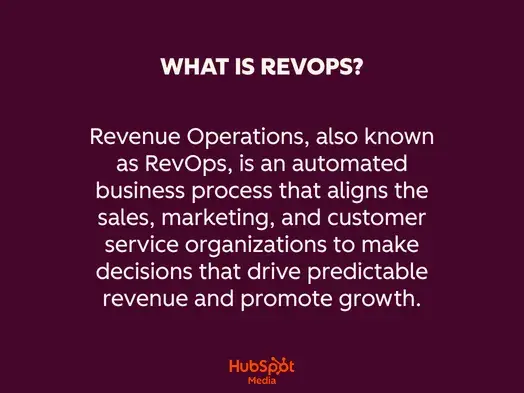
RevOps is the business function that aligns sales, marketing, and customer success around shared data, processes, and goals to drive predictable, scalable revenue growth.
Rather than letting each team operate in its own silo, RevOps creates a unified go-to-market motion. B2B companies use it to eliminate the friction that kills deal momentum: inconsistent data, unclear ownership, and misaligned priorities across customer-facing teams.
To measure whether that alignment is working, RevOps teams typically track a core set of metrics:
- Annual Recurring Revenue (ARR): The normalized yearly value of subscription-based revenue, used to gauge overall growth trajectory.
- Customer Lifetime Value (CLV): The total revenue a business can expect from a single customer relationship over time.
- Customer Churn Rate: The percentage of customers lost during a given period, which is a key signal of post-sale health.
- Sales Cycle Length: The average number of days from first touch to closed deal, which reveals friction in the pipeline.
- Win Rate: The percentage of deals closed out of all opportunities pursued, reflecting overall sales effectiveness.

Free Go-To-Market Kit
This comprehensive kit provides everything you need to plan, execute, and measure a successful product launch.
- Proven GTM frameworks and strategies from HubSpot experts
- Launch planning and execution checklists
- Messaging templates for compelling product stories
- Essential metrics and dashboards to track your success
Download Free
All fields are required.
Form not available
RevOps vs. sales ops: What’s the difference?
Sales operations and revenue operations are often used interchangeably, but they’re not the same thing. Understanding the difference helps B2B leaders know which function they actually need, and when it’s time to evolve.
Sales operations focus on optimizing the sales team’s performance. Its scope is narrow by design: pipeline management, quota setting, CRM hygiene, sales forecasting, and rep enablement. Sales ops reports to the sales org, and its goals are measured by sales outcomes such as win rate, ramp time, and cycle length.
Marketing operations is the parallel function on the marketing side, such as owning campaign execution, lead scoring, marketing automation, and attribution. Like sales ops, it’s siloed by department and optimized for marketing-specific KPIs like MQL volume, cost per lead, and campaign ROI.
Revenue operations is what happens when those two functions, plus customer success operations, are unified under a single revenue operations strategy. RevOps owns the full customer lifecycle, from first marketing touch to closed deal to renewal and expansion.
It sets shared KPIs, standardizes data definitions across systems, and ensures that handoffs between teams are clean, automated, and accountable.
Pro tip: If your sales and marketing teams are already aligned but you’re still seeing inconsistent data, broken post-sale handoffs, or unpredictable revenue, you’re getting the signal to move from sales ops to RevOps.
The 4 Pillars of Revenue Operations
A RevOps strategy is only as strong as the foundation it’s built on. Before optimizing handoffs or consolidating dashboards, B2B teams need a shared framework that defines how revenue operations actually function across the go-to-market org.
The four pillars of revenue operations provide that structure by covering everything from day-to-day execution to long-term performance visibility.
1. Operations
This is the process layer of the RevOps framework, where operations owns the standardized workflows and RevOps automation that govern how leads move through the funnel, deals progress, and accounts are managed. When this pillar is working, nothing falls through the cracks as every stage of the customer lifecycle has a defined owner, clear entry and exit criteria, and a documented process.
Pro tip: Start here before touching your tech stack. Automating a broken process just makes it break faster.
2. Enablement
This pillar ensures that every customer-facing team has the training, content, and context they need to perform at their best. In a RevOps framework, enablement isn’t limited to onboarding new sales reps. Enablement actually spans the full GTM org and is grounded in data. RevOps uses performance insights to identify what the top-performing reps, marketers, and CSMs are doing differently, then scales those behaviors across the team.
3. Insights
The insights pillar is where RevOps earns its seat at the leadership table. This covers KPI definition, reporting standardization, forecasting, and the cross-functional analysis that helps leadership make faster, better-informed decisions.
A strong insights function goes beyond reporting on what happened; it surfaces why it happened and recommends what to do next.
Pro tip: One of the highest-leverage moves in RevOps is aligning on a single definition for every metric across teams. “Pipeline,” “qualified lead,” and “churn” should mean the same thing across all dashboards and teams.
4. Tools & Technology
The tools and technology pillar governs the revenue operations tools and platforms that power your market function, thus selecting, integrating, and maintaining the systems that enable seamless data flow across teams.
This includes your CRM, marketing automation, revenue intelligence tools, and analytics platforms. RevOps doesn’t just administer these tools but ensures they communicate cleanly and that the data flowing between them is accurate and actionable.
Best for: Companies struggling with tool sprawl. RevOps should rationalize the stack rather than add to it — prioritizing deep integration over feature breadth.
Together, these four pillars of revenue operations create the infrastructure for a go-to-market org that can scale without losing alignment, visibility, or execution quality.
Why Revenue Operations Matters for B2B
A lack of effort doesn’t cause most B2B revenue problems, but a lack of alignment does. When sales, marketing, and customer success operate on fragmented data and disconnected processes, the result is inconsistent customer experiences, unreliable forecasts, and growth that’s hard to sustain. Revenue operations exist to close that gap.
The business case for RevOps is well-documented. Here’s what B2B companies consistently see when they get it right:
- Predictable revenue: A centralized RevOps function gives leadership a single, trusted view of pipeline health, forecast accuracy, and revenue risk — replacing gut-feel planning with data-driven confidence.
- Better customer experience: According to LeanData’s State of Revenue Operations report, 95% of B2B firms agree that a seamless, consistent experience across the customer lifecycle is key to increasing revenue. RevOps makes that consistency possible by standardizing handoffs and aligning teams around the customer journey rather than departmental boundaries.
- Faster decision-making: When every team reports from the same data and uses the same KPI definitions, leadership spends less time reconciling conflicting numbers and more time acting on them.
- Stronger business performance: Publicly traded companies with dedicated revenue operations functions have seen higher stock performance than those without, which is a signal that investors recognize the operational maturity RevOps brings.
Pro tip: If your leadership team regularly debates whose numbers are “right” before making a decision, that’s a data alignment problem that a well-structured RevOps function is designed to solve.
The bottom line: RevOps extends far beyond operational efficiency. For B2B companies pursuing consistent, scalable growth, it’s a strategic advantage.
Free Go-To-Market Kit
This comprehensive kit provides everything you need to plan, execute, and measure a successful product launch.
- Proven GTM frameworks and strategies from HubSpot experts
- Launch planning and execution checklists
- Messaging templates for compelling product stories
- Essential metrics and dashboards to track your success
Download Free
All fields are required.
Form not available
How RevOps Extends Beyond Sales and Marketing Alignment
Sales and marketing alignment is a good start, but it only covers part of the customer journey. Revenue operations takes a wider view, optimizing the full lifecycle from first marketing touch through post-sale retention and expansion.
That distinction is crucial. Research from LeanData found that 95% of B2B firms agree that providing a seamless, consistent experience throughout the entire customer lifecycle is key to increasing revenue. Yet most alignment efforts stop at the handoff from marketing to sales, leaving customer service as an afterthought.
RevOps closes that gap by bringing customer service into the same operational framework as sales and marketing. That means shared data on customer health, standardized escalation and renewal workflows, and consistent messaging from the first touchpoint to the last.
When all three functions operate within a unified system, handoffs become smoother, churn signals surface earlier, and customers experience greater consistency, building trust and driving expansion revenue.
What we like: Treating customer success as a revenue function and not just a support function. When customer service teams are looped into RevOps, retention and expansion become as measurable and manageable as a new business pipeline.
Who owns revenue operations?
Revenue operations doesn’t belong to any single department, but it does need a clear owner. How that ownership is structured depends on the company’s size, growth stage, and the maturity of the go-to-market org.
Common RevOps Ownership Models
Centralized RevOps is the gold standard for scaling B2B companies. In this model, a dedicated RevOps function sits outside of sales, marketing, and customer success, serving all three as a shared operational layer.
It owns data governance, tech stack management, reporting standards, and cross-functional process design. This model eliminates the redundancy and misalignment that arise when each department runs its own operations function independently.
Partially centralized RevOps is where most companies start. Some operational functions — like CRM administration or sales forecasting — are consolidated under a RevOps lead, while marketing ops and customer success ops still retain some independence. It’s a practical stepping stone, particularly for companies that aren’t ready to reorganize their teams fully.
Regardless of model, RevOps most commonly reports to the Chief Revenue Officer (CRO), the executive accountable for the full revenue engine across sales, marketing, and customer success.
Typical RevOps Team Roles
- Chief Revenue Officer (CRO): Sets the overarching revenue operations strategy and serves as the executive sponsor for RevOps initiatives across the GTM org.
- VP / Director of Revenue Operations: Owns the RevOps roadmap, manages cross-functional alignment, and translates business goals into operational priorities.
- RevOps Manager / Analyst: A RevOps Manager or Analyst, a key role in defining what is a revenue operations manager, handles day-to-day reporting, pipeline analysis, KPI tracking, and process documentation across teams.
- Systems Administrator: Manages the tech stack, including CRM configuration, integrations, and data quality, to ensure systems support, not slow down, the revenue engine.
Best for: Early-stage or mid-market B2B companies that aren’t ready to build a full team. Start with one senior RevOps hire who can own the revenues operations strategy and execution, then scale the team as process complexity and headcount grow.
Most companies don’t need a fully built-out RevOps org on day one. What they need is clear ownership, a defined scope, and the right person to build the foundation.
How to Build a Revenue Operations Strategy
Building a revenue operations strategy doesn’t require a full org restructure on day one. What it does require is a clear sequence, starting with visibility into what’s broken before trying to fix it. Here’s a practical five-step framework for B2B teams to stand up or formalize their RevOps motion.
Step 1: Audit the current state.
Before building anything, map what already exists. Document the tools each team uses, how data flows between systems, where handoffs currently happen, and where they break down. The goal is to surface the gaps, such as inconsistent data definitions, duplicative processes, ownership ambiguity, that are quietly costing revenue. This audit becomes the foundation for every decision that follows.
Pro tip: Interview stakeholders from sales, marketing, and customer success separately before comparing notes. The gaps in their answers will tell you more than any dashboard will.
Step 2: Define shared goals and KPIs.
RevOps only works when every team is pulling toward the same outcomes. Establish a core set of shared metrics and align on exactly how each one is defined and measured. Ambiguity here is expensive: if sales and marketing calculate “pipeline” differently, no forecast will ever be trustworthy.
What we like: Documenting KPI definitions in a shared RevOps glossary that every team can reference. It sounds simple, but it eliminates a surprising amount of cross-functional friction.
Step 3: Consolidate the tech stack.
Audit the tools used across sales, marketing, and customer success, and identify redundancies, integration gaps, and data silos. The goal isn’t to rip and replace everything but to ensure your core systems are connected, your CRM is the system of record, and data flows cleanly between platforms without manual intervention.
Tools like HubSpot Data Hub are purpose-built for this, enabling automated data sync, real-time data quality management, and process automation across the full go-to-market stack.
Best for: Teams running three or more disconnected point solutions. Consolidating on an integrated platform significantly reduces data inconsistency and administrative overhead.
Step 4: Standardize handoffs and workflows.
Define exactly what happens at every transition point in the customer lifecycle from MQL to SQL, SQL to opportunity, closed-won to onboarding, and onboarding to renewal. Each handoff should have a documented trigger, a clear owner on both sides, and the data required to pass context without the receiving team needing to start from scratch.
Pro tip: Treat every handoff like a relay race and include smooth transitions with context intact. The baton needs to arrive with context intact, like account history, engagement signals, and open commitments, or the next team starts behind.
Step 5: Build reporting from one source of truth.
Centralize reporting so that every team and level of leadership is working from the same data. This means unified dashboards that track performance across the full funnel, not departmental scorecards that optimize in isolation. When revenue reporting lives in one place, forecasting becomes more accurate, accountability becomes clearer, and leadership spends less time reconciling numbers and more time acting on them.
What we like: Building a single executive revenue dashboard that shows pipeline health, forecast versus actual, churn risk, and expansion opportunity side by side. It forces the right cross-functional conversations at every leadership meeting.
RevOps implementation is iterative, not a one-time project. Start with the steps that address your most acute pain points, establish ownership early, and build from there.
Revenue Operations Adoption Trends and What’s Driving Them
RevOps has moved from early-adopter experiment to mainstream business strategy, and the data reflects it. B2B companies are increasingly recognizing that fragmented go-to-market operations aren’t just inefficient; they’re a direct drag on revenue growth.
The market momentum is clear:
- Companies using revenue operations and intelligence (RO&I) solutions report meaningful performance gains, with 59% seeing improved win rates and 53% reporting increased net-dollar retention, according to research from Forrester and Clari.
- Publicly traded companies with dedicated RevOps functions have seen stock performance higher than peers without one.
- Among B2B companies that haven’t yet adopted RevOps, more than half say they plan to, indicating that most organizations have moved past the question of whether to invest in RevOps and are now focused on timing and approach.
Why adoption is accelerating comes down to a few converging pressures: buyer journeys are more complex, teams are larger and more distributed, and the volume of data flowing through revenue stacks has outpaced most organizations’ ability to manage it manually. RevOps provides the operational infrastructure to keep pace.
The barriers holding companies back tend to cluster around the same three challenges:
- Inconsistent data: Teams using different systems and definitions create reporting conflicts that undermine trust in the numbers.
- Disconnected systems: A fragmented tech stack means data doesn’t flow cleanly between marketing, sales, and customer success, thus creating missed spots at every handoff.
- Limited resources: Many companies recognize the need for RevOps but lack a clear starting point or dedicated headcount to build it.
The practical reality is that these barriers aren’t reasons to delay since they’re exactly the problems RevOps is designed to solve. Companies that wait for perfect conditions to build their revenue operations function tend to find that the misalignment compounds the longer it goes unaddressed.
Build a revenue engine that scales.
Predictable revenue doesn’t come from working harder in silos but from building a system where sales, marketing, and customer success are operating from the same data, toward the same goals, with clearly defined handoffs between them. That’s what a well-executed revenue operations strategy delivers.
The starting point isn’t a full org restructure. Its alignment: shared KPIs that every team trusts, connected systems that eliminate data gaps, and a single source of truth that makes forecasting and decision-making faster and more reliable. From there, each process improvement, data quality improvement, or handoff efficiency improvement translates directly into pipeline velocity and revenue consistency.
For B2B teams ready to put that infrastructure in place, a comprehensive revenue operations platform provides the data sync, automation, and reporting tools to connect sales, marketing, and customer success.
Pro tip: Don’t wait until your revenue is stalling to invest in RevOps. The best time to build the foundation is when things are working so the systems are in place before the complexity arrives.
Editor’s note: This post was originally published June 30, 2020, and has been updated for comprehensiveness.
Free Go-To-Market Kit
This comprehensive kit provides everything you need to plan, execute, and measure a successful product launch.
- Proven GTM frameworks and strategies from HubSpot experts
- Launch planning and execution checklists
- Messaging templates for compelling product stories
- Essential metrics and dashboards to track your success
Download Free
All fields are required.
Form not available
RevOps

![What is Revenue Intelligence? [+5 Problems It Solves]](https://53.fs1.hubspotusercontent-na1.net/hubfs/53/revenue-intelligence-fi%20(1).jpg)