


Customer success and customer experience both influence retention, but they solve different problems. Customer success proactively helps customers achieve outcomes after purchase, while customer experience shapes how customers perceive every interaction across the full journey.

When teams blur that distinction, ownership of onboarding, renewals, Net Promoter Score (NPS), and customer satisfaction score (CSAT) can become unclear. This guide explains how to assign responsibilities, choose metrics, coordinate workflows, and use shared systems such as HubSpot’s agentic customer platform to connect experience data with customer outcomes.
What is customer success vs. customer experience?
Customer success proactively helps customers realize value after purchase, while customer experience shapes how customers perceive every interaction across the full journey. The difference between customer success and customer experience is scope: customer success focuses on post-purchase outcomes, while customer experience spans the end-to-end journey.
Customer Success: Outcome Ownership After Purchase
Customer success focuses on value realization after purchase through proactive relationship management. Customer success teams define the outcomes customers expect, track adoption and account health signals, and intervene when progress stalls.
For example, a CRM provider might assign a customer success manager to guide an enterprise account through onboarding, configure dashboards, and track whether the customer’s team adopts features aligned with its sales goals.
Pro tip: Treat customer success as proactive outcome management, not reactive support. Use customer success best practices to identify risk early and help customers reach measurable milestones.
Customer Experience: End-to-End Journey Design
Customer experience focuses on customer perception across every touchpoint, from research and purchase through product use, support, and renewal. Customer experience teams study friction across the journey and redesign interactions so customers can complete tasks easily and consistently.
For example, an ecommerce brand might simplify mobile checkout, send timely order updates, and make returns easy. Each improvement shapes how customers perceive the brand, even when no customer success manager participates directly.
.webp)
Free Customer Journey Template
Outline your company's customer journey and experience with these 7 free templates.
- Buyer's Journey Template
- Future State Template
- Day-in-the-Life Template
- And more!
Download Free
All fields are required.
Form not available
Metrics for Customer Success vs. Customer Experience
Customer Experience Metrics to Track
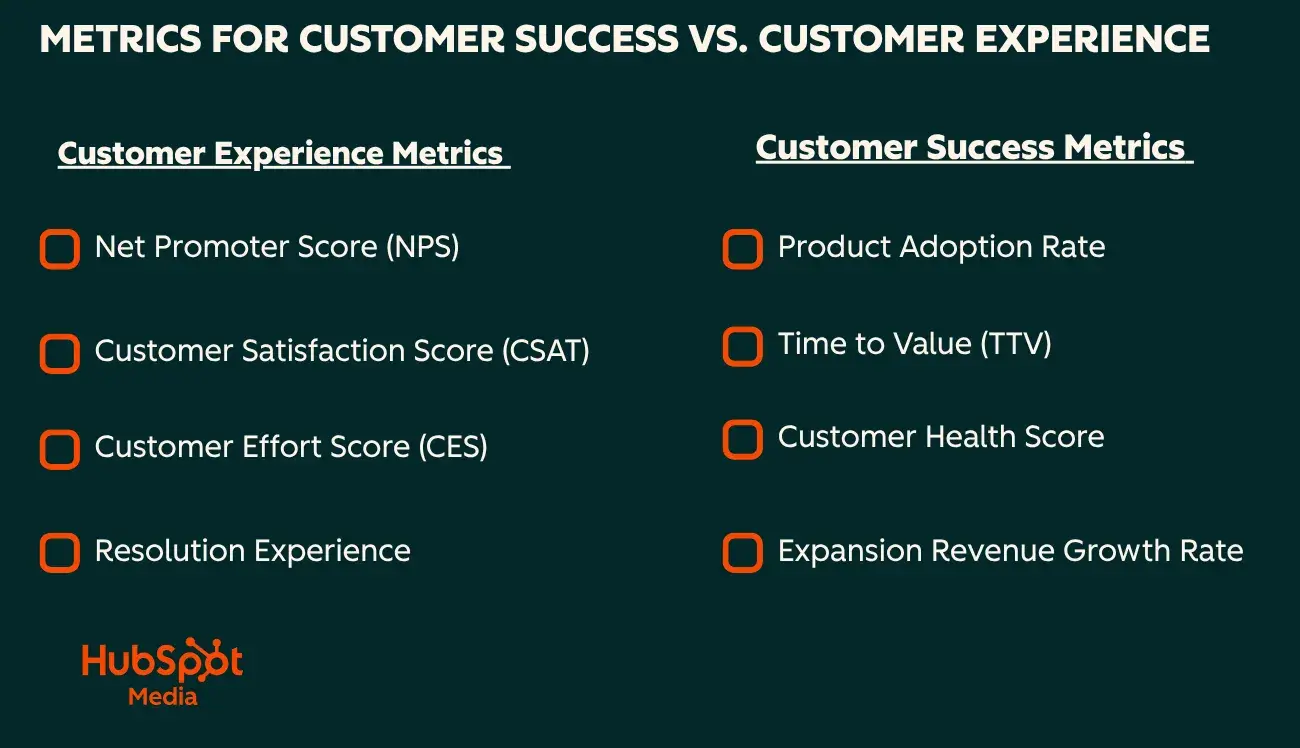
Customer experience metrics measure customer perception and effort across individual interactions and the broader journey. Track Net Promoter Score (NPS), customer satisfaction score (CSAT), customer effort score (CES), and resolution experience to identify where the journey creates confidence or friction.
Net Promoter Score (NPS)
Net Promoter Score asks customers how likely they are to recommend a company on a scale from 0 to 10. The score groups respondents as promoters, passives, or detractors and provides a relationship-level signal of customer sentiment.
Customer Satisfaction Score (CSAT)
Customer satisfaction score measures how satisfied customers are after a specific interaction, such as a support conversation, a purchase, or a product experience. Teams can use the result to identify touchpoints that meet expectations and those that need improvement.
Customer experience and customer satisfaction are related but not interchangeable. CSAT measures satisfaction at a particular moment, while customer experience covers the broader journey. The same distinction also helps teams separate customer satisfaction and customer loyalty.
Customer Effort Score (CES)
Customer effort score asks customers how easy or difficult it was to complete a task, such as resolving an issue or setting up a feature. Track CES at important touchpoints to identify friction that teams can remove.
Resolution Experience
Resolution experience combines operational data, such as resolution time and first-contact resolution, with feedback collected after an issue closes. It shows whether the support process solved the problem efficiently and restored customer confidence.
Customer Success Metrics to Track
Customer success metrics measure whether customers adopt the product, reach value, remain healthy, and expand. Track product adoption rate, time to value (TTV), customer health score, and expansion revenue growth rate.
Product Adoption Rate
Product adoption rate measures the percentage of customers who meet a defined threshold for meaningful product use. That threshold should reflect actions that demonstrate customers have integrated the product into their workflow, not merely signing in.
Product adoption rate = Customers who meet the active-use threshold ÷ Customers in the measured group × 100
Use the same customer group and time period in both parts of the calculation.
Time to Value (TTV)
Time to value measures the elapsed time between a defined starting event, such as contract signature or first login, and the customer’s first meaningful outcome. Teams should define both events before calculating the metric so everyone measures the same milestone.
TTV = Date or time of the first value event − Date or time of the starting event
A shorter TTV can indicate that onboarding and enablement help customers realize value more quickly.
Customer Health Score
A customer health score combines signals such as product adoption, satisfaction, support activity, and renewal risk into one account-level indicator. Teams choose the inputs and weights that match their business, then use the score to prioritize outreach.
For example, a company could calculate an illustrative health score this way:
Each company should set its own inputs, weights, and health thresholds based on its product and customer data.
Expansion Revenue Growth Rate
Expansion revenue growth rate measures the percentage increase in revenue from existing customers, driven by upsells, cross-sells, add-ons, or usage growth.
Expansion revenue growth rate = Expansion revenue during the period ÷ Starting revenue from the same customers × 100
If a customer group starts at $100,000 and adds $20,000 in expansion revenue, the rate is 20%.
Connecting Customer Experience and Customer Success to Revenue
Customer success and customer experience affect revenue through different mechanisms. Customer success helps individual accounts adopt the product, realize value, renew, and expand. Customer experience identifies and reduces friction across the journey that can affect satisfaction, loyalty, and retention.
Because product quality, pricing, market conditions, and other teams also shape financial performance, companies should treat revenue metrics as shared outcome indicators. Neither customer success nor customer experience alone controls these results.
Net Revenue Retention (NRR)
Net revenue retention measures the percentage of recurring revenue a company retains from an existing customer group after accounting for expansion, contraction, and churn. It shows whether additional revenue from existing customers offsets revenue lost during the same period.
NRR = (Starting recurring revenue + expansion revenue − contraction revenue − churned revenue) ÷ starting recurring revenue × 100
An NRR above 100% means expansion revenue exceeded the revenue lost through downgrades and churn. Customer success can influence NRR through adoption, renewal, and expansion work, while customer experience can support it by reducing friction across the journey.
Gross Revenue Retention (GRR)
Gross revenue retention measures the percentage of recurring revenue a company retains from an existing customer group before accounting for expansion. It isolates revenue lost through downgrades and churn.
GRR = (Starting recurring revenue − contraction revenue − churned revenue) ÷ starting recurring revenue × 100
Because GRR excludes expansion revenue, it cannot exceed 100%. Customer success can influence GRR by addressing renewal risks, while customer experience can identify journey and support problems that contribute to revenue loss.
Customer Lifetime Value (CLV)
Customer lifetime value, sometimes called LTV, estimates the total revenue a company can expect from a customer over the lifetime of the relationship. A basic calculation uses the customer’s average value and average lifespan.
Customer value = Average purchase value × average number of purchases
CLV = Customer value × average customer lifespan
Recurring-revenue businesses can also estimate CLV by multiplying average recurring revenue per customer by the average customer lifespan, using the same time unit for both figures. Companies that need a profitability-based measure can also account for gross margin and the cost of serving the customer.
Customer success can influence CLV by supporting adoption, retention, and expansion. Customer experience can influence it by reducing friction and improving the journey, but pricing, product performance, and customer acquisition quality also affect the outcome.
Customer Acquisition Cost (CAC) Payback Period
CAC payback period measures how many months it takes a company to recover the cost of acquiring a customer from the gross profit that customer generates.
CAC payback period = CAC ÷ (Average monthly recurring revenue per new customer × gross margin)
Customer success and customer experience usually influence CAC payback indirectly. Effective onboarding and a low-friction early experience may support activation, retention, and expansion, but they do not change the acquisition cost already incurred. Sales and marketing efficiency, pricing, billing, and gross margin also determine the payback period.
Free Customer Journey Template
Outline your company's customer journey and experience with these 7 free templates.
- Buyer's Journey Template
- Future State Template
- Day-in-the-Life Template
- And more!
Download Free
All fields are required.
Form not available
How to Align Customer Success and Customer Experience
Customer success and customer experience work best when teams share goals, data, and handoff rules while keeping ownership clear. Customer success acts on account-level risks and outcomes, while customer experience improves journey-wide patterns and touchpoints.
Workflows That Require Both Teams
Customer success and customer experience should collaborate when an account-level signal points to a journey-wide problem or when a broad experience issue threatens customer outcomes. The following workflows require both perspectives.
Onboarding and Activation
Customer success guides implementation and tracks whether each account reaches its first value milestone. Customer experience reviews the onboarding journey, messaging, and touchpoints for patterns that create confusion or delay.
For example, a customer success manager might identify a setup blocker during a check-in. If journey data shows that other customers stall at the same step, the customer experience team can simplify the instructions, improve in-product guidance, and update the onboarding sequence.
Low Adoption or Declining Usage
Customer success monitors engagement within individual accounts, while customer experience looks for usability or journey problems that affect multiple customers.
For example, customer success may learn that several at-risk accounts do not understand the value of a core feature. Customer experience can analyze usage patterns and customer feedback, then work with product and enablement teams to improve guidance and remove friction.
Negative Feedback or Low NPS or CSAT
Customer experience analyzes feedback patterns, while customer success follows up with affected accounts and manages the relationship-level response.
For example, a decline in NPS may reveal broad dissatisfaction with response times. Customer experience can identify the recurring journey problem, while customer success contacts affected accounts, communicates what will change, and monitors whether confidence improves.
At-Risk Renewals
Customer success typically owns the renewal plan, while customer experience supplies context about recurring friction, support history, and sentiment.
For example, a customer with declining usage and poor feedback may need targeted enablement, a change to the product workflow, or a service recovery plan. The teams should agree on the underlying problem, assign each corrective action, and track whether the account returns to a healthier state before renewal.
How Voice of the Customer Fits In
Voice of the customer (VoC) gives customer success and customer experience a shared evidence base. It combines direct feedback, NPS and CSAT results, support conversations, product-usage signals, and other customer input to show what customers experience and why.
Customer experience teams typically analyze VoC data for journey-wide patterns. Customer success teams apply those insights within individual accounts, gather additional context, and act when feedback signals a risk to adoption, value, or renewal.
VoC becomes useful when both teams close the loop. Customer experience should identify the systemic change; customer success should address affected accounts; and both teams should track whether the change improves the customer’s experience and outcomes.
The Tech Stack for Customer Success and Customer Experience
Unify data and reporting.
A unified data and reporting layer brings customer records, product usage, communication history, feedback, support activity, and revenue data into a consistent view. It allows customer success and customer experience teams to work from the same customer context. The system should provide:
- A shared customer record across teams.
- Real-time visibility into engagement, health, and sentiment.
- Consistent reporting on adoption, retention, and expansion.
- Clear context during handoffs and important lifecycle events.
Without unified data, customer success teams may act on incomplete account information while customer experience teams analyze patterns without the context behind them.
HubSpot Smart CRM
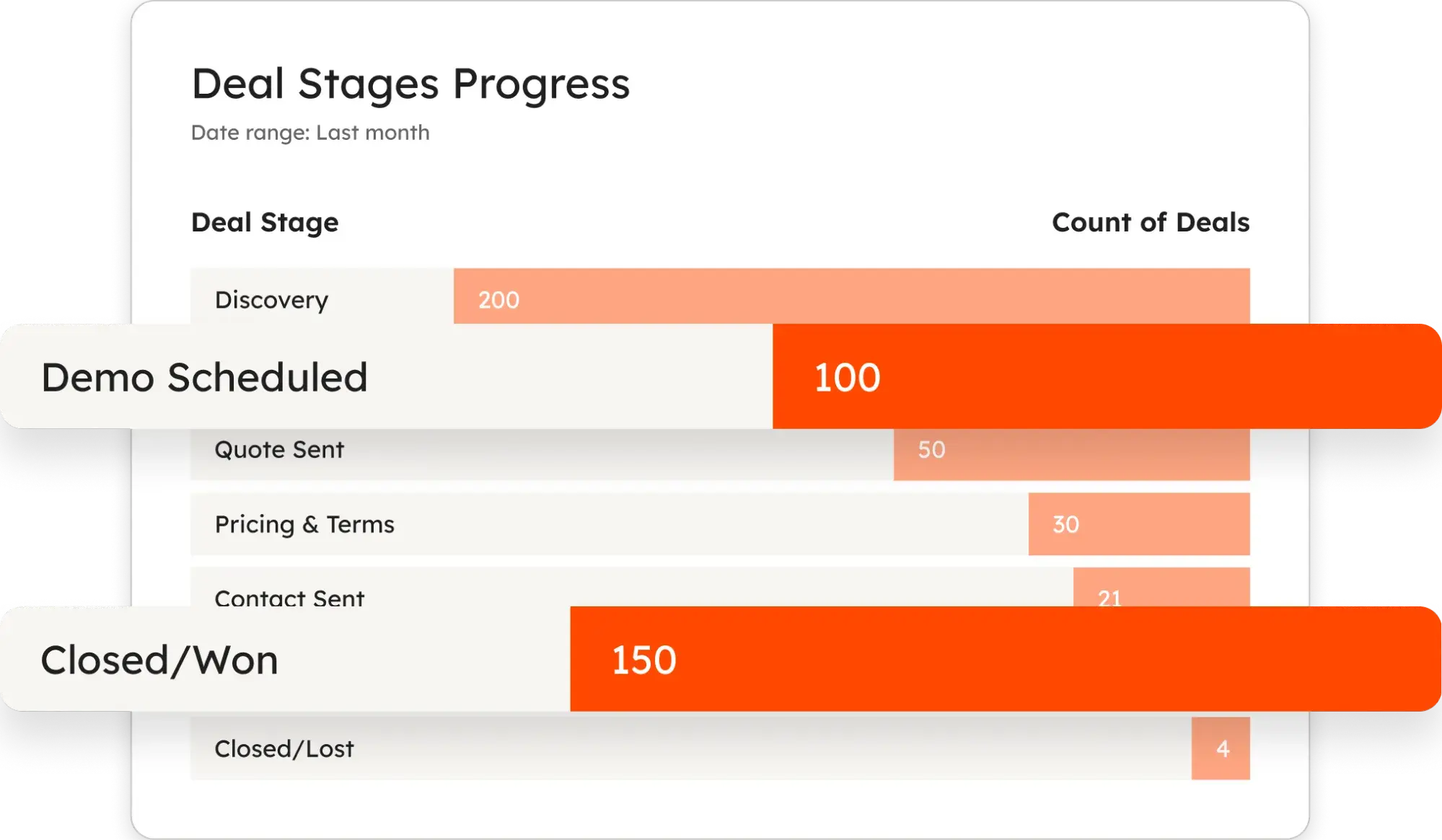
HubSpot Smart CRM centralizes customer records, interactions, lifecycle activity, and reporting into a single connected system. Customer success and customer experience teams can use the same account context to coordinate onboarding, support, adoption, and retention work.
Because Smart CRM connects data across HubSpot’s agentic customer platform, teams can analyze journey-level patterns without losing the account-level history behind them.
Key Features
- Shared customer records: Contact, company, deal, ticket, and activity data give teams a consistent view of each customer.
- Lifecycle automation: Custom properties, stages, and workflows can trigger actions when engagement, feedback, or account status changes.
- Reporting: Dashboards connect customer activity with lifecycle and performance metrics.
Best for: Customer-facing and operations teams that need a shared CRM foundation for customer experience and customer success work.
Pricing: Select Smart CRM features are available in HubSpot’s free tools. Standalone Smart CRM Professional starts at $45 per seat per month with an annual commitment, and Enterprise starts at $75 per seat per month.
What we like: Smart CRM keeps account history and journey data in the same system, giving customer success and customer experience teams shared context without requiring them to use identical scorecards.
Serve and delight at scale.
Customer service technology helps teams manage support channels, self-service resources, customer feedback, and account health without losing context. It should connect immediate service interactions to the broader experience patterns and customer outcomes that follow.
Service Hub
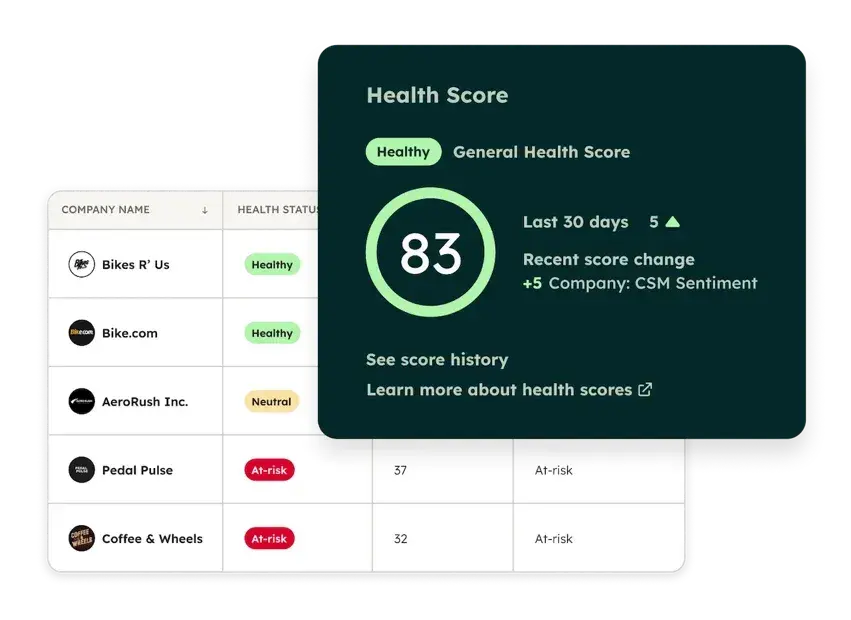
Service Hub is HubSpot’s customer service software for managing support, feedback, self-service, and customer success workflows on a shared customer record. It helps teams connect immediate service interactions with broader experience and retention signals.
Key Features
- Support operations: The shared inbox and help desk organize conversations, route tickets, and give service teams the context they need to resolve issues.
- Self-service and feedback: Knowledge base and feedback tools help customers find answers while providing teams with structured insights into satisfaction and effort.
- Customer success and analytics: Customer success workspace, health scores, and service analytics help teams prioritize accounts and monitor service performance.
Best for: Customer service, customer experience, and customer success teams that need a single connected system for support and retention.
Pricing: Service Hub is free for up to two users. Starter starts at $7 per seat per month with an annual commitment, Professional starts at $90 per seat per month with an annual commitment, and Enterprise starts at $150 per seat per month. Professional and Enterprise require one-time onboarding fees.
What we like: Service Hub connects ticket-level service data with feedback, customer health, and renewal work, so teams can solve an immediate problem without losing sight of the customer’s broader outcome.
Add AI for faster value.
AI can answer routine questions, summarize customer context, and route complex issues to a person. When teams use it with clear guardrails and an accurate knowledge base, AI can reduce wait times while preserving human ownership of sensitive or high-impact conversations.
Agent Hub
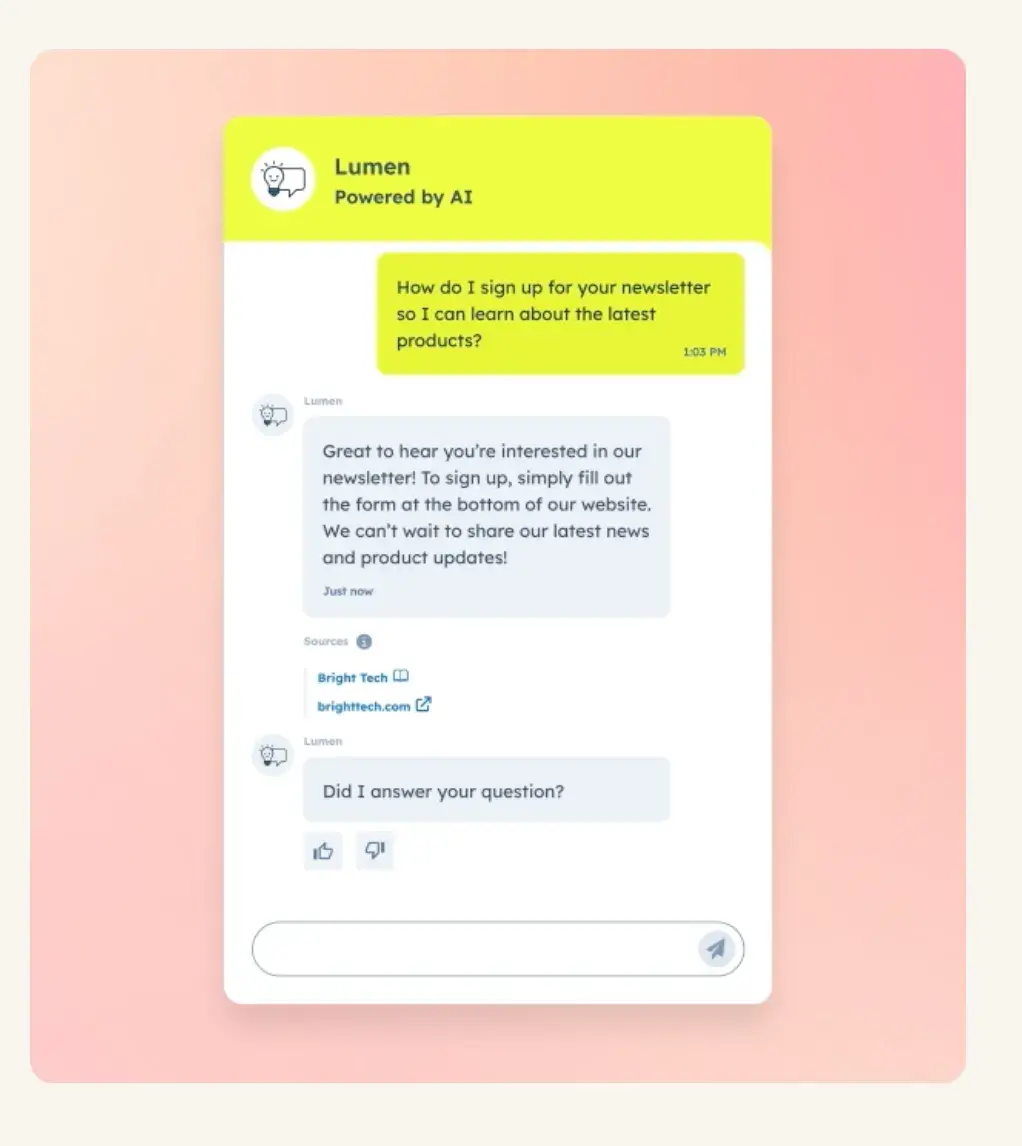
Agent Hub is HubSpot’s central home for building and managing AI agents across marketing, sales, and customer service. Agents automate specialized workflows. Customer agent answers and resolves common customer questions across supported channels.
HubSpot reports that customer agent can resolve up to 70% of conversations without human intervention. Nutribees chief marketing officer Pietro Ripanti said customer agent “lowered the number of tickets handled by customer support by 77%.”
Key Features
- Contextual answers: Customer agent uses approved knowledge sources and CRM context to answer common questions.
- Automated resolution and routing: The agent can resolve routine conversations and route complex cases to a person.
- Guardrails and handoffs: Teams control the agent’s channels, availability, guidance, and escalation rules.
Best for: Service teams that want AI to handle repeatable inquiries while human specialists focus on conversations that require judgment or deeper expertise.
Pricing: Customer agent is available to Professional and Enterprise customers and costs $0.50 per resolved conversation, billed through HubSpot Credits.
What we like: The resolution-based model ties customer-agent cost to completed work, while configurable handoffs let teams retain control over complex or sensitive conversations.
Free Customer Journey Template
Outline your company's customer journey and experience with these 7 free templates.
- Buyer's Journey Template
- Future State Template
- Day-in-the-Life Template
- And more!
Download Free
All fields are required.
Form not available
Customer Experience vs. Customer Service vs. Customer Success
Customer service delivers support, customer experience designs and improves the journey, and customer success helps customers achieve outcomes after purchase. The functions overlap, but each answers a different customer need.
When software fails, customer service resolves the immediate issue. Customer experience examines whether the interface, communication, or support journey created avoidable friction. Customer success determines whether the disruption threatens the customer’s ability to achieve an important outcome.
When to Prioritize Customer Success or Customer Experience
Prioritize customer success when customers have already committed but struggle to adopt the product, realize value, renew, or expand. Prioritize the customer experience when friction affects research, purchase, onboarding, support, or any other part of the journey.
Prioritize customer success when:
- Adoption is low.
- Time to value is slow.
- Customers are not achieving the expected outcome.
- Renewal or expansion is at risk.
Prioritize customer experience when:
- Customers struggle to find or understand important information.
- The buying or onboarding journey feels unclear or inconsistent.
- Support interactions create additional friction.
- Customers abandon the journey before activation or early engagement.
The functions often need to work together. A poor onboarding experience can lower adoption, while low adoption can reveal a broader journey or usability problem.
Use a customer experience strategy to locate the journey problem, then assign an accountable owner. Teams can use the resulting insight to improve customer experience before the same friction affects more accounts. HubSpot Smart CRM can connect account data, feedback, and lifecycle activity so teams can trace the issue and coordinate a response.
Frequently Asked Questions About Customer Success vs. Customer Experience
Is customer success part of customer experience?
Customer success is closely connected to customer experience, but organizations do not always structure it as a subset of CX. Customer experience focuses on the end-to-end journey and customer perception, while customer success focuses on post-purchase value realization, adoption, retention, and growth.
The functions overlap during onboarding, support, and renewal. Organizations should define responsibilities and handoffs rather than rely on a single universal org chart.
Who owns churn and renewals vs. NPS and CSAT?
Customer success usually owns churn and renewals because it manages account health, adoption, and commercial outcomes. Customer experience often owns NPS and journey-level feedback, while customer service or operations teams may administer transactional CSAT surveys.
The exact owner varies by organization. Assign one accountable owner to each metric and define how other teams will act on the results.
Do small teams need both customer success and customer experience?
Small teams need both disciplines, but they do not need separate departments. Either a single person or a cross-functional team can own journey design and customer outcomes, as long as responsibilities, metrics, and handoffs remain clear.
Start with a simple operating model that covers the full journey, not only post-purchase activity. Separate the roles when workload or specialization makes that structure useful.
What tools do we need to measure both effectively?
Use a CRM as the shared system of record, feedback tools for NPS, CSAT, and CES, product analytics for adoption and behavior, and customer service software for tickets and resolution metrics. Connect the systems so teams can analyze account outcomes alongside journey-level feedback.
HubSpot Smart CRM and Service Hub can combine customer records, support activity, feedback, health scores, and reporting into a single connected system. Teams can also integrate product analytics when they need deeper feature-usage data.
A Unified Path to Retention
Customer experience designs the journey, customer service resolves immediate issues, and customer success helps customers achieve outcomes after purchase. Clear ownership keeps those responsibilities distinct, while shared data and coordinated workflows connect them. Service Hub can bring support, feedback, customer health, and customer success work together so teams can protect retention without creating new silos.
In my work as a freelance content marketer, I see why small teams often combine customer experience and customer success. The same person may manage onboarding and long-term value, but the work still requires separate measures: journey friction indicates whether the process works. In contrast, outcomes indicate whether the client receives value.
To start aligning these disciplines, download the free Customer Journey Map Template and map every critical touchpoint from awareness through expansion.
Free Customer Journey Template
Outline your company's customer journey and experience with these 7 free templates.
- Buyer's Journey Template
- Future State Template
- Day-in-the-Life Template
- And more!
Download Free
All fields are required.
Form not available