-3.png?width=112&height=112&name=support%20strategy%20cover%20(3)-3.png)

Sales and marketing teams bring customers through the door, but customer support keeps them around. What is customer support? It‘s the crucial pillar of customer experience that prevents churn and drives retention. When customers struggle to use and understand a product, they’re likely to switch to a competitor. Support teams solve customer issues, identify pain points, and help ensure users experience a product's full value with minimal friction
![→ Free Download: 61 Templates to Help You Put the Customer First [Download Now]](https://no-cache.hubspot.com/cta/default/53/a66c79d4-2a39-46e6-a80a-f7b999133c06.png)
This post discusses customer support, why it is vital for all businesses, and how to develop an effective customer support strategy that bolsters customer retention and satisfaction.
Table of Contents
- What is customer support?
- Why is customer support important?
- Customer Support Team Structure
- Customer Support Responsibilities
- Customer Support Channels
- Customer Support Skills
- How to Improve Your Customer Support Strategy
- Customer Support Software
- Examples of Great Customer Support
- Customer Support and Business Growth
- Frequently Asked Questions About Customer Support
What is customer support?
Customer support is the function or team within an organization dedicated to helping customers resolve technical issues, troubleshoot problems, and successfully use products or services. Unlike general customer service, which encompasses the entire customer experience, customer support focuses specifically on technical problem-solving and ensuring customers can effectively utilize the products they have purchased.
.png)
Customer Support Strategy & Planning Template
Outline your company's customer support strategy with this free template.
- Customer Support Vision
- Team Structure & Hiring Plan
- Support Process
- And More!
Download Free
All fields are required.
Form not available
Why is customer support important?
Customer support is essential because it directly impacts customer loyalty, satisfaction, and churn. Customers who receive timely, helpful, empathetic support are more likely to continue using a product and recommend it to others, which has a significant impact on profitability and growth.
Here’s why customer support is essential.
Customer support drives retention
Acquiring a new customer can cost 5-25x more than retaining an existing one, making customer retention a critical business priority. Customer support serves as the frontline defense against customer churn and a key driver of customer retention. When customers encounter friction with a product or service, the speed and quality of customer support they receive often determine whether they renew or cancel.
Customer support’s impact on churn prevention is significant as well. 67% of customer churn is preventable if problems are solved during an initial support interaction. Excellent customer support provides effective resolutions, reduces customer frustration, and increases revenue through retention.
Investing in customer support delivers measurable retention benefits. Even a modest 5% increase in retention through customer support can boost profitability by 25%. For businesses focused on long-term growth, excellent customer support is a retention engine that protects revenue and forms the foundation of loyal customer relationships.
Customer support increases customer lifetime value (CLV)
Customer support keeps customers engaged and directly impacts revenue growth. HubSpot data shows that 93% of customers are likely to make repeat purchases with companies that offer excellent customer support. When support teams help customers overcome technical issues and realize value from a product, their loyalty increases, and so does spending.
This happens through repeated positive interactions that build trust and reveal opportunities for expansion. Customers who master advanced features through support guidance are more likely to upgrade to premium tiers and purchase add-ons. By resolving technical barriers and enabling product mastery, support teams solve problems and unlock revenue.
Customer support provides critical product feedback
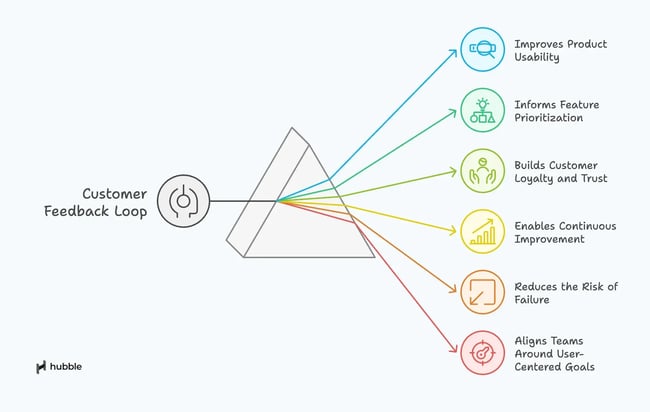
Support teams interact with customers more than anyone else in the organization, giving them unfiltered insight into how products actually perform in the real world. I was a support rep at HubSpot, and I was usually the first to hear about bugs, identify confusing UI elements that tripped up customers, and spot the features customers wished we had.
When companies build strong feedback loops between support and product teams, these insights directly shape development priorities to align with customer needs. By analyzing support ticket trends alongside direct customer feedback, product teams can eliminate common friction points and build products customers actually want.
The financial impact of support insights is significant. Identifying and solving recurring issues through feedback reduces customer service costs. For example, Dropbox redesigned its file-sharing interface based on support feedback, resulting in a 34% reduction in support tickets. Beyond cost savings, companies that actively listen and act on customer feedback grow 41% faster than competitors that don’t.
Customer support builds brand reputation and trust
As a support rep at HubSpot, I noticed that our commitment to exceptional support was one of our strongest differentiators from the competition. Customers didn’t just stick around because the product worked well. They remained loyal because they trusted we’d always be there when they needed help.
That trust directly translates into advocacy and revenue growth. When customers receive exceptional support, they are more likely to become brand advocates. 72% of customers share positive experiences with 6 or more people, and 92% of consumers trust recommendations from friends and family over all other forms of advertising. Customer support enhances revenue by encouraging word-of-mouth marketing via consistent, positive customer experiences, creating a network of advocates who drive growth through referrals.
Beyond referrals, support quality allows companies to charge a premium. Research shows that 86% of buyers are willing to pay more for a better customer experience, and quality of support is a primary factor in that equation. In today’s saturated business landscape, where most products offer the same or similar features, support quality often becomes the tiebreaker. That’s why companies known for premium support retain customers and command premium pricing.
Delivering Exceptional Customer Support at Scale
Modern customer support teams provide streamlined service through tools that leverage automation and personalization. HubSpot Service Hub provides a CRM-integrated omnichannel ticketing, knowledge base management, customer feedback tools, AI copilots and agents, and workflow automation to help support teams resolve issues while maintaining personalization at scale.
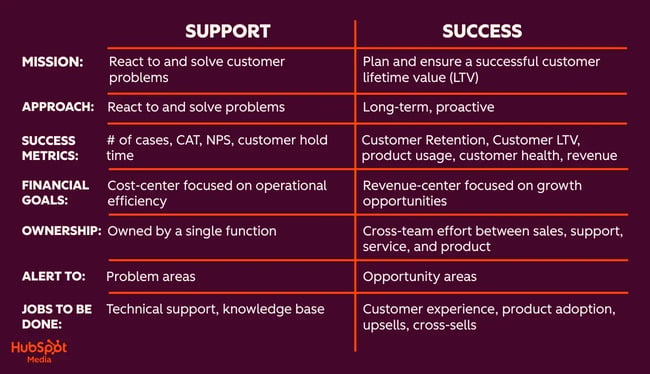
How Customer Support Interacts With Customer Service and Customer Success
Customer support, customer service, and customer success are all customer-facing teams essential to a company's prosperity and growth. Despite their interconnected roles, they serve distinct functions.
Customer Service vs. Customer Support
Customer service teams proactively aim to enhance customer satisfaction by anticipating needs and addressing them before issues arise. For example, at a SaaS company, customer service may involve contacting clients to discuss product updates and new features that support their goals.
In contrast, customer support teams operate reactively, responding directly to customer inquiries, comments, or concerns. Support representatives typically handle incoming calls and support tickets without initiating contact for check-ins or updates.
I was a support rep at HubSpot for two years, and during that time, I never called customers out of the blue to discuss strategy or talk about product updates (that was the customer success manager’s job). Instead, I fielded incoming calls and tickets and resolved technical issues for customers.
Integrating customer support and success creates a comprehensive support ecosystem that addresses both immediate and future needs, fostering a customer-centric environment that promotes retention and long-term loyalty.
Customer Success vs. Customer Support
Customer success teams adopt a strategic, high-level approach to help clients identify goals and achieve success with the company’s products or services. Unlike the reactive troubleshooting focus of customer support, customer success involves ongoing consultation to ensure sustained success and increased lifetime value.
For example, a customer might ask their customer success manager:
- “How can I use this tool to increase my ROI?”
Meanwhile, inquiries like “My login isn't working” fall under customer support.
These teams often collaborate with other departments, such as Sales and Product, to facilitate upselling and cross-selling of features and services aligned with client objectives. Typically, customers have a dedicated customer success manager serving as the primary contact for strategic guidance. Conversely, customer support inquiries are handled by whichever support team member is available at the time.
Customer Support Team Structure
The structure of a customer support team directly impacts its effectiveness, influencing team agility, support quality, customer satisfaction, and the ability to scale with company growth.
Designing an Effective Support Team Structure
Building the proper support structure begins with assessing both business and customer needs. Organizations should examine the types of support requests customers most often submit and create team structures that address these patterns.
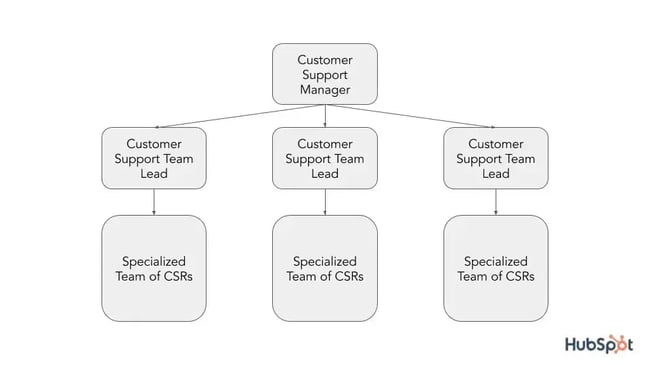
The image below shows a standard customer support team structure:
Specialized Roles Within Support Teams
Most support teams implement tiered structures with specialized roles. When I worked at HubSpot support, our team was divided into the following roles:
- Frontline support representatives handle initial customer inquiries and resolve common issues.
- Team leads oversee small groups of representatives, providing coaching and quality assurance.
- Product experts or specialists possess deep technical knowledge in specific product areas and manage escalated or complex cases.
HubSpot’s support team reflects its nature in supporting a SaaS product with many technical features. The team exclusively handles technical questions and includes product experts who specialize in individual product areas and can assist with highly complex and escalated cases. This specialization ensures customers receive accurate, efficient resolution regardless of issue complexity.
Aligning Structure With Customer Needs
Effective support organizations design their structure around the requests they most commonly receive. SaaS companies like HubSpot benefit from tiered teams with specialized product experts, while ecommerce businesses may prioritize larger frontline teams handling high volumes of straightforward inquiries.
The right structural alignment reduces escalations, improves first-contact resolution rates, and ensures customers receive efficient, knowledgeable support regardless of issue complexity.
Customer Support Responsibilities
Customer support responsibilities vary by industry and customer needs, but most teams share common core functions:
Direct Customer Assistance
- Answer phone calls, emails, and live chat inquiries to resolve issues in real time
- Provide support on social media channels where customers seek help
- Guide customers through onboarding and product training
Knowledge Management
- Create, update, and maintain self-service knowledge base content
- Document solutions to common issues for customer and internal reference
Team Development
- Train and onboard new support representatives
- Shadow calls and provide coaching to junior team members
Cross-Functional Collaboration
- Collect and route customer feedback to appropriate teams
- Partner with product and engineering to resolve complex technical issues
- Communicate customer needs and pain points across the organization
Brand Representation
- Maintain a positive, on-brand presence in all customer interactions
- Embody company values as the primary customer-facing team
Customer Support Channels
Modern customers expect support through their preferred channels. Meeting them where they are is essential for satisfaction and retention, and effective support strategies balance traditional methods, real-time digital channels, and self-service options.
Traditional Channels
Phone support remains critical for complex issues requiring detailed troubleshooting or an immediate human connection. Dedicated support lines with intelligent routing connect customers to the right expertise quickly, reducing frustration and resolution time.
Email support handles non-urgent issues that benefit from detailed documentation. Customers can attach screenshots, thoroughly explain problems, and reference conversations later. Ticketing systems help teams track, prioritize, and resolve email requests efficiently.
Real-Time Digital Channels
Live chat has become the preferred channel for quick questions. Customers get immediate responses without leaving the website. Teams should set clear expectations by using automated greetings that include typical response times.
Social media support isn't optional anymore. Customers expect responses on X, Facebook, Instagram, and LinkedIn. Organizations can use social media monitoring tools to catch mentions even when customers don't tag the brand directly.
Self-Service Options
Knowledge bases empower customers to find answers independently, reducing ticket volume while maintaining high satisfaction. Well-organized help centers with searchable articles, tutorials, and FAQs enable customers to resolve simple issues quickly on their own terms.
Community forums enable customers to assist one another. Peer-to-peer support is simple to scale and fosters community among users. Support teams should moderate conversations and intervene when complex issues arise or incorrect information spreads.
AI chatbots handle routine questions 24/7. They're perfect for password resets, order status checks, and basic troubleshooting. If issues are complex or accounts need a human touch, chatbots should automatically escalate to human agents.
Building an Effective Channel Strategy
A team’s channel strategy depends on the customers’ preferences and the product’s complexity. B2B software companies need robust phone and email support for technical issues, while ecommerce businesses might prioritize chat and social media for quick order questions.
HubSpot Service Hub enables easy ticketing across all channels so businesses can meet customers wherever they are.
Customer Support Skills
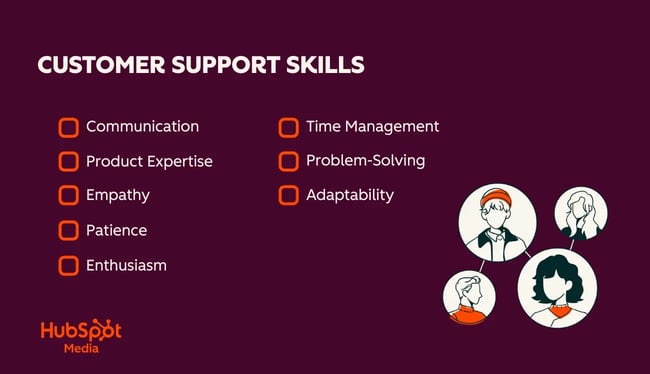
Customer support reps need a range of skills to succeed and deliver customer satisfaction. Essential customer support skills include communication, empathy, product expertise, and problem-solving. Here’s a quick rundown of the essential customer support skills that reps need to connect with customers and provide top-quality support.
Communication
Effective communication is the cornerstone of high-quality customer support.
I’m an introvert, so when I started in support, I was worried I would struggle to communicate with customers. However, having communication skills doesn’t mean you need to be the life of the party. Instead, I found that successful communication meant articulating myself clearly, listening actively, and showing genuine empathy to help customers succeed.
Pro tip: Listen with the intent to understand, not to respond. Re-articulate customers' questions and objectives to ensure both parties are on the same page.
Product Expertise
To effectively respond to customer inquiries, a thorough understanding of a product's features and capabilities is non-negotiable. Product knowledge enables clear answers and valuable insights, enhancing the customer experience.
Pro tip: Be honest. It’s impossible to know everything. If I encountered a question I was unsure about, I would let the customer know I would do some research and testing to find the best possible answer.
Empathy
Empathy is crucial in customer support. Reps must understand customers' needs, actively listen, and show genuine compassion and a desire to solve their problems. To provide the best-quality customer support, reps must have an intimate understanding of how customers feel and what they need from a company’s product or service.
Pro tip: Empathy is most critical in difficult situations when customers are frustrated or upset. In those cases, always start by validating the customer's feelings. Displaying empathy and understanding about why they are upset makes it clear that the support team is on their side.
Mental Toughness and Patience
Take it from me: customer support isn’t always a walk in the park. When I worked at HubSpot, there were tough days when the phone lines were overloaded, and it felt like we were drowning in tickets.
It takes mental toughness and patience to remain calm when facing situations like this, and even more so when unfairly confronted by demanding or rude customers.
Pro tip: Resilience is like a muscle. Support reps can build it over time as they become more experienced and confident in their work. Managers should encourage reps to take breaks, remember to breathe, and not be afraid to lean on their teammates when they need help. Even support reps need support sometimes.
Enthusiasm
As members of a company‘s primary customer-facing team, customer support reps must display a positive, enthusiastic attitude that embodies the brand’s values. Support reps should be motivated to help solve customers' problems, encouraging customer loyalty through consistent positive interactions.
Pro tip: Authenticity is key. Maintaining a positive attitude is essential, but overdoing it can be counterproductive. In my experience, customers can smell inauthenticity a mile away.
Time Management
Support reps must master time management to handle large volumes of customer requests effectively. Prioritizing urgent matters and working efficiently are key skills, with successful support reps demonstrating a strong sense of urgency that enables them to resolve issues promptly and thoroughly.
Pro tip: Try the Pomodoro Technique, which alternates highly focused work with short breaks to manage time.
Problem-Solving
Problem-solving is at the heart of a support rep‘s role. Customer inquiries aren’t always straightforward, so support reps must develop strong problem-solving skills to understand customers’ needs and provide solutions.
Pro tip: Sometimes there isn’t a simple solution to a customer’s question. In such cases, support reps can use their resourcefulness, creativity, and analytical skills to devise workarounds that accomplish the customer’s goal in unexpected ways.
Adaptability
Customer support reps must adapt to ever-changing business strategies and product offerings. As products and services evolve, so must support reps' knowledge and expertise.
HubSpot’s product is constantly evolving and improving, so when I worked at HubSpot support, I had to stay on top of updates and new features to provide the highest-quality support.
Pro tip: Adaptability is a mindset. Reps should avoid getting stuck in a single way of doing things, and management should encourage enthusiasm for new features and offerings.
How to Improve Your Customer Support Strategy
Working in support is highly rewarding, as it positively impacts both customers and the company’s bottom line. However, customer support presents challenges, including mental fatigue and, at times, discouragement from managing overwhelming tickets and difficult customer interactions.
Here are some effective support strategies to ensure team members remain motivated, effective, and engaged.
1. Optimize staffing and training
Building an effective support team starts with ensuring the right number of people are in place and properly equipped to handle customer needs.
Team Size
Analyze current and projected ticket volumes to determine staffing levels needed to meet SLAs and customer expectations without overextending reps. Understaffing leads to burnout, and overstaffing wastes resources.
Tailor training to product complexity
Training needs vary significantly by industry. SaaS companies with feature-rich products like HubSpot require several weeks of support training to ensure representatives master complex product functionality.
Retail or e-commerce companies with straightforward transactions may need less intensive training since reps’ responsibilities are less technical by nature.
2. Identify and develop critical skills
Customer support skills are weighted differently in terms of importance across industries. Organizations should identify which core competencies (empathy, problem-solving, communication, product knowledge) are most important for meeting customer needs and achieving business goals.
For example, tech companies like Microsoft may prioritize analytical skills and problem-solving abilities in their reps, while consumer-facing brands like Trader Joe's emphasize interpersonal warmth and customer engagement as core skills for team members.
3. Foster collaboration with product teams
Businesses benefit from close collaboration between support and product teams, especially software companies, where reps need direct access to engineering resources. Since support reps speak to customers directly more than almost anyone in a business, they have unique insight into customer needs and pain points. When support and product teams are closely aligned, it’s easier for businesses to translate that feedback directly into product updates and customer experience improvements.
4. Equip teams with purpose-built tools
Modern support teams need a ticketing system that organizes all incoming customer inquiries into a shared, omnichannel inbox for enhanced collaboration and organization. Tools like HubSpot Service Hub provide all the tools a support team needs, and more, including an omnichannel inbox, AI agent assist features, and complete customer history powered by HubSpot CRM Data.
Businesses should evaluate multiple customer service platforms to find one that best fits their business needs. Smaller teams might consider lightweight platforms that focus solely on the shared inbox, while larger teams may need robust solutions with advanced automation and customizable workflows.
Pro tip: Training customer support reps on using customer support software is essential. Reps must be able to navigate support software effortlessly to serve customers best.
5. Create a culture of recognition and empowerment
Support team satisfaction directly impacts customer satisfaction. Organizations that value their support reps see higher morale, better performance, and happier customers.
Effective recognition strategies include:
- Taking feedback seriously: Acting on representative suggestions demonstrates that their insights matter
- Celebrating achievements: Acknowledging top performers and milestones boosts motivation
- Providing growth opportunities: Creating clear career paths within and beyond support roles
- Offering meaningful perks: Benefits that genuinely improve work-life balance and bring reps joy
When I worked in support, HubSpot went to great lengths to ensure the support team and all employees were satisfied. I loved the free coffee and unlimited vacation time, but what really made me feel valued was that management took our feedback and recommendations seriously. Feeling recognized and heard was a boon for fostering my sense of ownership and motivation to solve problems for the customer.
6. Measure and analyze team performance
Regular performance analysis optimizes support operations.
Key metrics include:
- Net Promoter Score (NPS): Measures customer loyalty and likelihood to recommend a product/service to others.
- Customer Satisfaction Score (CSAT): Directly measures satisfaction with support interactions.
- Customer Effort Score (CES): Assesses how difficult or easy it is for customers to use a product or complete a task.
- First Contact Resolution Rate: Measures the percentage of customer issues resolved after the first interaction.
- Employee Satisfaction Metrics: Internal health indicators that predict external performance
Combine customer-facing metrics with employee satisfaction data to gain a comprehensive view of support effectiveness.
7. Prioritize wellbeing and prevent burnout
Burnout is an unfortunate reality of customer-facing roles, but organizations can enact proactive strategies to create a healthy, sustainable work environment:
- Professional development opportunities: Support roles are often entry-level positions. Providing skill development, cross-training, and clear advancement paths helps representatives grow while adding value to the organization.
- Mental health resources: Access to counseling services, stress management programs, and mindfulness workshops significantly improves representative wellbeing and reduces turnover.
- Relaxation spaces: Provide designated areas for reps to unwind during breaks. Quiet rooms, meditation spaces, or outdoor areas support mental recovery.
- Recognition programs: Consistent acknowledgment of strong performance through awards, public recognition, or advancement opportunities reinforces the value and visibility of team contributions.
- Anonymous feedback channels: Offer safe, judgment-free ways for representatives to share concerns about workload, processes, or management. Feedback channels enable leadership to address issues before they cause attrition.
Customer Support Software
Customer support software is essential for managing customer interactions, streamlining processes, and enhancing your team's productivity.
As a support rep, I spent my entire day in customer support software, so I can’t stress enough how important it is for support tools to be user-friendly and include all the necessary features to solve customers' problems.
HubSpot Service Hub is a customer-centric, full-service software solution that can power every aspect of a business's support operation.
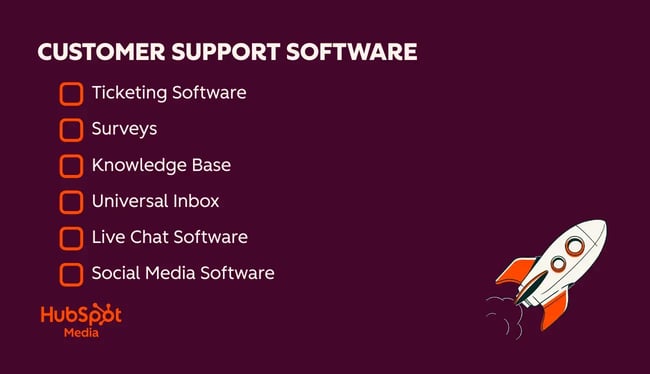
Below are the main types of customer support tools that teams use to manage incoming tickets, gather feedback, and offer self-service resources.
Ticketing Software
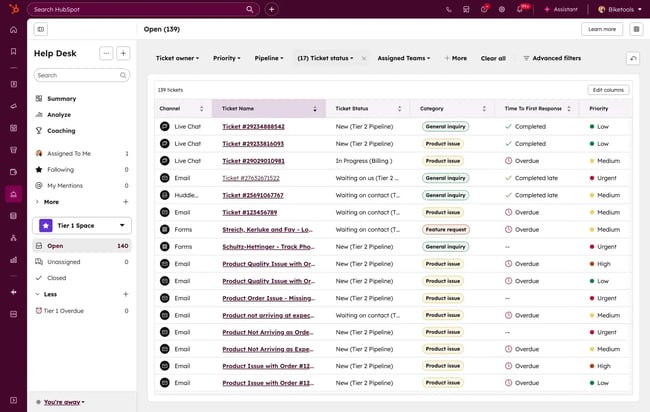
Help desk and ticketing software are critical for organizing incoming customer requests. HubSpot Service Hub’s Help Desk allows support teams to track, triage, and automatically assign cases to the right person, ensuring no request goes unnoticed.
Surveys
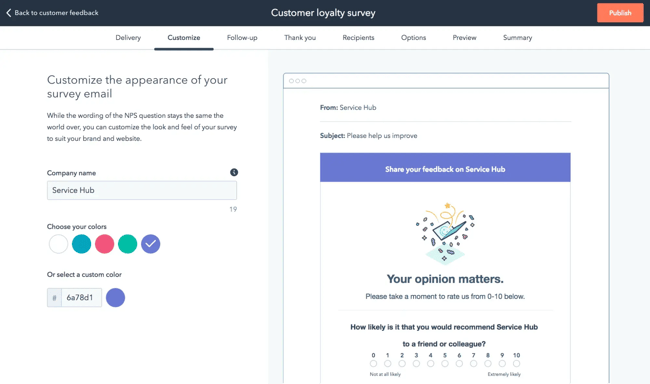
Surveys are essential for measuring a business’s internal and external successes. Teams should collect customer feedback before or after a customer interacts with a representative. The goal is to gather insights from customer service representatives about their job satisfaction and happiness. HubSpot’s Survey and Customer Feedback software reveals important information about the people who are most vital to success and growth.
Knowledge Base
Maintaining a knowledge base of informative, up-to-date self-service resources is crucial for customer satisfaction. HubSpot’s knowledge base software helps businesses create educational support content, so customers can answer questions independently. A knowledge base can include FAQs, how-to guides, video walkthroughs, product documentation, and other helpful information.
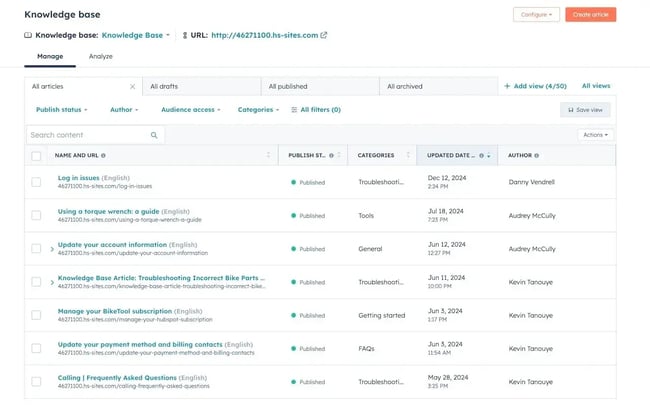
A knowledge base empowers customer self-service by providing a centralized, accessible library of information that allows customers to find answers to their questions independently, leading to faster problem resolution, increased customer satisfaction, and reduced support costs for businesses.
Universal Inbox
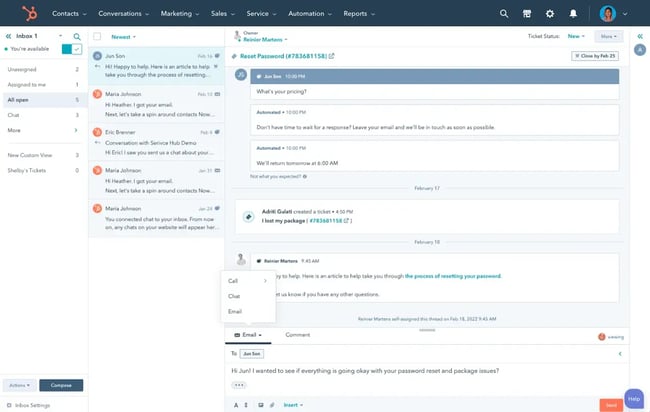
HubSpot, Zendesk, and Freshdesk offer shared inboxes to help customer support reps organize incoming tickets from all support channels into a unified inbox. A universal inbox also keeps track of each customer’s interaction history, giving reps the context to provide personalized, informed support.
Live Chat Software
Customers expect immediate support via live chat software in today's digital landscape. Live chat enables real-time, text-based customer interactions via widgets integrated directly into a business’s website. It allows support teams to resolve technical issues and answer questions instantly while the customer is still on the page.
HubSpot’s Breeze AI Agent can automatically greet customers and solve inquiries in a live chat window. It can deflect common questions (which reduces support volume) and escalate more complex inquiries to human representatives.
Social Media Software
Customers are bound to take to social media to provide feedback, ask questions, or lodge complaints. Social media software allows businesses to monitor and manage customer interactions across all social channels in a unified inbox.
I was a member of the social support team during my time at HubSpot, where we used social listening to monitor for brand mentions and even specific keywords. Using social listening software, I proactively supported customers online, boosting satisfaction and loyalty.
Examples of Great Customer Support
Below are real-world examples of customer support that go above and beyond to create excellent customer experiences that drive revenue, retention, and shape brand identity.
Chewy
Chewy is the ecommerce giant of the pet industry, but it didn't get there by just selling kibble and chew toys. Chewy aligns its values with pet parents, and they understand that pets are what get many people out of bed every day. They put customers (and their pets) first, and always go above and beyond to ensure customer satisfaction. Here’s what a Reddit user has to say about Chewy’s customer support in a thread on Chewy’s exceptional service:

What Stands Out
The ability to get on the phone with a real human being is a key differentiator in Chewy’s customer support. Just that fact alone is enough to convince many customers to go with Chewy over other retailers like Amazon, where they could technically buy many of the same products. It seems like a low bar, but many companies are missing the human element of customer support, so that alone is enough to sway many consumers.
In addition, Chewy is known for sending flowers and a card when a pet passes away. For pet parents, the empathy Chewy’s customer support shows is authentic and demonstrates that it is truly aligned with their customers' values. It elevates their brand identity from good to great.
Lesson: Empathetic customer support humanizes a brand and deepens loyalty.
Apple’s Genius Bar
Apple’s Genius Bar set the standard for in-store technical support. They offer quick diagnostics, face-to-face communication, and transparent problem resolution. It’s an industry-leading support experience that is defined by its lack of friction, consistency, and clarity. Customers can easily schedule appointments online and rest assured that an Apple technician will assist with any technical issues, without confusing jargon or annoying upsells.
Why It Works
The key to the Apple Genius Bar experience is the reduced friction. Customers don’t have to worry about knowing all the details or troubleshooting over the phone. They can just schedule an appointment, show up, and leave the rest to the Genius Bar.
Lesson: Reducing friction in the support process increases satisfaction and long-term brand loyalty, particularly for complex products and services.
Spectrum

I had issues with the Wi-Fi in my apartment all last week. As a former customer support rep myself, I tried all the troubleshooting I could on my own. I restarted my router and modem multiple times, updated my DNS settings, and dove deep into my router security settings. When none of that worked, I reached out to Spectrum customer support, not expecting much.
I decided to use the live chat feature, and I was pleasantly surprised with how quickly I was connected to an agent. I explained the issue to Denise (the agent) and all the troubleshooting steps I had already performed on my end. Instead of dismissing my input or asking me to restart the router again, she took the time to listen, acknowledged the steps I had completed, and moved straight into a deeper diagnostic.
Denise ran a remote test and measured the ping time between the modem and the router, identifying a significant communication delay. This confirmed there was no issue with Spectrum’s service and led us to conclude that the Ethernet cable connecting the devices needed to be replaced. I replaced the cable, and voila, I’m back online.
What Stands Out
This interaction shows how powerful attentive, personalized support can be. Denise:
- Didn’t treat me like a novice user
- Didn’t waste time repeating basic steps
- Used internal diagnostic tools intelligently
- Respected the information I provided
- Solved the real root issue
Lesson: Effective support starts by listening to the customer, not the script. Acknowledging user effort reduces frustration and speeds up resolution.
Customer Support and Business Growth
Customer support is a critical and often undervalued driver of business growth. As the direct connection between customers and the company, adequate support impacts revenue in many significant ways. Here’s an overview of the key growth drivers of customer support.
|
Growth Driver |
The Data |
Business Impact |
|
Customer Retention |
A 5% increase in retention can increase profitability by 25%. |
Acquiring a new customer costs 5x more than retaining an existing one. Support protects recurring revenue and reduces acquisition costs by enhancing customer retention. |
|
Word-of-Mouth Marketing |
72% of customers will share a positive experience with six or more people. |
92% of consumers trust peer recommendations over ads. Great support turns customers into an effective marketing channel. |
|
Churn Reduction |
67% of churn is preventable if the issue is resolved in the first interaction. |
Excellent support stops friction before it becomes a cancellation, preserving recurring revenue and customer relationships. |
|
Pricing Power |
72% of customers are willing to pay more for a premium experience when doing business with a company. |
Superior support justifies premium pricing. Customers view top-tier customer support as a premium part of the product's value. |
|
Product Innovation |
Support teams surface bugs, feature requests, and customer feedback faster than any other department. |
The support-product feedback loop enables data-driven product decisions that align development with customer needs, reducing future support costs and increasing customer satisfaction. Companies that actively collect and act on customer feedback grow 40% faster than competitors that don’t. |
|
Lifetime Value (CLV) |
Repeat customers spend 67% more than new customers. |
High-quality support builds trust, extends the customer relationship, and increases total revenue per customer. |
Frequently Asked Questions About Customer Support
What is the meaning of customer support?
Customer support is the team or function dedicated to helping customers resolve technical issues, troubleshoot problems, and successfully use a product or service. Unlike general customer service, support focuses specifically on problem-solving and ensuring customers can fully utilize what they've purchased.
What does a customer support person do?
Customer support representatives diagnose and resolve technical issues, guide customers through product features, answer questions about functionality, and escalate complex problems to specialized teams. Support reps work across email, chat, phone, and self-service portals to ensure customers can overcome obstacles and achieve their goals with the product.
What is an example of customer support?
A customer support interaction might involve walking a customer through an advanced feature they‘re struggling with, or investigating a bug that’s preventing them from completing a workflow.
What are customer support skills?
Here are the most essential skills required by reps for effective customer support:
- Empathy: Understanding customer frustration and responding with patience
- Problem-solving: Diagnosing root causes and finding effective solutions
- Product knowledge: Deep familiarity with features, limitations, and use cases
- Communication: Translating technical concepts into clear, actionable guidance
How is customer support different from customer service?
Customer support specifically focuses on technical problem-solving and product usage. It is reactive, meaning customer support reps respond directly to incoming customer inquiries. Customer service encompasses the entire customer experience and focuses on the overall customer relationship and satisfaction. For example, customer service might help a customer process a return or update account information, while customer support helps users fix a broken feature or learn how to use a complex tool.
Delight your customers with excellent customer support
Customer support is a strategic growth driver that builds stronger, long-lasting customer relationships and sustained revenue. This team or function helps customers solve problems, use products effectively, and get the most value from a purchase. Unlike customer service, which focuses on general assistance and relationship-building, customer support specializes in resolving technical issues and answering product-specific questions.
Excellent customer support drives loyalty, reduces churn, and fuels business growth. Through troubleshooting, guiding users, and providing solutions across channels like email, chat, and phone, support teams strengthen customer relationships and business performance. Building an effective support strategy starts with transparent processes, the right tools, and a team trained in empathy and problem-solving.
Net Promoter, Net Promoter System, Net Promoter Score, NPS, and the NPS-related emoticons are registered trademarks of Bain Company, Inc., Fred Reichheld, and Satmetrix Systems, Inc.
Editor's note: This post was originally published in May 2019 and has been updated for comprehensiveness.
.png)
61 Templates to Help You Put the Customer First
Email, survey, and buyer persona templates to help you engage and delight your customers
- 6 buyer persona templates
- 5 customer satisfaction survey templates
- 50 customer email templates
Download Free
All fields are required.
Form not available