

Table of Contents
- What is a lead nurturing email?
- How does lead nurturing work?
- Are lead nurturing emails effective?
- Lead Nurturing Email Sequence
- Lead Nurturing Email Best Practices
- How To Write a Lead Nurturing Email

Email Marketing Planning Template
Organize your email marketing strategy and metrics with this free template.
- Gather data
- Summarize results
- Manage A/B tests
- And More!
Download Free
All fields are required.

What is a lead nurturing email?
A lead nurturing email has one goal: move your prospect down the sales funnel. How? By engaging, enticing, and encouraging your leads to interact with your brand further. As they become more familiar with your company they will be converted into customers (and upsold on other products).
The Advantages of Lead Nurturing Emails
- Lead nurturing leads to more sales. Companies that use lead nurturing successfully generate 50% more sales-ready leads at a 33% lower cost (Marketo).
- The ROI of lead nurturing is so high because you can tailor your messaging to the customer. After all, there’s a reason the most effective email marketing strategies are segmentation (78%), personalization (72%), and automated email sequences (71%) (HubSpot).
- Lead nurturing emails connect your customer to your product without hard selling. Half of consumers purchase from marketing emails monthly (Salecycle).
- Automated emails on triggers with high intent often bring the highest ROI. Abandoned cart emails have triple the conversion rate of other automated emails (Email Tool Tester).
How does lead nurturing work?
In my experience, lead nurturing is all about building and maintaining relationships with potential customers who aren't quite ready to buy. It’s a way to stay top-of-mind and provide ongoing value — so that when the lead is ready to purchase, your brand is the first they think of.
In that sense, Paul Stainton, director of content and SEO at AgencyAnalytics, thinks of lead nurturing emails as “strategic touchpoints to engage prospects and remind them why they connected with your brand in the first place… Attention spans are short, and it's easy for potential leads to forget why they initially showed interest in your company.”
The process starts when a lead first interacts with your brand, whether that’s by signing up for a newsletter, downloading a whitepaper, or attending a webinar.
At this point, they’re typically at the top of the marketing funnel, just beginning to learn about what you and your company offer. And from there, a series of targeted emails helps guide the lead through the funnel.
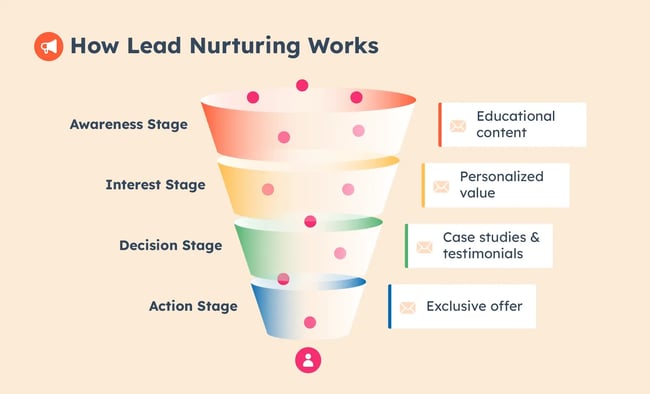
(Tip: If you’re unfamiliar with lead nurturing, we encourage you to take our free lead nurturing course.)
Are lead nurturing emails effective?
Nurtured leads make 47% larger purchases than non-nurtured leads. They also produce a 20% increase in sales opportunities (on average). So, in short? Yes. Lead nurturing emails have proven to be highly effective at moving potential customers through the sales funnel and ultimately driving conversions.
For instance, Stainton noticed that some users were signing up for free trials but not completing a key onboarding step needed to fully utilize the platform. To address this gap, he started “sending a simple reminder email urging users to explore these features, which resulted in a 15% increase in user activation.”
Similarly,Joe Kevens, director of demand generation at PartnerStack, shares that the brand usually sends its leads “emails like ‘5 easy steps to build a partner program’ containing a ‘Partnerships 101: The Ultimate Partnerships Checklist’” as part of its lead nurturing email sequence to help them build their partner foundation and set them up for success.
Overall, I noticed a few commonalities among the marketers I spoke with. Your lead nurturing email needs to achieve three separate goals simultaneously to be effective:
- Get your prospect's attention.
- Be personalized to the way they found your brand.
- Educate your prospects on features and benefits they might not be aware of.
Email Marketing Planning Template
Organize your email marketing strategy and metrics with this free template.
- Gather data
- Summarize results
- Manage A/B tests
- And More!
Download Free
All fields are required.
What is a lead nurture email campaign?
A lead nurture email campaign is a series of targeted emails sent to leads over a period of time with the goal of moving them closer to a purchase decision. It’s a strategic warming-up tactic that’s often personalized and optimized with the goal of building relationships and trust with potential customers who have shown interest in your brand.
That said, as the word nurturing implies, you typically don’t send a single email. It takes a few emails to achieve the goals I listed above. So marketers, here’s how you can do just that:
Lead Nurturing Email Sequence
A lead nurturing email sequence is a series of emails that are automatically triggered when the lead takes a certain action. For example, once a customer adds an item to their cart, a lead nurturing email sequence could include a purchase reminder, a limited-time offer, or a list of similar products they may like.
I’ve found that the more segmenting and personalization you can add to a lead-nurturing email campaign, the better it will perform and the more conversions you’ll get.
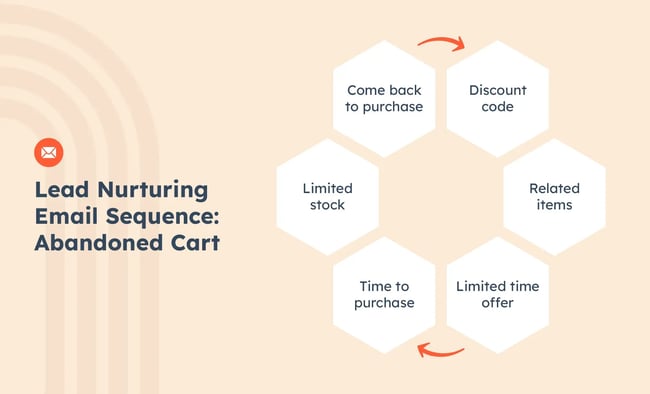
Now that you understand how lead nurturing fits into your funnel, I’ll dive into some best practices.
Lead Nurturing Email Best Practices
- Provide valuable, targeted content that addresses interests and/or pain points.
- Focus on one relevant topic per email.
- Keep it short.
- Ensure the emails progress naturally.
- Test your emails and track key metrics.
- Personalize and segment the emails.
- Stay consistent with your brand.
I’ve found that lead nurturing emails take time to optimize. It’s challenging to put together an email sequence that will convert at a high level the first time around. As with any marketing initiative, testing is how you see what works best. And once you find a working formula, you can apply it to all your email campaigns.
That said, here are some general best practices that can help improve your email game.
1. Provide valuable, targeted content that addresses interests and/or pain points.
Your lead nurturing emails should be all about your audience. Take the time to understand their interests, challenges, and goals. Then, craft content that speaks directly to those needs.
If you're nurturing leads who downloaded an ebook on 10 Tips for Better Email Marketing, use your follow-up emails to dive deeper into each tip. Share actionable advice, real-world examples, and your own experiences. The more targeted and relevant your content is, the more likely your leads will engage with it.
Stainton agrees and emphasizes, "If you can solve a potential customer’s basic problem, they’re far more likely to turn to your company when they need help solving a more complex problem.”
Pro tip: I’ve noticed the biggest needle movers in lead nurturing emails are the ideas behind the email — not necessarily the copy itself. If you’re a SaaS company, that might mean testing different features in your email, for instance.
2. Focus on one relevant topic per email.
Less is often more with lead nurturing emails. I’ve found that focusing on one key topic per email is far more effective than trying to cram multiple ideas into one email. It keeps your emails concise, digestible, and easy to act on.
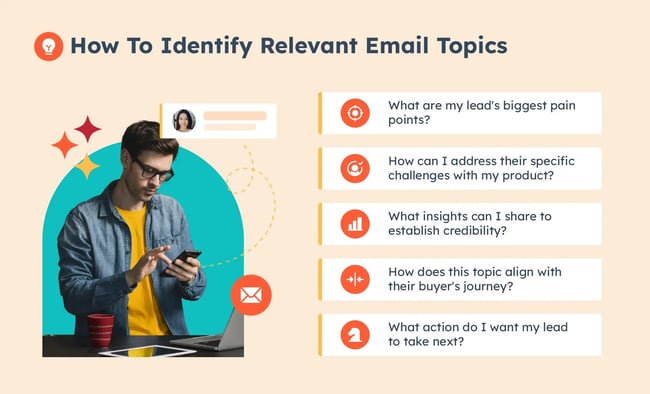
Plus, it allows you to really dig into each topic and provide value rather than just skimming the surface. For example, if your lead downloaded a whitepaper about immutable backups, you know they might be interested in some form of data security.
Your first email might be about how to sell the idea of data security to your team. It’d be counterproductive to talk about an irrelevant topic, like VPNs, if your goal is to sell them on cybersecurity services.
3. Keep it short.
Think about the last time you opened your inbox and took the time to read an email for more than five minutes. The answer is likely to be pretty far and few between. That’s why I always try to keep emails short.
Most people just scan their inboxes — especially if it’s an email from a brand they’re not familiar with. Data suggests that your emails should be between 50 and 125 words. Aim for that range, but don’t be afraid to go a bit longer if you need to flesh out a topic.
For example, some B2B topics are much more complex and require in-depth explanations, while an email for an ecommerce store might not need as much copy.
Pro tip: As a reminder, Chad Debolt, founder of Surchability, says, “Email nurturing isn‘t meant to talk about yourself...it’s meant to nurture. People want you to help solve their problems,” so make sure your language is customer-focused.
Email Marketing Planning Template
Organize your email marketing strategy and metrics with this free template.
- Gather data
- Summarize results
- Manage A/B tests
- And More!
Download Free
All fields are required.
4. Ensure the emails progress naturally.
A great lead nurturing sequence should feel like a natural, logical progression. Each email should build upon the last, guiding your leads toward a specific goal or action. I like to map out my sequences in advance to ensure a cohesive, compelling narrative.
Think about where your leads are in their buyer journey, what information they need at each stage, and how you can gradually move them closer to a conversion.
Use cliffhangers, teasers, and calls to action to create momentum and encourage leads to open your next email. By crafting a sequence that tells a clear, purposeful story, you'll keep your prospects engaged and invested in the lead nurturing process.
5. Test your emails and track key metrics.
As marketers, we all know testing is the name of the game. And lead nurturing emails are no different. What works for one audience might not work for another. That’s why I always recommend A/B testing different topic ideas.
Beyond topics, I recommend testing subject lines, content, calls-to-action, and even the timing and frequency of your emails. However, make sure you’re testing one variable at a time.
For example, you could set up your email sequence to send emails every day consecutively to 50% of the list and every other day to the other 50%.
During email testing, pay attention to these key metrics:
- Open rates. Determined by the subject line and preview text.
- Click-through rates. Determined by the “big idea” and call to action in the email.
- Conversion rates. Determined by your offer, landing page, and how well you’ve conveyed your message in the emails.
6. Personalize and segment the emails.
With high-tech email tools, personalization and segmentation are the biggest levers you can pull to see the best results when used alongside testing.
Generic, one-size-fits-all emails simply don’t cut it anymore. To truly resonate and connect with your new leads, you need to personalize your emails based on their unique interests, behaviors, and stage in the funnel.
For example, Lyn Collanto, outreach specialist at KBA Web, personalizes lead nurturing emails this way: “If a lead visits our pricing page multiple times but doesn't convert, we might trigger a special welcome email sequence that highlights customer success stories and offers a limited-time discount.”
I recommend creating several automated email sequences based on specific actions. Some businesses may have more opportunities than others, but by personalizing the trigger point, you can focus on the exact intent of the lead.
To take it one step further, you can segment within each email sequence. For instance, if a lead doesn’t open the first two emails, you might want to send them down a different path — like emails with more intriguing subject lines.
Or, if your leads are opening emails, clicking links, and even replying but not converting, you can set off a lead-nurturing email sequence designed to overcome objections.
7. Stay consistent with your brand.
Remember that your lead nurturing emails are an extension of your overall brand. They should feel cohesive and consistent with the rest of your marketing materials, from your website to your social media posts.
Use colors, fonts, and imagery that align with your brand guidelines. Write in a tone and style that feels authentic to your brand voice — whether that’s friendly and casual or professional and authoritative. Consistency helps build trust and credibility with your leads over time.
That said, showing your personality in emails can help make you more memorable, building connections faster. The more genuine and human your emails feel, the more likely your leads are to connect with them on a personal level. It’s something I recommend you test.
How to Write a Lead Nurturing Email
- Identify a purpose.
- Personalize the greeting and subject line.
- Address pain points.
- Include testimonials.
- Share a knowledge bomb.
- Use a CTA.
- Include an unsubscribe button.
- Follow up and optimize.
Now that you know what makes a great lead-nurturing email, I’ll guide you through the process of creating one. Let’s dive in.
1. Identify a purpose.
Before crafting your email, take a moment to consider its purpose within the overall lead nurturing sequence. Ask yourself: What do I want this email to achieve? Is it meant to educate the lead, inspire them to take action, or offer a specific solution to their problem?
I’ve found that having a clear, focused purpose for each email helps me create more compelling content that resonates with the reader and moves them closer to conversion.
Pro tip: Riccii Terro, marketing manager at Intellek, recommends you try to visualize the whole picture at this stage because: “Tailoring the messaging and content offered to specific groups based on their industry, role, or stage in the buying cycle is crucial.”
2. Personalize the greeting and subject line.
In my experience, personalization can make a world of difference in email engagement. For instance, you’ll want to tailor subject lines to how your leads interact with your brand. If they signed up for a lead magnet about content marketing, your subject line could be “The secret to Google’s 2024 update…”
I like to think of the subject line as a promise — what value will the reader gain by opening this email? This inherently builds curiosity and will get your prospect’s attention.
Pro tip: Check out this guide on how to leverage segmentation to take your personalization efforts to the next level.
Email Marketing Planning Template
Organize your email marketing strategy and metrics with this free template.
- Gather data
- Summarize results
- Manage A/B tests
- And More!
Download Free
All fields are required.
3. Address pain points.
Once you have their attention, it’s time to address potential pain points with your solution. Put yourself in their shoes and ask:
- What keeps them up at night?
- What obstacles are preventing them from achieving their goals?
- How can you frame your email to show that you understand their problem and can actively solve it?
4. Include testimonials.
While not every lead nurturing email will require social proof, you should include it when you’re actively selling. It’s contextual. Sharing success stories or testimonials from satisfied customers helps leads envision how your product or service can benefit them.
For example, you could include multiple short testimonials. Or you could write an entire story-based case study email that shows how one of your customers solved the exact problem prospective customers are facing with your solution.
5. Share a knowledge bomb.
I always strive to include at least one aha! moment in each lead nurturing email. This could be a surprising statistic, a thought-provoking insight, or a valuable piece of industry knowledge.
In marketing, you want to persuade the prospect to think about their problem on your terms. This shifts your prospect’s perspective and positions your brand as the right solution to the problem.
For example, let’s say you’re in a cybersecurity firm and decide to send out an email covering data security. In that case, you may cite statistics about how X% of firms know data security is an issue, but only X% are successfully avoiding threats by using your company’s unique solution to protect data at the highest levels.
6. Use a CTA.
Every lead nurturing email should have a clear, purposeful CTA that guides the reader toward the next step in their customer journey. When crafting your CTA, ask yourself: What do I want the lead to do after reading this email?
Is it to schedule a demo, download a resource, or simply engage with another piece of content? Make sure your CTA is prominent, unambiguous, and aligned with the overall goal of the email sequence.
7. Include an unsubscribe button.
While it might seem counterintuitive, you always want to include an unsubscribe button. As a marketer, I’d always choose a lean, 5,000-person email list that’s actively engaged and ready to buy over a 50,000-person email list that’s not.
Plus, including an unsubscribe button keeps you in line with authorities and ensures your deliverability rate is high.
8. Follow up and optimize.
Lead nurturing is an ongoing process, and there's always room for improvement. That’s why I consistently monitor key email metrics like open rates, click-through rates, and conversions to identify areas for optimization.
If an email isn’t performing as well as expected, I’ll experiment with different subject lines, CTAs, or content angles.
Lead Nurturing Emails Are Essential
Lead nurturing emails bridge the gap between initial interest and final conversion. And often they can build trust, establish credibility, and guide leads toward a purchase decision within the two points of initial interest and conversion.
Effective lead nurturing saves time and resources by focusing on the most qualified leads. It allows you to segment your audience, personalize your messaging, and deliver the right information at the right time.
When your lead nurturing strategy is done correctly, it will help you attract more of the right customers while filtering out the wrong customers.
Editor's note: This post was originally published in December 2021 and has been updated for comprehensiveness.
Lead Nurturing






![How to Expand Your Lead Nurturing Strategy Beyond Just Email [SlideShare]](https://53.fs1.hubspotusercontent-na1.net/hub/53/file-1390659247-jpg/Blog_Thinkstock_Images/lead_nurturing.jpg)