

I’ve seen long documents and cheat sheets, and both work as long as they explain why you do things the way you do.
That’s the real power: knowing when something strengthens your message — and when it waters it down. Especially now, with teams using AI to write faster, it’s never been more important to train both your tools and your people to sound like you.
So, what exactly goes into a content style guide — and why does it matter so much? Glad you asked. I’m going to show you.
Table of Contents
- What is a content style guide?
- Style Guide vs. Brand Guide
- How to Create a Writing Style Guide
- What to Include in Your Style Guide [+ Checklist]
- What Not to Include in Your Style Guide
- How to Get Others to Use Your Style Guide
- Writing Style Guide Examples
.webp)
Free Brand Style Guide Template
Take your brand to the next level with this free guide + templates.
- Build your brand
- Define your voice
- Set image guidelines
- And more!
Download Free
All fields are required.
What is a content style guide?
A content style guide — sometimes called a brand voice guide or editorial style guide — is your team’s go-to resource for how your brand communicates in writing. It covers everything from what to say, grammar, punctuation, formatting, and tone of voice across everything you publish.
Yes, even whether or not you use em dashes or capitalize the word after a colon!
Why are content style guides important?
Debating the same comma or tone choice over and over?
Tired of giving your team the exact same feedback over and over?
Getting frustrated with each editor requesting different stylistic changes — that all conflict with one another?
Those are all things I’ve experienced as a writer and editor. And guess what? They’re all signs you need a style guide.
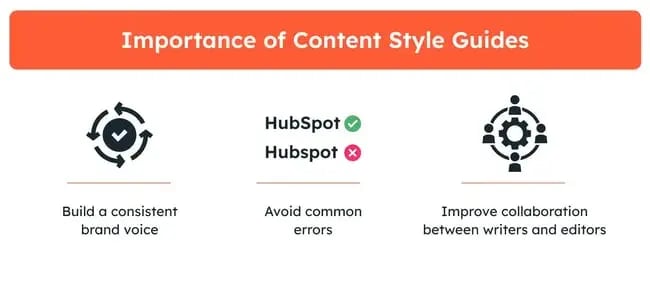
Whether you're working with freelancers, agencies, or in-house marketers, a solid content style guide helps you:
- Build a consistent brand voice. Every writer interprets “friendly” or “authoritative” differently. A brand voice guide clears that up.
- Avoid common errors. If your company name has a tricky spelling or formatting (looking at you, HubSpot), you can lock that down once, instead of correcting it every time.
- Make collaboration easier. A well-documented guide reduces nitpicky edits and helps you give constructive feedback without killing anyone’s confidence.
Style Guide vs Brand Guide
A content style guide sets the rules for how your brand sounds in writing — covering tone, voice, grammar, punctuation, and formatting across everything you publish.
A brand guide can mean a lot of things. It may focus on visual elements like logos, colors, and typography, or I’ve also seen them expanded to include messaging, brand values, and positioning.
Both play a key role in how people experience your brand. One shapes what they see, the other shapes what they hear.
Now that we've cleared that up, I’m going to show you how to create a content style guide that actually works.
How to Create a Writing Style Guide
- Use a style guide template.
- Review your brand’s mission and values.
- Create buyer personas for your target audience.
- Define your company’s voice and tone.
- Decide on a reference style manual.
- List troublesome words and branded phrases
- Establish guidelines for graphics.
- Share your formatting recommendations.
- Describe your SEO requirements.
- Add recommended methods to source reliable data.
- Outline prohibited topics.
- Give examples to finalize the writing style guide.
There’s no one-size-fits-all formula here — but there is a framework that works.
Whether you’re starting from scratch or fine-tuning what you’ve already got, I’m listing the 12 steps I recommend for creating a style guide that clears things up for your team, brings consistency to your brand, and yes, makes your AI tools smarter, too.
1. Use a style guide template.
A content style guide covers a lot — from brand values to grammar rules. You can start from scratch, but I recommend kicking things off with a solid template. It’ll help get your ideas on the page faster— and make sure you’re not forgetting something obvious (like whether to use title case in H2s).
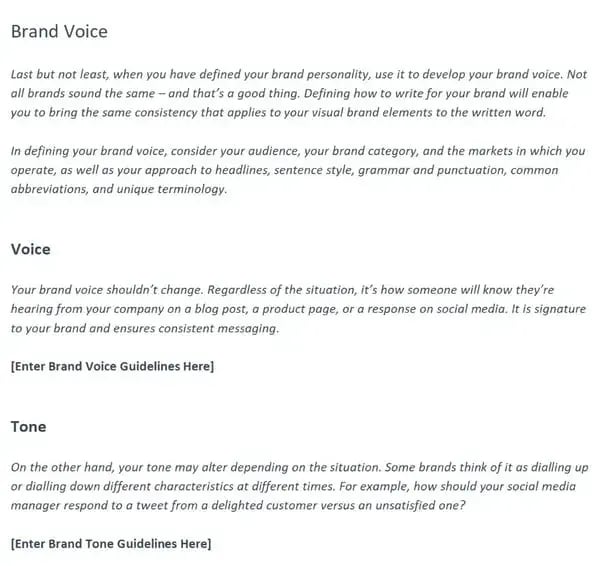
HubSpot’s free style guide template is a great starting point. Or pull inspiration from one of the examples at the end of this post and make it your own.
2. Review your brand’s mission and values.
Not every brand has a formal mission statement or core values. And actually, I kind of love it when they don’t because it’s a great discussion and leads to a session that creates a ton of clarity for both internal and external communications.
Wondering what that looks like? I’ve found it may be difficult to say what you want to do, but figuring out what you don’t want to be usually creates a killer discussion. Here are some of my favorite questions to get this going:
- What drives you nuts about the industry you’re in?
- How do you not want to come across?
- What do you want to make sure never to do?
- What do you never want to sacrifice?
A few short answers to those questions will help your content style guide come to life so your writers can rally behind why you do things the way you do.
What else should you consider?
If your brand stands for transparency, your content should avoid hype and lean into clarity. If inclusivity is a core value, your guide should reflect that in both language and examples.
If what your brand says and what it practices don’t match up, readers can (and they will, trust me) see the disconnect — it’s like watching a TV show with bad lip-syncing.
Take it from Maddy Osman , founder of The Blogsmith , who knows how seriously brands should take conveying values like inclusivity through their content.
“We wanted our content practices to reflect what The Blogsmith stands for, and needed to find a way to get a team with diverse backgrounds on the same page,” says Osman.
To nurture these values, Maddy got the ball rolling by establishing clear-cut guidelines in her style guide.
“I sat down with team members to brainstorm what inclusivity would look like on paper — the things we normally don‘t account for in day-to-day speech. Whether it’s listing alternatives to outdated words like blacklist or manpower or examples of people-first language.”
The bottom line here is that your style guide is how you express your values.
3. Create buyer personas for your target audience.
Imagine writing to a Gen Z buyer vs. a Boomer. Same product, totally different tone. That’s why I always include simplified personas in a style guide — not full marketing profiles, but enough to ground content creators in who they’re speaking to.
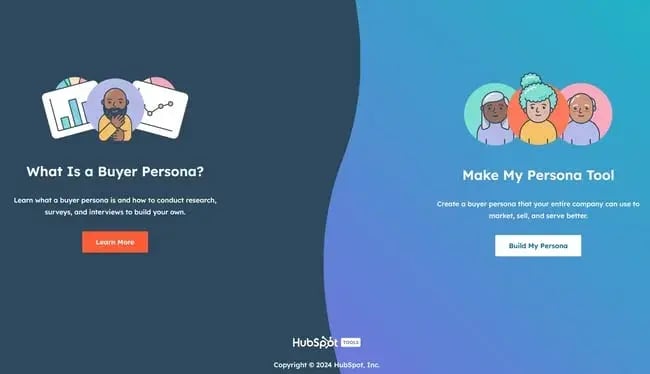
New to buyer personas? I’ve done everything from semi-fictional characters with names to high-level descriptions of pain points and messaging. Both are fantastic. But if you’re about to tackle this for the first time, I recommend starting with HubSpot’s persona generator.
Amanda Price , content manager at Imagefix, is also totally on board: “Understanding who we're communicating with is just as important as understanding our brand itself.”
Price adds that detailed buyer personas make sure a style guide “stops being about abstract rules and starts being a proper and useful tool to build a real connection with our readers.”
She’s right. And when personas are included, your guide becomes less about rules and more about relationships.
At minimum, I recommend including:
- A short description of the audience
- Key pain points
- Communication preferences
- Solutions your brand offers
- Preferred tone (formal, conversational, etc.)
If you can go one step further and include actual phrasing they use—or language that’s proven to win them over—you’ll help your writers create content that feels personal, relevant, and usually converts well
Free Brand Style Guide Template
Take your brand to the next level with this free guide + templates.
- Build your brand
- Define your voice
- Set image guidelines
- And more!
Download Free
All fields are required.
4. Define your company’s voice and tone.
Voice and tone get mixed up and overlooked all the time.
I’ve had more than a few animated discussions about the difference with other copywriters. That might say a lot about my personality… but it also speaks to how important this section is.
Because if you want your content (or your AI output) to sound on-brand, you’ve got to spend some time here.
Here’s how I break it down:
- Voice is your brand’s personality. Your brand voice should be consistent across all content.
- Tone is how that voice adapts to different channels or situations.
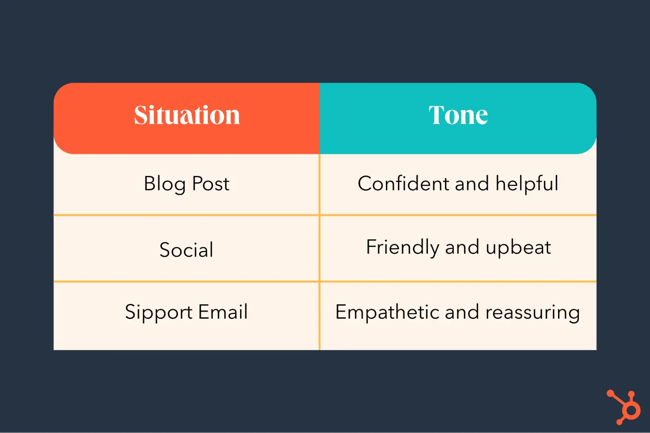
Think of it like this: When I talk to my clients, I sound like me. When I talk to my family, I still sound like me, but the tone is often very different. Your brand should work the same way.
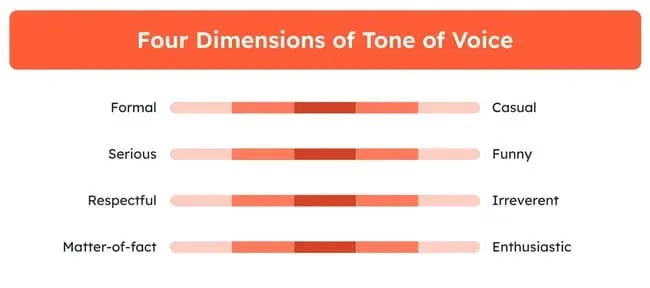
To define your tone, a lot of brands reference Nielsen Norman Group’s four tone dimensions:
- Formal vs. casual
- Serious vs. funny
- Respectful vs. irreverent
- Matter-of-fact vs. enthusiastic
That’s a solid starting point. That said, I usually like to go deeper, taking my friend Justin Blackman’s approach from Brand Voice Academy. He starts with over 100 tone descriptors and distills a brand’s voice into one of nine styles that fall into three categories:
- Authoritative
- Outlook-driven
- Accessible
It’s the most comprehensive (and effective) approach I’ve seen—and it works beautifully, especially when you want to define a voice that scales across channels, teams, and AI tools.
Regardless of what approach you take, make sure to codify it with examples. Think “Say This, Not That.”
For example, if you’re a coaching brand that trades on humor, but never wants to come across as sarcastic or mean-spirited, you might have these:
✅ Messy starts count. So do snack breaks.
✅ You don’t need another planner. You need a plan that fits your life.
❌ This isn’t that hard, you know.
❌ You’re great at quitting — congrats.
If it’s helpful, you can also encourage people to channel their inner [celebrity name here]. (For me, it’s always Robin Arzon from Peloton.)
Wondering what else to include in this section?
- Preferred perspective: First-person, second-person, third-person?
- Writing style: Friendly guide? Trusted expert? Straight-talking peer?
- Favorite phrases: A few go-to lines can help writers (and AI tools) capture your brand voice faster.
Especially if you’re using generative AI, this section helps it learn what “sounding like you” actually means.
5. Decide on a reference style manual.
Want to stop arguing about em dashes and serial commas? Consider picking a reference style and stick with it — and just note any variations in the content style guide.
Lots of brands use the Associated Press Stylebook (AP) Chicago Manual of Style. Personally, I find AP a better fit for online content — less formal, easier to remember, and widely used by media outlets.
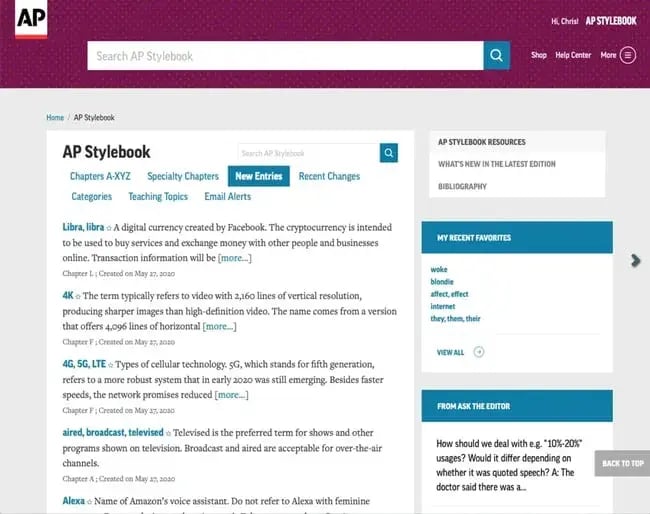
Bernard Meyer, senior director of communications and creative at Omnisend, shares that he prefers AP Style as it helps Omnisend come across as friendlier and less formal.
Pro tip: Get your team an online subscription. It’s easier to search — and much more likely to be used — than a dusty print copy.
6. List troublesome words and branded phrases.
This is one of the most practical (and used!) sections of any guide.
Include:
- Proper formatting for your brand name (HubSpot, not Hubspot or Hub spot)
- Product names, slogans, or phrases with preferred spelling and punctuation
- Commonly miswritten words (ecommerce vs. e-commerce, etc.)
- Job title formatting (Director of Marketing vs. director of marketing)
- Degree usage (bachelor’s degree vs. Bachelor of Arts)
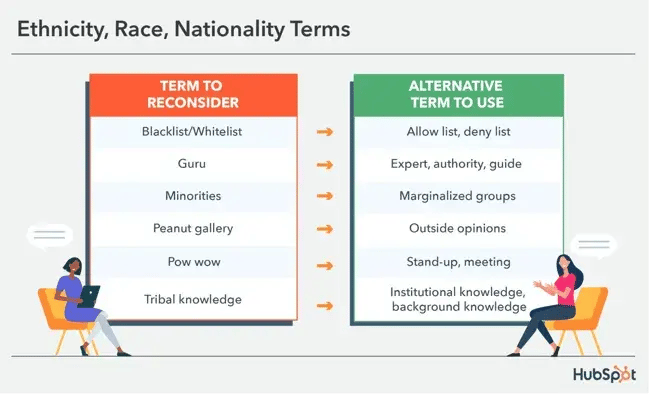
Also be sure to make note of language preferences based on regional usage (color vs. colour, apartment vs. flat) and inclusive alternatives (blocklist vs. blacklist, “first-year student” vs. “freshman”).
This section saves editors so much time — and helps AI tools get more accurate, too.
7. Establish guidelines for graphics.
You don’t need to rewrite your brand design manual here, but if your writers are expected to source, edit, or write for visual content, you do need to give them some direction.
Address common questions like:
- Where should images come from, and how should they be attributed?
- How many images per post?
- Should images include alt text?
- What are the preferred image sizes, file types, and alignment rules?
- Are screenshots allowed?
- Should text wrap around images?
- How do you handle video embeds?
If you have a paid stock image account, list it. If you want all graphics to have descriptive alt text (you should), make that clear.
Also, if you expect writers to include infographic content for designers and you have guidelines around what should be included, I highly recommend sharing that here, too.
8. Share your formatting recommendations.
This is where you prevent formatting chaos before it happens. At a minimum, cover your guidelines for
- Body text: Preferred font, size, color (if applicable)
- Headers: How many levels? Use of title vs. sentence case?
- Hyperlinks: Should writers link whole phrases or just keywords?
- Lists: Bulleted or numbered? Punctuation at the end?
- Styling: When to bold, italicize, or use quotation marks
- Special characters: When to use ampersands, em/en dashes, acronyms, etc.
With consistent formatting, your readers will be able to skim and digest your information more easily.
9. Describe your SEO requirements.
No need to include your full SEO strategy here, but a basic overview helps writers avoid keyword stuffing or structure issues. I always recommend covering:
- Keyword usage: Where to include target keywords (title, headers, alt text, etc.)
- Content structure: How to use headers and organize ideas
- Linking strategy: Internal and external links, plus link density guidelines
- Length expectations: General word count ranges for key content types
- Meta tags: If writers are expected to write meta titles/descriptions, include guidance
In addition to these sections, I also include links to external sources like HubSpot’s guide to SEO to ensure writers can find answers to their questions from reputable sources.
Free Brand Style Guide Template
Take your brand to the next level with this free guide + templates.
- Build your brand
- Define your voice
- Set image guidelines
- And more!
Download Free
All fields are required.
10. Add recommended methods to source reliable data.
You’ve probably seen that stat about humans only having an 8-second attention span. BBC debunked it in 2017.
That’s the problem with relying on secondhand (or fifth-hand) data — once it’s out there, it spreads. So if you want your brand to sound credible, you need to be picky about your sources.
Because “Trust me, bro” doesn’t cut it.
Neither is that Medium post that links to a blog that links to a roundup from 2016. That’s lazy research and if you want to be credible, you need to make it clear to your writers that it won’t fly.
If you’re serious about trust and transparency, your style guide needs to spell out what “good” looks like.
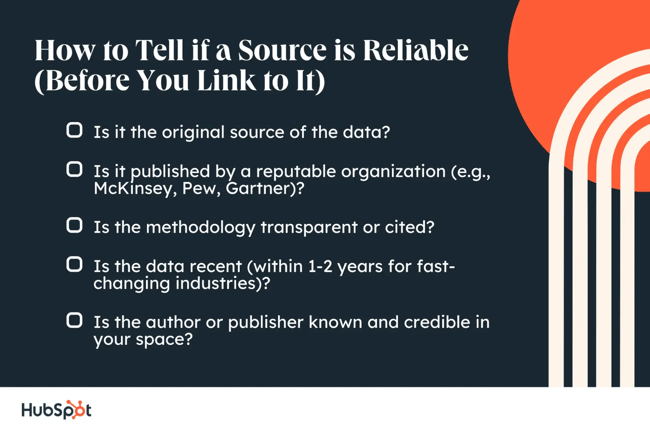
If you want to create trustworthy, authoritative content, you’ve got to be picky about what you cite and where it comes from. And that means teaching your team — and your AI tools — how to tell the difference between solid data and sketchy filler.
And AI is notoriously untrustworthy, both at following directions and sourcing current data. Sometimes it makes things up, too.
So be sure to call out sources you want, what to avoid, and guidelines.
For example:
Examples of great sources:
- Primary data and studies: Surveys, interviews, customer analytics, original research
- Suggested industry studies: Deloitte, Gartner, McKinsey, BCG, Pew, HubSpot Research
- Government + nonprofit sources: Census Bureau, World Bank, WHO, NIH
- Reputable news outlets and trade pubs: Think Harvard Business Review or AdWeek, not your cousin’s Substack
“Sources” to avoid:
- Aggregator blogs with no clear citation trail
- Roundups that quote roundups (if it takes 3 clicks to get to the source, stop)
- LinkedIn thought-leader posts that link to nothing
- Sketchy data with no date
- Anything that sounds like: “According to a recent study I once saw somewhere…”
You may also want to include an example of how you want data cited.
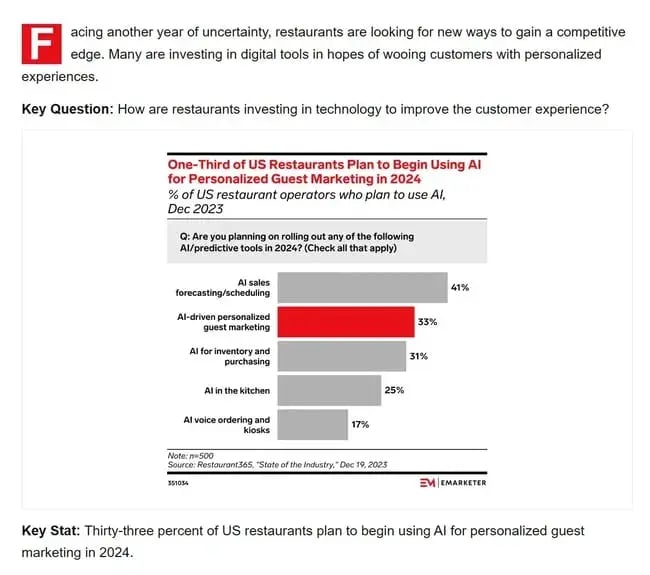
While that helps address most data-sourcing questions, you’ll also want to decide if competitor statistics and data are allowed.
My general rule is “yes!” if it’s reliable and trustworthy, but again, you’ve got to make the call for your business.
If you’re worried about search engine optimization (SEO), Osman, who is also ranked among the top 100 content marketers by Semrush, shares that she’s not “against using data from competitors. But you have to be careful from an SEO perspective if the data you’re referring to is a keyword competitor.”
Beyond that, it also depends on your brand’s core values. Meyer prefers to include “ helpful data even if the data comes from our competitors” because Omnisend wants to come across as a customer-centric brand.
11. Outline prohibited topics.
Even if your team has good judgment, it helps to spell things out — especially for freelance contributors.
List any off-limits content, including:
- Politics or religion (unless your brand explicitly addresses them)
- Legal advice (encourage linking to resources or consulting a lawyer)
- Controversial topics without expert input
Think of this as setting smart boundaries — so writers know what not to touch. And if there’s ever a possibility of an exception to the rule, outline the process for requesting that.
12. Give examples to solidify the writing style guide.
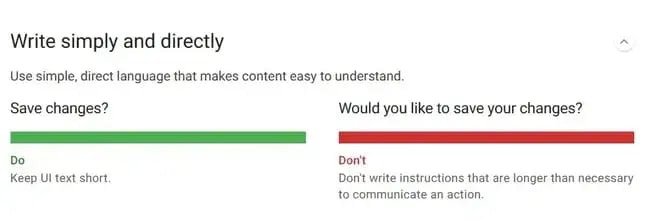
This is the section most guides skip — and the one that makes the biggest difference.
Meyer agrees, “The more specific you can make [your style guide], the better your team will understand how to adopt it effectively.”
Osman also prefers adding examples. According to her, “style preferences make a lot more sense to writers when they see them executed in actuality — much like a case study.”
Here’s how I write content style guides to show the team what “good” looks like:
- Use do’s and don’ts. Add an incorrect example and then mark it up to show how a writer could fix it.
- Include visual examples. For formatting and graphics, I prefer adding visual examples to help the contributors visualize what the brand requires.
- Preferred text. I find that writers are more likely to succeed in nailing down the brand tone and voice if you provide examples of it in practice.
- Editorial process. What are the steps involved from assignment to editing to publishing? You don’t need a detailed SOP, but a high-level overview of the flow makes it easy for writers to understand and deliver on expectations.
Style guides are living documents. The world isn’t static, customer expectations aren’t static, so I feel like it’s unrealistic to think you’ll never edit them.
What to Include in Your Style Guide [+ Checklist]
My favorite content style guides are easy to follow because they are hyper clear. WIth that said, it’s not about creating rules for the sake of…well, having rules.
It’s about making everything simpler for your team and your customer base.
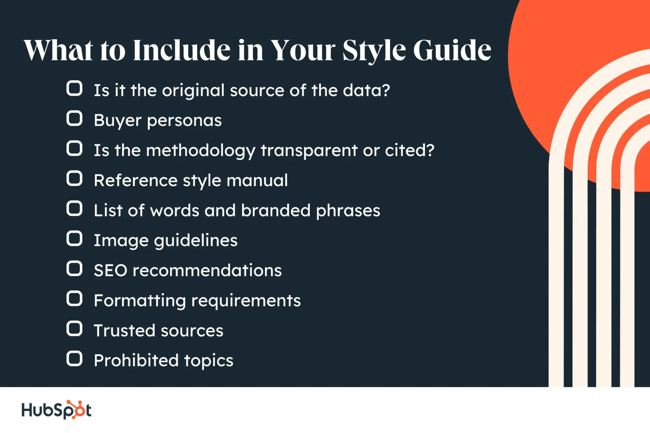
Pro tip: This shouldn’t just go to writers. I’d recommend sharing this with any core customer-facing teams. It’s helpful when marketing, sales, and customer service talk about things the same way.
What Not to Include in Your Style Guide
Don’t try to do too much. I’ve shared a ton of things you can include and that I recommend including on some level. But you don’t have to go into detail on all of them. Here’s what I recommend leaving out — or at least linking to specific SOP documents.
Content Operation Notes
Yes, content ops are the backbone of your process. But things like editorial calendars, request forms, approval workflows, and publishing timelines don’t belong in your style guide. Keep those reference links in your project playbooks. Your writers need writing guidance, not a lesson in Airtable.
Visual Style Recommendations
This is one of those “your call” things. I personally like to include a page with the company logo, typography, and color palette. After all, they’re critical for the brand and it’s helpful for onboarding new team members.
But think high-level instead of 6 pages on how to use the logo. Instead, include that detail in a separate brand and visual style guide to convey the brand identity elements.
Training Materials
Stay as high-level as you can. If there’s important information writers need to refer to, include links to reference documents or how-to videos in the style guide, but don’t go overboard.
Rule of thumb: If it feels like a text, thin it out.
How to Get Others to Use Your Style Guide
If you put in all that work, you want people to use it. Most will, but not everyone. I know it feels personal, especially when people have paid me to consult on their stuff and then ignore it, but I promise it’s not personal at all.
This is an area where change management principles rule the roost — so here’s what I’ve found works best:
1. Involve others early on.
Your freelancers won’t care, but if you have in-house writers, get their buy-in and make people feel like they’re part of the process. Even if you don’t take all of their suggestions, they feel some ownership in it.
Where possible, I like to come up with two equally awesome options for different categories and then let people weigh in on those options. I’m always fine with whatever they choose.
2. Make it easy.
Store it where people already work. Link to it in onboarding docs, pin it in Slack, and reference it in briefs.
Personally, I love a living doc with a table of contents and quick-reference sections that are easy to skim.
3. Keep updating it.
It’s not a static set-and-forget document.
Not everyone should have edit access, but I do ask teams to flag questions or inconsistencies as they come up, and we review and update the doc regularly. It doesn’t have to be perfect on day one. Just keep it useful — and make updates part of your workflow.
Free Brand Style Guide Template
Take your brand to the next level with this free guide + templates.
- Build your brand
- Define your voice
- Set image guidelines
- And more!
Download Free
All fields are required.
Writing Style Guide Examples
If you want to see a writing style guide in action, here are a few examples of writing style guides I have liked from well-known companies like Google, Shopify, and Intuit.
1. Google
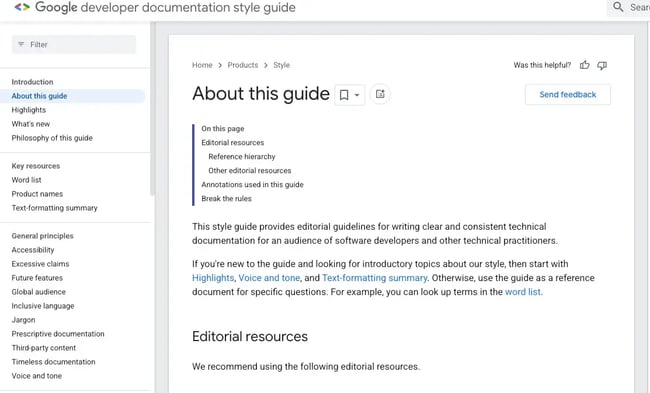
In Google’s style guide, I noticed that Google is very explicit in its goal of creating clear, consistent content. It’s broken up into simple sections so that people can easily navigate what might seem like a complicated document
What I liked: My absolute favorite part of this guide is the statement, “This guide contains guidelines, not rules. Depart from it when doing so improves your content.”
Any rule that says “don’t follow the rules” is a HUGE win in my book.
2. Intuit
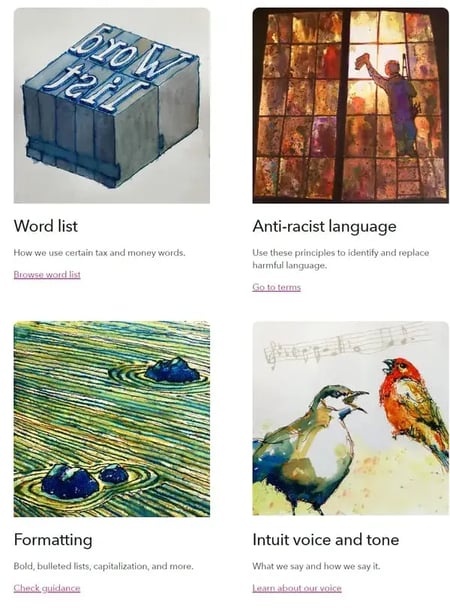
I nerd out over this stuff, so when I found things broken down into categories that highlight what is most important to Intuit, I got excited.
- Word list — makes sense to start with tax and money words since that’s Intuit’s bread and butter.
- Anti-racist language — to make it easier to focus on inclusivity and avoiding words that may be harmful
- Formatting — no style guide is complete without it
- Voice and tone — which is, of course, what I’ve focused on here. While exploring Intuit’s style guide, I found a lengthy word list, which seems appropriate since Intuit deals with financial topics. Plus, their guidelines regarding anti-racist language and formatting are on point as well.
What I liked: Not going to lie - I love this guide. It’s beautifully laid out and so easy to follow. Plus, for regulars, it includes a what’s new section so people can easily see what may have changed.
3. Shopify
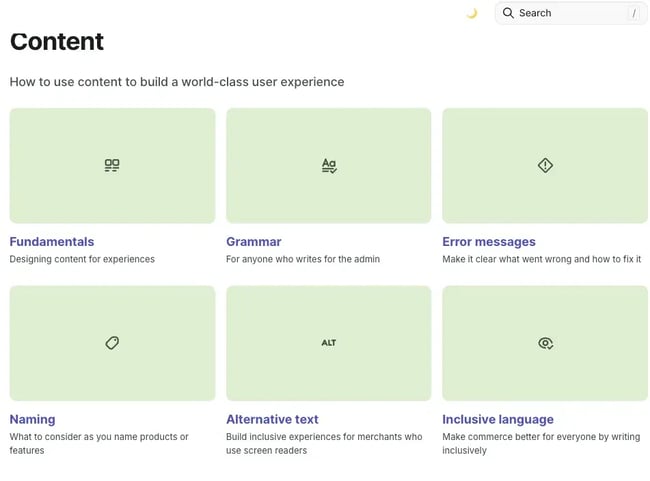
I found Shopify’s content style guide to be extensive. It walks the writers through voice and tone, inclusive language, grammar, and other style-related guidelines.
Unlike Intuit, I noticed that Shopify was clearer about its voice and tone requirements — they even included dos and don’ts with examples to explain how to match Shopify’s tone.
What I liked: Despite covering a range of style preferences, I appreciated that Shopify included an example for each concept.
4. Microsoft
Like Shopify’s, Microsoft’s content style guide is also extensive, covering everything from proper nouns to bias-free communications. I also liked the examples Microsoft included. That said, Microsoft tried to stay minimalist and didn’t include examples for everything like Shopify.
What I liked: I found Microsoft’s style guide easier to navigate using the sidebar. You can filter the list of entries by title to find stuff faster. Plus, I love their headline, “Make every word matter.” I think it speaks to the importance of word choice and clarity.
5. Apple
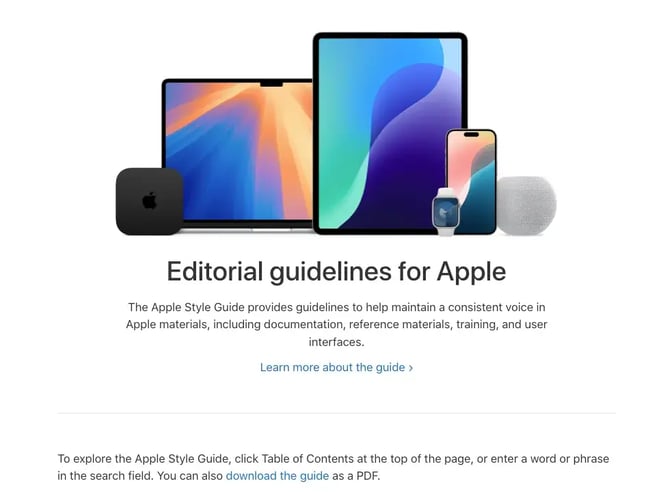
Instead of overwhelming writers with a laundry list of do this, not that right off the bat, it focuses the why behind each word. That said, if people want to dig deeper, particularly on technical content, they can literally dig into the A-Z of Apple’s style, starting with AAC and wrapping with Zoom.
Additionally, it suggests users follow the Chicago Manual of Style and Merriam-Webster’s Collegiate Dictionary.
What I liked: While many content marketers might not prefer it, I liked Apple’s minimalist approach since a style guide is typically for things where you deviate from a reference manual. Plus it echoes Apple’s “less is more” approach.
6. Mailchimp
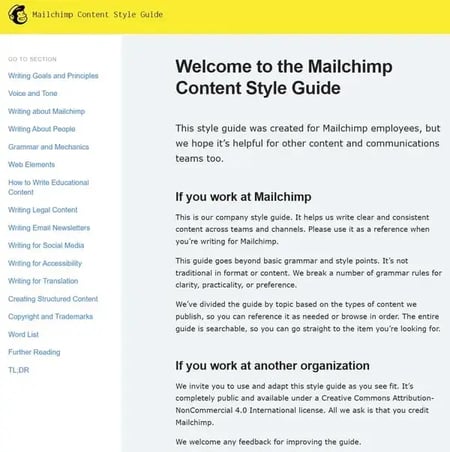
I’ve been curious to see how Mailchimp’s notoriously scrappy approach might change after its 2021 acquisition by Intuit. While still playful and fun, its language has become much clearer (at least in my opinion). I’m not sure if I’d attribute this to Intuit or more following what I’m seeing as a trend in the industry.
While I’m generally not a fan of including media-specific guidelines in a style guide, Mailchimp does a great job. Since its style guide isn’t based on a single formal document, it was able to add process guidelines without overwhelming readers.
What I liked: I loved Mailchimp’s word list as it outlines exactly how to handle troublesome words in a minimalist way.
7. Yokel Local
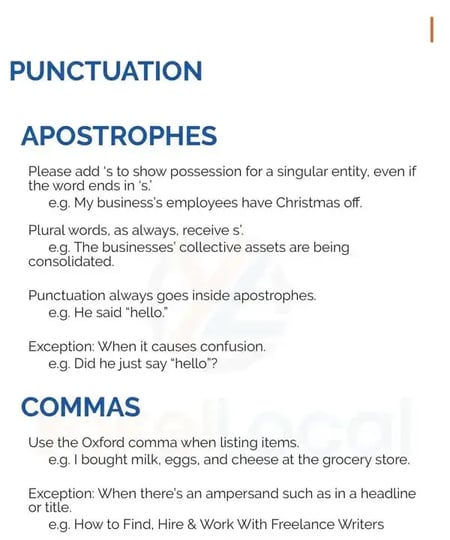
This example comes from HubSpot Partner Yokel Local. I love its simplicity, which makes it easy for both in-house contributors and freelancers to follow without going into the weeds.
What I liked: While Yokel Local remained minimalist, I loved that it still included examples to help writers get into the right mindset.
Polish your editorial and content style.
Style guides may seem like a strange thing to obsess over, but they make it so much easier for writers to pick up voice and run with it.
Whenever I work with someone who doesn’t have a content style guide, I create one — formally or informally — because it saves everyone time, frustration, and back-and-forth edits down the line. I build it right into the process, whether it’s baked into a statement of work or just something I develop naturally during onboarding and early drafts.
It’s worth it. Every time.
It saves a boatload of time and frustration for all parties — including the AI “members” of your team (wink, wink). When everyone knows what the expectation is and why you use the voice and tone you do, you have a cohesive team.
Remember — keep it as simple as you can and focus on clarity. The result will be content that feels and sounds like you.
Editor's note: This post was originally published in May 2015 and has been updated for comprehensiveness.
Free Brand Style Guide Template
Take your brand to the next level with this free guide + templates.
- Build your brand
- Define your voice
- Set image guidelines
- And more!
Download Free
All fields are required.
Content Marketing
-1.webp)