
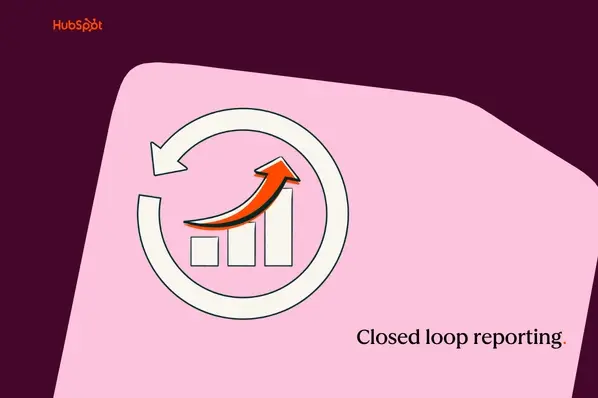
Closed-loop reporting is one of the most powerful tools that we online marketers have at our disposal. Not only does it allow us to demonstrate our work’s value to our bosses, organizations, and clients, but it also enables us to improve our marketing.
![Download Now: Free Marketing Plan Template [Get Your Copy]](https://no-cache.hubspot.com/cta/default/53/aacfe6c7-71e6-4f49-979f-76099062afa0.png) In this blog post, we will review several different ways in which closed-loop reporting helps you attract more high-quality leads and become a smarter marketer.
In this blog post, we will review several different ways in which closed-loop reporting helps you attract more high-quality leads and become a smarter marketer.
Table of Contents
- What is closed-loop marketing?
- Frequently Asked Questions About Closed-Loop Reporting
- Make Smarter Marketing Decisions with Closed-loop Reporting
TL;DR: Closed-loop reporting helps marketers drive customer acquisition
Closed-loop reporting connects marketing and sales data to show which channels, offers, and campaigns generate leads, customers, and revenue. It helps marketers prove ROI, improve lead quality, shorten the sales cycle, set better goals, and lower cost per lead by focusing on the sources that actually drive customer acquisition.
Free Marketing Plan Template
Outline your company's marketing strategy in one simple, coherent plan.
- Pre-Sectioned Template
- Completely Customizable
- Example Prompts
- Professionally Designed
Download Free
All fields are required.
Form not available
What is closed-loop marketing?
Closed-loop reporting connects marketing data to sales outcomes. Sales teams report lead status and customer outcomes back to marketing, and marketers use those insights to identify which sources generate qualified leads and customers.
Typically, this involves connecting your marketing analytics software with your customer relationship management (CRM) software. With closed-loop reporting, marketers can plan more strategically for the future by focusing on their best lead sources, specifically those with the highest conversion rate to customer. To help you understand how closed-loop marketing works, check out our loop marketing playbook for a more detailed explanation of each step in the process.
What Closed-Loop Reporting Can Do for Marketing Teams
The six capabilities below show how closed-loop reporting moves marketing teams from activity-based reporting to revenue-based decision making.
1. Focus on the Right Channels and Offers
Closed-loop marketing directs your attention to the most powerful conversion events and channels. By looking at the sources and offers that traditionally brought in new customers for your organization, you will be able to identify the behavior you need to engage in to qualify leads and push them through the sales funnel.
For instance, HubSpot’s Marketing Analytics software helps marketers compare channels by customer acquisition, so they can see which sources generate leads and which sources generate customers. In the screenshot below, we are comparing the number of sales from social media marketing to the number of sales from email marketing. It becomes clear that email marketing has a higher lead-to-customer rate than social media. This insight can then help us take action: nurture the social media leads with targeted email messages.
The same type of intelligence will direct marketers to the content they can use to build their lead-nurturing communication. With closed-loop data, teams can compare the effectiveness of different marketing offers in terms of customer acquisition.
In the screenshot below, we used HubSpot’s landing page dashboard to compare the performance of two ebooks in generating new customers. This information helps us decide which of these ebooks to use as a call-to-action when we are trying to push a lead through the sales funnel.
2. Deliver Clearer Results to Your Boss
The data teams can gather thanks to closed-loop marketing will also help teams build their authority and support the decisions you make in front of stakeholders. It shows that the strategy is driven by evidence and doesn’t rely on abstract theories or assumptions.
It also enables users to build powerful marketing presentations for company-wide meetings or when jumping into co-marketing partnerships. For example, consider how much more impactful it would be to tell your boss that, since you started blogging, you’ve driven 45% more traffic to your website, and of that traffic, you’ve generated 15 new leads and 3 new customers. What better way to both validate your inbound marketing efforts and show your worth?
3. Gain Insights About Your Target Audience
Closed-loop reporting gives marketers a 360-degree view of the sales cycle. Marketers can use that data to identify common behaviors, connect those behaviors to customer outcomes, and build more accurate buyer personas.
As we’ve already discussed in our guide to buyer personas, personas are fictional representations of a brand’s ideal customers based on real data about customer demographics and online behavior, along with educated speculation about their personal histories, motivations, and concerns.
Analyzing the path prospects take to becoming customers can reveal what the target audience actually cares about and how to nurture new prospects more effectively.
- Review the content prospects download to identify likely pain points.
- Compare download behavior with form data to spot patterns by company size.
- Look for differences by geographic location or demographic group.
- Use those patterns to refine buyer personas and improve lead nurturing.
4. Shorten Your Sales Cycle
By learning more about your leads and targeting them with smarter communication, marketers reduce the time it takes them to convert into customers. If a prospect with specific characteristics (e.g., a B2B company with 100 employees located in North America) follows a specific trajectory of actions to become a customer, you can replicate that path for a larger segment of that demographic profile.
As an example, let’s explore the lead intelligence of a company that became a HubSpot customer.
We see that the prospect initially became interested in our ebook, 101 Awesome Marketing Quotes. A few days after they downloaded that ebook and converted into a lead, they visited HubSpot’s product pricing page. That behavior, combined with the customer’s demographic data, could dictate our behavior-based communications with similar type of companies.
In other words, based on this insight, we might want to encourage new leads of this type to visit our pricing page to learn more about HubSpot’s software.
Pro tip: Learn more about lead nurturing tactics that help accelerate your sales cycle in this post.
5. Set the Right Goals & Expectations
Historical conversion data helps teams set more realistic goals for both marketing and sales.
- Track visitor-to-lead conversion rate.
- Track lead-to-customer conversion rate.
- Compare current performance against last month’s results.
- Build a daily or monthly leads waterfall to monitor progress.
Pro tip: Wondering how to build a daily leads waterfall graph? Check out this guide to waterfall charts. Authored by Mike Volpe, HubSpot’s CMO, the post will walk you through the steps of setting up your own waterfall chart.
6. Keep Your Cost-Per-Lead Low
As mentioned earlier, closed-loop analytics provides insights into your most powerful inbound marketing offers and enables brands to set realistic goals for both Marketing and Sales. These two factors are key to helping teams determine which channels to spend their inbound marketing budget on.
Closed-loop reporting helps teams choose the right offer and audience before they spend budget.
- For trade shows: Promote the offer that has already proven it can turn leads into customers.
- For paid advertising: Use CRM-based demographic insights to target the right audience.
- For campaign planning: Pair the highest-converting offers with the channels that produce customers, not just leads.
- For budget control: Cut spending on content and channels that do not produce efficient ROI.
Free Marketing Plan Template
Outline your company's marketing strategy in one simple, coherent plan.
- Pre-Sectioned Template
- Completely Customizable
- Example Prompts
- Professionally Designed
Download Free
All fields are required.
Form not available
Frequently Asked Questions About Closed-Loop Reporting
What is closed-loop reporting?
Closed-loop reporting is the process of connecting marketing and sales data so you can see which campaigns, channels, and offers generate actual customers and revenue, not just leads or traffic.
How does closed-loop reporting work?
Closed-loop reporting works by linking your marketing analytics and CRM data so you can track a contact from first touch to closed customer, then send that outcome back to marketing for future optimization.
What is the difference between closed-loop and open-loop reporting?
Closed-loop reporting ties marketing activity to sales outcomes, while open-loop reporting stops before revenue data comes back to marketing. In short, closed-loop reporting shows what created customers, not just what created leads.
What is a real-world example of closed-loop reporting?
A simple example is tracking whether leads from email or social media become customers. If email produces fewer leads but more customers, closed-loop reporting helps you shift budget and follow-up toward the channel that drives revenue.
What tools do you need for closed-loop reporting?
You typically need a CRM, a marketing analytics or automation platform, and a reliable integration between them so lead, pipeline, and customer data stay connected.
How is closed-loop reporting different from regular marketing analytics?
Regular marketing analytics usually measures traffic, clicks, and conversions at the campaign level. Closed-loop reporting goes further by tying those activities to pipeline, customers, and revenue.
Make Smarter Marketing Decisions with Closed-loop Reporting
Closed-loop reporting gives marketing teams a direct line between marketing activity and revenue outcomes that most analytics tools can’t provide. By connecting marketing and sales data, teams can identify which channels generate customers rather than just leads, set more realistic goals, and allocate budget toward the sources that actually drive growth. The marketers who use closed-loop reporting consistently don’t just prove their value. They compound it, because every campaign makes the next one smarter.
Editor's note: This post was originally published in August 2017 and has been updated for comprehensiveness.
Free Marketing Plan Template
Outline your company's marketing strategy in one simple, coherent plan.
- Pre-Sectioned Template
- Completely Customizable
- Example Prompts
- Professionally Designed
Download Free
All fields are required.
Form not available


-Oct-10-2023-02-55-07-8252-AM.png)
-Apr-22-2023-12-26-04-1013-AM.png)
.png)
![How to Calculate Marketing ROI [+Free Excel Templates]](https://53.fs1.hubspotusercontent-na1.net/hubfs/53/Marketer%20calculating%20ROI%20in%20marketing%20from%20free%20Excel%20templates.jpg)

![How to Create a Funnel Report [Quick Guide]](https://53.fs1.hubspotusercontent-na1.net/hubfs/53/funnel-reporting_1.webp)