Manufacturing businesses need CRMs that can capture product specifications and follow an order through a complex approval process. Beyond that, the system of record needs to integrate with the ERP systems that a business needs to manage inventory and production schedules.

The right CRM solution transforms how manufacturing companies operate. Back-of-house teams can streamline quote-to-cash processes and improve sales forecasting accuracy. Service teams can learn more about customer history and order details. For smaller manufacturing operations, owners can keep admin organized, so they can focus on what they’re building.
The following comprehensive comparison examines the top CRM platforms specifically designed to meet manufacturing industry needs. Keep reading for feature breakdowns, pricing analysis, and implementation guidance.
Table of Contents
- Best CRMs for Manufacturing Companies at a Glance
- Best CRM Software for Manufacturing Businesses
- Benefits of CRM Software for Manufacturing
- 4 Important Features for a Manufacturing CRM
- How to Choose a CRM for Manufacturing (Step-by-step)
- Frequently Asked Questions About CRMs for Manufacturing
- Meet HubSpot, the top CRM choice for manufacturing companies.
What is a CRM for manufacturing?
A CRM for manufacturing is specialized software that connects operations to the work in the fabrication facility. Teams can see exactly what orders entail — from initial customer inquiry through production and delivery. Unlike generic CRMs, manufacturing-specific platforms integrate seamlessly with ERP systems, production planning tools, and inventory management to provide real-time visibility across departments.
Modern manufacturing CRMs leverage AI and automation to streamline complex sales cycles that often involve multiple stakeholders. Teams can also track custom product configurations and where a deal is in the approval process. These connected systems ensure sales teams can access current inventory levels, production schedules, and pricing data while managing customer relationships.
HubSpot’s CRM currently serves manufacturing companies worldwide, with real case studies showing significant growth results. Kuntze Instruments grew its team by 66% after implementing HubSpot’s platform, while Epec Engineered Technologies increased its blog subscribers from 50 to over 2,000 and boosted organic traffic by 4.2x.
Best CRMs for Manufacturing Companies at a Glance
Best CRM Software for Manufacturing Businesses
Selecting the right CRM requires understanding how each platform addresses manufacturing-specific workflows and integration requirements.
1. HubSpot

HubSpot CRM helps manufacturing companies centralize customer data. Sales teams can see customers’ order histories and the specs of their next project. Beyond that, HubSpot CRM integrates with the platform’s other hubs, which can help automate sales and marketing processes. The platform supports the unique complexity of manufacturing sales, including multi-contact deals and custom quote generation.
HubSpot is best for: Growing manufacturing companies seeking comprehensive sales and marketing automation with seamless scalability
Key HubSpot Features
- Custom product catalogs: Use HubSpot to specify product details and pricing
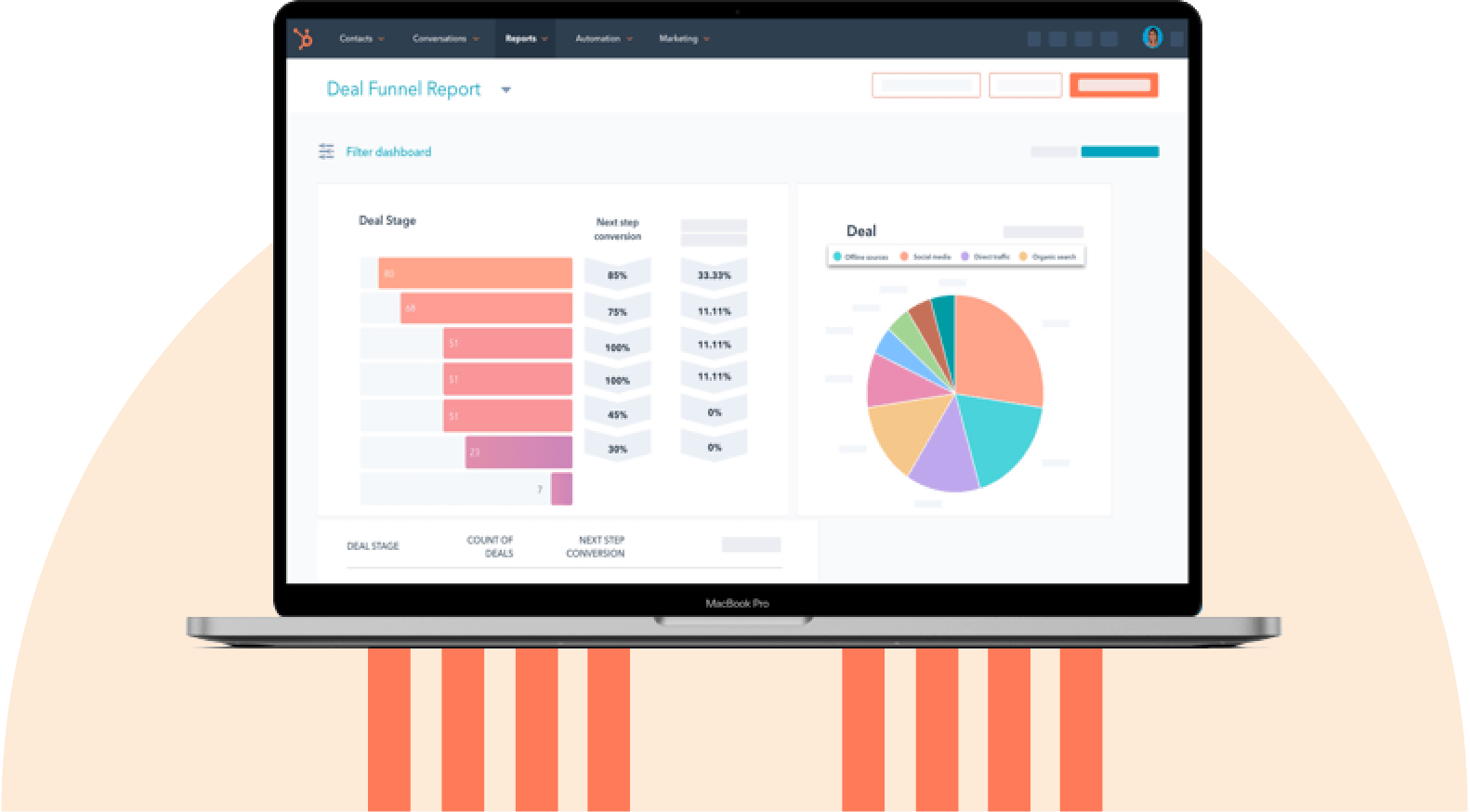
- Advanced manufacturing reporting: With HubSpot, you can monitor sales performance for different products, regions, and types of customers with dashboard analytics
- ERP Integration Hub: HubSpot can connect seamlessly with SAP, NetSuite, and other manufacturing ERPs
HubSpot Pricing
- Free tier includes basic CRM functionality for unlimited users
- Starter plan begins at $45/month with advanced features
- Professional and Enterprise tiers offer manufacturing-specific customizations
- Custom pricing available for large manufacturing operations
Learn more about HubSpot pricing.
HubSpot's Free CRM Software
Free CRM Software & Tools for Your Whole Team
- Sales
- Marketing
- Operations
- Customer Service
2. Salesforce

Salesforce helps teams manage their complete book of business, while providing a 360-degree view of customers. The platform also offers Agentforce Manufacturing, an industry solution designed to unify back-office operations with sales and service.
Best for: Large manufacturing enterprises requiring extensive customization and third-party integrations
Key Salesforce Features
- Lightning platform: Build custom applications for unique manufacturing processes and compliance requirements
- Territory management: Assign sales territories based on geographic regions, product expertise, or customer segments
- Advanced analytics: Einstein AI provides predictive insights for sales forecasting and customer behavior analysis
Salesforce Pricing
- Essentials plan starts at $25/user/month
- Professional plan at $75/user/month includes advanced features
- Enterprise and Unlimited tiers offer full customization capabilities
Learn more about Salesforce pricing.
3. NetSuite CRM

NetSuite’s CRM offers a customer management solution that unites back-office teams, so everyone knows what deals are in progress. The CRM integrates natively with NetSuite Manufacturing ERP, a solution designed to manage procurement, inventory, and shipping.
Best for: Established manufacturers requiring a complete business management suite integration
Key NetSuite Features
- Complete ERP integration: Unified platform manages CRM, inventory, financials, and production planning
- Real-time visibility: Access current inventory levels and production schedules during sales conversations
- Industry-specific functionality: Pre-built manufacturing workflows and compliance reporting
NetSuite Pricing
- Custom pricing based on modules and user count
- Implementation and training services available
- Contact NetSuite directly for detailed quotes
Learn more about NetSuite pricing.
4. Microsoft Dynamics 365

Dynamics 365 offers a helpful solution for teams that are already in the Microsoft ecosystem. Microsoft also offers an ERP solution that can help teams manage their production processes and order fulfillment.
Best for: Manufacturing companies heavily invested in the Microsoft ecosystem that require advanced analytics
Key Dynamics 365 Features
- Office 365 integration: Seamless connectivity with Outlook, Teams, and SharePoint
- Power BI analytics: Advanced reporting capabilities with interactive dashboards
- AI-powered insights: Predictive analytics for sales forecasting and customer behavior
Microsoft Dynamics 365 Pricing
- Sales Professional starts at $65/user/month
- Sales Enterprise at $95/user/month includes advanced AI features
- Custom pricing available for enterprise implementations
Learn more about Microsoft Dynamics 365 pricing.
Benefits of CRM Software for Manufacturing
Manufacturing companies implementing CRM systems typically experience significant operational improvements across multiple business functions. Kuntze Instruments reduced customer service response time by seven hours per week after implementing HubSpot’s integrated knowledge base and automated ticket routing system.
Similarly, Epec Engineered Technologies transformed its lead generation strategy using HubSpot’s automation tools, growing its blog subscribers forty-fold while improving sales and marketing alignment across their manufacturing operations.
Here are the most common benefits of using a CRM in manufacturing.
Enhanced Sales Cycle Management
HubSpot’s deal stages and custom properties streamline complex B2B processes by tracking multi-stakeholder decision cycles and maintaining detailed interaction histories throughout lengthy approval processes using HubSpot’s comprehensive contact timeline and activity tracking.
Improved Quote Accuracy and Speed
HubSpot’s custom objects for product configuration and quote automation enable sales teams to access real-time inventory data and pricing information through integrated workflows, reducing quote preparation time while minimizing errors that delay order processing.
Better Customer Service Coordination
HubSpot’s Service Hub centralizes customer communications across sales, support, and technical teams through shared inboxes and conversation routing, ensuring consistent messaging and faster resolution of complex manufacturing inquiries with HubSpot’s ticketing system and knowledge base.
Advanced Sales Forecasting
HubSpot’s sales analytics and forecasting tools leverage historical data and pipeline analytics to predict revenue more accurately, supporting better production planning and resource allocation decisions through HubSpot’s custom reporting dashboards and deal probability tracking.
Streamlined Communication Between Departments
HubSpot’s team management and internal notifications connect sales teams with engineering and production departments through task assignments and workflow automation, ensuring accurate product specifications and realistic delivery timelines throughout the sales process using HubSpot’s project management capabilities.
HubSpot's Free CRM Software
Free CRM Software & Tools for Your Whole Team
- Sales
- Marketing
- Operations
- Customer Service
4 Important Features for a Manufacturing CRM
1. ERP System Integration
HubSpot’s robust integration capabilities provide seamless connectivity with existing manufacturing software, including inventory management, production planning, and financial systems. HubSpot’s App Marketplace offers pre-built connectors for popular ERP platforms, enabling manufacturers to synchronize data across their entire tech stack without manual data entry.
2. Custom Product Configuration
HubSpot’s custom objects feature allows manufacturers to create detailed product catalogs with specifications, pricing tiers, and compatibility requirements for complex manufacturing offerings. HubSpot’s flexible data structure enables sales teams to configure products with multiple variables, ensuring accurate quoting for custom manufacturing solutions.
3. Advanced Pipeline Management
HubSpot’s multi-stage pipeline tracking accommodates lengthy manufacturing sales cycles with multiple approval levels and stakeholder involvement. HubSpot’s deal stages and automated workflows help manufacturers manage complex B2B sales processes, from initial inquiry through contract approval and production scheduling.
4. Comprehensive Reporting and Analytics
HubSpot’s advanced reporting capabilities track manufacturing-specific KPIs, including sales by product line, regional performance, and customer lifetime value analysis. HubSpot’s custom reporting dashboard allows manufacturing teams to monitor key metrics like quote-to-close ratios, production capacity utilization, and sales velocity across different product categories.
How to Choose a CRM for Manufacturing (Step-by-step)
Step 1: Map your current sales workflows.
Document existing processes from initial inquiry through order fulfillment, identifying bottlenecks and manual tasks that could benefit from automation.
Step 2: Identify must-have integration requirements.
List current software systems, including ERP, inventory management, and accounting platforms that require CRM connectivity for seamless data flow.
Step 3: Evaluate team adoption and ease of use.
Consider your team’s technical expertise and change management capabilities when comparing user interfaces and training requirements across different platforms.
Step 4: Calculate the total cost of the tech stack.
Factor in licensing costs, implementation fees, training expenses, and ongoing maintenance when projecting CRM investment over multiple years.
Step 5: Choose a platform that can grow with the business.
Select a CRM that accommodates future expansion into new markets, product lines, or geographic territories without requiring complete system replacement. Kuntze Instruments successfully grew their team by 66% after consolidating their fragmented tech stack onto HubSpot.
Frequently Asked Questions About CRMs for Manufacturing
What is the best CRM for manufacturing companies?
HubSpot consistently ranks as the top choice for manufacturing businesses due to its combination of ease of use, powerful automation capabilities, and seamless ERP integration options. The platform serves over 2,000 manufacturing companies worldwide with specialized features for complex B2B sales processes.
What features should I look for in a manufacturing CRM?
Essential features include ERP system integration, custom product configuration tools, advanced pipeline management for lengthy sales cycles, mobile access for field sales teams, automated quote generation, and comprehensive reporting that tracks manufacturing-specific KPIs across product lines and territories. HubSpot delivers all these capabilities through its custom objects for product configuration, deal stage customization for complex sales processes, the HubSpot Mobile app for field teams, and advanced reporting dashboards tailored to manufacturing metrics.
Is HubSpot good for manufacturing businesses?
Yes, HubSpot excels in manufacturing environments by offering specialized tools for complex sales processes, seamless integration with popular ERP systems, and scalable pricing that grows with your business. Manufacturing customers like Kuntze Instruments report significant operational improvements, including streamlined team collaboration and improved customer service efficiency after consolidating their tech stack on HubSpot’s platform.
How much does a manufacturing CRM cost?
CRM pricing varies significantly based on features and user count. Basic solutions start around $15/user/month, while enterprise platforms can exceed $100/user/month. HubSpot offers exceptional value with a free tier for growing manufacturers and paid plans beginning at $45/month, providing comprehensive functionality that scales with your manufacturing business needs without the complexity of traditional enterprise CRM pricing models.
What integrations are most important for manufacturing CRMs?
Critical integrations include ERP systems (SAP, NetSuite, Microsoft Dynamics), inventory management platforms, accounting software (QuickBooks, Sage), email marketing tools, and document management systems. HubSpot’s extensive integration marketplace and robust API capabilities ensure seamless data flow between sales and operational systems, with pre-built connectors for major manufacturing software and the flexibility to create custom integrations for specialized manufacturing tools.
What are the 4 types of CRM systems for manufacturers?
The four CRM types serve distinct manufacturing needs. Most modern platforms, like HubSpot, combine all four types, providing manufacturers with comprehensive relationship management capabilities.
-
Operational CRMs like HubSpot automate daily sales tasks, quote generation, and order processing.
-
Analytical CRMs leverage data to forecast demand, identify trends, and optimize pricing strategies.
-
Collaborative CRMs connect sales, engineering, and production teams for seamless communication on custom orders.
-
Strategic CRMs focus on long-term customer relationships, helping manufacturers identify expansion opportunities and develop key accounts.
Meet HubSpot, the top CRM choice for manufacturing companies.
HubSpot stands out as the premier CRM solution for manufacturing businesses seeking comprehensive sales automation without the complexity of traditional enterprise platforms.
- Industry-specific customization: Pre-built manufacturing workflows and pipeline templates designed for complex B2B sales processes typical in industrial sectors
- Seamless ERP integration: Native connectivity with leading manufacturing systems ensures real-time inventory visibility and accurate quote generation
- Scalable growth platform: Flexible pricing and feature sets accommodate everything from startup manufacturers to established industrial companies with global operations
Ready to see how HubSpot can transform your manufacturing business operations? Get started with HubSpot’s free CRM today and discover why manufacturing companies worldwide trust our platform to drive growth and efficiency.
Editor's note: This post was originally published in July 2025 and has been updated for comprehensiveness.
HubSpot's Free CRM Software
Free CRM Software & Tools for Your Whole Team
- Sales
- Marketing
- Operations
- Customer Service



-1.png)

%20(1).png)