
Conversion rate optimization (CRO) addresses this challenge by systematically improving the percentage of visitors who take desired actions, such as signing up, requesting a demo, or completing a purchase. With AI-driven search increasing in popularity, the focus for businesses in 2026 has to be optimizing conversion rates.
This guide outlines how to improve your conversion rate optimization strategy, along with a downloadable conversion optimization planner designed to drive measurable results.
Table of Contents
- What is conversion rate optimization?
- What is the purpose of conversion rate optimization?
- Why is conversion rate optimization so important in 2026?
- What is a conversion rate?
- CRO Formulas
- How To Optimize Conversion Rates
- How CRO and SEO Work Together (With Examples)
- Where To Implement a CRO Strategy
- Should improving the conversion rate optimization be the primary goal for businesses?
What is conversion rate optimization?
Conversion rate optimization, or CRO, is the process of increasing the percentage of users or website visitors who complete a specific action. The primary goal of CRO is to increase the number of leads generated by a business.
CRO focuses on systematically improving conversion rates through A/B testing, user experience optimization, and data-driven decision making to generate more leads without increasing traffic.
In practice this means fine-tuning your website to create seamless experiences where every interaction moves visitors closer to conversion, generating more leads without increasing traffic.
What is the purpose of conversion rate optimization?
The purpose of conversion rate optimization (CRO) is to increase the likelihood that visitors take a desired action on a webpage. A good website CRO plan results in increased sales and engagement by refining content, running split tests, and improving workflows.
What is a CRO strategy?
A CRO strategy is designed to convert more of your visitors into paying customers.
While each conversion optimization strategy will vary company by company, the general steps will not. The process begins by identifying key metrics and the target audience, followed by collecting user feedback and data to inform testing decisions.
A practical conversion optimization strategy involves:
A/B Testing
A/B tests are run to improve conversion performance across different pages and site elements. Prioritize high-impact areas such as the homepage, pricing pages, and key landing pages, as these directly influence conversion outcomes.
HubSpot makes A/B testing on website pages simple. Marketers can test multiple versions of their website pages and landing pages.
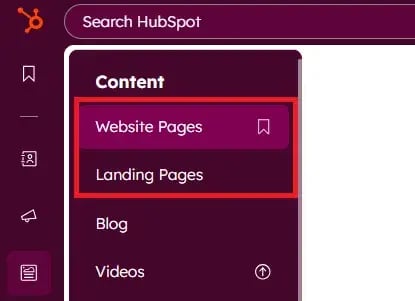
In the HubSpot account, navigate to Content, then select Website Pages or Landing Pages.
In terms of CRO, it helps identify which variations drive the strongest conversion performance. Test one element at a time to isolate what creates impact:
- Subject line
- Email sender
- Copy
- Images
- Offers
- CTAs
For example, instead of generic CTAs like “Submit,” use action oriented, benefit driving language such as “Get Your Free Quote Now.” A/B testing different colors, sizes, and wording of CTA buttons is essential to finding the combination that converts best.
HubSpot Marketing Hub also makes A/B testing on marketing emails straightforward. The tool has an option of A/B test in the top-right of the editor:

Test naming within the tool is straightforward, and using distinct names clearly differentiates test variations. The A/B test field allows entering a percentage of recipients that can be included in the test.
HubSpot includes a winning metric dropdown that helps identify which variation performs best. The available metrics include open rate, click rate, and click-through rate, that allow teams to evaluate what drives the strongest engagement and conversions.
According to research, 77% of consumers rate convenience as “important” to their buying experience. So, a great experience should remain the core focus throughout the process, as even strong offers fail when a site is difficult to navigate or use.
What are CRO tools?
CRO tools are designed to simplify or automate the process of optimizing conversion rates. They might help with lead capture, research, analytics, mouse tracking and heat maps, feedback, or running experiments.
HubSpot’s Marketing Hub is a CRO tool that offers slide-in boxes, drop-down banners, and pop-up forms for different types of offers. It also provides resources to help you set up your optimization efforts.
How important is retargeting in conversion rate optimization?
Most people on the website don’t take the desired action on their first visit. Retargeting helps re-engage these visitors who previously left the website. It works by tracking visitors to the website and serving them online ads as they visit other sites around the web.
This approach is especially effective in CRO when retargeting visitors who engaged with the website’s highest-converting pages.
To support this, HubSpot enables conversion events to be synced directly with ad accounts, allowing for more accurate targeting and performance reporting. By creating and syncing ad conversion events with Google Ads, teams can better optimize campaigns.
HubSpot also allows creating conversion events for LinkedIn ads and Facebook ads. The normal inbound rules still apply — well-crafted copy, engaging visuals, and a compelling offer are required for ads to work.
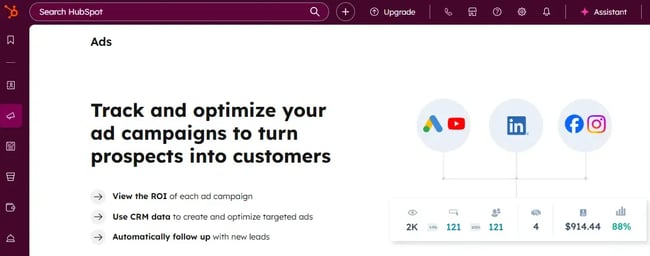
Conversion events are created within HubSpot’s Ads tool and tied to key lifecycle milestones, such as when a lead becomes qualified. Each event can be assigned a fixed value or dynamically mapped to the associated deal amount, allowing ad platforms to optimize toward higher-quality conversions rather than just form fills.
HubSpot supports consent-based data sharing. It ensures only contacts who have opted in are included in ad measurement and optimization.
HubSpot customers can also explore the AdRoll integration to help strengthen conversion efforts.
Why is conversion rate optimization so important in 2026?
Conversion rate optimization is critical in 2026 because AI Overviews reduce click-through rates, making traffic harder to earn and requiring businesses to extract more value from existing visitors.
For many informational searches today, users can get answers directly from AI Overviews without clicking through to websites. As a result, impressions rise while click-through rates decline, forcing businesses to extract more value from the traffic they do earn.
Fortunately, marketers can now rely on AI to help analyze large data sets, identify patterns, and uncover optimization opportunities more efficiently. This guide on AI conversion rate optimization explains how to use these tools to make smarter, data-backed decisions and improve performance from existing traffic.
HubSpot’s CRO planner supports marketers by applying AI-driven insights to optimize visitor actions.
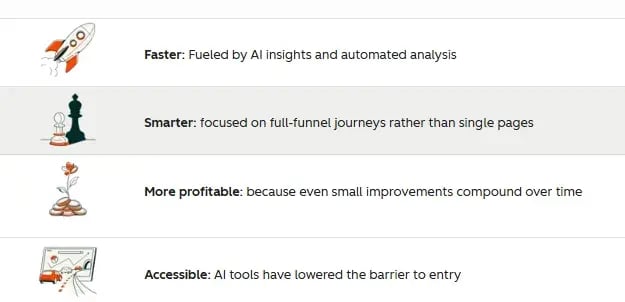
The benefits of conversion rate optimization are that it directly impacts profitability, efficiency, and revenue predictability in the following ways:
1. Lower CPL and CAC Without Increasing Spend
CRO improves the percentage of visitors who take a desired action (e.g., filling out a form, requesting a demo, signing up). When conversion rates improve, each lead effectively costs less, even if traffic and ad costs stay the same.
Impact:
- Better ROI from existing marketing budgets
- Reduced dependence on increasingly expensive paid channels
Bonus Resource: read the AI-powered conversion rate optimization playbook.
2. Greater Revenue Efficiency and Predictability
When conversion rates are optimized, revenue becomes more predictable. This directly supports more accurate sales forecasting and better budget planning.
Impact:
- Improved pipeline velocity
- Stronger connection between marketing spend and revenue outcomes
- Easier benchmarking of channel performance
CRO Example
Let’s take the example of HubSpot’s newsletter. A conversion, in this case, is a newsletter opt-in. An opt-in form is placed on every page of the website.
The conversion rate is calculated by dividing the total number of newsletter opt-ins by the total number of website visitors, then multiplying by 100. For instance, if there were 500 opt-ins and 20,000 visitors last quarter, the conversion rate would be 2.5%.
This process can be repeated for every conversion opportunity on the site, ensuring that only visitors to pages where the offer appears are counted.
Before CRO optimization:
- Monthly website visitors: 20,000
- Conversion rate: 2%
- Leads generated: 400
- Monthly marketing spend: $4,000
Cost per lead (CPL):$4,000 ÷ 400 = $10 per lead
After CRO optimization (no increase in spend):
- Conversion rate improves to 3%
- Leads generated: 600
New CPL:$4,000 ÷ 600 = $6.67 per lead
Business Result:
- 33% reduction in CPL
- 200 additional leads per month
- Sales teams benefit from a larger pipeline
What is a conversion rate?
A conversion rate is the percentage of visitors who complete a desired action, like completing a web form, signing up for a service, or purchasing a product.
A high conversion rate means your website is well-designed, formatted effectively, and appealing to your target audience. A low conversion rate could result from a variety of factors related to website performance or design.
How to Calculate Conversion Rates
Conversion rates are calculated by dividing the number of conversions by the number of visitors and multiplying that number by 100 to get a percentage.
So how can you identify your conversions in the first place? Conversion rate tools make this process straightforward.
By defining a custom conversion event, such as a form sign-up or a product purchase, the platform can spot and keep track of visitors who performed that specific action.
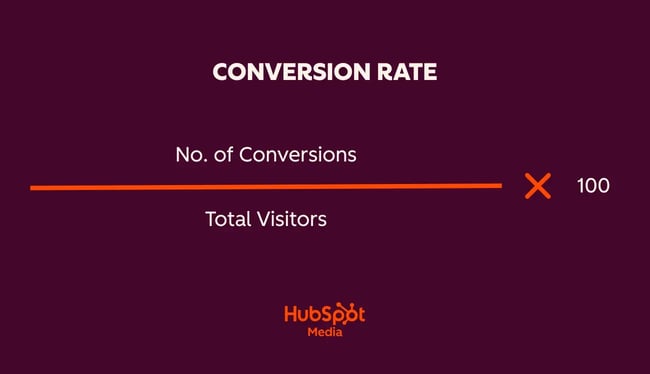
Common reasons for a poor website CRO include slow load times, a broken form, or website copy that doesn’t convey the value of the offer.
What is a good conversion rate?
A “good” conversion rate doesn’t have a single universal benchmark. It depends on the industry, niche, goals, traffic channel, and audience demographics, among other factors.
Data from the third quarter of 2025 shows that the average conversion rate across all sectors is 1.7%.
The following table shows conversion rates for many verticals:
|
Industry / Vertical |
Conversion rate |
|
Skincare |
2.7% |
|
Food & beverage |
2.2% |
|
General apparel |
1.9% |
|
Active footwear |
1.9% |
|
Toys and learning |
1.8% |
|
Active apparel |
1.7% |
|
General footwear |
1.6% |
|
Health & beauty |
1.5% |
|
Electronics & accessories |
1.5% |
|
Home, dining, art & decor |
1.5% |
|
Sporting goods |
1.3% |
|
Beauty & makeup |
1.1% |
|
General handbags & luggage |
1.1% |
|
Home appliances |
0.8% |
|
Home furniture |
0.7% |
|
Luxury apparel |
0.4% |
Pro tip: Rather than chasing a higher conversion rate in isolation, the more effective approach is to evaluate it alongside customer quality, acquisition costs, and actual revenue impact.
CRO Formulas
To better evaluate conversion performance at any given point in time, the following three formulas are commonly used to measure, analyze, and improve conversion rates.
CRO Calculation 1: Conversion Rate Percentage
Calculating your conversion rate percentage is as simple as dividing the number of conversions (or leads generated) by the number of visitors (or web traffic), and then multiplying that number by 100 to get the percentage.
%20conversion%20rate%20percentage.webp?width=650&height=374&name=conversion%20rate%20optimization%20(CRO)%20conversion%20rate%20percentage.webp)
CRO Calculation 2: Number of Net New Customers
To calculate your number of net new customers, divide the revenue goal by the average sales price. For example, a company with a $1 million revenue goal and an average sale of $10,000 needs 100 net new customers. This number then informs lead generation targets and helps identify where CRO efforts will have the greatest impact.
%20number%20of%20net%20new%20customers.webp?width=650&height=374&name=conversion%20rate%20optimization%20(cro)%20number%20of%20net%20new%20customers.webp)
CRO Calculation 3: Lead Goal
To calculate the lead goal, take the number of new customers and divide it by the lead-to-customer close rate (which is the total number of leads divided by total number of customers) percentage.
%20lead%20goal.webp?width=650&height=374&name=conversion%20rate%20optimization%20(cro)%20lead%20goal.webp)
Here's an example of these formulas in action:
Let’s explore how these three formulas work together:
Starting scenario: Company A has 10,000 monthly website visitors, generates 100 leads, and closes 10 new customers.
Conversion Rate Percentage: (Leads generated ÷ Monthly visitors) × 100 = Conversion rate
(100 ÷ 10,000) × 100 = 1% conversion rate
Lead-to-Customer Close Rate: (New customers ÷ Leads generated) × 100 = Close rate
(10 ÷ 100) × 100 = 10% close rate
Lead Goal (if targeting 30 customers): New customers needed ÷ Lead-to-customer close rate = Lead goal 30 ÷ 10% (0.10) = 300 leads needed
The CRO Opportunity
Doubling customer volume does not necessarily require doubling traffic (which is highly unlikely with the surge of AI-driven search). Instead, the goal is to improve the conversion rate to generate more leads from existing traffic. The table below shows how conversion rate improvements translate to business growth:
|
COMPANY |
A |
B |
C |
|
Monthly Site Traffic |
10,000 |
10,000 |
10,000 |
|
Conversion Rate |
1% |
2% |
3% |
|
Leads Generated |
100 |
200 |
300 |
|
New Customers |
10 |
20 |
30 |
The table highlights that substantial business growth can be achieved through conversion optimization alone, even without additional traffic.
With the fundamentals of conversion rate optimization in place, the next step is to begin implementing CRO within the organization. The following section provides a starting point for optimizing conversion rates:
How To Optimize Conversion Rates
Optimizing conversion rates is a structured process that combines clarity, trust, urgency, persuasion, and retention. Effective conversion rate optimization is when all of these are applied at the right moments across the user journey.
Conversion rates can be improved by using established principles of consumer psychology. These steps are designed to influence subconscious decision-making and increase conversion rates:
1. Clarify the Value Proposition Above the Fold
Conversion optimization starts with making the primary value immediately obvious. Consider a pharmaceutical e-commerce website aiming to improve its conversion rate. Taking the following actions will help:
Actions
- Add a clear hero CTA (e.g., “Find My Medicine”).
- Highlight key incentives in the header, such as “Free home delivery”.
- Use benefit-focused tags like “Fast-acting” or “Clinically tested” to reduce decision effort.
Recommended tool
- Hotjar (to validate attention and scroll behavior)
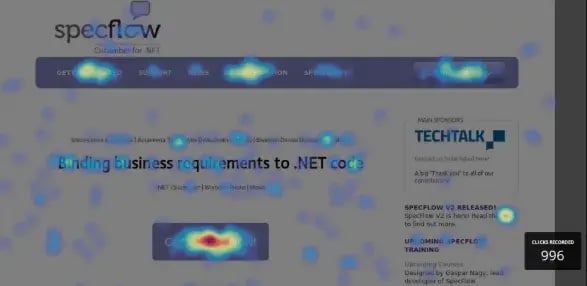
Hotjar enables testing across website elements such as copy, content offers, imagery, form fields, and entire pages, making it easier to identify which variations resonate most with target audiences.
2. Use Emotional and Contextual Visuals
Visuals should reinforce trust, reassurance, and relevance — not just aesthetics.
Actions
- Add emotionally resonant imagery that reflects the customer outcome (e.g., a relieved child on a cough relief page).
- Ensure imagery aligns with the product’s promise and use case.
Recommended tool
- Visual Website Optimizer (VWO) for image A/B testing
.webp?width=650&height=422&name=website%20cro%20tools%20-%20visual%20website%20optimizer%20(vwo).webp)
VWO integrates with HubSpot for deeper segmentation. The integration also supports omnichannel campaigns and detailed performance reporting.
3. Strengthen Social Proof at Decision Points
Social proof is most effective when placed close to moments of action.
Actions
- Display product ratings directly on product pages.
- Place testimonials near the “Place Order” or purchase CTA.
- Add behavioral proof, such as “Most customers bought this with X.”
Recommended tool
- Trustpilot reviews and ratings

Featured resource: 8-Week Conversion Rate Optimization Planner
If the business does not have a Trustpilot account, other alternatives to consider include Yotpo or Judge.me.
4. Increase Urgency and Scarcity
Urgency nudges users to act now rather than delay decisions.
Actions
- Introduce time-limited offer popups (e.g., “Get 10% off this week”).
- Display “Low stock” labels on high-demand products.
Recommended tools
- Sleeknote is recommended for popups and introducing gamification. A popup can be designed to attract attention and offer value.
- Shopify stock indicators or custom scripts for non-Shopify and custom-built websites.
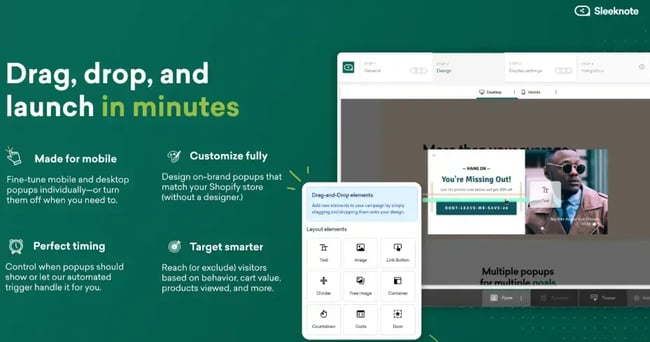
5. Optimize CTA Language for Commitment
Small copy changes can significantly affect conversion behavior.
Actions
- Replace generic CTAs. Add commitment-based phrasing such as “I’ll add to cart”.
- Replace “Checkout” with more personal, intent-driven language like “I’ll purchase”.
- Test removing the cart indicator to reduce hesitation and price anchoring.
Recommended tool
HubSpot’s adaptive testing shows how small page changes influence conversion rates. It allows teams to easily gain insights from campaigns.
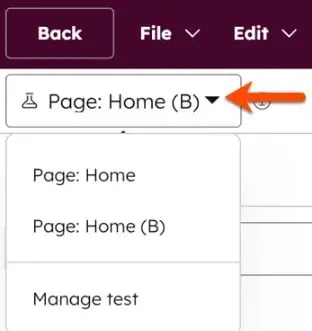
Inside HubSpot, traffic can be analyzed across each variation. View the traffic distribution report to analyze which variation yields the best result.
Pro tip: If the company website is multilingual, it makes sense to run a separate test for each language variation.
6. Increase Order Value with Smart Recommendations
Guide users toward higher-value actions.
Actions
- Display “Frequently Bought Together” bundles on product or checkout pages.
- Use contextual recommendations instead of generic “You may also like” sections.
Recommended tool
- HubSpot CRM gives insights on website analytics, purchase histories, and can also be used for personalization.
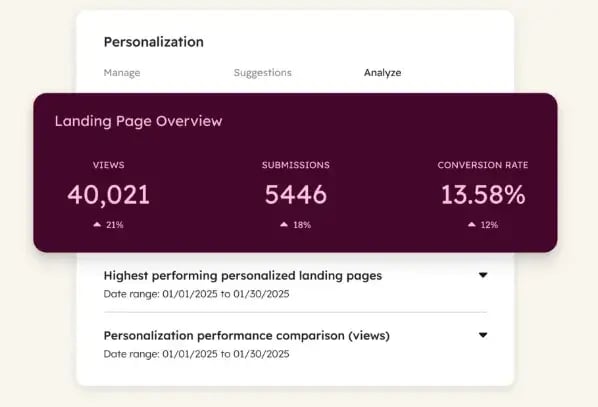
Using these insights, targeted campaigns can be created. HubSpot connects conversion optimization activities directly to measurable ROI.
7. Reinforce Retention After Conversion
A benefit of conversion rate optimization is that it does not stop at the first purchase.
Actions
- Offer discount codes for the next purchase immediately after checkout.
- Frame incentives as appreciation rather than promotion to build loyalty.
Recommended tool
- HubSpot workflows are used to automate post-purchase actions that improve retention and lifetime value.
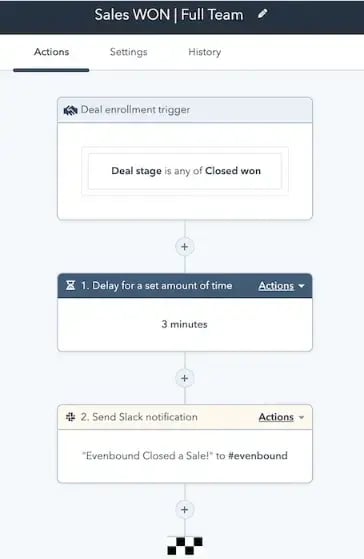
After a purchase is completed, workflows can trigger confirmation emails, onboarding or usage guidance, and follow-up messages such as review requests or cross-sell recommendations.
Pro tip: Utilize HubSpot to segment customers based on purchase behavior. Enable timely, personalized communication to keep customers engaged beyond the initial transaction.
How CRO and SEO Work Together (With Examples)
CRO and SEO work together by aligning search intent with conversion-focused content, using SEO to drive qualified traffic and CRO to convert that traffic into leads and revenue.
While CRO and SEO take different approaches, the end goal is the same: increasing conversions. When aligned, they reduce CPL, improve lead quality, and increase ROI without increasing spend.
Here are some examples and actionable tips on how CRO and SEO work together:
Example 1: Matching Search Intent Improves Rankings and Conversions
Scenario:
A B2B SaaS page ranks for “sales forecasting software,” but it focuses heavily on product features instead of buyer intent.
SEO Insight:
Search intent analysis shows users want:
- Comparisons
- Pricing context
- Use cases by role or company size
Action:
HubSpot captures buyer intent by embedding a tracking code on the website. It allows configuration of intent criteria and filters visitors based on fit, engagement, and intent level.
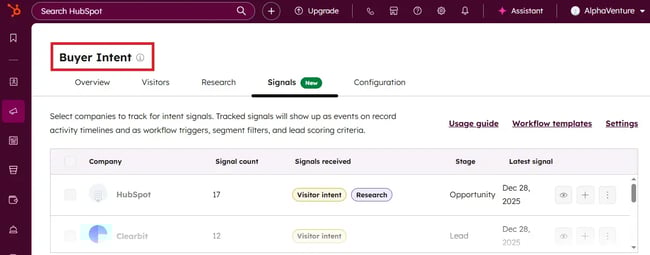
HubSpot tracks website activity. Utilizing insights from HubSpot, a comparison table is added on the website, and a “Who this is best for” section is included. A contextual CTA is also placed.
Watch the video to learn how to increase conversions with advanced tracking in HubSpot.
Why it works:
- Search engines reward pages that satisfy intent - and users are more likely to convert when the content matches what they’re searching for.
- Higher on-page engagement indicates that visitors are interacting more with content.
- A lower bounce rate signals positive SEO performance.
- Increased qualified demo requests reflect stronger lead generation outcomes.
Example 2: SEO Content + CRO CTAs Increase Pipeline Value
Scenario:
A blog post ranks well but only drives informational traffic.
SEO Strength:
High impressions and clicks for long-tail keywords.
CRO Action:
- Add mid-content CTAs aligned with funnel stage
- Use content upgrades (checklists, calculators, templates)
- Personalize CTAs by industry or role
Result:
- Blog becomes a lead-generation asset
- Higher MQL rates from organic traffic
- Stronger connection between SEO and revenue
Actionable Tips to Align CRO and SEO
Behavioral data captures how customers interact with a business across digital touchpoints. In a CRO context, this includes tracking the following behavioral signals to help users convert better:
- Sign-ups
- Page view time
- Engagement patterns
- Scroll depth
HubSpot allows for tracking and reporting on specific user behaviors. Marketing Hub enables highly detailed analysis for optimization efforts by understanding real customer journeys.
HubSpot also identifies high-impact pages. Use them to prioritize CRO tests where optimization efforts are most likely to drive meaningful results.
Where To Implement a CRO Strategy
Here are six areas of your website to focus on for your conversion optimization strategy:
1. Homepage
Home pages are prime candidates for CRO. In addition to making a first impression on visitors, the home page is an opportunity to retain them and guide them deeper into your website.
Some strategies for doing this include:
- Emphasizing links to product information
- Offering a free signup button
- Incorporating a chatbot that solicits questions from visitors
Pro tip: A/B testing on homepages has consistently shown that value-driven headlines and intuitive design improve user engagement and conversion rates.
Regularly test different headlines and imagery to see which combinations drive the most engagement and conversions.
2. Pricing Page
Pricing pages are critical CRO opportunities where A/B testing pricing intervals, product features, and form placement can significantly impact conversion rates.
A website's pricing page can be the make-or-break point for many website visitors. CRO strategies that improve pricing page conversions include modifying pricing intervals (e.g., price-per-year vs. price-per-month), clearly describing the product features associated with each price, including a phone number for visitors to call for a price quote, or adding a simple pop-up form.
HubSpot’s adaptive testing can be used to test key variables. Some of the CRO recommendations are outlined below:
- Copy: try a different formatting or style of the content
- Media: try with a different image or video
- Form fields: try with a simple form that asks for only the email address, then test the conversions with a longer form and see which one works best
- CTAs: try with different CTAs to see which one works best
Pro tips:
- Simplify your pricing options and add social proof, such as testimonials or trust badges, to reduce anxiety around making a purchase decision.
- Implement a tiered pricing model with clear distinctions between each tier's benefits. A/B test different layouts and pricing structures to find the sweet spot that maximizes conversions.
3. Blog
A blog is a massive conversion opportunity for a website. In addition to publishing thoughtful and helpful content about your industry, a blog can use CRO to convert readers into leads.
At HubSpot, the majority of our monthly blog views and leads come from posts published over a month ago.
To get started optimizing your blog content, identify your posts with high web traffic but low conversion rates. In one instance, we at HubSpot added an inbound press release template offer to a blog post about press releases — as a result, we saw conversions for that post increase by 240%.
Marketers should have a look at the blog posts with high conversion rates.
The goal is to drive more qualified website traffic to these posts by optimizing the content for SERPs and LLMs. Update content as needed to keep it fresh and relevant.
4. Call-to-Action Buttons
CTAs are the gateway to conversions. CTAs must be highly visible, visually distinct, and action-oriented.
While it's considered a best practice to include CTAs in a blog post, they sometimes fail to entice visitors to take your desired course of action. Why?
Banner blindness is a real phenomenon related to people becoming accustomed to ignoring banner-like information on websites. This lack of attention, coupled with the fact that site visitors don't always read all the way to the bottom of a blog post (rather, they "snack” on content), means a different approach is required.
That's where the text-based CTA comes in handy. Here at HubSpot, we ran a test with text-based CTAs — a standalone line of text linked to a landing page and styled as an H3 or an H4 — to see if they would convert more traffic into leads than regular CTAs located at the bottom of a web page.
In HubSpot‘s limited test of 10 blog posts, regular end-of-post banner CTAs contributed an average of just 6% of leads that the blog posts generated, whereas up to 93% of a post’s leads came from the anchor-text CTA alone.
Pro tip: Make the CTA buttons stand out with contrasting colors and compelling, action-oriented text that clearly states the benefit of clicking.
5. Landing Pages
Landing pages have the highest average conversion rate at 23% among all signup forms because they are designed specifically for single conversion actions.
Landing pages are an important part of the modern marketer's toolkit and integral to conversion rate optimization. Their focused, distraction-free design makes them ideal candidates for testing and optimization
An event landing page, for example, can be optimized with a video of last year‘s event to encourage visitors to register this year. A landing page offering a free resource can be optimized with preview content from that resource to encourage visitors to download it. To optimize a landing page, run experiments to identify the best design and content features for audience members.
The bounce rate of a landing page can be lowered by:
- Dynamic A/B testing to increase user engagement
- Mobile responsiveness to optimize user experience across devices
- Decreasing load speeds
Get everything you need to start effectively A/B Testing your website CRO today
Pro tips:
- Keep landing pages focused and free of distractions. Each landing page should have one clear goal, whether it's collecting an email address or selling a product.
- Minimize navigation options. Use bullet points to convey key information quickly, and ensure that the form or CTA is prominently displayed above the fold.
6. Forms
Sign-up forms, contact forms, and lead generation forms should have user-friendly CTAs.
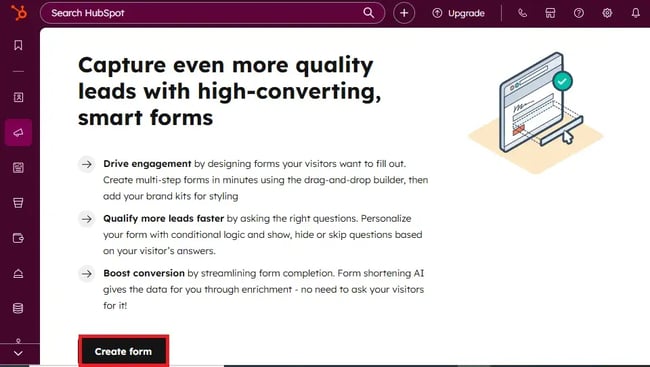
HubSpot lets teams create smart forms that boost conversions and qualify leads faster.

When creating a form inside HubSpot, minimize the number of required fields. Use clear labels, and provide instant validation feedback to make it easier for users to complete the form.
Pro tip: If you need more information, consider breaking the form into multiple steps or using conditional logic to show fields only when necessary. Adding microcopy, like explanations for why certain information is needed, can also help reduce friction.
Should improving the conversion rate optimization be the primary goal for businesses?
Jonny Longden, the Chief Growth Officer at Speero, is of the opinion that many teams assume from the outset that increasing the website CRO is the goal. This is an expectation that is not always realistic or achievable.
Longden says that if a conversion rate is already on a downward trajectory, a one-time increase of 20% does not automatically reverse that trend. It may continue to decline despite the improvement.
A website’s conversion rate is simply a percentage that reflects the relationship between incoming traffic and completed orders. This metric is influenced by almost every part of the business and the market it operates in. All of these factors play a role:
- Marketing strategy
- Brand strength
- Pricing
- Competitive positioning
In comparison, on-site UX typically has a much smaller impact on overall conversion rates.
Because of this, CRO rarely creates a dramatic or obvious change in the conversion rate line on a chart. However, that does not mean CRO fails to generate revenue.
Longden’s recommendation is not to expect CRO to visibly “fix” the conversion rate graph as this mindset undermines the effectiveness of the entire effort.
Even a modest, incremental improvement (such as a 1% lift) can translate into significant financial gains over the course of a year, even if the overall trend appears unchanged.
My Final Thoughts on Excelling at CRO
Today, search traffic is constantly changing, and so is the audience behavior. Instead of clicking on pages, people are relying more on AI Overviews to get instant answers. I see this trend accelerating in 2026.
In this environment, companies have to realize that “getting more traffic” is not the metric to go after with eyes closed. Reframe the core question for B2B teams from “How do we get more traffic?” to “How do we generate more value from existing visitors?” Even modest improvements in conversion rates can deliver outsized returns: a 1% lift in conversions can double leads and generate additional revenue.
Effective CRO execution starts with:
- Simplifying the user experience: Shortening forms to collect only essential information reduces friction and improves completion rates.
- Using the right tools: Platforms such as HubSpot help improve conversion tracking and attribution accuracy while remaining compliant.
- Leveraging automation: Create workflows that alert sales teams when leads take high-intent actions, such as viewing pricing pages.
In my opinion, the best conversion optimization strategy is one that contributes to sustainable profitability.
.png)
Free Conversion Rate Optimization Planner
The Complete DIY Guide to Improving Conversions in 60 Days
- How to conduct a conversion rate audit
- Constructing hypotheses
- Choosing the right experiment
- Analyzing and learning from results
Download Free
All fields are required.
Form not available

.webp)
![How to create a landing page with high ROI [+ expert and data-backed tips]](https://53.fs1.hubspotusercontent-na1.net/hubfs/53/%5BUse-2.webp)

![Signs it's time to redesign your website [+ 15 steps to follow]](https://53.fs1.hubspotusercontent-na1.net/hubfs/53/phaseswebsiteredesign%20copy.png)
%20(7).webp)

![How to start a blog and write posts people want to read [+ free templates]](https://53.fs1.hubspotusercontent-na1.net/hubfs/53/how-to-start-a-blog-1-20260903-6017394.webp)
![What is a lead magnet? 20 lead magnet ideas and examples [+ step-by-step]](https://53.fs1.hubspotusercontent-na1.net/hubfs/53/lead%20magnet%20represented%20by%20a%20magnet.webp)