
SEO tips improve search visibility and organic traffic, but knowing which ones to prioritize makes all the difference. Search intent determines which content format should rank, and keyword research identifies the terms people actually search for. Get those two things right, and the rest of your SEO strategy gets a lot easier.
Strong SEO foundations also have AEO benefits. Content that’s well-structured, clearly sourced, and intent-aligned is exactly what both search engines and AI answer engines want. HubSpot Marketing Hub comes equipped with tools that measure performance in both: HubSpot SEO lets teams see how they rank for important keywords, and HubSpot AEO offers a visibility overview so marketers can see AI citations.
![→ Download Now: SEO Starter Pack [Free Kit]](https://no-cache.hubspot.com/cta/default/53/1d7211ac-7b1b-4405-b940-54b8acedb26e.png)
The SEO tips below are organized by impact, covering content strategy, technical foundations, and authority building, so teams can build a resilient strategy that performs consistently, even as search continues to evolve.
Table of Contents
- How does SEO work? Here are the basics you need to know.
- 19 Essential SEO Tips Organized by Impact
- Where AI search comes into play
- Frequently Asked Questions About SEO Tips
- SEO is continuously changing.
How does SEO work? Here are the basics you need to know.
SEO (search engine optimization) is the process of improving a website so it appears more prominently in results pages for relevant queries. The goal is straightforward: attract the right audience organically by creating content that matches what people are searching for. If you’re new to the discipline, our guide on how to become an SEO expert is a solid starting point.
SEO combines content strategy, technical website optimization, link building, and authority-building signals to help search engines understand a site. At a high level, search engines work in three stages:
- Crawling is when search engine bots scan a website and discover pages through links.
- Indexing is the process of storing and organizing that content so it can be retrieved later.
- Ranking happens when a user performs a search. Search engines analyze hundreds of factors, like relevance, quality, page experience, and authority, to decide which pages appear and in what order.
SEO is a long-term growth channel, not an overnight win. Unlike paid ads, where traffic stops when a brand stops spending, SEO builds momentum over time. High-quality content and authority signals compound, so results improve the longer a team consistently optimizes for search. Done right, SEO becomes one of the most sustainable, cost-effective ways to drive traffic and leads.
.png)
Complete SEO Starter Pack
An introductory kit to optimize your website for search.
- Increase your organic traffic.
- Plan your keyword strategy.
- Debunk SEO myths.
- Build a blog strategy.
Download Free
All fields are required.
Form not available
AEO: An Emerging Search Category
Teams focused on search now optimize for both SEO and AI-powered search experiences. According to HubSpot research, 30% of marketers have seen a decrease in search traffic as users prefer conversational search in answer engines.
AEO helps businesses ensure they appear accurately and consistently in answer engines like Gemini and ChatGPT, a channel SEO alone doesn’t address. To thrive in this search landscape, marketers need to integrate answer engine optimization (AEO) into their search strategy. While SEO helps content rank, AEO helps content get selected.
Pro tip: At the Pro and Enterprise levels, Marketing Hub has both SEO and AEO tools. Content marketers can evaluate their performance in traditional search and answer engines all on one platform.
19 Essential SEO Tips Organized by Impact
Teams should build a comprehensive SEO strategy that addresses site specifications and technical requirements, while driving helpful content. For teams just getting started, begin with the basics, like optimizing for the right keywords, then work on driving authority.
HubSpot SEO can help teams see areas of improvement and offer recommendations to optimize each page for search.
Content & Keyword Optimization
The first step in any SEO strategy is making content that matches users’ queries so search engines display pages in results. Experts recommend running a SERP analysis, building intent clusters, and leveraging pillar content as best practices.
1. Master SERP analysis before creating content.
Before creating SEO content, perform keyword research and check what’s already ranking in search engine results pages (SERPs). Keyword research identifies the terms real users look for, and the SERPs reveal the content that best satisfies their intent — the real reason behind a query. Search intent alignment improves content relevance.
Running a SERP analysis reveals more than competitor positioning. Teams can reverse-engineer what users actually want. By analyzing the results page, marketers can identify whether the intent is informational, transactional, navigational, or commercial. They’ll also see what content formats win and how comprehensive current results are.
Aja Frost, senior director of global growth at HubSpot, says, “Yes, tools offer us a ton of information. But that information is often based on incomplete, out-of-date, or biased datasets. I encourage SEOs to combine the insights they’re getting from their tools with real-time clues on the SERPs.”
Every time a marketer decides to target a new keyword, refresh a piece of content, or diagnose a page with irregular traffic, Frost recommends they “take a look at what’s coming up for the main queries on Google.”
In practice, this means studying:
- Search features like snippets, AI overviews, videos, or “People Also Ask.”
- Dominant content types, like guides, tutorials, listicles, product pages, etc.
- Top-ranking websites and domains, including brands, publishers, marketplaces, or directories.
Note how top pages structure content, and whether results favor freshness, evergreen guides, or AI-generated answers. If AI summaries appear, analyze their sources to inform content structure for answer engines, not just rankings.
Tools like HubSpot AEO surface how a brand appears across AI answer engines like ChatGPT, Gemini, and PerplexityAI. Marketers see which prompts cite a brand’s content, how competitors perform, or where gaps lie.
Pro tip: Use incognito mode, clear cache/cookies, and check both desktop and mobile. Results vary by device and location, so understanding these differences helps marketers align content with how users actually search.
2. Target a variety of keywords and build intent clusters.
With organic search, it’s important to target queries that span an entire buyer’s journey, including a variety of high and low-volume keywords. According to HubSpot’s Web Traffic & Analytics survey, 26% of SEOs said they target keywords of moderate to high difficulty, while another 43% say they target keywords with low difficulty.
Braden Becker, SEO lead at Faire, says, “Broad, early-interest keywords tend to be higher in volume, while later-interest or even purchase-ready keywords tend to be lower in volume, because the audience is more specific. Therefore, you shouldn’t be afraid to target low-volume keywords if they have a higher likelihood of turning traffic into leads or customers.”
While this approach remains effective, modern SEO requires a broader lens. Instead of focusing on isolated keywords alone, marketers should think in terms of intent clusters — groups of related queries that reflect how users naturally explore a topic.
Search behavior has become more conversational and dynamic, especially with AI-powered search. Users often move through multiple related queries in sequence, refining their understanding as they go. In practice, that means:
- Identifying clusters of closely related queries.
- Creating content that addresses those questions together.
- Anticipating follow-up questions and answering them within the same page or content hub.
Intent clusters improve a brand’s ability to rank for multiple queries and increase the likelihood that content is selected for AI-generated answers. So, instead of targeting one keyword, aim to cover definitions, comparisons, use cases, pros and cons, and “how to” variations.
Ultimately, the goal is to move beyond keyword targeting and toward complete topic coverage. By doing so, marketers position their content to perform across traditional search results and emerging AI-driven experiences.
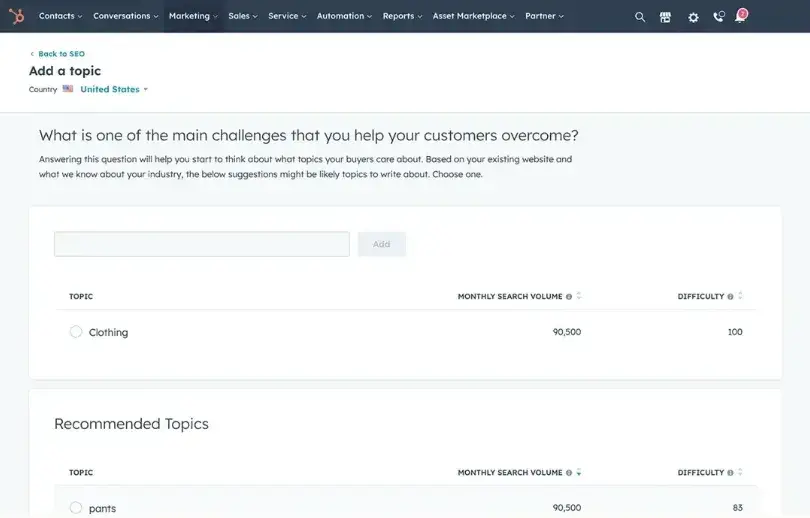
Pro tip: HubSpot’s SEO Marketing Software includes a content strategy tool that helps marketers discover topics that matter to a brand. It reveals keywords’ monthly search volume, relevance, competition, and popularity, helping teams identify a range of high and low-volume keywords to target.
3. Use the pillar-cluster model.
People rely on search engines and AI-driven tools to deliver accurate, relevant answers. Those systems need to understand both individual pages and how topics connect across a site. The pillar-cluster model addresses this need.
By creating a pillar page that covers a topic at a high level and linking it to supporting cluster content, marketers signal that their site has depth and authority on that subject. Search engines then crawl the content, understand relationships between pages, and surface the most relevant results.
The role of this model has recently evolved. Today, it requires helping search engines understand entities and their relationships, beyond internal linking alone. Modern search relies on mapping connections between topics and brands. The clearer those connections are, the more likely the content is to be recognized as authoritative.
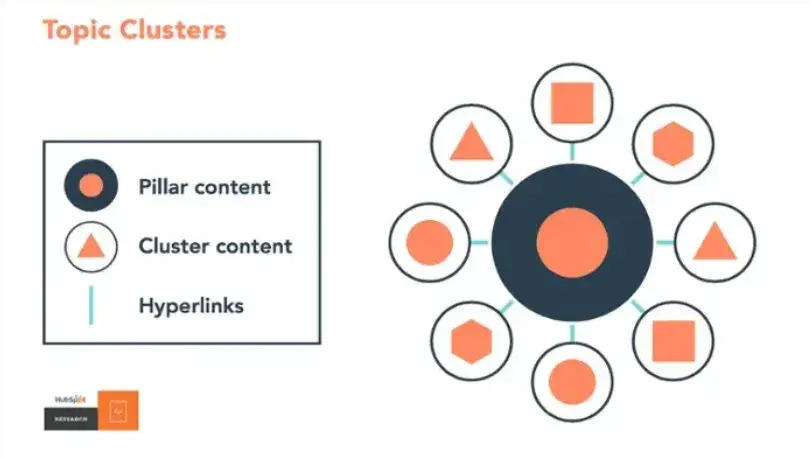
When content is structured into clusters, search engines can:
- Understand a site’s topical depth.
- Associate the brand with key concepts.
- Identify the content as a reliable source for rankings and AI-generated answers.
Structured content also improves the user experience. Visitors can more easily navigate related content and find what they need. To strengthen a pillar-cluster strategy, marketers should:
- Use consistent terminology across pages.
- Clearly define key concepts.
- Interlink related content with descriptive anchor text.
- Cover topics in depth.
Done well, the pillar-cluster model helps ensure content is understood and selected when users look for information.
4. Consider on-page SEO.
On-page SEO is the process of optimizing a page on a website with front- and back-end components, including high-quality page content, page titles, headers, meta descriptions, image alt-text, structured markup, page URLs, internal linking, and site speed.
Marketers should prioritize creating optimized page copy to improve SERP rankings. The content should include the target keyword and be contextually relevant. Ultimately, the goal is to indicate to search engines that a piece of content answers real questions users might have.
“While you work on optimizing all other on-page SEO elements, the main goal always remains to answer the search intent. Neglecting search intent is one of the grave SEO mistakes,” shares Victor Pan, principal marketing manager of marketplace growth at HubSpot.
Pan notes that content should become the end of the users’ search. Great content includes page headers that logically flow to answer user follow-up questions. “The headers should start with answering the most important questions first. It works for skimmers who want a quick answer. Then expand your answer to include a more elaborate explanation to satisfy the readers who like reading the entire blog post,” he suggests.
Comprehensive content is also critical for AEO. Answer-first formatting, where a clear, concise response appears immediately under a heading, increases the likelihood that content gets extracted for featured snippets or AI-generated answers.
Pro tip: Marketing Hub’s SEO tools show how pages perform in traditional search. AEO tools in Marketing Hub Pro and Enterprise can help identify when a brand is cited in AI search.
5. Use CTAs as often as possible.
A page that ranks but fails to convert visitors wastes its traffic. Maximize conversion opportunities by using calls-to-action (CTAs) with content offers relevant to the page and the different stages of the buyer’s journey.
Every page on a site is an opportunity for conversion, so every page should include a CTA that aligns with the visitor’s search intent. Visitors are there to learn something, and CTAs offer more insight and educational information to keep them moving forward.
Pro tip: HubSpot’s Marketing Hub makes it easier to turn traffic into leads by connecting CTAs, landing pages, and automation in one place. Teams can create personalized conversion paths, capture leads, and nurture them with targeted follow-ups while tracking how SEO-driven traffic contributes to pipeline.
6. Use image alt text.
Search engine crawlers can’t understand images unless they include alt text. Adding image descriptions is a priority for SEO, and image alt text is also helpful for ranking site pages in image-based SERPs. In multimodal search experiences, AI systems interpret both text and images when generating answers.
Alt text is also a best practice for creating an accessible website. Screen readers pick up on alt text, ensuring all visitors have a consistent browsing experience. All alt text should be descriptive, contextually relevant to the page content, and short.
7. Prune content after long periods of growth.
Pruning content is the process of reducing the number of indexed pages by deleting old, low-quality content that doesn’t add value to a site.
Becker says, “Consider ‘pruning’ content after long periods of growth. As websites grow and scale, you’ll find some content fails to perform as expected. As that pile gets bigger, it can have adverse effects on the rest of your site’s speed and performance.”
Becker recommends that teams audit their site for pages that aren’t driving a certain level of traffic, backlinks, or conversions. They can then unpublish low-quality content. This is especially relevant for small business SEO teams working with limited resources. A lean, high-quality site almost always outperforms a bloated one.
Complete SEO Starter Pack
An introductory kit to optimize your website for search.
- Increase your organic traffic.
- Plan your keyword strategy.
- Debunk SEO myths.
- Build a blog strategy.
Download Free
All fields are required.
Form not available
Technical SEO Foundations
Technical elements influence how search engines crawl, index, and interpret a website. Even the best content can underperform if a site has structural or performance issues. These SEO tips help ensure search engines can properly access, understand, and prioritize content.
8. Conduct a technical SEO audit.
When a search engine crawls a site for indexing, bots need to understand what the site is. Sites need helpful content and a clean structure. Disorganized websites are difficult to index because contextual relationships are hard to discern, and these pages won’t rank in SERPs as a result.
A site’s technical setup is a critical component of SEO. Technical aspects can include, but aren’t limited to:
- Page speed.
- XML site map.
- URL structure.
- Site architecture.
- Pagination.
- Structured data and schema markup.
- llms.txt for AI crawlers.
Pro tip: To avoid crawl issues, conduct a technical audit of all web pages on a regular cadence.
9. Optimize for mobile and Core Web Vitals.
Google uses mobile-first indexing, which means it primarily uses the mobile version of a page for ranking and indexing. If a site isn’t optimized for mobile, it’s at a disadvantage by default. Responsive design, where a page layout automatically adapts to screen size, is the standard approach and the one Google recommends.
Beyond mobile layout, Core Web Vitals are a set of performance metrics Google uses as ranking signals. The three metrics are:
- LCP (Largest Contentful Paint): How quickly the main content of a page loads. Google’s threshold for a good score is under 2.5 seconds.
- INP (Interaction to Next Paint): How responsive a page is to user interactions like clicks and taps. A good INP is under 200 milliseconds.
- CLS (Cumulative Layout Shift): How much the page layout shifts unexpectedly while loading. A good CLS score is under 0.1.
Poor Core Web Vitals scores signal a bad user experience, which search engines factor directly into rankings. Use Google PageSpeed Insights to audit a site’s scores and see specific recommendations. Common fixes include optimizing images, reducing render-blocking JavaScript, and reserving space for embeds to prevent layout shifts.
Pro tip: Mobile performance and Core Web Vitals aren’t one-time fixes. Set a recurring audit schedule so performance regressions don’t quietly hurt rankings.
10. Consolidate website pages using redirects and canonical tags.
During a site audit, SEO specialists may find multiple pages with similar content. If that happens, consider consolidating using redirects or canonical tags.
Becker says, “Nobody wants multiple pieces of website content serving the same purpose because it can cause you to cannibalize your traffic in SERPs.” To fix this, content strategists can redirect low-performing pages to a page on their site containing related information.
Becker adds, “Besides redirecting, if you have exact duplicates, you may even add a canonical tag from the duplicate to the core page, which keeps the duplicate visible but tells Google to prioritize the core page when ranking your website.”
11. Compress and optimize multimedia files.
Video, image, and GIF file size directly affect a site’s page load speed, one of the most important ranking factors. The bigger an image’s file size, the longer it takes a browser to load, which increases loading time for the whole page. The longer a website takes to load, the more likely Google is to penalize it.
Compression blends similarly colored pixels into single pixels to reduce image resolution and file size. Changes are undetectable to the human eye. Some high-quality tools for multimedia file compression are Squoosh, TinyPNG (which supports batch compression), and YouCompress.
Pro tip: Check out how to improve web design for SEO for a broader look at how design choices affect performance.
12. Don’t change URLs.
The inventor of the internet, Tim Berners-Lee, once said, “Cool URIs don’t change.” Keeping the URL the same makes content easy to find, prevents broken links, and signals content history to search engines.
Victor Pan says, “URLs should change as little as possible. The history of ‘why a URL changes’ is filled with good intentions that often get lost with time, so be sure to add a note the same way you should when you notice traffic anomalies.”
Pro tip: Teams can manage this within HubSpot’s URL Mapping tool.
13. Check, double-check, and triple-check your data.
To succeed in SEO, marketing teams need to measure their success consistently. Key metrics include organic traffic growth, conversion rate, bounce rate, and keyword rankings. As AEO becomes more important, teams should also monitor visibility beyond clicks. HubSpot AEO shows AI visibility and what search queries earn brand mentions.
Becker says, “Growing organic traffic takes time, but it also takes a village. When performing keyword research, traffic analysis, or any performance-related audit, always have more than one source of data to guide you.”
If a content management system like Content Hub shows a drop in traffic, check Google Search Console to see which pages were affected. If the decline is concentrated to just a few pages or articles, use a rankings tracker. The smarter the diagnostics, the better the decisions in response.
Pro tip: HubSpot’s SEO Marketing Software brings these insights together by tying keyword performance and traffic data into a single view. Instead of piecing together reports from multiple tools, teams can quickly identify what’s working and which optimizations will have the biggest impact.
Authority & Link Building
Sites that appear in SERPs showcase authority and credibility on a given subject. Teams can work with field experts to capture valuable lived experiences. Marketers can also link to other authoritative sites and earn media to increase trust.
14. Develop page authority.
Page authority is one of the factors search engines use to determine rankings. If a brand has a seasoned blog with a reputation as a go-to industry expert, it will likely rank higher than pages from a more recent publisher.
Brands should build a reputation and authority within their niche. Google’s E-E-A-T (Experience, Expertise, Authoritativeness, and Trustworthiness) framework is a key way to build this type of authority:
- Experience relates to having real-world, personal experience with a topic.
- Expertise signals that the writer has training, real-world experience, or verifiable credentials related to the topic.
- Authoritativeness refers to the reputation of the website, content creator, or business within their industry.
- Trustworthiness means a website’s content is credible and factual.
According to Google’s Search Quality Evaluator Guidelines, trustworthiness is the most important of the E-E-A-T factors. Some strong ways to build brand reputation and authority are blogging regularly, guest posting on other sites, and simply being active in the industry.
15. Create a link-building and authority-building strategy.
Backlinks signal authority and trust. Earning high-quality inbound links is crucial for boosting domain authority.
At HubSpot, the primary method we use to earn high-quality links is networking with other sites and requesting links to our content. We also make sure our content is relevant to the referring website’s posts.
Earning high-quality backlinks remains important, but authority in modern search extends well beyond backlinks. Search engines and AI systems evaluate a broader set of signals, including backlinks from trusted sources, brand mentions (even without links), citations across articles, forums, and media, and consistent references to a brand in context.
A brand’s strategy should extend beyond traditional link building to include digital PR and thought leadership, contributing insights to industry publications, being referenced in comparisons, discussions, and reviews, and building a recognizable brand within its niche.
Unlinked mentions and repeated citations help reinforce credibility, especially for AI systems that synthesize information from multiple sources. Marketers can use Marketing Hub Pro and Enterprise’s AEO features to track citations.
16. Train website visitors to search for your brand.
A customer may already want to buy from a brand, but still use Google to compare products from the same company. Branded traffic matters, especially for mature businesses.
Pan says, “The logic was that these were potential customers that would not have otherwise converted. This logic is good for a young business, but for mature businesses that have a good relationship with their customers, branded traffic is just as important.”
Platforms like Amazon have trained their customers searching on Google to append “amazon” to their searches for site-specific results. Marketers can encourage this by becoming the go-to expert on topics related to their brand.
“Brand authority is also coming up as an important ranking factor. So, the higher the number of branded searches you get, the better your authority. You can do that by creating a brand outside of SEO,” Pan says.
He recommends teams leverage social media, email marketing, and social forums to train their audience to do branded searches, since creating a brand ecosystem on other platforms is just as important as optimizing for Google.
Complete SEO Starter Pack
An introductory kit to optimize your website for search.
- Increase your organic traffic.
- Plan your keyword strategy.
- Debunk SEO myths.
- Build a blog strategy.
Download Free
All fields are required.
Form not available
Advanced Strategies
Teams that already have strong SEO fundamentals can focus on more sophisticated tactics. The best content marketers keep an eye on emerging trends to stay competitive as search continues to evolve.
17. Master the SERP overlap test.
Aja Frost recommends that teams conduct a SERP overlap test. She says, “I use this test all the time to determine whether to target two-plus queries with a single piece of content.”
Here’s how it works:
- Do a quick search in incognito for Keyword A and a separate search for Keyword B.
- If the SERPs look fairly different (the top-ranking pages are different, or the first result for Keyword A is the ninth result for Keyword B), Google treats those queries as separate searches with different intent.
- If the SERPs have a lot of overlap, treat them as the same query.
The overlap test aligns a content strategy with how search engines actually interpret intent. Instead of guessing whether two keywords belong on the same page, marketers use real SERP data to decide. They can then avoid combining mismatched intents (which weakens rankings) or splitting similar ones (which leads to keyword cannibalization).
18. Aim for featured snippets and AI Overviews in SERPs.
Search visibility now spans rankings, clicks, and AI citations. A growing number of queries result in zero-click experiences, where users get answers directly from the SERP or AI-generated responses. AI Overviews are increasingly synthesizing information from multiple sources rather than pointing to a single featured snippet.
Zero-click shifts the goal of SEO. Teams should focus on both traffic and citations, making sure a brand is featured across AI-generated answers, featured snippets, “People Also Ask” boxes, and citations within summaries.
In this environment, success is measured by whether content appears in answers and whether users encounter a brand before ever visiting the site.
To compete across both featured snippets and AI-generated results, content should be:
- Clear and precise. Directly answer questions under descriptive headings.
- Structured. Use lists, tables, and concise paragraphs for easy extraction.
- Comprehensive. Go beyond a single answer by adding context, related subtopics, and follow-up questions.
- Authoritative. Create content that demonstrates expertise, stays accurate over time, and reflects credible information.
- Extractable. Write in clear chunks of information that provide a complete answer an AI can excerpt.
Done well, this approach helps a website rank and helps a brand’s content get chosen for rich SERP features and AI answers.
19. Implement a historical optimization and content freshness strategy.
Historical optimization improves the performance of older content. Marketers should refresh blogs with new information and updated SEO tactics, restructure sections to include clearer answer-first formatting, and build upon existing organic value and user engagement to improve traffic.
Pam Vaughn, a marketing fellow at HubSpot and web strategy expert, made an important discovery about HubSpot’s organic blog traffic: the overwhelming majority of engagement came from old posts — not new ones. That finding shaped how content teams think about ongoing maintenance.
Historical optimization works best as a recurring maintenance habit, not a one-time project. On a regular cadence, teams should:
- Update outdated stats, examples, and product references.
- Fix broken links.
- Add new follow-up questions that have emerged in “People Also Ask” or AI overviews.
- Tighten introductions and refresh headers to better match current search intent.
- Add internal links to newer cluster content that didn’t exist when the post was first published.
Historical optimization works best for a blog that generates a significant amount of organic traffic, has a considerable number of blog subscribers, has social media followers that can supply a surge of traffic and backlinks to updates, and owns a substantial repository of older posts worth refreshing. If a business has all four, this strategy is one of the highest-ROI moves in SEO.
This recurring refresh habit also matters for YouTube SEO and local SEO — any channel where content ages and search behavior shifts over time.
Where AI Search Comes Into Play
Modern SEO is about being understood, trusted, and selected. As AI-driven search grows, content needs to be discoverable within generated answers, not only in blue links. Targeted SEO improvements have direct AEO benefits: content that covers real search intent and uses well-structured formatting improves appearances in both types of search. Entity clarity, consistent brand signals, and citation-worthy answers are what give AI systems the confidence to reference a brand.
When the SEO foundation is strong, AI visibility becomes a natural extension of what work teams are already doing. Marketing Hub Pro and Enterprise have AEO features that show exactly where the gaps are and what to do about them.
Frequently Asked Questions About SEO Tips
What are the four pillars of SEO?
The four pillars of SEO are technical SEO, on-page SEO, content, and off-page SEO (authority and link building). Technical SEO ensures search engines can crawl and index a site. On-page SEO covers page-level elements like title tags, headers, and meta descriptions. Content is what earns rankings by matching search intent. Off-page SEO builds the authority signals, like backlinks and brand mentions, that help search engines trust a site.
What are the top SEO strategies?
The top SEO strategies are conducting SERP analysis before creating content, building intent clusters around target topics, structuring content with the pillar-cluster model, optimizing technical performance (including Core Web Vitals and mobile), earning high-quality backlinks and brand mentions, and refreshing older content on a recurring basis. The highest-ROI strategies tend to combine strong technical foundations with content that’s helpful and clearly structured.
What is the 80/20 rule for SEO?
The 80/20 rule in SEO means that a small portion of your efforts (20%) typically drives the majority of your results (80% of outcomes). In practice, this often looks like a handful of high-performing pages, keywords, or optimizations generating most of your organic traffic. Instead of trying to optimize everything equally, strong SEO strategies focus on identifying and doubling down on those high-impact opportunities.
Is SEO dead?
SEO isn’t dead — it’s evolved significantly. In 2026, AI-powered search experiences like Google’s AI Mode and ChatGPT search have changed how users interact with results. Zero-click rates are up, and featured snippets have declined sharply. But the core of SEO — creating content that earns trust, matches intent, and signals authority — still drives visibility in both traditional search and AI-generated answers. What’s changed is that teams now need to optimize for citations and inclusion in AI responses, not just for page-one rankings. The discipline hasn’t gone away; the definition of “ranking” has just expanded.
Can ChatGPT do an SEO audit?
ChatGPT can help with parts of an SEO audit, especially content-related analysis. It can guide strategy, interpret data, and suggest improvements. It can’t replace dedicated SEO tools for technical crawling, indexation status, backlink analysis, or accurate traffic data. A complete audit typically combines AI-assisted insights with specialized tools to get a full, reliable picture of performance.
SEO is continuously changing.
SEO is growing in importance, and the fundamentals matter more than ever as AI search expands. For marketers, this shift doesn’t require a complete reset. It requires prioritization.
Focus first on the highest-impact opportunities: aligning content with search intent, improving site health, and strengthening authority. From there, layer in optimizations that improve visibility in AI-generated results.
Teams also need tools that measure presence beyond traditional rankings. AEO features in Marketing Hub Pro and Enterprise give marketers a clear view of how their brand appears in AI-generated answers, along with concrete recommendations for strengthening that visibility.
Editor’s note: This post was originally published in March 2019 and has been updated for comprehensiveness.
Complete SEO Starter Pack
An introductory kit to optimize your website for search.
- Increase your organic traffic.
- Plan your keyword strategy.
- Debunk SEO myths.
- Build a blog strategy.
Download Free
All fields are required.
Form not available
SEO