


CRM onboarding improves time-to-value, user adoption, and data quality. When teams take a thoughtful approach, the system becomes a central hub for sales, marketing, and customer service — with faster handoffs and better cross-team execution from day one.

Learn more about why HubSpot's CRM platform has all the tools you need to grow better.
The stakes are higher than most teams expect. According to a recent benchmark study on CRM implementation failure rates, 55% of CRM rollouts fall short of their main goals, largely due to delays, messy processes, and low team adoption.
What is CRM onboarding, and why does it matter?
Customer relationship management (CRM) onboarding is the process of embedding a new system into daily workflows across sales, marketing, and customer service. The process covers data migration, configuration, training, adoption, and measurement. Proper onboarding marks the exact boundary between a platform that drives measurable growth and expensive software that never gets off the ground.
A properly onboarded CRM provides every user with a single, unified view instead of scattered spreadsheets and fragmented email threads. Platforms with centralized infrastructure, such as HubSpot’s Contact Management, create a single master record per contact. This record automatically consolidates interaction history, deal notes, and team activity. Setting up this unified baseline is the exact goal onboarding accomplishes before teams depend on the system for daily work.
Quality onboarding yields returns far beyond basic feature usage. Supported, confident teams embrace operational change faster and contribute directly to ongoing process improvements.
According to Nucleus Research, when organizations properly implement CRMs, team productivity gains and overall process efficiency account for 51% of total CRM ROI.
Every department extracts distinct value from a structured rollout.
- Customer service teams: Deliver personalized customer experiences backed by a complete, real-time service history.
- Sales managers: Maintain full visibility into pipeline movement, deal bottlenecks, and rep performance.
- Operations leaders: Streamline cross-departmental workflows and establish clean, reliable data for reporting.
- Business owners: Accelerate time-to-value through automated processes and central customer analytics.
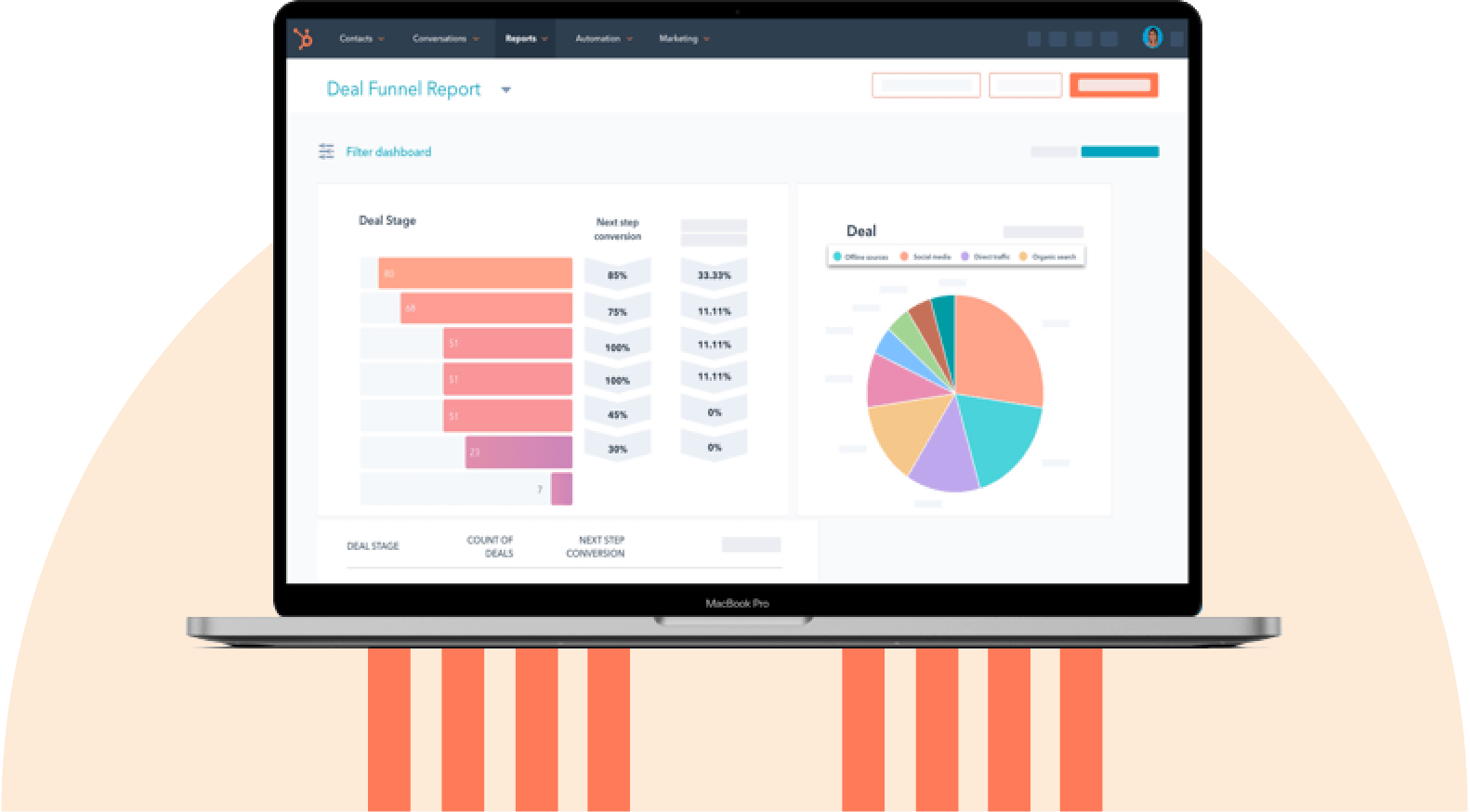
HubSpot's Free CRM Software
Free CRM Software & Tools for Your Whole Team
- Sales
- Marketing
- Operations
- Customer Service
What are the biggest CRM onboarding challenges?
Inconsistent Data
Inconsistent data creates an immediate bottleneck during software implementation. When records contain duplicate entries, missing contact details, or mismatched formatting, data transfer results in immediate reporting errors and team distrust. Teams must establish clear data mapping and cleaning routines up front to ensure that core functionality works from day one.
Unclear Ownership
Unclear ownership is a major organizational barrier during CRM rollouts. Because implementation touches sales, marketing, customer success, IT, and operations, projects stall quickly without explicit role assignments. Essential tasks, including workflow configuration and system validation, face delays or duplicate effort.
Unclear ownership causes slower CRM onboarding and inconsistent execution. Executive sponsorship and structured governance remain essential for software success. As highlighted by Gartner, ill-defined responsibilities for account management and customer success teams lead directly to:
- Confusion across customer-facing roles.
- A siloed, fragmented view of the customer life cycle.
- Escalating operational costs.
- A negative overall customer experience.
Weak Measurement
Without clear benchmarks, team leaders cannot track user adoption, workflow efficiency, or total return on investment. Skipping goal definition at the start leaves the implementation without direction, which makes mid-course corrections almost impossible.
Leaders Should slow down early to identify the specific problems the software needs to solve. Involving active daily users from day one ensures the system aligns with real-world daily tasks, driving organic adoption, smooth workflows, and real value without added complexity.
Siloed Processes
Siloed processes pose a significant obstacle during CRM rollouts. When customer records and daily operations remain trapped inside department-specific tools, teams struggle to build a unified view of the buyer journey. They often rely on separate software and isolated datasets.
During setup, these disconnected tools trigger duplicate data entry, mismatched customer files, manual handoffs, and communication gaps. As a result, employees spend more time reconciling records than serving clients.
Industry benchmarks confirm the widespread operational damage caused by departmental silos. According to Salesforce’s State of the Connected Customer report, 57% of customers feel business interactions occur with separate, disconnected departments rather than one unified company.
Meanwhile, research from Forrester reveals that organizations with strong cross-functional alignment achieve 2.4× higher revenue growth and 2× higher profitability growth compared to siloed peers.
Connecting core software — such as marketing platforms, support ticketing software, and central customer databases — erases information silos and establishes consistent cross-team handoffs.
Weak Reinforcement or Lack of Training
Treating a rollout as a simple IT update rather than a shift in daily habits quickly undermines system adoption. When leadership assumes that modern software is self-explanatory, user engagement drops and teams revert to comfortable offline workarounds.
Sales reps already spend a large chunk of their day on manual administrative tasks rather than selling. Rollouts fail when reps view the system as extra work on top of quota pressure. Long-term success requires showing team members upfront how features — like lead scoring or call logging — save time and simplify their daily routines.
These issues track closely with the common onboarding challenges most customer-facing teams run into — CRM onboarding just adds a layer of data and cross-team complexity on top.
How to Run CRM Data Onboarding Without the Headaches
Build the CRM around how each team already works.
Effective setup requires software customization to existing team workflows rather than relying on rigid default templates. When leadership seeks input from sales, finance, and customer service to map cross-functional processes before system configuration begins, long-term operational friction disappears.
Dave Toby, managing director of Pathfinder Marketing, learned this lesson through direct client experience overseeing HubSpot implementations. “Onboarding runs smoothly when you build the CRM around how each team already works instead of a standard template. Sales, finance and service need input mapping their process before anyone touches a field, or things turn messy months later,” Toby says.
As Toby explained, his team once built a client pipeline tailored solely to sales preferences without input from finance. Three months later, monthly revenue reports failed to match the CRM data, forcing a manual rebuild of half the pipeline. Today, his agency maps both sales and finance requirements before system setup begins.
To protect data accuracy after launch, Toby recommends a simple weekly habit rather than a complex checklist. Every Monday, his team pulls a single report that highlights deals without a scheduled next activity date. One designated team member owns the fixes, which catches data decay before bad records impact revenue forecasts.
Keep one source of truth during cutover.
Running two systems at once during a rollout gets confusing fast. If teams do not know which tool holds the real data, messages slip through the cracks, and customer requests sit completely ignored.
David Caruso, Founder & CEO of BuyFactory.direct, ran into this exact issue when his team migrated to a custom setup. “During our migration, agents kept replying to customers inside the old tool without realizing it no longer reached them. Ticket after ticket looked answered and was not,” Caruso explained.
Caruso fixed the breakdown with two practical moves:
- Clear system priority. He named the new platform as the official source of truth in writing, so everyone knew which inbox to use.
- Small, controlled switch. His team limited the cutover to a single routing rule instead of the full domain. If something went wrong, they could reverse one line of code in seconds.
To avoid surprises, Caruso recommends a full dry run — from initial inbound message to final outbound reply — before anyone touches that master switch.
HubSpot's Free CRM Software
Free CRM Software & Tools for Your Whole Team
- Sales
- Marketing
- Operations
- Customer Service
Ensure that the migration mirrors your teams’ processes.
Before moving data into a new CRM, companies should make sure it mirrors how data flows through the organization, who owns each stage, and which information needs to be captured. Aligning these processes before migration creates a consistent foundation for employees to adopt the system after launch.
Eric Turney, Owner and Sales and Marketing Director at The Monterey Company, says this became one of the biggest lessons from his sales team’s migration from Salesforce to Pipedrive. Looking back, he believes many organizations make the mistake of “trying to migrate everything before deciding what the sales team actually needs every day.”
Based on that experience, Turney recommends reviewing pipeline stages, required fields, lead sources, and deal ownership rules before migrating records. In his view, those decisions should come before moving any data because they determine how teams will actually use the CRM.
Turney also argues that a technically successful migration can still fail if teams lack clear processes. “If reps do not understand where a lead goes, what counts as a real next step, or who owns follow-up, the CRM becomes a cleaner-looking mess.” Although his example focuses on sales, the same principle applies for company-wide CRM onboarding, too.
Which data should you migrate first?
Decisions about data migration dictate how quickly a rollout proceeds and how clean the system stays in the long term. Instead of standard import steps, these two founders recommend distinct strategies to protect record quality and reduce system strain.
Yad Senapathy, Founder & CEO of Project Management Training Institute, leads project delivery for enterprise software rollouts. When his company rebuilt its own Salesforce instance, he discovered that messy data reveals deep process gaps early on.
“Everyone says ‘start with active accounts.‘ I’d say start migration with your worst data, the duplicates and dead leads nobody wants to touch. If your team can’t agree on rules for garbage records, they definitely can’t agree on rules for good ones,” Senapathy says.
As Senapathy team learned that “clean later” turns into 15 months of delay. He also points out that a smooth data transfer requires one named owner across departments, which cut his second migration timeline in half. To maintain quality post-launch, Senapathy tied CRM hygiene to quarterly bonuses for sales ops, which boosted adoption by 16% in three months.
Caruso took a different angle during his custom tool build. He focused on record architecture to avoid duplicate files.
- Centralized record access: His team migrated support tickets first, but left core customer records where they lived. The tool queried the main order database directly, so customer data never drifted out of sync.
- Unified system design: He warns against treating platforms as separate islands. Duplicating records creates multiple versions of the truth and erodes team trust in the system.
- Customer protection rules: When an automated CRM setup check fails, his system defaults to protect the user experience by keeping buyers classified as real customers.

Luckily, many modern CRM platforms simplify the migration process. HubSpot’s CRM Import supports importing contacts, companies, and deals from spreadsheets or legacy CRM systems. Automatic field mapping and validation identify common issues before the import is completed.
How do you maintain data quality post launch?
The first few months after launch often determine whether CRM data remains reliable or gradually loses value. As new records are created and existing ones are updated, missing information, duplicate entries, and inconsistent formatting can quietly reduce reporting accuracy and weaken automation.
Maintaining data quality requires a combination of automation and regular governance.
Tom Bukevicius, CEO and Founder of Scube Marketing, agrees. He recommends relying on systems to catch common issues before they affect reporting rather than expecting employees to identify them manually. As he explains, “automation should do as much of the quality control as possible. If a lead enters the CRM without a source, owner, or next step, the system should flag it or prevent it from progressing rather than relying on someone to notice later.” He also underlined that the same should apply to duplicate contacts, stale opportunities, and missing customer information.
Some platforms, like HubSpot’s Data Enrichment, can help fill in missing company and contact information in CRM records, reducing the number of incomplete data that require manual updates.

Bukevicius also cautions against treating data quality as solely a user problem. In his experience, “companies often blame employees for poor CRM data when the real problem is a poorly designed system.”
He argues that unnecessary data entry, inconsistent lead definitions, and outdated workflows encourage shortcuts and reduce reporting accuracy. As he puts it, “Good CRM design removes unnecessary work and makes the correct action the easiest action. I would rather have ten well-designed fields that the team actually uses than fifty fields that exist only because someone thought they might be useful someday.”
How to Configure CRM for Cross-Team Workflows
Tailored software settings that mirror actual daily operations form a critical step in any CRM implementation. Reliance on default platform structures forces teams into awkward workarounds. System admins who use flexible setups, such as HubSpot’s CRM Customization options, can adjust custom properties, deal views, and pipeline stages before launch. This transforms theoretical plans into smooth operational workflows.
Define lifecycle stages.
Lifecycle stages establish a shared framework for how teams understand a customer’s journey, from initial interaction through conversion, onboarding, retention, and expansion. Without clearly defined stages, different departments may interpret customer status differently. For example, marketing may consider a lead qualified while sales may not consider it ready for outreach, creating confusion and inefficient handoffs. The same breakdown that shows up in a poorly defined sales-to-CSM handoff later in the customer journey.
Clearly defined lifecycle stages improve accountability because teams know when ownership changes and what actions are expected at each point in the customer journey.
Set naming conventions.
Consistent naming conventions ensure that teams interpret CRM data consistently. Without standardized names, organizations quickly create duplicate records, inconsistent reporting, and unreliable analytics.
Naming conventions become essential as companies grow because new team members must understand system structures without relying on undocumented institutional knowledge. According to Salesforce, consistent data standards and governance practices help organizations improve data quality and create a reliable customer view across departments.
Standardized naming also supports automation because workflows depend on exact values. For example, an automated trigger set for “Enterprise Customer” fails if another team uses “Enterprise Client” or “Enterprise Account” instead.
Align on documentation.
Documentation creates a shared operating system for CRM usage. Teams need clear guidelines that explain what information should be entered, who owns specific fields, when updates should occur, and how processes should be followed.
Without documentation, CRM adoption becomes inconsistent because employees develop their own methods of recording information. This creates incomplete records and reduces trust in CRM data.
Research from Gartner emphasizes that CRM success depends heavily on governance, including clear processes, ownership, and standards for managing customer information. Documentation ensures that CRM processes remain consistent even as teams expand or employee turnover occurs.
Create feedback loops.
A CRM should not be treated as a system that is configured once and left unchanged. Cross-functional teams need regular feedback loops to identify problems, improve workflows, and adapt the CRM as business needs change.
Feedback loops allow different users to report friction points, suggest improvements, and highlight missing information. This is critical because employees using the CRM daily often identify process issues faster than implementation teams.
According to Prosci, continuous reinforcement and feedback are important components of successful organizational change because they help ensure new processes are adopted and maintained over time.
What does CRM onboarding launch week look like?
Use this as a week-one CRM onboarding checklist to keep launch week on track across every team involved in the CRM implementation plan.
Day 1: Validate the CRM setup.
- Confirm all users have the correct access permissions and roles.
- Verify the quality of migrated data, including customer records, contacts, and opportunities.
- Test integrations, automations, workflows, and notifications.
Day 2: Prepare teams for adoption.
- Share CRM documentation, process guidelines, and team-specific workflows.
- Run training sessions covering daily tasks, reporting, and handoff processes.
- Confirm that lifecycle stages, fields, and naming conventions are understood by all teams.
Day 3: Monitor real usage.
- Track user activity, record updates, and workflow completion.
- Identify adoption barriers, missing data, or process issues.
- Collect feedback from sales, customer success, service, and operations teams.
Day 4: Fix issues and improve workflows.
- Resolve data quality problems and correct incorrect records.
- Adjust workflows, permissions, or automation rules based on user feedback.
- Update documentation with any process changes.
Day 5: Review performance and plan next steps.
- Hold a launch review with key stakeholders.
- Evaluate CRM adoption metrics and onboarding progress.
- Create a prioritized improvement plan for future CRM optimization.
How to Train and Drive CRM Adoption That Sticks
Long-term CRM adoption starts during the planning phase of a CRM rollout. That’s why Joe Bushnell, CRM expert at enable.services, recommends making adoption a project objective from day one, alongside implementation, data migration, and system configuration. Early planning helps align the CRM with existing workflows, reducing friction once teams begin using the platform.

For adoption to last, the CRM needs to support everyday work across sales, marketing, and customer service while also providing leadership with accurate reporting and visibility into performance. When employees can complete routine tasks efficiently and trust the data they rely on, consistent usage follows more naturally.
Effective CRM training reinforces that goal by equipping each team with the knowledge and confidence to use the system in the context of their roles. Successful organizations don’t rely on a single onboarding session. Instead, they combine initial training with ongoing enablement, practical exercises, and regular feedback as teams become more familiar with the platform.
The practices below build on general onboarding best practices but were adapted specifically to drive CRM adoption across teams.
Engage in role-based onboarding for marketing, sales, and service.
Role-based training increases CRM adoption across marketing, sales, and service teams. Each department works with different data, workflows, and objectives, so generic onboarding often introduces features irrelevant to day-to-day responsibilities. Focusing training on role-specific tasks makes the CRM easier to learn and more valuable from the start.
For sales team CRM training, focus on:
- Lead prioritization
- Pipeline and opportunity management
- Sales forecasting
- Automating administrative tasks.
Marketing teams should learn how to use CRM data for:
- Audience segmentation
- Campaign performance measurement
- Lead nurturing.
Respectively, service teams need training on:
- Customer case management
- Accessing complete customer histories
- Resolving issues more efficiently.
Aligning training with real workflows is one of the most effective CRM adoption best practices because it helps employees see the CRM as a tool that improves everyday work rather than adding another administrative task.
HubSpot's Free CRM Software
Free CRM Software & Tools for Your Whole Team
- Sales
- Marketing
- Operations
- Customer Service
Include in-app guidance and AI coaching for self-service.
In-app guidance, self-service resources, and AI-powered coaching help employees learn the CRM as they’re actively using it. This way, organizations can provide users with support when they need it through tutorials, automated prompts, knowledge bases, and contextual recommendations.
For example, HubSpot Service Hub supports onboarding through workflows, a knowledge base, and a customer portal connected to HubSpot Smart CRM, helping teams access information and follow standardized processes more efficiently.
This approach reduces dependency on reaching out to internal experts for help. It allows employees to solve common questions independently.
Another benefit of such continuous guidance is that it reinforces correct CRM behaviors, improving data quality and reducing the risk that employees return to old processes after launch.
Show “what’s in it for them.”
Employees are more likely to embrace a CRM when its value is tied to their own day-to-day responsibilities rather than organizational goals. The same pattern appears across workplace technology more broadly.
Microsoft’s Work Trend Index found that 75% of knowledge workers use AI at work because it saves time, allowing them to focus on more valuable work. The takeaway for CRM onboarding is similar — people are more willing to adopt new tools when the personal benefits are clear.
Those benefits should be tailored to each role:
Framing the CRM around individual outcomes instead of company-wide reporting helps employees see it as a productivity tool rather than another administrative requirement.
Design the CRM around current workflows.
CRM implementation should reinforce how teams already operate rather than requiring them to learn entirely new processes. Existing sales stages, lead handoffs, and service procedures provide a strong starting point for system configuration. This reduces the amount of change employees need to manage at once.
The focus should be on supporting everyday work with streamlined workflows and reports that help teams make decisions. Avoid introducing unnecessary fields, custom objects, or complex processes during the initial rollout. A CRM that reflects established ways of working is easier to learn, easier to maintain, and more likely to achieve long-term adoption.
How to Measure CRM Onboarding Success
Launching a CRM is only the first milestone. Long-term success depends on whether employees use the platform consistently, data remains reliable, and the system supports measurable business outcomes across sales, marketing, and customer service.
CRM onboarding success is measured by time-to-value, adoption by role, training completion, and data hygiene. Together, these metrics provide an early indication of whether the CRM has become part of day-to-day operations or whether additional training, process improvements, or data governance are needed.
The following KPIs help evaluate onboarding from multiple perspectives, covering user adoption, operational efficiency, learning progress, and data quality.
Time-to-Value
Time-to-value measures how quickly teams begin receiving meaningful benefits from the CRM after launch. This could include faster sales processes, improved customer visibility, reduced manual work, or more accurate reporting. A shorter time-to-value indicates that the CRM has been configured around real business needs. It also shows that users can quickly apply it in their daily workflows.
Teams should track early indicators such as the time required to complete key workflows, when users begin creating and updating records independently, and when managers can access reliable reports.
Measuring time-to-value helps identify whether onboarding processes are effective or whether users are struggling to understand how the CRM supports their work.
Adoption by Role
Because each department interacts with the system differently, CRM adoption should be measured separately across different teams. Tracking overall login numbers alone does not show whether employees are using the CRM effectively.
Instead, organizations should measure role-specific behaviors, such as sales representatives updating opportunities, marketing teams managing campaigns, and service teams maintaining customer records.
Role-based adoption metrics help see where additional training or process improvements are needed. For example, if sales teams regularly access the CRM but fail to update pipeline stages, the issue might not be willingness to use the system but unclear processes or insufficient training.
Training Completion and User Readiness
Training completion is an early indicator of whether employees are prepared to use the CRM correctly. However, in addition to attendance, organizations should also evaluate whether users can independently complete important tasks after training.
Useful metrics include:
- Completion rates for CRM training programs
- Knowledge assessments
- Participation in onboarding sessions
- Number of support requests after launch
High training completion combined with low support demand usually indicates that users understand the system and feel confident using it.
Tracking training effectiveness helps organizations identify knowledge gaps before they become adoption problems. Continuous learning resources, refresher sessions, and role-specific training can help maintain engagement as CRM processes evolve.
Data Hygiene and Data Quality
Data hygiene measures whether CRM information remains accurate, complete, and consistent after migration and launch. Poor data quality quickly reduces trust in the CRM because employees stop relying on information they believe is outdated or incorrect. In fact, 37% of CRM users who participated in Validity’s State of CRM Management study reported losing revenue due to bad data quality.
Early KPIs should include duplicate-record rates, missing required fields, outdated customer information, and data-completion percentages. Monitoring these metrics helps teams identify whether users are following CRM processes correctly and whether additional automation or governance is required.
Maintaining strong data hygiene is especially important because CRM insights, forecasting, and automation depend on reliable information. Clean data also ensures teams can make better decisions and deliver consistent customer experiences.
Workflow Efficiency
A successful CRM should improve how teams work instead of simply replacing existing spreadsheets or manual processes. Measuring workflow efficiency helps organizations understand whether the CRM is reducing friction and saving employees time.
Useful KPIs
- Time spent updating CRM records: Employees should spend less time on data entry as workflows become more streamlined. If record updates continue to take longer than expected, forms, required fields, or approval processes may need to be simplified.
- Speed of customer handoffs: Measure how quickly leads, opportunities, or support cases move between marketing, sales, and customer service. Faster handoffs reduce delays, improve the customer experience, and help prevent important information from being lost.
- Sales cycle duration: Compare the average time it takes to move opportunities from first contact to closed deal before and after implementation. A shorter sales cycle often indicates that the CRM is helping teams prioritize opportunities, collaborate more effectively, and remove bottlenecks.
- Number of manual tasks replaced by automation: Track repetitive activities such as lead assignment, follow-up reminders, contact enrichment, or status updates that are now automated. Increasing automation frees employees to focus on higher-value work while improving process consistency.
Together, these metrics reveal whether the CRM is delivering operational improvements or creating unnecessary administrative work. If efficiency gains are limited, the underlying workflows, automations, or user experience may need to be refined rather than additional training alone.
Feedback and Continuous Improvement
CRM onboarding doesn’t end after launch. Regular feedback helps identify usability issues, process gaps, and training needs that may not be visible through adoption metrics alone, allowing the CRM to evolve alongside the business.
A continuous feedback loop is also more likely to increase long-term adoption. According to Yooz’s 2025 workplace technology survey, 36% of employees believe technology adoption would improve if they had more input into technology decisions. Involving end users in ongoing CRM improvements is one of the most effective ways to act on that finding. The metrics and feedback sources below help teams do that consistently.
- User satisfaction: Regular surveys reveal how well the CRM supports day-to-day work and can highlight workflow or training issues.
- Support requests: Frequent questions often indicate confusing processes, missing documentation, or areas that need simplification.
- Workflow improvement suggestions: Employee feedback helps identify practical ways to streamline processes and improve long-term adoption.
Reviewing this feedback regularly helps organizations refine CRM configuration, improve training, and adapt workflows as business needs change. The same continuous improvement approach is explored in more detail in our guide to ongoing CRM optimization.
HubSpot's Free CRM Software
Free CRM Software & Tools for Your Whole Team
- Sales
- Marketing
- Operations
- Customer Service
Which CRM Onboarding Tools Help and When
The real question is not which onboarding tool is “best”, but whether a CRM can handle onboarding on its own, or whether the complexity of the data, teams, and processes has outgrown what’s native. That threshold usually shows up in four places: integration, governance, adoption, and workflow complexity.
Integration
CRM-native onboarding is usually sufficient when the tech stack consists of a handful of applications that integrate with your CRM out of the box. Dedicated onboarding software becomes more valuable when dozens of systems with different data models need to stay synchronized. If you’re a HubSpot user, then Data Hub data sync connects HubSpot with third-party apps, and paid Data Hub plans support custom field mappings. Capabilities like these reduce the need for a separate integration layer in many growing organizations.
Governance
Native onboarding works well when a single team (usually RevOps in B2B setups) owns permissions, naming conventions, and record structure. HubSpot’s User Permissions control which teams and roles can access which data, keeping the CRM organized as headcount grows without a separate admin layer.
Dedicated governance tools become more valuable when different business units or regions have their own compliance requirements. However, for most mid-market organizations, native CRM permissions and field-level controls are enough.
Adoption
If reps are already living in the CRM daily, in-app guidance and role-based training are sufficient to drive adoption. Organizations don’t need a separate digital adoption platform layered on top. Specialized tools add the most value for large, distributed frontline teams, such as field sales, where guided onboarding helps employees adopt the CRM more quickly.
Workflow Complexity
Simple, linear handoffs (e.g., sales to service) run fine on native workflows and lifecycle stages. When onboarding requires branching logic across many teams, custom approval chains, or heavy conditional logic, a specialized workflow tool can offer more flexibility than out-of-the-box CRM automation.
For most growing teams using HubSpot tools, these four lenses point the same direction — native CRM onboarding extended by Data Hub for sync and Smart CRM for unification. These capabilities will help cover the majority of cases. Smart CRM unifies customer data, teams, and tools in one platform, which is exactly the problem most standalone customer onboarding software is trying to solve from the outside in.
Specialized tools still have a place for edge cases, including sprawling integration footprints, multi-entity governance, or large frontline teams. The decision should be driven by the company’s complexity or whether it has crossed a threshold native tools can’t stretch to cover.
It helps to ask the following questions:
- Is the company syncing more systems than the CRM’s native connectors and field mappings can reasonably cover?
- Does more than one team need independent governance rules over the same records?
- Are reps failing to adopt the CRM even with in-app guidance and role-based training?
- Does the current onboarding workflow require branching logic beyond what lifecycle stages and native automation support?
If the answer is “no” to most of these, native onboarding is the right call.
Frequently Asked Questions About CRM Onboarding
How long should CRM onboarding take?
CRM onboarding timelines depend on system complexity, data volume, and the number of teams involved. A simple setup may take a few weeks, while larger implementations with custom workflows and integrations can take several months. The focus should be on readiness rather than speed — a rushed rollout creates adoption problems that take longer to fix than the time saved.
Should we do CRM onboarding ourselves or hire a partner?
Companies with simple CRM needs and internal technical expertise can often manage onboarding themselves. Organizations with complex workflows, large datasets, or custom integrations typically benefit from working with an implementation partner. The decision should be based on internal resources, CRM complexity, and the level of customization required.
What is the best way to train field reps with limited time?
Field reps need short, practical training focused on the workflows they use most often. Role-based onboarding, mobile-friendly resources, and real-world examples from daily activities work better than long sessions covering every feature. Short video tutorials, in-app guidance, and coaching from CRM champions reinforce learning without pulling reps away from customer-facing work.
When should you introduce a client onboarding portal?
A client onboarding portal makes sense when customers need to complete repeatable steps, share information, or track progress during onboarding. It is especially valuable for teams managing high volumes of customers or complex processes. Internal workflows should be standardized first — introducing a portal too early without defined processes creates confusion rather than clarity.
How do we prevent data decay after launch?
Preventing data decay requires ongoing governance, clear ownership, and regular data quality checks. Teams should define who is responsible for maintaining records, establish required field rules, and use automation to flag incomplete or outdated information. Data quality should be treated as an ongoing operational process rather than a one-time cleanup task.
Make CRM onboarding faster with HubSpot.
A well-planned CRM onboarding process gives every team a clear way of working from day one. When customer data stays accurate and processes are easy to follow, adoption becomes easier and the CRM continues to deliver value long after implementation.
HubSpot’s Smart CRM unifies customer data, teams, and tools on a single platform. That shared foundation helps sales, marketing, and customer service stay aligned without switching between disconnected systems. Data Hub keeps information synchronized across the business and supports ongoing data quality, while Service Hub streamlines onboarding communication through workflows, knowledge bases, and customer portals.
If the goal is to onboard teams faster while maintaining a CRM that can grow with the business, HubSpot brings those capabilities together in one place.
HubSpot's Free CRM Software
Free CRM Software & Tools for Your Whole Team
- Sales
- Marketing
- Operations
- Customer Service