Choose the wrong platform, and you can end up with a good-looking store and a messy operation behind it. Choose the right one, and the platform does more than sell products — it gives you a connected system for business growth.
A strong ecommerce solution helps you understand who your customers are, what they bought, which campaigns influenced them, what support issues they have had, and what they are likely to need next.
Below, we’ll compare ecommerce website solutions, break down the features that matter most, and show how to choose a platform that supports growth without creating data silos.
Table of Contents
- Ecommerce Website Software: Features to Look For
- Best Ecommerce Website Platforms
- How to Create a Website to Sell Products Without Creating Silos
- Frequently Asked Questions About Ecommerce Website Solutions
- Choose the ecommerce solution that protects your growth.
What are ecommerce website solutions?
Ecommerce website solutions are software platforms or tool stacks that help businesses sell products or services online. At the basic level, they usually include a storefront, product pages, cart functionality, checkout, payment processing, and order management.
Modern ecommerce website solutions do more than build a storefront. They also serve as the backbone of your ecommerce operations.
A storefront builder gives you product pages, a cart, and checkout. An ecommerce website solution does that too, but also connects your store to your CRM, marketing tools, payment processor, support system, and reporting stack.

The practical difference shows up fast when your storefront and your CRM don’t talk to each other.
For example, a customer may email support for three days while your marketing team sends them a discount on the same product they already bought and need help with.
Data silos are not just inconvenient. They create manual work, reporting gaps, and customer experience problems. And as your store grows, the cost of that disconnection scales with it.
Modern ecommerce website solutions treat the storefront as one layer within a connected system. When customer data flows between your store, marketing platform, support desk, and reporting tools, your team can act on it.
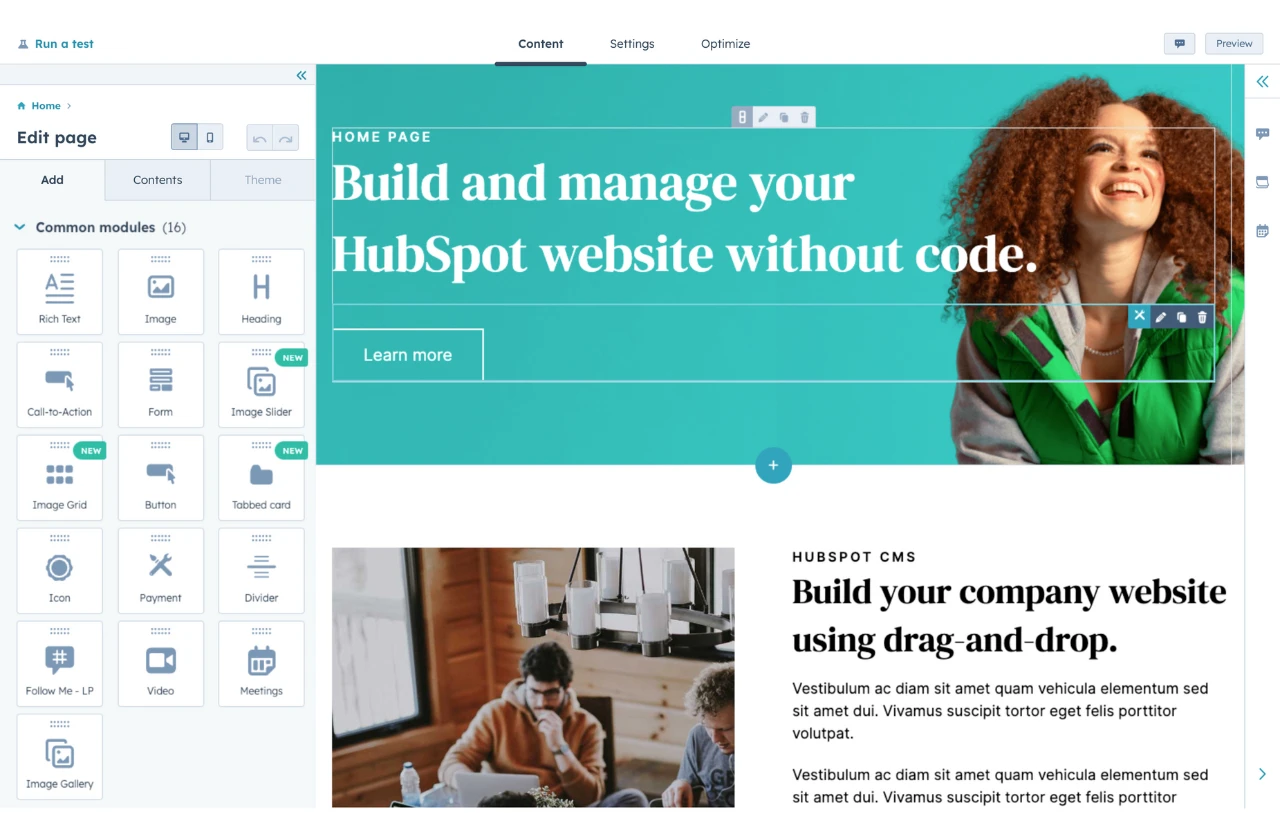
HubSpot's Free Website Builder
Create and customize your own business website with an easy drag-and-drop website builder.
- Build a website without any coding skills.
- Pre-built themes and templates.
- Built-in marketing tools and features.
- And more!
Ecommerce Website Software: Features to Look For
Before comparing platforms, clarify what you’re evaluating. The features below separate an ecommerce platform built for launch from one built for long-term growth.
CRM Integration
Your ecommerce platform continuously generates customer data, including purchase history, browsing behavior, abandoned carts, and repeat visits.
At minimum, your ecommerce platform should sync customer profiles, order history, payment status, lifecycle stage, email activity, and support context with your CRM.
Without that, your teams are working with an incomplete view of the customer.
For example, your support team may provide slow support to a high-value customer, and the customer stops purchasing because of that experience. Your sales team may not see that a B2B customer abandoned a large cart.
This is where a CRM-first setup becomes powerful. HubSpot Smart CRM unifies customer data across marketing, sales, service, and commerce, which makes personalization, reporting, and automation easier to manage from a single customer record.

Marketing Automation
Once your store is live, customer engagement doesn’t manage itself. Without automation, ecommerce marketing gets harder to manage as order volume grows.
You need welcome emails, abandoned cart messages, post-purchase follow-ups, win-back campaigns, product recommendations, review requests, loyalty offers, and seasonal promotions.
You need to know whether a customer views a product three times but doesn’t buy, or a repeat customer reaches a loyalty threshold, or whether a buyer should be introduced to a related product.
Managing all of that manually is a fast way to burn out your team.
Good ecommerce website solutions should connect with marketing automation tools so you can trigger campaigns based on real customer behavior.
Marketing Hub supports these workflows through email automation, lead scoring, and journey orchestration, all powered by CRM data.
Payments, Quotes, Invoices, and Subscriptions
Most ecommerce platform comparisons talk about checkout. Fewer people talk about what happens after checkout.
- Can the platform support one-time and recurring payments?
- Can quotes, invoices, and subscriptions connect to customer records?
- Can revenue reports show which campaigns or customers influenced payment activity?
Payments, subscriptions, invoices, and quotes affect forecasting, reporting, renewals, and customer experience. If those systems are disconnected from your CRM, you can process transactions but still struggle to understand revenue.
For B2C businesses, payment processing is a basic requirement. For B2B ecommerce, or any business offering subscriptions, bundles, or installment plans, this gets considerably more complex.
For example, Revenue Hub — formerly Revenue Hub — supports quotes, contracts, billing, payments, subscriptions, invoices, and revenue reporting, helping you keep critical commerce data connected to your CRM.
Not every ecommerce business needs advanced billing and quote workflows. But every growing business should evaluate how payment and subscription data connect to customer records and revenue reporting.
Customer Service and Post-Purchase Support
A strong ecommerce setup should connect support tickets, live chat, help desk tools, knowledge base content, and customer history. Service Hub can help teams manage post-purchase support from the same customer record, so agents can see what someone bought, what issue they reported, and what follow-up they need.
Post-purchase is where many customer relationships are won or lost. Strong customer relationships in ecommerce depend on fast, informed support after the sale.
This also matters for retention. A customer who receives fast, informed help with a delivery issue is easier to win back than one who has to explain the same problem three times.
Reporting and Revenue Attribution
A growing ecommerce business needs to know which campaigns, channels, products, landing pages, and customer segments are driving revenue. That requires more than page views and conversion rates.
- Which products are driving revenue?
- Which campaigns are converting?
- Which customer segments are most valuable?
When your ecommerce platform, CRM, payment system, marketing automation, and service tools stay connected, reporting gets easier. When they stay disconnected, your team spends more time exporting, cleaning, and debating data than acting on it.
AI and Personalization
AI is now part of most ecommerce website software in some form. The important question is not whether a platform has AI, but rather where the AI sits in the workflow. The most practical applications right now are product recommendations, dynamic content personalization, and support automation.
Using AI gets better when it has the right context. A generic AI writing tool can help you draft copy. AI connected to customer, product, order, and support data can help you personalize experiences more intelligently.
Platforms vary significantly in how deeply they embed AI into the workflow. Breeze, HubSpot’s AI, can support ecommerce teams with AI-assisted workflows across marketing, sales, service, and commerce when those teams share customer context.
Website Templates and Content Management
Templates are the most flexible option. A team can launch and update an ecommerce site without calling a developer every time. Your ecommerce solution should make it easy to create and manage content alongside products.
Templates can help you launch faster if you don’t have developers available for every change. Here are some of the top website ecommerce templates that can help you speed up your ecommerce development.
Integration Flexibility, Including Headless or Modular Options
Some businesses need an all-in-one ecommerce platform. Others need a more modular architecture that connects different systems across the ecommerce stack.
For example, a fast-growing brand might want Shopify for the storefront, HubSpot for CRM and marketing automation, Recharge for subscriptions, Gorgias or Service Hub for support, and a warehouse management system for fulfillment.
If your business has custom requirements, such as a proprietary inventory system, a specific ERP, or a custom checkout flow, evaluate the available API access before choosing a platform. Headless commerce may make sense when you need to separate the frontend experience from backend commerce operations.
Best Ecommerce Website Platforms
The best ecommerce website platform depends on how you plan to grow. Some tools are best for fast storefront launches. Others are better for B2B sales, complex catalogs, subscriptions, or CRM-first operations. The table below compares the options by the features that matter most for scalable ecommerce.
1. Revenue Hub + HubSpot Smart CRM

HubSpot is not a traditional ecommerce storefront platform in the same way Shopify, WooCommerce, or BigCommerce are. Instead, HubSpot helps businesses connect commerce activity to the rest of the customer journey. That matters when your storefront, CRM, marketing automation, service tools, payments, subscriptions, quotes, invoices, and reporting all need to work from the same customer data.
Revenue Hub and HubSpot Smart CRM give ecommerce teams a connected system for customer and commerce data. A marketing manager, support rep, and sales manager can work from the same customer record instead of piecing together updates from separate tools.
For example, say you sell products online and also offer sales-assisted purchases, subscriptions, quotes, invoices, onboarding, renewals, and support. In that case, you do not only need a cart. You need a system that shows how commerce activity connects to marketing, sales, and service.

If you just need a shopping cart, there are faster ecommerce software options. Still, if you need a storefront that connects marketing activity, support history, and revenue reporting without separate data pipelines, HubSpot is worth a serious look.
HubSpot positions Revenue Hub around CPQ, billing, and payments, with tools for AI-powered quotes, integrated billing, embedded payments, approval workflows, and quote analytics.

Key Features
- HubSpot Smart CRM: HubSpot Smart CRM unifies customer data across marketing, sales, service, and commerce so that teams can work from the same customer record.
- Revenue Hub: Supports quotes, contracts, billing, payments, subscriptions, invoices, and revenue reporting.
- Marketing Hub: Marketing Hub helps ecommerce teams automate campaigns based on real customer behavior, including abandoned carts, post-purchase follow-ups, and win-back campaigns.
- Service Hub: Service Hub helps teams connect post-purchase support, tickets, and customer history to the broader ecommerce relationship.
- Breeze: Breeze, HubSpot’s AI, helps teams use shared customer context for AI-assisted workflows across marketing, sales, service, and commerce.
Best for: Growing businesses that want ecommerce, CRM, marketing, sales, service, payments, automation, and reporting connected around the same customer data.
Pricing: Revenue Hub includes free tools for invoices, payment links, and subscriptions. Revenue Hub Professional starts at $95/seat/month and includes tools for quotes, contracts, billing, payments, and revenue reporting.
What we like: HubSpot’s biggest advantage is that it treats commerce as part of the customer journey, not as a separate transaction layer. That matters when your marketing, sales, service, and payment data all need to point back to the same customer record.
Pro tip: If you already use Shopify, WooCommerce, or another storefront, don’t evaluate HubSpot as only a “store builder.” Evaluate it as the CRM, automation, service, and commerce layer that can sit around your storefront and keep your customer data connected.
2. Shopify

Shopify is one of the most useful ecommerce platforms for businesses that want to grow without having to rebuild their store every few years. It’s simple to set up, has a highly polished admin panel, supports a massive app marketplace, and is suitable for small to large businesses.
Shopify gives businesses an online shopfront, the ability to manage products, checkout, payments, shipping, inventory, analytics, apps, point-of-sale (POS), and sell across multiple channels. Shopify Plus offers more advanced controls and enterprise-level features for larger brands that handle more work.

Shopify also offers native B2B features in the Shopify admin and the online store. Businesses can sell B2B and D2C from a single store or create a dedicated B2B store, making Shopify more scalable than a simple small-business website builder.
Shopify is excellent as a storefront and commerce engine. Where it usually needs help is CRM depth, advanced marketing automation, and service visibility across the full customer journey.
I’d choose Shopify when storefront performance, checkout reliability, the app ecosystem, and fast product selling matter most. If your business needs deeper CRM, service, and revenue operations in the same system, plan the integration before you launch.
Key Features
- Checkout: Shopify has one of the strongest checkouts in ecommerce with Shop Pay. On Shopify Plus, you can customize checkout with extensions, but the core checkout stays Shopify’s.
- Shopify payments: Easy to receive payments and tightly integrated with the platform. But the fees still apply, and third-party payment processor fees can still add extra cost.
- App ecosystem: Shopify’s app marketplace is one of its biggest advantages. You can add almost anything without building from scratch, using over 16,000 apps from the App Store.
Best for: Direct-to-consumer (D2C) brands, high-volume retailers, and product-focused businesses that prioritize storefront performance and checkout conversion above all else.
Pricing: Shopify Basic starts at $29/month when billed annually. Shopify charges third-party transaction fees when you use a third-party payment processor, and those fees vary by plan.
What we like: Shopify’s biggest strength is operational reliability. Its hosted infrastructure, checkout, app ecosystem, and Shop Pay make it a strong option for businesses that need to sell quickly without managing their own ecommerce infrastructure.
Pro tip: If you use Shopify and want to integrate a smart CRM, you can use the HubSpot integration to sync contacts, orders, and abandoned carts into HubSpot’s Smart CRM in real time. This gives you a better foundation for building healthy customer relationships beyond the Shopify storefront.
HubSpot's Free Website Builder
Create and customize your own business website with an easy drag-and-drop website builder.
- Build a website without any coding skills.
- Pre-built themes and templates.
- Built-in marketing tools and features.
- And more!
3. WooCommerce

WooCommerce is the natural choice if you want to run your ecommerce store on the open-source WordPress CMS with ecommerce built into its ecosystem. It’s the right tool for content-led commerce, allowing you to focus heavily on SEO, content, tutorials, and product education.
WooCommerce gives you more control and flexibility than many hosted platforms. But that flexibility comes with more responsibility. The software is free and open source, but businesses still need to budget for hosting, paid extensions, development, maintenance, and payment processing.
Key Features
- Open source and full ownership: WooCommerce gives businesses control over their WordPress ecommerce setup, including hosting, extensions, and checkout configuration.
- WordPress content integration: WooCommerce works well for businesses that want ecommerce and content management in the same WordPress environment.
- Extension flexibility: WooCommerce supports a large ecosystem of extensions for payments, subscriptions, shipping, tax, analytics, and CRM integrations.
Best for: WordPress businesses that want open-source control and flexibility.
Pricing: Installing WooCommerce is free, but you should budget for hosting, premium plugins, extension security, backups, and possibly developer support.
What we like: WooCommerce’s biggest advantage is that it lives inside WordPress. Teams can manage content and products in a single environment, making it useful for businesses that rely heavily on content, SEO, and flexible site management.
I’d choose WooCommerce when the business is already built around WordPress, and content is a major part of the sales engine, particularly organic growth focused on SEO, tutorials, comparison pages, and product education to reach and engage buyers.
Pro tip: Document your plugin stack carefully. The more flexible WooCommerce becomes, the more you need to know where order data, subscription data, email consent, and support history live. WordPress flexibility works best when someone owns plugin maintenance, security, and data quality.
4. BigCommerce

BigCommerce is an ecommerce platform that offers more serious commerce capabilities than a simple website builder can offer. It is often considered by brands that want scalability, multi-channel selling, stronger catalog management, and more native ecommerce features.
Key Features
- Open SaaS architecture: BigCommerce gives businesses hosted ecommerce infrastructure with flexible APIs, multi-storefront support, and room for more complex integrations.
- B2B features: BigCommerce supports B2B ecommerce needs such as customer groups, price lists, quotes, and account-based buying workflows.
- Payment flexibility: BigCommerce does not charge additional platform transaction fees for embedded payment providers, though open payment provider fees can apply depending on the plan and payment provider.
Best for: Growing ecommerce businesses that want robust built-in commerce features without having to manage WordPress.
Pricing: BigCommerce’s official pricing page lists Core at $29/month, Growth at $79/month, Scale at $299/month, and custom pricing for Performance starting at $1,499/month when billed annually.
What we like: BigCommerce treats complex selling as a core use case, which matters for ecommerce businesses that sell through B2B, B2C, wholesale, or multi-storefront models.
I’d choose BigCommerce when the business needs stronger native ecommerce features, B2B tools, multi-storefront support, and open APIs, but doesn’t want to deal with the complexity and cost of a large-scale ecommerce platform like Adobe Commerce.
Pro tip: BigCommerce’s open APIs make it a good option for headless commerce. If you need a custom frontend, review BigCommerce before moving to a more complex enterprise platform.
5. Adobe Commerce (Magento)

Adobe Commerce is built for complex ecommerce. It runs on the Magento core and is now positioned as a flexible, AI-powered ecommerce platform serving both B2B and B2C brands. It can scale with complex catalogs, custom workflows, and enterprise requirements, but that flexibility usually depends on budget, implementation resources, and technical support.
Its biggest strength is handling requirements that simpler platforms struggle with, such as huge product catalogs, multi-warehouse inventory, complex pricing, and advanced B2B workflows.
It’s best for large merchants with strong engineering resources and needs that standard SaaS platforms cannot easily support.
Key Features
- B2B and B2C in a single license: Adobe Commerce natively supports both B2B and B2C, helping businesses avoid managing two separate systems.
- Catalog and inventory scale: Adobe Commerce supports large catalogs, high SKU counts, multi-warehouse inventory, and advanced B2B workflows.
- Deep customization: Adobe Commerce gives technical teams more control over complex ecommerce requirements, but excessive customization can make upgrades more difficult.
Best for: Enterprise ecommerce businesses with complex catalogs, global operations, B2B/B2C needs, and deep customization requirements.
Pricing: Adobe Commerce uses custom pricing. Businesses need to contact Adobe for a quote. Magento Open Source is free to download, but hosting, development, maintenance, and extensions still add cost.
What we like: Adobe Commerce is useful when you can’t meet your precise ecommerce needs with traditional ecommerce website solutions. If a business needs complex functionality such as multi-warehouse inventory, advanced B2B pricing, and deep ERP integrations, Adobe Commerce can handle it natively.
Pro tip: Don’t choose Adobe Commerce just to look enterprise-ready. Choose it when your ecommerce operation needs complex catalogs, regional stores, custom workflows, and global scale. Otherwise, the cost and implementation work can slow you down.
6. Wix Ecommerce

Wix Ecommerce is a practical option for small businesses that want a managed storefront without hiring developers. It includes product listings, checkout, Wix Payments, abandoned cart recovery, templates, and basic marketing tools.
Key Features
- Website builder: Wix offers small businesses templates, hosting, product pages, and checkout in a single managed website builder.
- Payments: Wix supports online payments through Wix Payments and third-party payment providers, depending on region and setup.
- Built-in business tools: Wix includes tools for product management, basic marketing, analytics, and customer communication.
Best for: Small businesses and one-person operations that need an easy-to-set-up, fully managed ecommerce solution.
Pricing: Wix ecommerce plans start at $29/month when billed annually. Higher-tier plans add more advanced ecommerce, marketing, and business features.
What we like: Wix makes it simple to build a presentable store, publish products, and start selling without a long setup process.
Pro tip: Wix works best for simple ecommerce use cases such as small catalogs, services, digital products, bookings, and appointment-based offers. If you expect complex CRM, support, or subscription workflows, plan your integrations early.
7. Squarespace Commerce

Squarespace Commerce is known for polished templates and a smooth website-building experience. It works well for businesses that want a beautiful website with simple commerce attached. It’s particularly useful for businesses that sell a limited number of products, digital goods, services, appointments, or memberships.
Key Features
- Storefront and product management: Squarespace Commerce offers polished templates, product pages, checkout, and simple selling tools.
- Marketing and customer data: Squarespace includes basic marketing tools and can integrate with CRM platforms, but it does not offer deep CRM-first functionality on its own.
- Payments and recurring revenue: Squarespace supports payments and some recurring revenue use cases, but complex quoting, invoicing, and support workflows usually require external tools.
Best for: Creative businesses, designers, photographers, and artisan makers with small product catalogs and a strong emphasis on visual presentation.
Pricing: Squarespace offers four pricing tiers: Basic at $16/month, Core at $23/month, Plus at $39/month, and Advanced at $99/month when billed annually. All paid Squarespace plans support selling products and services, but the Advanced tier includes the strongest ecommerce features.
What we like: Squarespace stands out for visual presentation. Its templates make it a strong option for brands where the storefront experience is part of what customers are buying.
I’d choose Squarespace when design quality, content presentation, and ease of use matter more than operational depth. It works best for creative businesses that need a polished storefront without a complex ecommerce stack.
Pro tip: Squarespace is the best starting point for rapid deployment. If subscriptions, repeat purchases, or advanced customer segmentation become central to your model, plan for integrations or a future migration.
How to Create a Website to Sell Products Without Creating Silos
There are two common ways to launch or replatform an ecommerce website.
Path 1: Fast launch with hosted tools.
This faster setup involves building your ecommerce website with platforms such as Shopify, BigCommerce, Wix, Squarespace, or Webflow. You get hosting, templates, checkout, product management, and the basic ecommerce features you need without building everything from scratch.
Pick a hosted SaaS platform if you need a clean store, working checkout, product pages, and standard reporting quickly.
This path makes sense when speed matters more than customization. It works best when you’re validating product-market fit, selling a limited catalog, testing a new market, or operating without dedicated developers.
The risk is that “launch fast” often means “create technical debt.” A storefront that doesn’t connect to a CRM from day one will need a retroactive integration later — and retroactive integrations are harder, messier, and more expensive than building the connection at the start.
Path 2: Use a CRM-first architecture.
If long-term growth is the goal, start with the customer data model before choosing the storefront.
Before choosing a storefront, decide where your customer data will be stored. If you already use HubSpot for marketing or sales, your ecommerce platform should sync customers and order data into the same CRM.
If you’re starting from scratch, a platform that connects commerce, marketing, and service data natively — like HubSpot — can reduce the number of integrations you need to build and maintain.
This approach takes more time to set up up front, but protects you from the bottleneck that shows up six months after launch, such as customer, order, and support data spread across four systems, none of which has a complete picture.

1. Map your customer journey.
Before choosing a platform, map the entire customer journey. Start from the first website visit, product discovery, email signup, first purchase, payment confirmation, delivery, support, repeat purchases, renewals, referrals, and reviews. This map serves as your list of integration requirements.
2. Decide what data must sync.
Next, decide where each important data point will live, such as your contacts, companies, product views, cart activity, orders, payments, invoices, subscriptions, refunds, support tickets, email consent, campaign attribution, and customer lifetime value.
For each one, identify two things:
- Which system owns the data
- Which systems need a copy of that data
If you cannot clearly answer that, your stack is not ready yet. This step helps you design clean integrations instead of inheriting a messy setup later.
3. Choose your storefront and CRM architecture together.
Decide whether your storefront or CRM will be the main source of customer truth. In many ecommerce businesses, the storefront handles catalog and checkout, while the CRM manages customer relationships. That division can work well if the sync is planned.
For example, HubSpot Smart CRM can unify customer data across marketing, sales, service, and commerce. If you pair that with a storefront platform, you can keep commerce activity connected to the broader customer journey.
If you’re using separate tools, map the integration before you launch. You can use ecommerce automation planning to identify where manual work will accumulate if you don’t automate.
4. Test payments and subscriptions before go-live.
Run your complete payment and subscription flow in a test environment before you take orders. Checkout failures and subscription billing errors are the most operationally damaging problems in ecommerce, and they’re almost always preventable with proper ecommerce website testing.
5. Build automation before you need it.
Build automation around actual customer behavior. Abandoned cart sequences, post-purchase emails, and win-back campaigns are easier to set up before your order volume grows. Each workflow should connect to an event in the customer journey you already mapped, so the data sync needs to come first. Configure these workflows early.
6. Pilot integrations before full migration.
Before you migrate anything, run a pilot to prove the system works, because a small test now can save you from a painful replatform later. If you’re adding a new CRM, marketing platform, or service desk, run a parallel test with a subset of customers before migrating your full database. Errors at the migration scale are expensive and slow to fix.
7. Plan customer, order, and catalog data migration carefully.
Map every data field to its destination in the new platform. Run a test migration, validate the output against your source data, and give yourself time for manual cleanup before your go-live date. If your team is exploring ecommerce website templates and storefront design, choose the visual layer after you decide the data architecture.
Frequently Asked Questions About Ecommerce Website Solutions
When should I choose a hosted vs. headless architecture for my ecommerce site?
Choose hosted ecommerce if you want to launch faster without managing hosting, security, and core platform maintenance. Shopify, BigCommerce, Wix, and Squarespace are examples of hosted platforms.
Choose headless ecommerce if you need custom frontend experiences, stronger performance control, multiple storefronts, or a modular architecture that your team can maintain. Headless is powerful, but it adds technical complexity and is not necessary for every growing ecommerce business.
How do I ensure my ecommerce platform and CRM stay in sync?
Start by deciding which system owns each type of data. For example, your ecommerce platform may own product catalog and checkout data, while your CRM owns customer profiles, lifecycle stages, marketing consent, sales activity, and service history.
Then set the sync rules. Choose the events that should update the CRM, such as purchases, refunds, subscription changes, abandoned carts, quote requests, and support tickets. Before going live, make sure your marketing, sales, customer service, and reporting teams share the same view of the customer.
What is the safest way to migrate customer and order data?
The safest way is to plan migration in stages. First, audit your current data. Then clean duplicate, outdated, or incomplete records. Next, map old fields to new fields so customer, order, catalog, payment, and subscription data have a clear destination.
After that, perform a test migration on a small dataset. Check that all customer records, order history, SKUs, images, prices, URLs, and consent fields have been moved correctly.
How do payments and subscriptions affect my reporting?
Payments and subscriptions affect revenue attribution, forecasting, retention analysis, lifecycle reporting, and customer segmentation. When payment and subscription data are tied to your CRM, you can see which campaigns, products, segments, and sales activities drive revenue. You can also trigger workflows for failed payments, renewals, cancellations, upgrades, and high-value customers.
Can I pilot an integration before a full replatform?
Yes, and you should whenever possible. A small pilot is much cheaper than discovering after launch that your customer data, order history, or subscription logic is broken.
A pilot helps you test whether your storefront, CRM, marketing automation, payment systems, and service tools work together. Select one product category, customer segment, or workflow. Then check whether data syncs correctly, automations run properly, and reports show the right numbers.
Choose the ecommerce solution that protects your growth.
The best ecommerce website solution does more than help you launch a store quickly. It keeps your customer, commerce, marketing, sales, service, payment, and support data connected as the business grows.
A beautiful storefront matters. A smooth checkout matters. But if every team is working from a different version of the customer, growth gets harder than it needs to be.
If your ecommerce strategy depends on connected customer data, HubSpot is worth considering as the CRM and revenue layer around your storefront. Revenue Hub, HubSpot Smart CRM, Marketing Hub, Service Hub, and Breeze work best when they share the same customer record.
HubSpot's Free Website Builder
Create and customize your own business website with an easy drag-and-drop website builder.
- Build a website without any coding skills.
- Pre-built themes and templates.
- Built-in marketing tools and features.
- And more!
Website Design