.jpg)
In 2024, there were an estimated 5.5 billion internet users globally, underscoring the need for a strong digital presence. With that in mind, I'm here to discuss all things digital marketing, backed by data from our 2025 State of Marketing Report that surveyed 1700+ marketers. Keep reading to learn more.
Table of Contents
What is digital marketing?
Digital marketing, also called online marketing, refers to all marketing efforts that occur on the internet. Businesses leverage digital channels such as search engines, social media, email, and other websites to connect with current and prospective customers. This also includes communication through text or multimedia messages.
How does a business define digital marketing?
Digital marketing is vital for your business and brand awareness. It seems like every other brand has a website, and if they don't, they at least have a social media presence or digital ad strategy.
Overall, digital marketing is defined as using numerous digital tactics and channels to connect with customers where they spend much of their time: online.
Digital Marketing For Small Business
Everything you need to know to get started with digital marketing. You'll learn about:
- SEO
- Content Marketing
- Marketing Analytics
- And More!
Download Free
All fields are required.
The best digital marketers have a clear picture of how each digital marketing campaign supports their overarching goals.
Depending on the goals of their marketing strategy, marketers can support a larger campaign through the free and paid channels they have available.
A content marketer, for example, could create a series of blog posts that generate leads from an ebook.
A social media marketer might help promote those blogs through paid and organic posts on the business's social media accounts, and the email marketer could create an email campaign to send those who download the ebook more information on the company.
Our 2025 State of Marketing Report found that the top five marketing channels that resulted in the biggest ROI in 2024 involved digital marketing. They are:
- Email marketing.
- Paid social media content.
- Social media shopping tools (e.g., Instagram shops).
- Website/blog/SEO.
- Content marketing.
Why is digital marketing important?
Digital marketing helps you reach a larger audience than you could through traditional methods and target the prospects who are most likely to buy your product or service. Additionally, it's often more cost-effective than traditional advertising and enables you to measure success on a daily basis and pivot as you see fit.
There are a few major benefits of digital marketing:
1. You can focus your efforts on only the prospects most likely to purchase your product or service.
Digital marketing allows you to identify and target a highly specific audience with personalized and high-converting marketing messages.
For instance, you might use social media targeting to show ads to a certain audience based on variables like age, gender, location, interests, networks, or behaviors.
Alternatively, you might use PPC or SEO strategies to serve ads to users who've shown interest in or searched for specific keywords related to your product, service, or industry.
Ultimately, digital marketing helps you conduct the research necessary to identify your buyer personas and refine your strategy to ensure you’re reaching prospects most likely to buy.
2. It's more cost-effective than outbound marketing methods.
Digital marketing helps you track campaign performance day to day, so you know which channels are performing well and which aren’t. This information helps you optimize your campaign budgets for high ROI.
A digital marketing strategy allows you to pivot continuously, ensuring you never waste money on channels that don't perform well.
For instance, if you work for a small business with a limited budget, you might try investing in social media, blogging, or SEO — three strategies that can give you high ROI even with minimal spending.
3. Online marketing evens the playing field within your industry and allows you to compete with bigger brands.
If you work for a small business, it's likely difficult for you to compete with the major brands in your industry, many of which have millions of dollars to invest in campaigns.
Fortunately, there are plenty of opportunities to outrank the big players through strategic digital marketing initiatives.
For instance, you might use long-tail keywords to create high-quality content that ranks on search engines. Search engines don’t care which brand is the biggest, but they do care about prioritizing content that resonates best with target audiences.
Adilo, an online video hosting platform competing against established brands in the space, understood the potential of focusing on search.
“We knew that trying to compete head-on with paid strategies like TV commercials, PPC, and print media would be a disaster, so we went all-in on content marketing … We also invested heavily in creating original and linkable articles to gain exposure and earned media,” says Felix Johnson, Senior SEO and Content Strategist at Adilo.
Today, Johnson notes that over 95% of new signups come from Google Search.
4. Digital marketing is measurable.
One of the biggest benefits of digital marketing is that it gives a start-to-finish view of all the metrics that matter to your company — including impressions, shares, views, clicks, and time on the page.
Unlike most offline marketing efforts, digital marketing allows marketers to see accurate results in real time.
If you‘ve ever put an advertisement in a newspaper, you’ll know how difficult it is to estimate how many people flipped to that page and paid attention to it. There's no surefire way to know if that ad was responsible for any sales at all.
On the other hand, with digital marketing, you can measure the ROI of pretty much any aspect of your marketing efforts.
Here are some examples:
Website Traffic
With digital marketing, you can see the exact number of people who have viewed your website's homepage in real time by using digital analytics software available in marketing platforms like HubSpot.
You can also see how many pages they visited, what device they were using, and where they came from, amongst other digital analytics data.
This intelligence helps you prioritize which marketing channels to spend more or less time on based on the number of people those channels drive to your website.
With digital marketing, you can identify trends and patterns in people‘s behavior before they’ve reached the final stage in their buyer's journey, meaning you can make more informed decisions about how to attract them to your website right at the top of the marketing funnel.
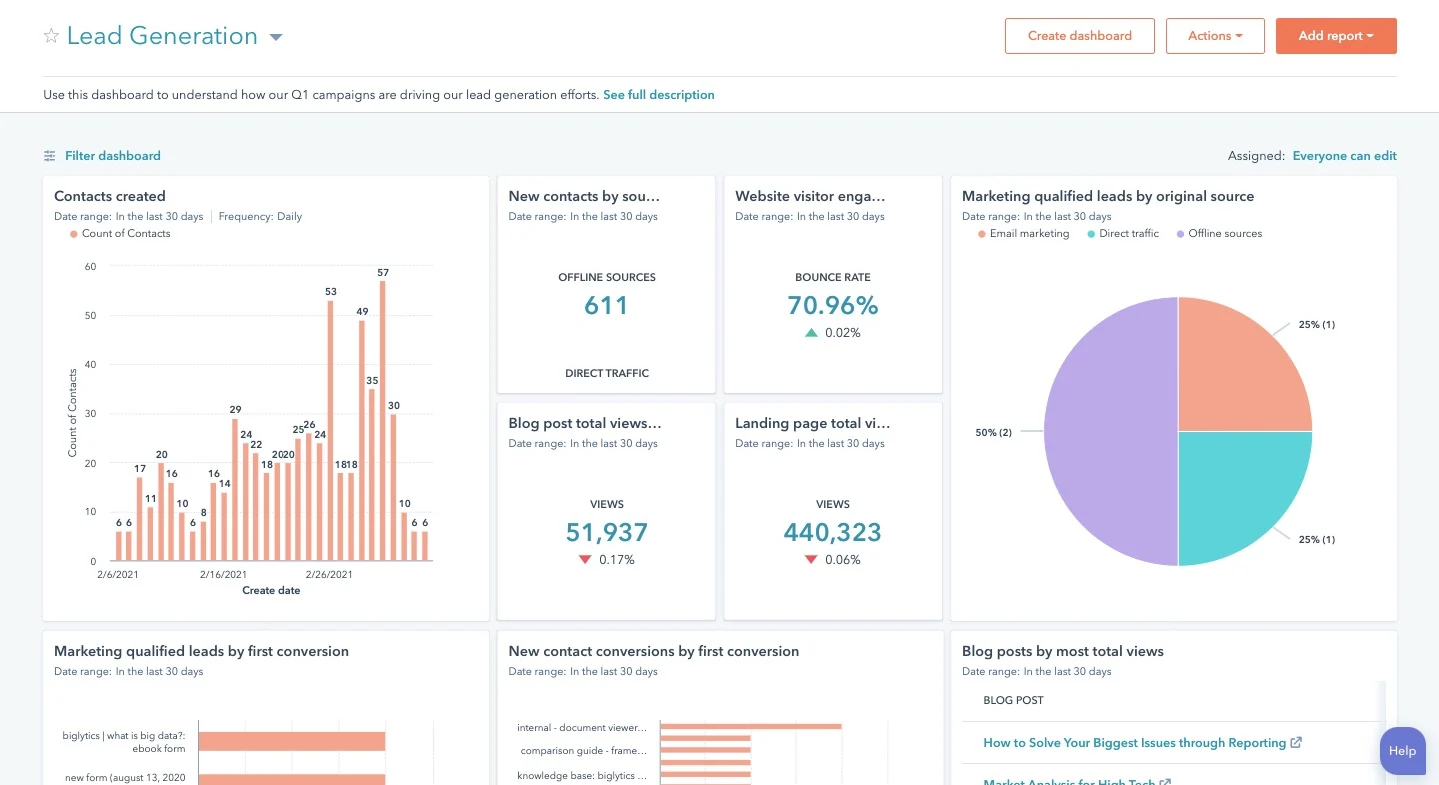
HubSpot Marketing Analytics Software
Measure the performance of all your marketing campaigns in one place with built-in analytics, reports, and dashboards.
- Marketing Analytics
- Dashboard Software
- Website KPIs
- And More!
Content Performance and Lead Generation
Imagine you‘ve created a product brochure and posted it through people’s letterboxes — that brochure is a form of offline content. Unfortunately, you have no idea how many people opened your brochure or threw it straight into the trash.
If you have that brochure on your website, you can measure how many people viewed the page it’s on, and you can use a form to collect the contact information of those who downloaded it.
It’s twofold: you measure how many people engage with your content and generate qualified leads when people download it.
Attribution Modeling
An effective digital marketing strategy combined with the right tools and technologies allows you to trace all of your sales back to a customer's first digital touchpoint with your business.
We call this attribution modeling.
It allows you to identify trends in the way people research and buy your product, helping you to make more informed decisions about which parts of your marketing strategy deserve more attention and which parts of your sales cycle need refining.
5. It’s easier to adapt and change an online marketing strategy.
A great benefit of digital marketing is the ease with which you can change your strategy. Adapting a digital marketing strategy is much easier than other, more traditional forms of marketing, like mailers or billboard advertising.
For instance, if an online ad isn’t delivering as expected, you can quickly adjust it or pause it to yield better results.
6. Online marketing can improve your conversion rate and the quality of your leads.
As digital marketing makes it simpler to measure your marketing efforts, improving your conversion rate becomes simpler as well. Being able to measure the effectiveness of each tactic helps you develop better strategies.
Continuously refining your methods improves your conversion rate. Investing in online marketing ensures that everything is optimized for the highest amount of conversions.
Additionally, not all leads offer the same value for your business. Digital marketing allows you to target a specific audience, which will yield higher-quality leads that are more likely to become customers.
Connecting your business with the most valuable leads will directly improve your conversion rate.
7. You can engage audiences at every stage with digital marketing.
Engaging your audience as early as possible is essential. Making a connection at the first stage of the buyer’s journey helps push the lead through the customer funnel.
Using digital marketing allows you to accomplish that from start to finish and at every point in between.
Online channels allow you to follow your customers' entire buying journey. Understanding and analyzing how customers operate is important for converting leads.
Digital marketing allows you to track them through that process. And, even if they don’t convert in the early stages, it at least helps ensure they have made a connection with your business.
Another way to connect with your customers is to ensure brand content resonates with customer values. Our survey revealed that 37.52% of marketers feel that one of the biggest ways the marketing industry changed in the past twelve months is focusing on the customer, and their experience with the brand became more important.
Additionally, one in five (21.19%) said that one of the top marketing trends they or their teammates are currently exploring is creating content that reflects brand values.
Richard White, content team lead at Omnisend, an ecommerce email marketing and SMS platform, says, “We’re absolutely aligning our content with our brand values because we believe that it’s the only way to make digital marketing work long-term.”
White says his team sticks stick to topics that actively help customers grow their businesses. Then, then listen for to see the response.
“Direct feedback, support conversations, social media — we track all of it to ensure we stay relevant and valuable to our customers,” White says.
Digital Marketing For Small Business
Everything you need to know to get started with digital marketing. You'll learn about:
- SEO
- Content Marketing
- Marketing Analytics
- And More!
Download Free
All fields are required.
Types of Digital Marketing
- Search Engine Optimization (SEO)
- Content Marketing
- Social Media Marketing
- Pay Per Click (PPC)
- Affiliate Marketing
- Native Advertising
- Marketing Automation
- Email Marketing
- Online PR
- Inbound Marketing
- Sponsored Content
- Influencer Marketing
- Search Engine Marketing (SEM)
- Instant Messaging Marketing
Here's a quick rundown of some of the most common digital marketing tactics and the channels involved in each one.
1. Search Engine Optimization (SEO)
This is the process of optimizing your website to “rank” higher in search engine results pages, thereby increasing the amount of organic (or free) traffic your website receives.
The channels that benefit from SEO include websites, blogs, and infographics.
There are a number of ways to approach SEO in order to generate qualified traffic to your website. These include the following.
On-Page SEO
This type of SEO focuses on all of the content that exists “on the page” when looking at a website. By researching keywords for their search volume and intent (or meaning), you can answer questions for readers and rank higher on the search engine results pages (SERPs) those questions produce.
Off-Page SEO
This type of SEO focuses on all of the activity that takes place “off the page” when looking to optimize your website. “What activity not on my own website could affect my ranking?” You might ask. The answer is inbound links, also known as backlinks.
The number of publishers that link to you, and the relative “authority” of those publishers, affects how highly you rank for the keywords you care about. By networking with other publishers, writing guest posts on these websites, and generating external attention, you can earn the backlinks you need to move your website up on all the right SERPs.
Technical SEO
This type of SEO focuses on the backend of your website, and how your pages are coded. Image compression, structured data, and CSS file optimization are all forms of technical SEO that can increase your website's loading speed — an important ranking factor in the eyes of search engines like Google.
For a real-life example on how to successfully implement SEO into your digital marketing strategy, check out our case study on Canva here:
2. Content Marketing
This term denotes the creation and promotion of content assets for the purpose of generating brand awareness, traffic growth, lead generation, and customers.
Want to learn and apply content marketing to your business? Check out HubSpot Academy's free content marketing training resource page.
The channels that can play a part in your content marketing strategy include:
- Blog posts. Publishing articles on a company blog helps you demonstrate your industry expertise and generates organic search traffic for your business. This ultimately gives you more opportunities to convert website visitors into leads for your sales team.
- Ebooks and whitepapers. Ebooks, whitepapers, and similar long-form content helps further educate website visitors. It also allows you to exchange content for a reader‘s contact information, generating leads for your company and moving people through the buyer’s journey.
- Infographics. Sometimes, readers want you to show, not tell. Infographics are a form of visual content that helps website visitors visualize a concept you want to help them learn.
- Audio or visual content. Television and radio are popular channels for digital marketing. Creating content that can be shared online as a video or heard on the radio by listeners can greatly broaden your potential audience.
Stumped? Download 150+ content creation templates by clicking below:
3. Social Media Marketing
This practice promotes your brand and your content on social media channels to increase brand awareness, drive traffic, and generate leads for your business.
If you're new to social platforms, you can use tools like HubSpot to connect channels like LinkedIn and Facebook in one place.
This way, you can easily schedule content for multiple channels at once and monitor analytics from the platform as well.
On top of connecting social accounts for posting purposes, you can also integrate your social media inboxes into HubSpot, so you can get your direct messages in one place.
The channels you can use in social media marketing include:
- X
- Snapchat
According to marketers, the social media channels that resulted in the biggest ROI in 2024 are Facebook followed by Instagram.
Another benefit of social media is the ability of a marketing campaign to go viral. Partnering with a popular content creator or participating in a trend that resonates with a wide audience is a viral marketing strategy.
The purpose is to create something share-worthy in the hopes that it will organically spread across a social media channel.
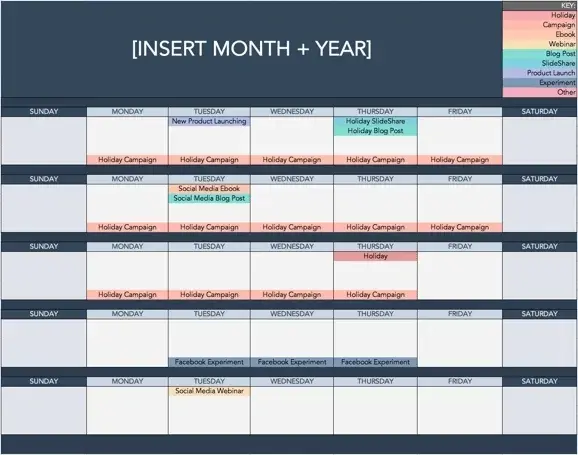
Don't know how to get started with social media marketing? Download our free social media content calendar to get your social strategy up and running.
4. Pay Per Click (PPC)
PPC drives traffic to your website by paying a publisher every time your ad is clicked.
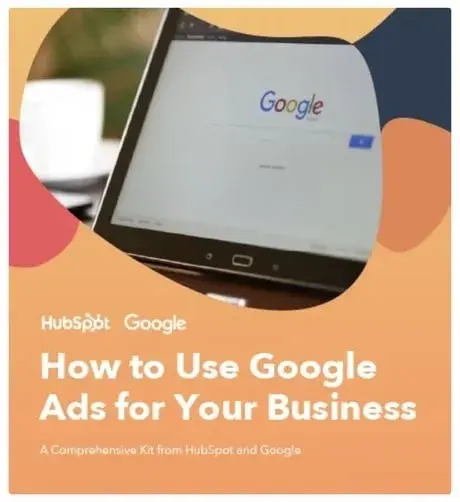
One of the most common types of PPC is Google Ads, which allows you to pay for top slots on Google's search engine results pages at a price “per click” of the links you place. Other channels where you can use PPC include:
- Paid ads on Facebook: Here, users can pay to customize a video, image post, or slideshow, which Facebook will publish to the news feeds of people who match your business's audience.
- X Ads campaigns: Here, users can pay to place a series of posts or profile badges on the news feeds of a specific audience, all dedicated to accomplishing a specific goal for your business. This goal can be website traffic, more X followers, tweet engagement, or even app downloads.
- Sponsored Messages on LinkedIn: Here, users can pay to send messages directly to specific LinkedIn users based on their industry and background.
PPC can be hard to grasp at first, so we've created a beginner-friendly guide to get you started. Download it below:
5. Affiliate Marketing
This is a type of performance-based advertising where you receive a commission for promoting someone else's products or services on your website. Affiliate marketing channels include:
- Hosting video ads through the YouTube Partner Program.
- Posting affiliate links from your social media accounts.
- Including affiliate links on your blog or website.
6. Native Advertising
Native advertising refers to advertisements that are primarily content-led and featured on a platform alongside other, non-paid content.
BuzzFeed-sponsored posts are a good example, but many people also consider social media advertising to be “native” — Facebook advertising and Instagram advertising, for example.
7. Marketing Automation
Marketing automation refers to the software that automates your basic marketing operations. Many marketing departments can automate repetitive tasks they would otherwise do manually, such as:
- Email newsletters. Email automation doesn't just allow you to automatically send emails to your subscribers. It can also help you shrink and expand your contact list as needed, so your newsletters are only going to the people who want to see them in their inboxes.
- Social media post scheduling. If you want to grow your organization's presence on a social network, you need to post frequently. This makes manual posting a bit of an unruly process. Social media scheduling tools push your content to your social media channels so you can spend more time focusing on content strategy.
- Lead-nurturing workflows. Generating leads, and converting those leads into customers, can be a long process.You can automate that process by sending leads specific emails and content once they fit certain criteria, such as when they download and open an ebook.
- Campaign tracking and reporting. Marketing campaigns can include a ton of different people, emails, content, web pages, phone calls, and more. Marketing automation can help you sort everything you work on by the campaign it's serving and then track the performance of that campaign based on the progress all of these components make over time.
8. Email Marketing
Companies use email marketing as a way of communicating with their audiences. Email is often used to promote content, discounts and events, as well as to direct people toward the business's website.
The types of emails you might send in an email marketing campaign include:
- Blog subscription newsletters.
- Follow-up emails to website visitors who downloaded something.
- Customer welcome emails.
- Holiday promotions to loyalty program members.
- Tips or similar series emails for customer nurturing.
Learn more about email marketing with our free guide:
9. Online PR
Online PR is the practice of securing earned online coverage with digital publications, blogs, and other content-based websites. It's much like traditional PR but in the online space.
The channels you can use to maximize your PR efforts include:
- Reporter outreach via social media. Talking to journalists on X, for example, is a great way to develop a relationship with the press that produces earned media opportunities for your company.
- Engaging online reviews of your company. When someone reviews your company online, whether that review is good or bad, your instinct might be not to touch it. On the contrary, engaging company reviews helps you humanize your brand and deliver powerful messaging that protects your reputation.
- Engaging comments on your personal website or blog. Similar to how you'd respond to reviews of your company, responding to the people reading your content is the best way to generate productive conversation around your industry.
If you don‘t have a dedicated PR team, it can be hard to get started. Luckily, we’ve got you covered. Download our free PR kit below:
10. Inbound Marketing
Inbound marketing refers to a marketing methodology wherein you attract, engage, and delight customers at every stage of the buyer's journey.
You can use every digital marketing tactic listed above throughout an inbound marketing strategy to create a customer experience that works with the customer, not against them.
Here are some classic examples of inbound marketing versus traditional marketing:
- Blogging vs. pop-up ads.
- Video marketing vs. commercial advertising.
- Email contact lists vs. email spam.
11. Sponsored Content
With sponsored content, you, as a brand, pay another company or entity to create and promote content that discusses your brand or service in some way.
One popular type of sponsored content is influencer marketing. Another type could be a blog post or article highlighting a topic, service, or brand.
12. Influencer Marketing
Influencer marketing falls under sponsored content, but with the exponential rise of content creators and influencers, I believe it deserves its own section.
Here, a brand sponsors an influencer in its industry to publish posts or videos related to the company on social media. According to marketers, Instagram and Facebook are the top two platforms delivering the highest ROI from influencers.
Another trend that appeared is the rise of the niche or small-scale influencer as a key channel. 44.88% of marketers say they saw the most success with micro influencers/content creators in 2024 i.e., those with 10,000-99,999 followers/subscribers.
The biggest benefits of working with influencers with a following count under 100k compared to those with higher? More trust with followers, access to niche and tight-knit communities, and lower costs.
Katerina Andreeva, head of talent relations at HypeFactory, a global influencer marketing agency, says, “While working with micro-influencers, we notice how perfectly imperfect and sincere the content they create is. They have the honesty that the modern audience is looking for among AI-generated content and deep fakes.”
She adds that micro-influencers cover niche topics that speak directly to often-overlooked audiences. This makes creators attractive to a narrow audience, creating a community of like-minded people around the influencer.
“Since the audience of micro-creators is engaged and loyal, the conversion rate of the brand's advertising message increases,” Andreeva says.
Finding the right content creators can take your digital campaign to the next level. Download our free guide below:
13. Search Engine Marketing (SEM)
When a potential lead is searching for a product or business related to yours, it’s a great opportunity for a promotion. Paid advertising and SEO are two great strategies for promoting your business and capitalizing on future leads.
Search engine marketing is another way to increase website traffic by placing paid ads on search engines. The two most popular SEM services are Bing Ads and Google Ads.
These paid ads fit seamlessly on the top of search engine results pages, giving instant visibility. This is also an example of effective native advertising.
14. Instant Messaging Marketing
Marketing your products through messaging platforms is a fast way to reach potential leads, even for those who haven’t offered up their cell phone number.
For example, you can send messages directly to a mobile phone via text or on platforms like Facebook Messenger or WhatsApp. It’s a simple way to let your audience know about flash sales, new products, or updates about their orders.
If your customers have questions or need more information, it’s also a convenient way for them to connect to customer service. You should also consider implementing live chat on your website here.
This way, first-time website visitors will have a quick and easy way to reach out in case they have any questions about your products or services, while you get to promptly offer the details necessary to solve the visitor’s query — details which may lead to an on-the-spot conversion.
What does a digital marketer do?
Digital marketers are in charge of driving brand awareness and lead generation through all the digital channels — both free and paid — that are at a company's disposal. These channels include social media, the company's own website, search engine rankings, email, display advertising, and the company's blog.
The digital marketer focuses on each channel‘s key performance indicators (KPIs) to properly measure performance. For example, a digital marketer in charge of SEO might measure their website’s organic traffic.
At small companies, one person might own many digital channels and tactics described above, while larger companies typically have a specialist focused on one or two brand channels.
Here are some examples of these specialists:
SEO Manager
Main KPIs: Organic traffic
SEO managers work to rank a business on Google SERPs.
Using various SEO strategies, this person might work directly with content creators to ensure the content is high-quality and up to Google’s standards, even if the company also posts this content on social media.
Content Marketing Specialist
Main KPIs: Time on page, overall blog traffic, YouTube channel subscribers
Content marketing specialists are digital content creators. They might keep track of a blogging calendar or develop a content strategy that includes video.
They often work with people in other departments to ensure products and campaigns are supported by promotional content on all digital channels.
Social Media Manager
Main KPIs: Follows, Impressions, Shares
A social media manager's role depends on each company and industry. Above all, social media managers manage social media by establishing a posting schedule for the company’s written and visual content.
They might also work with a content marketing specialist to develop a strategy for which content to share on social media.
(Note: Per the KPIs above, “impressions” refer to the number of times a business‘s posts appear on a user’s newsfeed.)
Interesting stat: Social media roles are sought after in marketing recruitment. The top three marketing roles expected tobe top priorities to hire in 2025 are content creator, social media coordinator, and social media strategist.
Marketing Automation Coordinator
Main KPIs: Email open rate, campaign click-through rate, lead-generation (conversion) rate
A marketing automation coordinator helps choose and manage the software a marketing team uses to understand customer behavior and measure business growth.
Many of the marketing operations described above might be executed separately, so it’s important for there to be someone who can group these activities into individual campaigns and track performance.
Inbound Marketing vs. Digital Marketing: Which Is It?
Inbound marketing is a methodology that uses digital marketing assets to attract, engage, and delight customers online.
Digital marketing, on the other hand, is simply an umbrella term to describe online marketing tactics of any kind, regardless of whether they're considered inbound or outbound.
Digital marketing is often compared to inbound marketing, but it doesn’t differentiate between ‘inbound’ and ‘outbound’ methods.
It’s more of an umbrella term for all marketing that involves digital communication, while inbound marketing is more of a strategy.
Digital outbound tactics put a marketing message in front of as many people as possible online — regardless of whether it's relevant or welcomed.
For example, the garish banner ads you see on websites that push a product or promotion to people who aren’t necessarily ready to receive it.
Marketers who employ digital inbound tactics use online content to attract their target customers by providing assets that are helpful to them.
One of the simplest yet most powerful inbound digital marketing assets is a blog, which allows your website to capitalize on the terms that your ideal customers are searching for.
.webp?)
Free Marketing Software
Easy marketing tools that deliver fast time-to-value, unified in one place.
- AI Tools
- Email Marketing
- Social Media Management
- And More!
Does online marketing work for all businesses?
Digital marketing can work for any business in any industry. Regardless of what your company sells, digital marketing still involves building buyer personas to identify your audience's needs, and creating valuable online content.
However, that's not to say all businesses should implement a digital marketing strategy in the same way.
B2B Digital Marketing
If your company is business-to-business (B2B), your digital marketing efforts are likely centered around online lead generation, with the end goal being for someone to speak to a salesperson.
The goal of your marketing strategy might be to attract and convert the highest quality leads for your salespeople via your website and to support digital channels.
Beyond your website, you'll probably choose to focus your efforts on business-focused channels like LinkedIn, where your demographic is spending their time online.
B2C Digital Marketing
If your company is business-to-consumer (B2C), depending on the price point of your products, it's likely that the goal of your digital marketing efforts is to attract people to your website and have them become customers without ever needing to speak to a salesperson.
You‘re probably less likely to focus on ‘leads’ in their traditional sense and more likely to build an accelerated buyer's journey from when someone lands on your website to when they make a purchase.
This can mean that your product features are higher up in the marketing funnel than it might be for a B2B business, and you might need to use stronger calls-to-action to inspire purchases.
For B2C companies, channels like Instagram and Pinterest are often more valuable than business-focused platforms like LinkedIn.
What types of digital content should I create?
The kind of content you create depends on your audience‘s needs at different stages in the buyer’s journey.
You should start by creating buyer personas (use these free templates, or try makemypersona.com) to identify what your audience's goals and challenges are in relation to your business.
On a basic level, your online content should aim to help them meet these goals and overcome their challenges.
Then, you‘ll need to consider when they’re most likely to be ready to consume this content in line with their stage in the buyer's journey. We call this content mapping.
With content mapping, the goal is to target content according to:
- The characteristics of the person who will be consuming it (that's where buyer personas come in).
- How close that person is to making a purchase (i.e., their lifecycle stage).
In terms of the format of your content, there are a lot of different things to try. Here are some options we‘d recommend using at each stage of the buyer’s journey:
Awareness Stage
- Blog posts. Your blog is great for increasing your organic traffic when paired with a strong SEO and keyword strategy. (You can plug your search terms into our blog topic generator to get content ideas and generate readily optimized outlines.)
- Infographics. These images are very shareable, meaning they increase your chances of being found via social media when others share your content. (Check out these free infographic templates to get you started.)
- Short videos. Again, these are very shareable and can help your brand get found by new audiences by hosting them on platforms like Instagram, Tik Tok, and YouTube. Short-form video is also the top media format marketers plan to invest the most in 2025.
Consideration Stage
- Ebooks. Great for lead generation as they're generally more comprehensive than a blog post or infographic, meaning someone is more likely to exchange their contact information to receive it.
- Research reports. Again, this high-value content type is great for lead generation. Research reports and new data for your industry can also work for the awareness stage, though, as they're often picked up by the media or industry press.
- Webinars. As they're a more detailed, interactive form of video content, webinars are an effective consideration stage content format as they offer more comprehensive content than a blog post or short video.
Decision Stage
- Case studies. Having detailed case studies on your website can be an effective form of content for those ready to make a purchasing decision, as it helps you positively influence their decision.
- Testimonials. If case studies aren‘t a good fit for your business, having short testimonials around your website is a good alternative. For B2C brands, think of testimonials a little more loosely. If you’re a clothing brand, these might take the form of photos of how other people styled a shirt or dress, pulled from a branded hashtag where people can contribute.
Interesting stat: Visual storytelling as a medium is gaining popularity. Marketers said that the media formats that yielded the biggest ROI in 2024 were short-form video, images, and live-streaming video (in that order).
How to Do Digital Marketing
- Define your goals.
- Identify your target audience.
- Establish a budget for each digital channel.
- Strike a good balance between paid and free digital strategies.
- Create engaging content.
- Optimize your digital assets for mobile.
- Conduct keyword research.
- Iterate based on the analytics you measure.
1. Define your goals.
When you get started with digital marketing, it's critical to identify and define your goals since you’ll craft your strategy with them.
For instance, if your goal is to increase brand awareness, you might want to focus on reaching new audiences via social media.
Or maybe you want to increase sales on a specific product — if that‘s the case, it’s more important you focus on SEO and optimizing content to get potential buyers on your website in the first place.
Additionally, if sales are your goal, you might test out PPC campaigns to drive traffic through paid ads.
Whatever the case, it's easiest to shape a digital marketing strategy after you‘ve determined your company’s biggest goals.
Digital Marketing For Small Business
Everything you need to know to get started with digital marketing. You'll learn about:
- SEO
- Content Marketing
- Marketing Analytics
- And More!
Download Free
All fields are required.
2. Identify your target audience.
We‘ve mentioned this before, but one of the biggest benefits of digital marketing is the opportunity to target specific audiences — however, you can’t take advantage of that benefit if you haven't first identified your target audience.
Of course, it's important to note your target audience might vary depending on the channel or goal(s) you have for a specific product or campaign.
For instance, perhaps you've noticed most of your Instagram audience is younger and prefers funny memes and quick videos. Meanwhile, your LinkedIn audience is older professionals looking for more tactical advice.
In any case, having a thorough understanding of how users react to your content across different marketing channels is a must. You'll want to vary your content to appeal to each specific audience for maximized results.
This is where data becomes all the more important. You can use platforms like Google Analytics to monitor website visitor behavior or native social media analytics tools to see how your followers engage with your social posts, for example.
However, it’s best to access all this data within the same place — it helps spot any similarities or discrepancies between audiences and see how each strategy contributes to your overall marketing goals.
This is where dedicated marketing analytics platforms, like HubSpot, come in handy. These solutions offer the tools necessary to see what content works best for each channel, examine how users move from one marketing channel to the other, as well as compare your marketing strategies’ results side-by-side.
If you're starting from scratch, however, feel free to take a look at How to Find Your Target Audience.
3. Establish a budget for each digital channel.
Your budget will depend on the elements of digital marketing you use.
If you‘re focusing on inbound techniques like SEO, social media, and content creation for a pre-existing website, the good news is you don’t need a big budget at all.
You can aim to create high-quality content your audience will want to consume, where the only investment you’ll need is your time.
You can get started by hosting a website and creating content using Content Hub.
For those on a tight budget, you can get started using WordPress hosted on WP Engine, using a simple theme from StudioPress, and building your site without code using the Elementor Website Builder for WordPress.
With outbound techniques like online advertising and purchasing email lists, there is undoubtedly some expense. What it costs comes down to what kind of visibility you want to receive as a result of the advertising.
For example, to implement PPC using Google AdWords, you‘ll bid against other companies in your industry to appear at the top of Google’s search results for keywords associated with your business.
Depending on the keyword‘s competitiveness, this can be reasonably affordable or extremely expensive, which is why it’s a good idea to focus on building your organic reach, too.
Interesting stat: 55.34% of marketers expect their marketing budget to stay the same in 2025, while 25.24% expect it to increase.
4. Strike a good balance between paid and free digital strategies.
A digital marketing strategy likely needs both paid and free aspects to truly be effective.
For instance, after spending time building comprehensive buyer personas to identify your audience’s needs and creating high-quality online content that converts them, you’ll likely see strong results despite minimal ad spend.
However, if paid advertising is part of your digital strategy, then the results might come even quicker.
Ultimately, aim to build your organic (or ‘free’) reach using content, SEO, and social media for more long-term, sustainable success.
Natalie Eagling, CEO of Madison Taylor Marketing, a full-service marketing agency, says, “Performance drives the balance between free and paid digital marketing strategies. Long gone are the days where half of our marketing dollars are wasted.”
According to Eagling, free strategies tend to build brand and community — two vital pillars of a successful strategy. While free tactics are “hard to see value from, the paid strategies are the fuel. They propel the free strategies,” she says.
Natalie adds that the agency uses brand lift studies or correlates data from paid campaigns that have also had free strategies running alongside them to show clients that combining both can yield more powerful results.
So, when in doubt, try both, and iterate on your process as you learn which channels — paid or free — perform best for your brand.
5. Create engaging content.
Once you know your audience and have a budget, it's time to start creating content for the various channels you will use.
This content can be social media posts, blog posts, PPC ads, sponsored content, email marketing newsletters, and more.
To create conversion-focused content consider using content marketing software. With this software, you can utilize an AI-powered content writing tool, repurpose blog posts into content for other channels, and improve your content quality by optimizing it with built-in SEO recommendations.
6. Optimize your digital assets for mobile.
Another key component of digital marketing is mobile marketing.
In fact, smartphone usage as a whole accounts for 69% of time spent consuming digital media in the U.S., while desktop-based digital media consumption makes up less than half — and the U.S. still isn‘t mobile’s biggest fan compared to other countries.
This means optimizing your digital ads, web pages, social media images, and other digital assets for mobile devices is essential.
If your company has a mobile app that enables users to engage with your brand or shop for your products, your app falls under the digital marketing umbrella, too.
Those engaging with your company via mobile devices need to have the same positive experience as they would on a desktop. This means implementing a mobile-friendly or responsive website design with Content Hub to make browsing user-friendly on mobile devices.
It might also mean reducing the length of your lead generation forms to create a hassle-free experience for people downloading your content on the go.
As for your social media images, it's important to always have a mobile user in mind when creating them, as image dimensions are smaller on mobile devices, and text can be cut off.
There are lots of ways you can optimize your digital marketing assets for mobile users, and when implementing any digital marketing strategy, it's hugely important to consider how the experience will translate on mobile devices.
By ensuring this is always front-of-mind, you‘ll be creating digital experiences that work for your audience, and consequently achieve the results you’re hoping for.
7. Conduct keyword research.
Digital marketing is all about reaching targeted audiences through personalized content — all of which can't happen without effective keyword research.
Conducting keyword research is critical for optimizing your website and content for SEO and ensuring people can find your business through search engines.
Additionally, social media keyword research can also help market your products or services on various social channels.
You‘ll still want to conduct keyword research even if you don’t have a full-time SEO strategist. Try creating a list of high-performing keywords related to your products or services, and consider long-tail variations for added opportunities.
8. Iterate based on the analytics you measure.
Finally, to create an effective digital marketing strategy for the long term, it's vital your team learn how to pivot based on analytics.
For instance, perhaps after a couple of months, you find your audience isn't as interested in your content on Instagram anymore — but they love what you're creating on X.
Sure, this might be an opportunity to re-examine your Instagram strategy as a whole, but it might also be a sign that your audience prefers a different channel to consume branded content.
Alternatively, perhaps you find an older web page isn't getting the traffic it used to. You might consider updating the page or getting rid of it entirely to ensure visitors are finding the freshest, most relevant content for their needs.
In any case, having access to all of this data in the same place through platforms like HubSpot analytics can be a godsend. You can track performance across multiple channels within easy-to-digest dashboards, compare their results side-by-side, and get all the data necessary to quickly spot new opportunities and adjust your strategy.
Interesting stat: According to marketers, a data-informed marketing strategy helps their team understand which marketing strategies are the most effective. This information also allows marketers to understand the ROI of their marketing efforts and reach their target audience most effectively. And 8 out of 10 (82%) say that having a single source of truth for their marketing data is beneficial to their organization.
However, data privacy changes such as GDPR and Google’s decision to phase out third-party cookies have left a mark. 88% of marketers say that data privacy changes impacted their marketing strategy over 2024.
Digital marketing provides businesses with incredibly flexible opportunities for continuous growth — but it's up to you to take advantage of them.
I'm ready to try online marketing. Now what?
If you‘re already doing digital marketing, you’re likely reaching some segments of your audience online. No doubt you can think of some areas of your strategy that could use a little improvement, though.
That's why we created a step-by-step guide to help you build a digital marketing strategy that‘s truly effective, whether you’re a complete beginner or have a little more experience.
Next, let’s look at some examples of digital marketing that will be sure to inspire you.
Digital Marketing Examples
- Dove’s “These Legs” - Video Marketing
- #ShotoniPhone - User-Generated Content
- Tide’s “Stains Happen to the Best of Us” - Video Marketing
- Topicals - Email Marketing
- Ashley White - Affiliate Marketing
- Samsonite - Search Engine Marketing
- Yes Williamsburg - Sponsored Ad
- HubSpot Blog - Content Offers
- For Keeps Bookstore - Local Business SEO
1. Dove’s “These Legs” - Video Marketing
As we continue to learn how body shaming affects young girls and teenagers in sports, Dove decided to send a message with the “These Legs” campaign.
The purpose is to increase awareness of how damaging words can be and how they can negatively impact self-esteem. Criticizing young girls for their body type can lead many of them to quit sports.
This is an excellent example of what marketing content can look like when you understand your audience intimately. By knowing its audience of real women, many of them parents, Dove brought light to this issue.
What I like: Dove's campaign shows the importance of knowing your audience to create relatable, understandable, and compelling content.
2. #ShotoniPhone - User-Generated Content
This campaign by Apple has been in existence for around a decade now. Periodically, the company releases photography challenges inviting people to share their best images clicked using the iPhone — the winning photos come with perks.
Apart from this, Apple posts user-generated content created using the hashtag on its Instagram handle, such as the image below shot by @keltorrance.
The overall campaign has seen massive success — there are 31 million posts on Instagram using the hashtag.
What I like: The #ShotoniPhone challenge is a great example of a campaign that is engaging and simple enough for users to participate in on their own. When creating a challenge or trend to promote your brand, remember K.I.S.S. (Keep It Simple, Sweetheart).
Digital Marketing For Small Business
Everything you need to know to get started with digital marketing. You'll learn about:
- SEO
- Content Marketing
- Marketing Analytics
- And More!
Download Free
All fields are required.
3. Tide’s “Stains Happen to the Best of Us” - Video Marketing
The “Stains Happen to the Best of Us” campaign by Tide for the 2024 Paris Olympic Games creatively uses humor, relatability, and celebrity features in this ad.
Spills can happen at any place, at any time, and to anyone — elite Olympians included — and Tide is always there to lend a hand to restore your outfit to its original cleanliness. It’s also a great example of timely and relatable advertising tied to a current event.
4. Topicals - Email Marketing
Topicals, a skincare company, uses email marketing as part of a digital marketing strategy. The image below displays a marketing email that advertises a subscribe and save deal, where people get 20% off refills if they choose to subscribe.
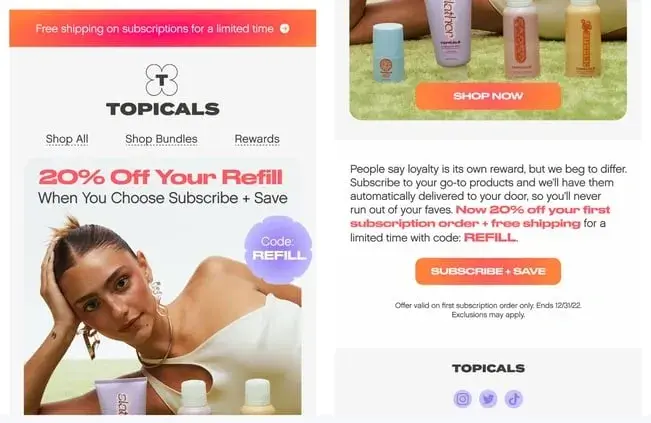
Pro tip: Notice how Topicals uses bold letters and colors to emphasize their deals and CTA button. Make sure to do the same in your own emails.
5. Ashley White - Affiliate Marketing
Ashley White is an esthetician who uses affiliate marketing. In her X profile, she includes a link to a personal Linktree page where she shares referral codes and discounts for people who shop with her codes and links.
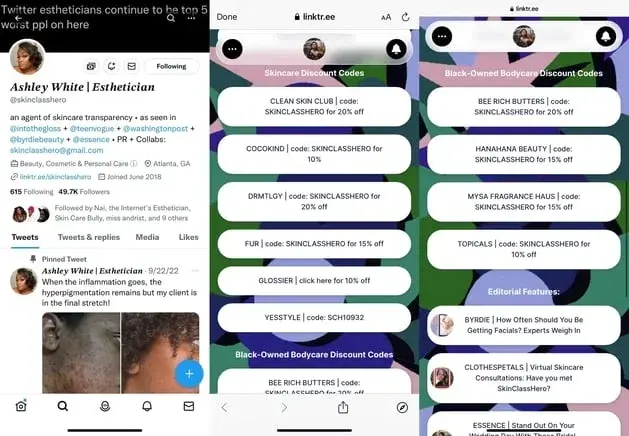
What I like: As Ashley White markets herself as an ambassador for these companies, the businesses generate brand awareness. Someone visiting her Linktree might be inspired to try a new brand, and an influencer recommendation can make this inspiration even more powerful.
6. Samsonite - Search Engine Marketing
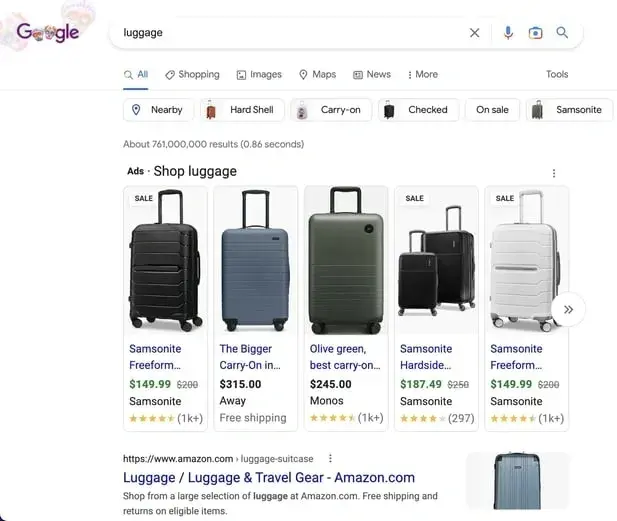
Search engine marketing is a great example of digital marketing, where brands bid on keywords and showcase ads for their products in SERPs when someone queries a related keyword.
The image below is an example from Samsonite, where a query for the word “luggage” surfaces various luggage options from known brands that have created ads to feature their products front and center in search results.
7. Yes Williamsburg - Sponsored Ad
Yes Williamsburg uses native advertising within its Instagram feed to share a paid sponsorship with a local Brooklyn business.
The Reel is tagged as a paid partnership, but it appears organically in a user's feed like a standard post. The ad is also in line with Yes Williamsbug’s usual content of sharing information about unique local businesses for people to try.
Pro tip: Today's audiences (especially Gen-Z) do not like to be blatantly advertised to, so creating content that feels organic and natural is more helpful than content that feels like an advertisement.
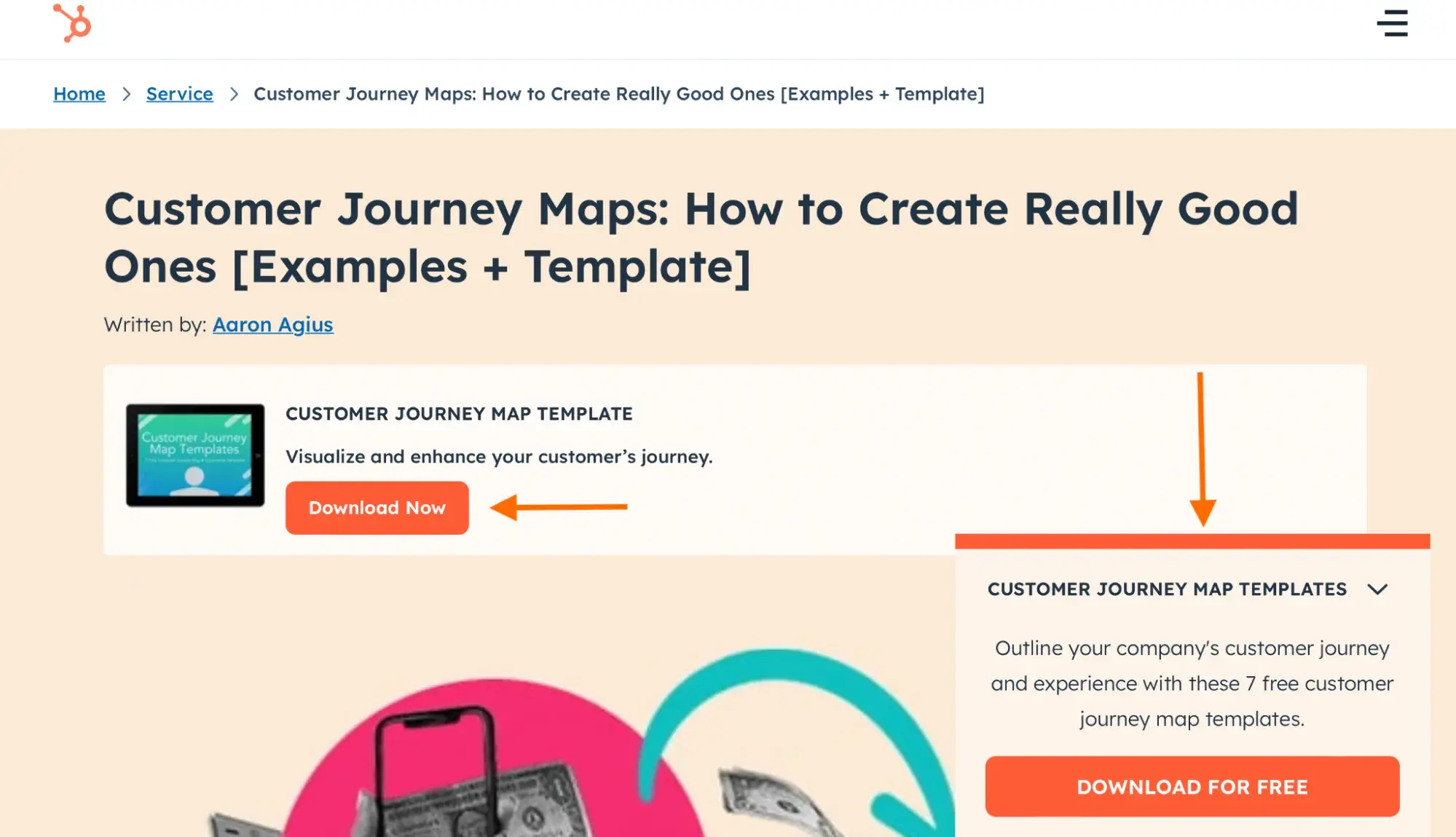
8. HubSpot Blog - Content Offers
Content offers are a form of digital marketing where businesses share helpful content with site visitors that it knows will benefit them.
For example, the HubSpot Blog often features content offers and learning material for people to learn more about the blog topic.
In this blog post — Customer Journey Maps: How To Create Really Good Ones [Examples + Template] — readers can download free templates to help them get started on creating a customer journey map.
9. For Keeps Bookstore - Local Business SEO
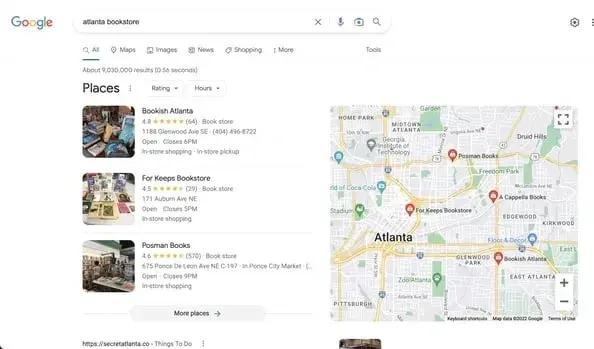
A search engine optimization strategy for many local businesses is an optimized Google My Business profile to appear in local search results when people look for products or services related to what you offer.
For Keeps Bookstore, a local bookstore in Atlanta, GA, has optimized its Google My Business profile for local SEO so it appears in queries for “atlanta bookstore.”
AI and Digital Marketing
In my opinion, artificial intelligence is here to stay — particularly in marketing. 1 in 2 marketers (50.17%) see AI working in conjunction with marketers, assisting them in performing most of their job duties.
And what are the various tasks AI can help with? Numerous. But the top four AI use cases are:
- Content creation (using generative AI to write copy, create images, get ideas, etc.)
- Learning how to do things (using generative AI to learn an Excel function, debug SQL code, etc.)
- Data analysis/reporting (using generative AI to analyze or manipulate marketing data)
- Research (using generative AI for market research, finding datasets, summarizing articles, etc.)
So, it’s not surprising that 71.27% of marketers say that AI has had a somewhat to very significant impact on their marketing role.
And while 47.18% have a clear understanding of how to use AI in their marketing strategy, there’s also a challenge. A little over half (51.80%) of the marketers surveyed feel overwhelmed by the prospect of implementing AI tools into their daily processes/workflows.
In the end, balance is key. There are tons of digital marketing strategy courses that provide lessons on the fundamentals when using AI. It’s vital to look at AI as not a be-all and end-all solution but rather as a tool to simplify and quicken a digital marketer’s work.
Integrate Digital Marketing Into Your Strategy
Any opportunity where you can connect to your audience is an opportunity to convert a lead or acquire a customer.
I feel that digital marketing creates so many more of those opportunities by allowing you to reach prospective buyers through a wide variety of channels.
Whether it’s social media platforms, websites, text messages, or any online medium, it’s an invaluable way to promote your business, service, or product.
Editor's note: This post was originally published in August 2016 and has been updated for comprehensiveness.
Digital Marketing For Small Business
Everything you need to know to get started with digital marketing. You'll learn about:
- SEO
- Content Marketing
- Marketing Analytics
- And More!
Download Free
All fields are required.




![Here‘s Everything I’ve Learned About Internet Marketing [Data + Expert Tips]](https://53.fs1.hubspotusercontent-na1.net/hubfs/53/internet-marketing-1-20250128-2273831.webp)

![24 Digital Marketing Tips That HubSpot Swears By [Research]](https://53.fs1.hubspotusercontent-na1.net/hubfs/53/digital-marketing-tips_0.webp)
.png)
![How Performance Marketing Works [+ 6 Tools You Can Use]](https://53.fs1.hubspotusercontent-na1.net/hubfs/53/performance%20marketing.webp)