AI insights are actionable findings generated by analyzing data with artificial intelligence. Marketers use AI insights across the funnel, from lead scoring to campaign performance, but this article focuses on one slice: the insights that reveal how your brand shows up in answer engines. Those AEO insights track brand mentions, citations, competitor visibility, referral activity, and content gaps.

That makes answer engine optimization (AEO) one marketing application of AI insights, not a synonym for the broader term. AI-driven insights can inform pricing, product, and lead scoring; AEO insights zero in on visibility inside AI answers. Getting value from them starts with understanding how AEO differs from the SEO you already know.
Table of Contents
- What is AEO and how is it different from SEO?
- AI and AEO Insights That Matter Most Right Now
- Unearthing AEO Insights for Your Brand
- Turning Insights Into AEO Actions
- AEO, SEO, and Inbound
- Measuring AI Referral Traffic
- Frequently Asked Questions About AEO
- From AI Insights to AEO Results
What is AEO and how is it different from SEO?
Answer engine optimization (AEO) is the practice of improving how your brand appears in AI answers on platforms like ChatGPT, Gemini, and Perplexity. As more buyers turn to answer engines to research solutions, showing up accurately and prominently in those responses is becoming as important as ranking in traditional search. You may also see it called generative engine optimization (GEO), artificial intelligence engine optimization (AIEO), or AI SEO. HubSpot calls it AEO.
Content with good SEO already has strong foundations for AEO, and the two practices complement rather than replace one another. Still, AEO is different from SEO in a few ways:
- AEO’s goal is to appear in an AI-generated answer; SEO’s goal is to rank at the top of a search engine results page.
- Answer engines seek a specific, direct answer; search engines seek a holistic, best resource.
- AEO is hyper-personalized, with prompts that can run several paragraphs; SEO is less personalized, with “long-tail” keywords that rarely exceed nine words.
- AEO metrics include brand mentions, citations, and share of voice; SEO metrics include ranking positions, clicks, and traffic.
- In AEO, results appear as a response inside an answer engine or an AI-generated summary at the top of the Google SERP, and they don’t always include clickable links. In SEO, results are typically blue links that users click through to read and get an answer to their query.
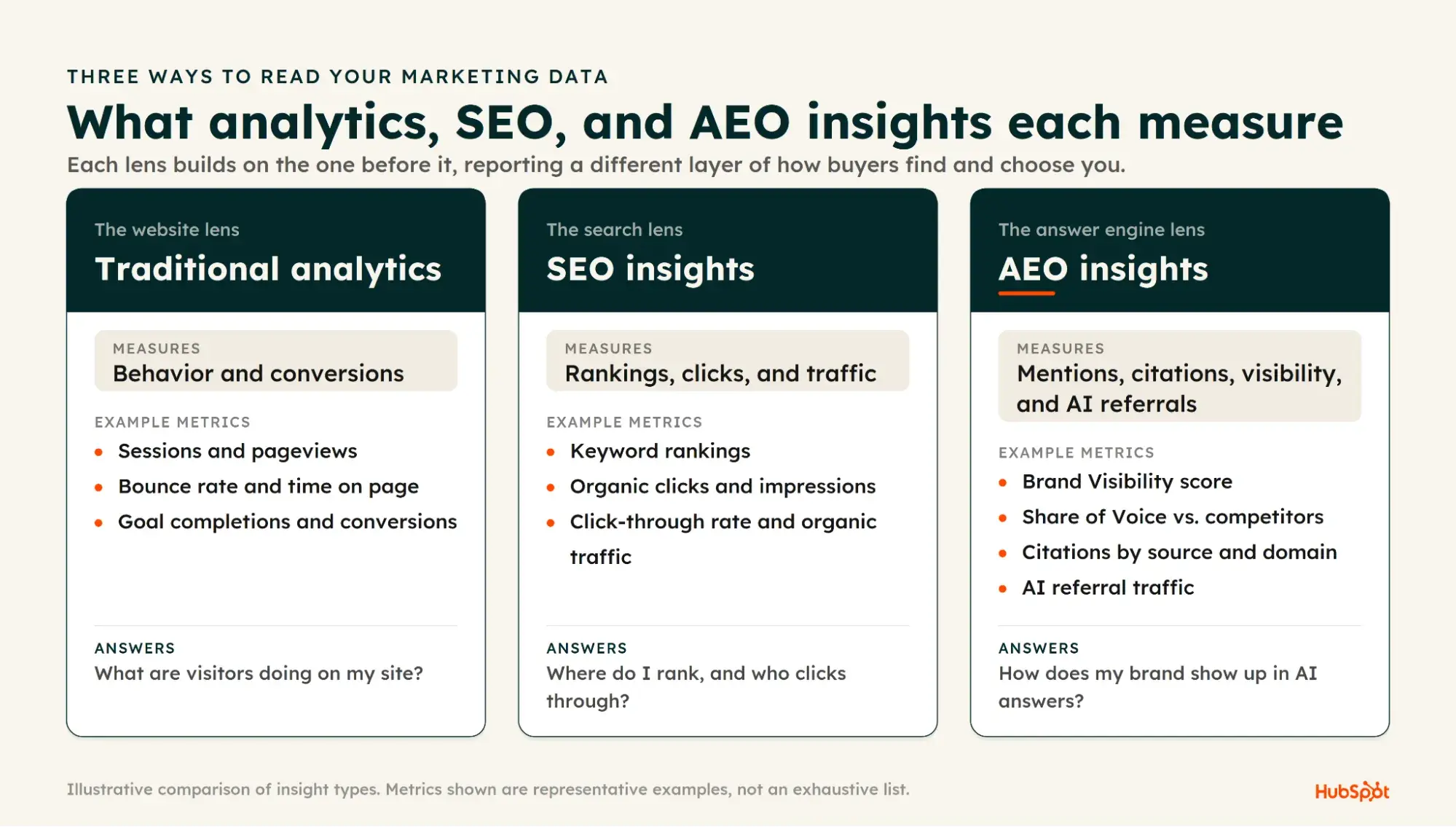
AI and AEO Insights That Matter Most Right Now
Before you optimize for answer engines, it helps to know what the data actually says about where buyer attention is moving. Staying current on answer engine optimization trends gives you a head start. These are the AI insights I’d prioritize if I were building a strategy from scratch today.
Traffic from AI is small, but growing — and has high intent.
Referral traffic from LLMs like ChatGPT and Gemini roughly tripled over a recent 12-month span, according to a Search Engine Land analysis. Volume is still a fraction of organic search, but the visitors convert. A Semrush study across more than 500 high-value digital marketing topics found LLM-referred visitors are 4.4 times more valuable than traditional organic visitors, based on conversion rate.
HubSpot AEO Tool
See exactly where your brand shows up in answer engines and take action to close AI visibility gaps.
- Track AI mentions.
- Analyze citations
- Monitor prompts
- Benchmark competitors
Takeaway: Track conversions from AI sources separately from organic, so a small but high-intent channel doesn’t stay hidden in your reporting.
Buyers are deciding inside the answer.
Roughly half of consumers now intentionally use AI-powered search, and 44% of those users call it their top digital source for buying decisions, per an August 2025 McKinsey survey. About two-thirds of US Google searches ended without a click in early 2026, based on SparkToro’s clickstream analysis (methodology shifts year to year, so read it as direction, not a precise line). Together these say the evaluation increasingly happens before anyone reaches your site.
Takeaway: Optimize how your brand is described inside AI answers, not just where you rank, because buyers are forming opinions before the click.
Your owned content isn’t the whole story.
Answer engines assemble responses from review sites, social platforms, forums like Reddit, and news coverage, not just your blog. How heavily each engine weights those sources isn’t public, so treat off-site presence as an influence on citations rather than a guaranteed lever. In practice, thin reviews or a weak brand presence can hold back your AI visibility even when your own content is strong. I cover how these signals build on inbound later in this piece.
Takeaway: Audit your reviews, social, and third-party mentions alongside your content, since what others say about you shapes what answer engines say.
From here, the useful question shifts from what’s happening across your category to what’s happening to your brand specifically. That’s where HubSpot AEO comes in. It measures how visible your brand is across answer engines and surfaces the prompts where competitors are cited and you aren’t.
Unearthing AEO Insights for Your Brand
Understanding the AEO landscape is useful, but the insights that change what you do next are the ones tied to your own brand: where you show up, where you don’t, and what to create or fix to close the gap. Manually prompting ChatGPT, Gemini, and Perplexity to check is inconsistent and hard to scale, so most teams use a dedicated tool.
I’ll walk through the core workflow using HubSpot AEO as the example, since it tracks prompts, monitors visibility, analyzes citations, and turns all of that into an action plan.
Step 1: Set up your brand, competitors, and prompts.
The first thing you’ll do in any AEO tool is define what to track: your brand, your main competitors, and the prompts your buyers are likely typing into answer engines.
In HubSpot AEO, you can enter prompts manually (for example, “What are the best email marketing tools for ecommerce?”) or use HubSpot’s suggestions, which draw on your company, competitors, and industry. On Marketing Hub Professional or Enterprise, those suggestions also pull from your CRM data, recommending potential buyer questions you might not think of on your own. You can also organize prompts into groups by product line or segment.
Step 2: Check your Brand Visibility score.
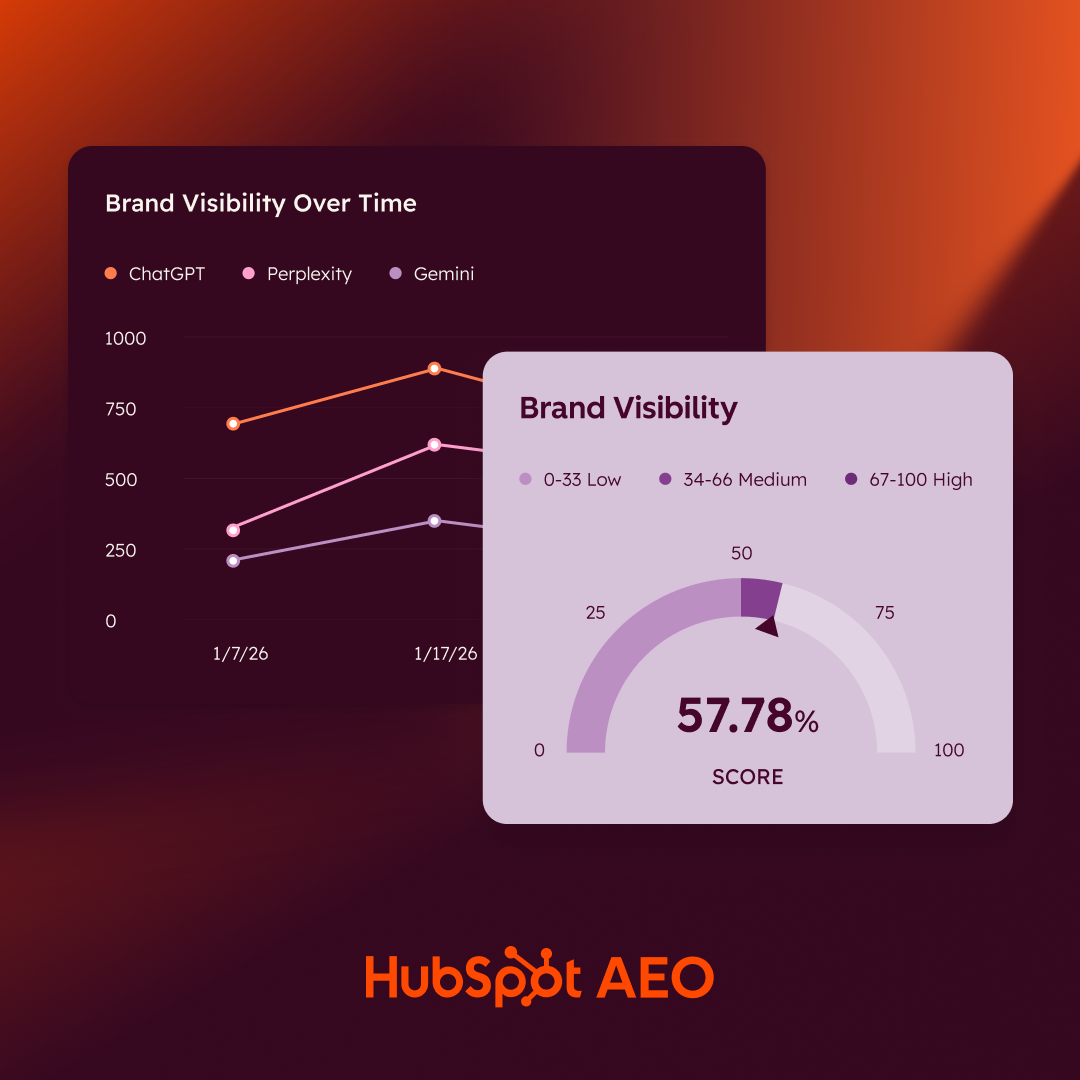
Your Brand Visibility score is how often your brand appears when answer engines respond to the prompts you track, shown as a percentage. If you track 25 prompts and your brand appears in 5 of those responses, your Brand Visibility score is 20%, the baseline you’re working to improve. HubSpot AEO breaks this out by engine (ChatGPT, Gemini, and Perplexity) and tracks it over time, so you can tell whether your visibility is climbing or slipping.
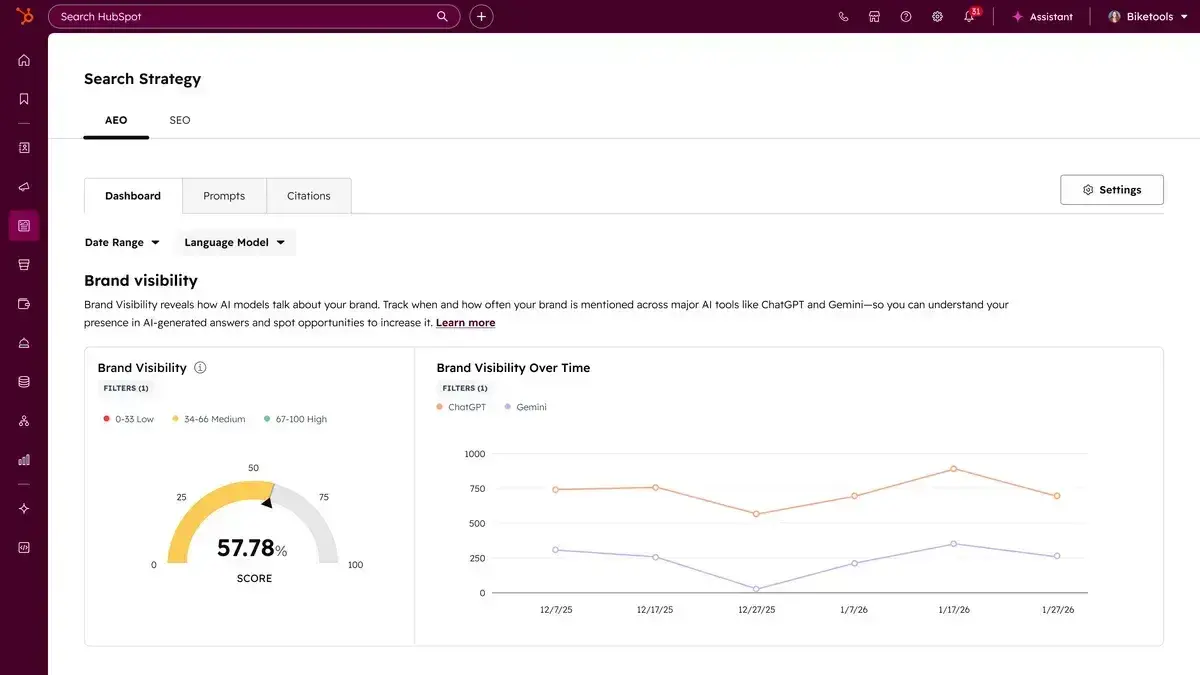
Step 3: See how you stack up against competitors.
Your own visibility only tells you half the story; what counts is how it compares to the competition. The competitor view reports your Share of Voice, which measures your brand’s mentions against the total brand mentions across you and the competitors you track. For example, if your brand earns 18 of 60 total mentions across your tracked prompts, your Share of Voice is 30%. More useful than the number itself, you can see which specific prompts your competitors appear on and you don’t. Those gaps are your biggest opportunities to gain ground.
Step 4: Analyze your citations.
When an answer engine replies to a prompt, it pulls from sources across the web. HubSpot AEO’s citation analysis shows which sources it references for prompts in your category, broken down by content type (blog posts versus comparison listicles), by source type (your owned pages versus Reddit threads versus earned media), and by individual domain.
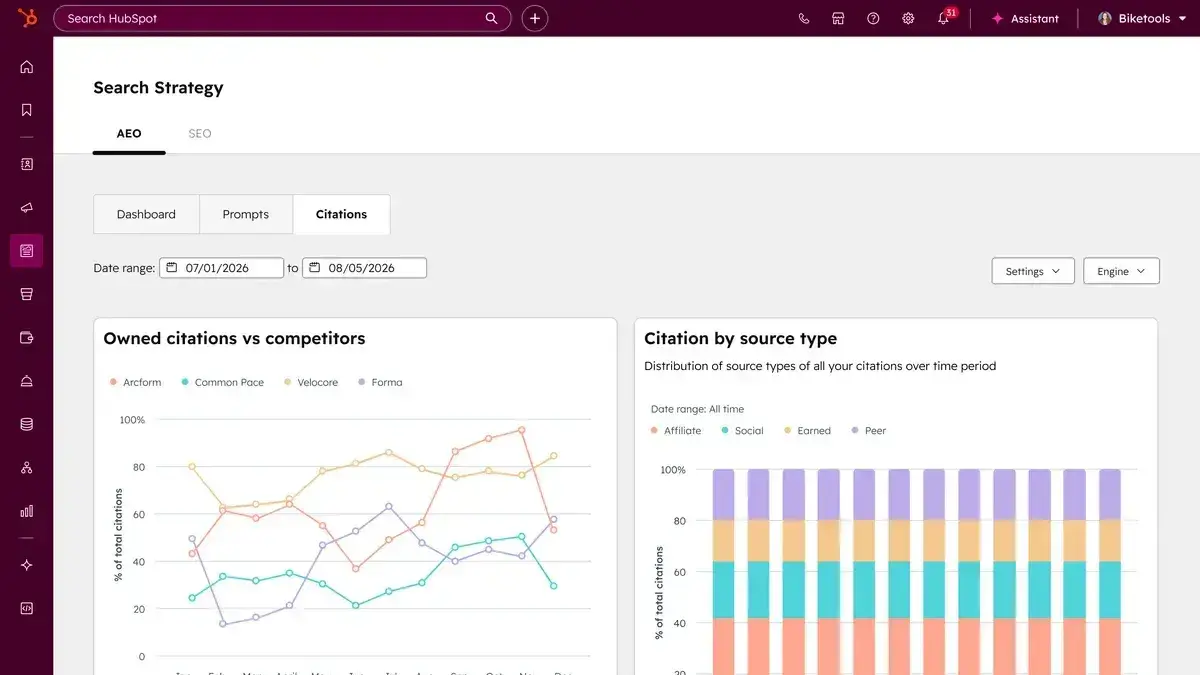
Use it to steer your content strategy. If comparison content earns most of the citations for your highest-intent prompts, that’s the format to invest in. If one review site keeps appearing across prompts, that’s a clear signal to get your product listed there.
Step 5: Turn data into an action plan with recommendations.
HubSpot AEO’s recommendations turn your prompt and citation data into prioritized actions, ordered so you can start with your biggest visibility gaps. Each one tells you what to do and why, whether that’s creating a new page, updating an existing one, publishing a post, or reaching out to a third-party site, and ties the suggestion back to the prompts and citations that triggered it.
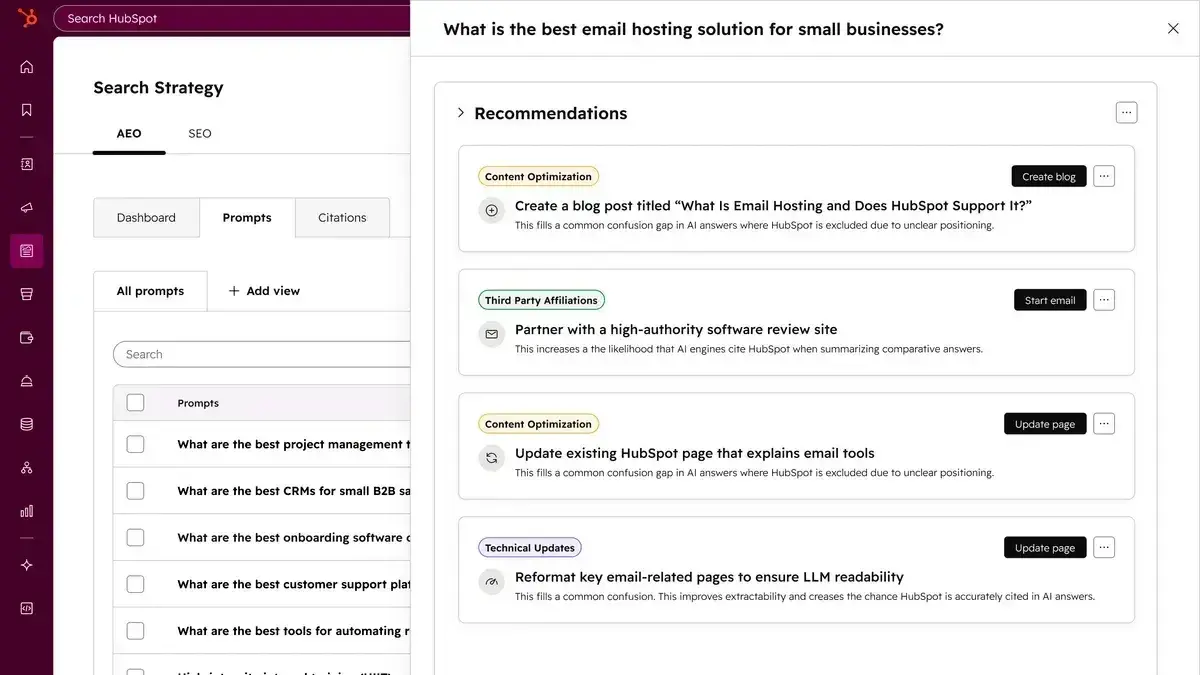
Treat these recommendations, like any automated insight, as a starting point rather than a verdict. Before you act, check the recommendation against the underlying prompts, responses, and citations the tool captured, and have a human confirm the call.
HubSpot AEO Tool
See exactly where your brand shows up in answer engines and take action to close AI visibility gaps.
- Track AI mentions.
- Analyze citations
- Monitor prompts
- Benchmark competitors
Step 6: Filter to focus your analysis.
As your AEO strategy matures, you’ll want to slice the data more precisely. Most AEO tools let you filter by answer engine, date range, and (in HubSpot’s case) prompt groups — so you can analyze performance for a specific product line, customer segment, or time period.
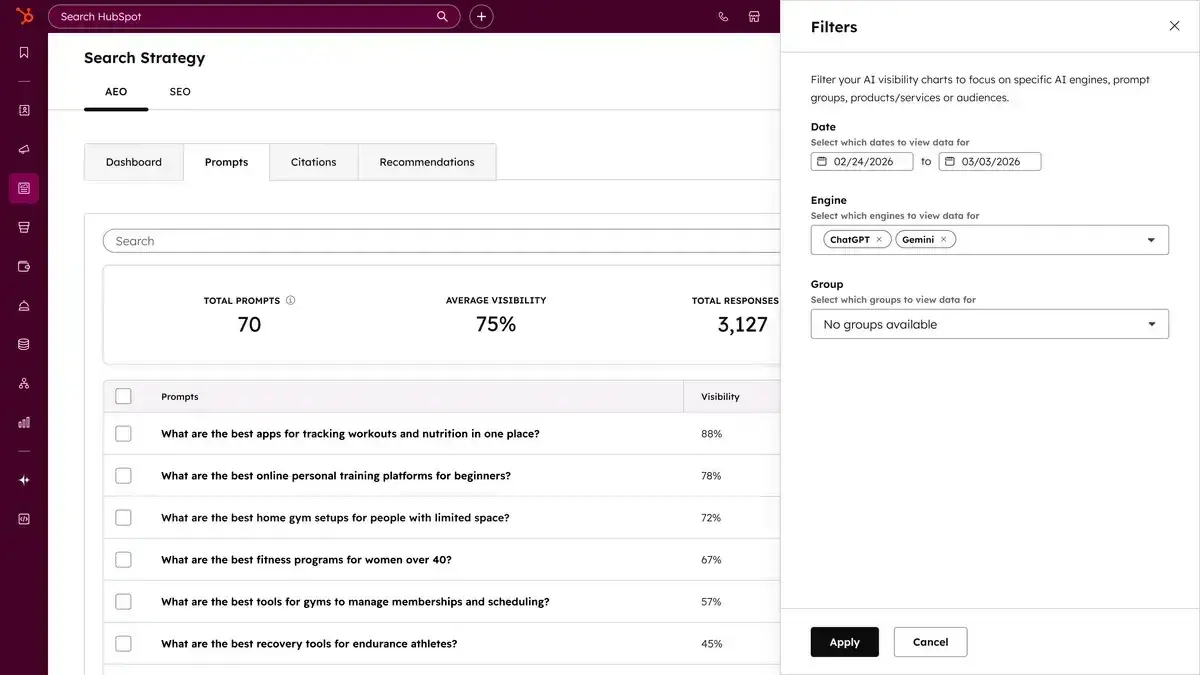
This matters because each answer engine behaves differently. You might be strong on ChatGPT and nearly invisible on Gemini, or the reverse. Filtering by engine shows you where to concentrate, and reading performance by segment keeps the work focused instead of trying to improve everything at once.
Pro tip: Put a monthly review on the calendar. Check your Brand Visibility trend, read the new recommendations, and see whether the actions you’ve taken are showing up in the data. Like SEO, AEO is an ongoing practice, not a one-time setup.
Turning Insights Into AEO Actions
Once you’ve reviewed your Brand Visibility score, competitor gaps, and citation data, the next question is where to start. These actions are sequenced: Clear the blockers first, build over the following weeks, then keep the work current.
Start here (week 1).
- Unblock AI crawlers. Check your robots.txt for rules blocking OAI-SearchBot, the OpenAI crawler that fetches pages when ChatGPT returns cited responses. Unblocking the crawler makes your content eligible for citation, but doesn’t guarantee it. If your concern is model training rather than citations, you can block GPTBot while keeping OAI-SearchBot allowed, since they’re controlled separately.
- Set up AI referral tracking. Confirm your analytics captures utm_source=chatgpt.com and referral traffic from perplexity.ai and gemini.google.com. You need this baseline before you can measure anything.
- Run an AEO benchmark. Use the free AI Search Grader for a one-time snapshot. HubSpot AEO continuously tracks your Brand Visibility score (the share of AI-generated answers where your brand appears in the response body) alongside your competitors’ scores, so you can watch your progress over time.
- Identify your top prompts. Start with 10-15 questions your buyers type into ChatGPT or Gemini during evaluation: comparisons, pricing, integrations, and decision criteria.
A structured approach to prompt research will help you prioritize the highest-intent queries.
On Marketing Hub Professional or Enterprise, prompt suggestions draw on your CRM data and surface potential buyer questions you might not have considered. Organize prompts into groups by product line or segment so you can read performance for that specific part of the business.
Build your foundation (weeks 2-4).
- Restructure your highest-traffic pages for citability. Pages already ranking in organic search are your strongest citation candidates. For each one, open with a direct, self-contained answer in the first 100-150 words; use subheadings that mirror specific questions (“How much does X cost?” beats “Key Considerations”); and make claims specific and attributable. “Marketing Hub customers reported a 3x lift in inbound leads in six months, per HubSpot’s ROI Report” reads as more citable than “marketing software helps generate leads.”
- Add schema to key pages. Start with the 10-15 pages tied to your tracked prompts. FAQPage schema helps engines parse question-and-answer pairs; Article schema supplies author, publisher, and date context; Product and Review schema align with buyer-intent queries. Schema makes strong content more machine-readable — it reduces ambiguity rather than earning citations on its own.
- Audit your off-site presence. HubSpot AEO’s citation analysis shows which third-party domains and content types answer engines reference for your category. If competitors appear on review sites, comparison pages, or Reddit threads where you’re absent, those are your next content and outreach priorities.
Maintain and compound (monthly cadence).
Answer engines refresh their sources regularly, and your competitive landscape shifts as others start optimizing.
- Review your Brand Visibility trend. Flat isn’t neutral. If competitors climb while you hold steady, your relative position slips. HubSpot AEO tracks the trend by engine, so you can tell whether a change is platform-wide or isolated to one engine.
- Act on new recommendations. As HubSpot AEO collects more data, it surfaces new content gaps, each tied to the prompts and citation patterns behind it. Prioritize gaps on high-intent prompts where competitors are cited and you aren’t, and check each recommendation against the underlying data before acting.
- Refresh aging content. Outdated statistics and stale examples make a page less citable over time. Treat freshness as routine maintenance — a signal that can help engines favor current sources, not a guaranteed citation factor.
HubSpot AEO Tool
See exactly where your brand shows up in answer engines and take action to close AI visibility gaps.
- Track AI mentions.
- Analyze citations
- Monitor prompts
- Benchmark competitors
AEO, SEO, and Inbound
AEO builds upon your existing SEO work; it doesn’t replace it. Helpful content, topical authority, and E-E-A-T signals that matter to search engines matter to answer engines, too. HubSpot’s State of AEO report found that pages ranking well in Google, and for more search terms, tend to get cited more often by answer engines, so organic performance feeds AI visibility rather than competing with it.
AEO adds breadth. Traditional SEO focuses heavily on your own pages and their backlinks. Answer engines pull from a wider field, including the off-site sources this piece covered earlier: review sites, social, Reddit, and news. How wide depends on the engine: Fan Out’s B2B citations study put Google AI Overviews at roughly half off-site sources, while ChatGPT Plus (22% off-site) and Perplexity (18%) leaned much harder on brand- and publisher-owned pages.
That breadth is why a single asset can pay off twice. SE Ranking found that a presence on review sites like G2 and Capterra makes ChatGPT about three times more likely to cite you, so one G2 profile can boost category visibility and hand engines a citable source at the same time.
The connection runs both ways, though, and not always in your favor. You can rank near the top of Google and still go almost unmentioned in ChatGPT for the same question. Semrush found that nearly 90% of the pages ChatGPT cites sit at Google position 21 or lower for the related query, a gap standard SEO reporting won’t show you. That blind spot is what the tool workflow earlier in this article surfaces, so you can carry your inbound strategy into answer engines rather than rebuild it from scratch.
Measuring AI Referral Traffic
No single report captures every AI referral, but you can use a combination of these methods to get a good estimate of how many visitors are being influenced by your AEO efforts.
- Referral-source reporting. Look for chatgpt.com, perplexity.ai, and gemini.google.com in your analytics referral reports. ChatGPT appends utm_source=chatgpt.com to outbound links automatically, so those visits are the easiest to isolate if you already track UTM parameters.
- Landing-page analysis. When the referrer gets stripped, the page a visitor lands on can still hint at the source. A jump in direct traffic to a deep comparison or pricing page, rather than your homepage, could signal an answer engine sent someone mid-evaluation.
- CRM source data. The ultimate goal of visits is to drive revenue, so it’s crucial for marketers to tie AI referral traffic to contacts or deals. HubSpot Smart CRM classifies answer engine clicks as AI Referrals and carries that source onto the contact record, connecting AI-referred sessions to real pipeline.
- Self-reported attribution. Use forms to ask visitors how they heard about your business. Because analytics undercounts AI traffic, self-reported answers catch referrals your reports miss.
- Assisted conversions. AI often shapes a deal without being the final click. On Marketing Hub Enterprise, multi-touch revenue attribution credits answer engines as an assisting touch, tracing AI-influenced contacts through to the deals they help close.
Keep in mind that some AI-driven visits will never be tagged as AI. When the referrer doesn’t survive the click, those sessions fall into your direct or unassigned buckets, so view any AI referral number as a floor rather than an exact count.
Frequently Asked Questions About AEO
What are AI insights in marketing?
AI insights in marketing are findings a machine-learning system pulls from your data: patterns, opportunities, risks, and performance gaps a person scanning spreadsheets might miss. These AI-powered insights appear at every funnel stage, from lead scoring to campaign performance to answer engine visibility, which is where AEO comes in.
How are AI insights different from AEO insights?
AEO insights are a subset of AI insights. AI insights cover any data-driven finding across marketing, from pricing to lead scoring. AEO insights narrow to one question: how your brand appears in AI-generated answers, measured through brand mentions, citations, competitor visibility, and referral activity. Every AEO insight is an AI insight, but most AI insights have nothing to do with answer engines.
How can marketers evaluate whether an AI insight is reliable?
Check the insight against its source data before acting. Ask whether the underlying data is complete and current, whether the tool could be hallucinating a pattern that isn’t there, and whether the recommendation accounts for context the model can’t see. AI-generated insights speed up analysis, but they can be wrong or incomplete, so a human should confirm any call before it drives spend. Privacy deserves a check too: AEO tools often draw on CRM and customer data, so confirm any tool handling it meets your data-privacy obligations.
Should I block or allow AI crawlers like GPTBot?
It depends on your goal. GPTBot crawls for model training; OAI-SearchBot fetches pages for cited ChatGPT answers, and the two are controlled separately in robots.txt. If you want citations but not training, block GPTBot and keep OAI-SearchBot allowed. Check your robots.txt today; some sites still carry blanket AI-bot blocks that cut their eligibility for AI citations.
Which schema is most impactful for AEO?
There’s no single “most impactful” schema for AEO — it depends on the page. FAQPage suits question-led content, Article suits editorial, and Product and Review suit commercial pages. In every case, schema makes strong content easier for engines to parse; it won’t earn citations for thin content.
From AI Insights to AEO Results
Strong AEO work follows a simple loop that sharpens with every pass through it:
- Collect reliable data on how answer engines describe and cite your brand.
- Read that data for meaningful patterns rather than one-off spikes: the prompts where competitors appear and you don’t, the content types earning citations, the engines where you’re weakest.
- Validate what you find before acting, since an automated insight can flag a pattern that isn’t real or miss context the model can’t see.
- Then act on the highest-intent gaps, and measure whether your Brand Visibility trend actually moves in response. Where it doesn’t, adjust and run the loop again.
HubSpot AEO runs that loop in one place. It tracks your Brand Visibility score across answer engines, flags where competitors are pulling ahead, and recommends what to fix next. See your Brand Visibility score with HubSpot AEO.
Editor's note: This post was originally published in April 2026 and has been updated for comprehensiveness.
HubSpot AEO Tool
See exactly where your brand shows up in answer engines and take action to close AI visibility gaps.
- Track AI mentions.
- Analyze citations
- Monitor prompts
- Benchmark competitors
AEO

-What-We-Learned-from-Analyzing-10+-Brands-With-High-AI-Search-Citations-1-20260826-304258.webp)
![Using LinkedIn for AEO: How marketers can use social media to improve their AI visibility [experiment]](https://53.fs1.hubspotusercontent-na1.net/hubfs/53/AEO-for-LinkedIn-piece-1-20260826-6108454.webp)
-1.png)
![Scrunch AI alternatives compared: Features, pricing, and fit [2026]](https://53.fs1.hubspotusercontent-na1.net/hubfs/53/scrunch-alternatives-1-20260812-5006620.webp)