
Sales close plans are critical for winning high-value accounts and converting prospective customers. Companies usually spend months nurturing prospects, and a poor sales-closing process could lead to lost deals.

A sales close plan template gives teams a uniform approach to closing and increases the odds of winning deals. This post covers how to create a sales close plan that can get thousands of deals across the finish line. But first up: What is a sales close plan?
Table of Contents
- How to Create a Sales Close Plan
- Sales Close Plan Template
- Sales Close Plan Checklist
- When to Create a Sales Close Plan
- Frequently Asked Questions About Sales Close Plans
What is a sales close plan?
A sales close plan (also known as a deal plan) is a document that outlines the steps a seller and prospect must take to go from verbal interest to a signed contract. The plan captures action items, follow-up steps, open questions, and potential objections. The shared intent is to get the deal done and ensure the customer derives product value fast.
Without a sales close plan, stakeholders lose alignment, timelines slip, and momentum stalls.
A close plan usually centers on the seller’s goal of closing the deal. Thus, many sales reps create them for internal use. However, the most effective sales close plans are built collaboratively with prospects. When built with prospects, teams may use the term mutual action plan (MAP) or mutual engagement plan. An effective close plan requires mutual accountability between buyer and seller.
Today, modern sales teams are using AI to build smarter close plans. With HubSpot, the impact is measurable. HubSpot customers see a 48% decrease in average time to close when using our AI sales features.
Free Sales Plan Template
Outline your company's sales strategy in one simple, coherent sales plan.
- Target Market
- Prospecting Strategy
- Budget
- Goals
Download Free
All fields are required.
Form not available
Why You Should Create a Sales Close Plan
A sales close plan includes key milestones, stakeholders, deadlines, and responsibilities. It ensures that everyone involved in the purchase decision is on the same page. Think of it as a mutual action plan that guides prospects through the final stages of the sales process.
Other benefits of a sales close plan follow.
- Removes inertia: A close plan lowers buyer resistance to closing deals. Once the prospect has invested time in creating a plan, they have more incentive to move forward so their work doesn’t go to waste.
- Accelerates deal velocity: Mapping milestones in advance (including procurement, legal, and security) prevents last-minute scrambles that push deals into the next quarter.
- Reduces “no decision” outcomes: Lots of B2B deals end in no decision; a well-built plan cuts through decision paralysis by giving buyers the right information at the right time.
- Qualifies deals in real time: A prospect’s willingness to co-own the plan is one of the clearest signals that the deal is real.
- Makes complex buying manageable: Breaking the process into achievable steps removes the fear of getting it wrong, especially for first-time buyers.
- Creates mutual accountability: Tasks are assigned to both parties, so the deal isn’t carried by one side alone.
- Stronger relationships: Collaboration from day one builds long-term trust.
Pro tip: Keep goals front of mind, both for you and your prospect. Emphasize the solution’s value throughout, not the product’s specific features.
How to Create a Sales Close Plan
An excellent deal plan is made custom for important prospects. What matters more than format is whether both sides have contributed to the sales close plan and whether it maps to the buyer’s actual process, not just the sales cycle.
Below are the steps to take when creating a sales close plan.
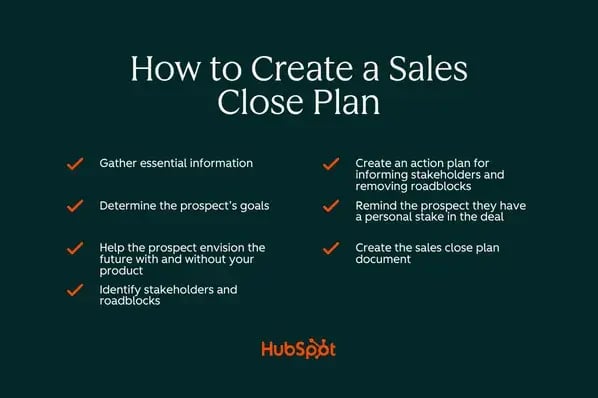
1. Gather essential information.
Understanding the buyer’s world lets reps write a close plan that reflects their reality. These three questions give an excellent head start.
What is the buyer’s most urgent priority?
Most prospects will provide a list of seven or eight priorities when asked. When that happens, always ask this follow-up question: “You’ve just shared a lot of priorities. If you had to pick the most important to get right in the next six months, what would that be?”
With this question, the urgency created won’t be sales pressure because it’s rooted in the buyer’s problem.
Leslie Venetz, founder of the Sales-Led GTM Agency, says lack of urgency is the primary reason deals slip: “The number one thing that causes deals to push out of quarter is that at the very beginning of the process, the rep failed to identify the thing that needs to be changed now.”
What is the go-live date, and why does it matter to them?
The go-live date is the most important anchor because it shows the day the buyer wants to start getting value from a product. Knowing the timeframe sets a clear target.
Note that the date comes from the buyer’s urgency. Find the date the buyer already cares about. Perhaps a product launch, a budget cycle, or a compliance deadline. Then work backward from that to set a deal closure and implementation timeline.
Have they bought something like this before?
A buyer who has navigated a similar purchase will engage differently with a close plan than a first-timer. The latter needs more hand-holding.
When asking about a contact’s buying experience, the potential response should be simple. For example, a sales rep might say, “Have you and your team recently bought a solution like this?” Their response? Yes or no.
Pro tip: Ask about the specific stages that often take time (e.g., legal review, security, and procurement). If the prospect says legal takes three days, that’s a signal to build the time into the plan. Break it into micro-steps to help the buyer see what’s involved.
2. Determine the prospect’s goals.
The prospect may have shared some of their goals during the discovery call and follow-up conversations. But it’s always an excellent idea to brush up on their goals once again when creating the sales close plan. Priorities might have shifted during conversations, especially if new issues came up.
Here are a few questions to ask.
What are your goals?
People without goals aren’t excellent customers. The job of a sales rep is to find valuable prospects who will become great clients and reduce churn.
What’s your why?
Prospects don’t buy for rational, but emotional reasons. The product is a rational means to an end, but emotion usually influences that end. The prospect has a mental image of the future, and the product can help them get there.
Pro tip: Prompting a prospect to talk about that future helps them understand why they should invest time and money in a solution.
If you don’t know the answers to these questions, do you know whom to ask to find out?
Hopefully, they’ll know the answers. But if not, they should be able to state who has the relevant information.
3. Help the prospect envision the future with and without your product.
The prospect won’t close unless they picture the outcome of their life (or job) after the purchase. Ask, “What changes will result from this purchase?” Without sounding sales-y, this question helps reps to look ahead and explore these questions:
- If they buy my product and use it successfully, what fundamental changes will they need to make to their business?
- Will they need to add headcount?
- Set up regular training sessions?
- Reallocate budget?
Questions go beyond logistics. Reps need to show prospects the positive changes, such as growth opportunities and increased revenue. After creating this image, move on to process- or logistics-related conversations.
Another question to ask is: “What happens if you don’t complete this purchase?”
With this question, the rep can find out the prospect‘s Plan B. They might be in a difficult situation if they don’t make this purchase, and asking them to envision that possibility will kick-start the closing process.
Extra insight: This question can reveal that you’re in a competitive situation. In such a case, reach out to a coach or champion and figure out where you stand.
Free Sales Plan Template
Outline your company's sales strategy in one simple, coherent sales plan.
- Target Market
- Prospecting Strategy
- Budget
- Goals
Download Free
All fields are required.
Form not available
4. Identify stakeholders and roadblocks.
After creating an image of the prospect’s future with and without the product, it’s time to clarify key logistical details, such as who has the last word on the purchase and who needs to grant buy-in.
Answers to these questions may have surfaced at the beginning of conversations with prospects, but often change once enough trust and rapport are established. When prospects first started speaking, they might’ve provided vague answers. The close plan is an opportunity to clarify these questions.
Who’s responsible for buy-in?
Responsibility for buy-in depends on who will use the product and how it will be implemented. It’s also important to consider whether an executive needs to sign off on a decision.
And don‘t forget about potential detractors. For example, if a stakeholder previously acted as a champion for a competitor, it’s important to bring them into the fold early. Identify that person and have a conversation about how to save face and smooth the transition to avoid making an enemy.
What are the biggest challenges to the purchase?
Identify the purchase roadblocks as soon as possible. This question helps with understanding what’s outstanding before the prospect signs on the dotted line. Other questions to consider asking include:
- Who needs to be involved in the actual purchase, including signing contracts, approving budgets, etc.?
- Does the purchase require an RFI (request for information), an RFQ (request for quotation), or any other documentation that will need to coordination?
- Does legal need to get involved?
- Is additional documentation or review needed, and how long will those processes take?
5. Create an action plan for informing stakeholders and removing roadblocks.
After getting answers to the questions outlined in the previous section, create an action plan to inform stakeholders, address any concerns, and draft any necessary documents.
If the prospect needs to create an RFQ or RFP, a strong next step is drafting the quote or proposal proactively, before the formal request arrives. If key stakeholders need to be informed about the purchase decision, outline meeting dates and confirm attendance early.
Pro tip: Remember that the sales close plan is a collaborative document. As the salesperson, you might be more driven to close, but success is a goal for both the seller and client, and the action plan should reflect this.
This collaborative approach makes a sales close plan a powerful tool. Reps who do this right set themselves up for a healthy, productive, long-term relationship with theclient.
6. Remind the prospect that they have personal stakes in the deal.
The most effective sales close plans are framed as mutual success plans rather than seller checklists. When a deal doesn’t close, the seller finds another prospect. The buyer is still stuck with the same problem.
When aiming for the close, it‘s all too easy to look at the deal from an overarching perspective, i.e., “My company will help your company achieve [x].” But when it’s near the end of the sales cycle, it’s critical to zoom back in.
That’s why top reps like to ask prospects, “What’s your personal goal?”
Reps always want to know whether a prospect has skin in the game. This gives the rep a sense of which motivating levers to pull to move the deal ahead. Prospects also revisit exactly why this deal is important to them.
The closer a deal gets to the end of a sales cycle, the higher the chance that the prospect will be fatigued. Refocusing them on the prize is crucial. Setting up the close plan as a joint execution plan can help reframe it for prospects.
7. Create your sales close plan document.
Whether sellers use a spreadsheet, a Word document, or a PowerPoint presentation, it’s important to compile all findings in a sales close plan document. Reps can usually adjust an existing company’s sales plan to create a close plan. Remember to share the document with the prospect so that they can make adjustments and leave comments as needed.
The format of a sales close plan is less important than it may seem. Common formats include spreadsheets, a one-slide presentation, and a simple bulleted document. Reps can also prompt Agent Hub to draft a close plan for a specific opportunity, pulling from CRM data to advise how to move the deal forward. Whatever format is chosen, a complete sales plan should cover the thes five components.
- Action items: Each task should be broken down by owner and deadline.
- Owners: Tasks should be assigned to both the rep and the buyer. The best owners are often the prospect; this makes the plan genuinely mutual.
- Timelines: Milestones should work backward from the go-live date, not forward from today.
- Micro-milestones for complex stages: Complex stages, such as legal review, should include specific interim deadlines, such as dates for first red lines, responses, and final responses.
- Stakeholders: Names and roles of everyone involved on both sides should be documented and kept current throughout the process.
Pro tip: Discuss the plan’s content live. Bring it up on screen every single time the team meets. Don’t just send task reminders through a tool.
The good news: Reps don’t have to make a successful sales close plan document from scratch. The template below can be used every time a rep needs to create a close plan, removing and adding sections when needed. Sales leaders can customize this plan for their sales teams to create a clear roadmap to closing.
Sales Close Plan Template
Featured Resource: Sales Close Plan Template

This free template includes all the sections reps need to create a foolproof close plan with prospects. There are two options:
- A plain-text document, or
- A designed one that includes images and graphics.
Depending on the industry, one might benefit from going the text-only route.
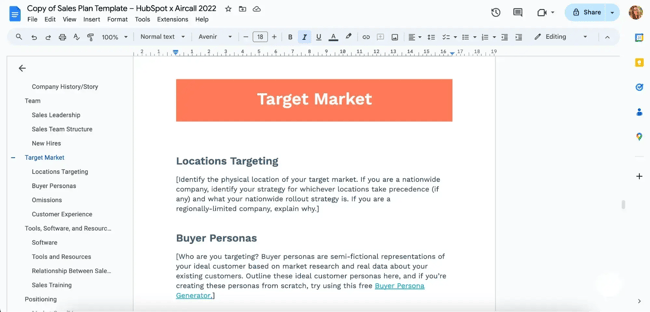
HubSpot’s free sales plan template includes both text and design options within one ready-to-customize document:
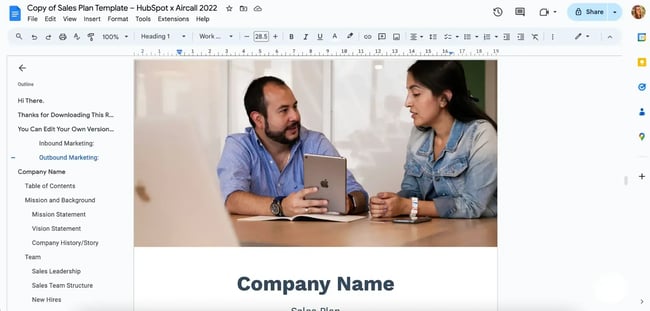
Reps can also use this template to create a company-wide sales plan that will enable an entire sales team to sell more effectively, reach revenue goals, and use the resources available to them.
Below are the sections in this template.
- Cover page: The cover page introduces the company and should include the prospect’s name under “Written by” or “Authors.”
- Mission (optional): This section includes the prospect’s mission if it will help with the close. Understanding the prospect’s goal from an overarching perspective can make the final pitch more effective.
- Team: The team section lists all stakeholders, paying special attention to decision-makers.
- Target market: This section outlines the prospect’s target market, populated with notes from the discovery call.
- Tools, software, & resources (optional): This section captures which tools the customer is already using, whether they use a competitor, and whether they typically buy this type of product.
- Positioning: The positioning section helps reps understand the prospect’s standing in their industry. Fill it in with their help. Guessing won’t do any favors here.
- Marketing strategy (optional): This section is relevant when the rep sells a marketing product and captures how the prospect currently markets their products and services.
- Prospecting strategy (optional): This section applies when the rep sells a product that can help the buyer generate more leads, such as sales software.
- Action plan: The action plan lists what both the rep and the prospect need to do to close the deal and successfully onboard the new customer.
- Business goals: The business goals section lists the prospect’s revenue and other quantitative KPIs. Any qualitative goals, such as “Streamline operations,” should also be listed here.
- Budget: The budget section includes a brief outline of the potential client’s budget for this purchase.
Don’t start from scratch. Use the free template below and get guided through the customization step by step.

Sales Close Plan Checklist
- Define objectives
- Map the buying process
- Confirm budget
- Secure buy-in
- Document requirements
- Address objections
- Set timelines
- Create accountability
1. Define objectives.
Confirm the buyer’s most urgent priority. Tie every milestone in the plan back to that priority. If the rep can’t draw a line from a task to the buyer’s stated goal, question whether it belongs in the plan at all.
Why it matters: Every step in a sales close plan must serve a specific, agreed-upon outcome that the buyer cares about, not just a date on a forecast.
2. Map the buying process.
Walk the buyer through each stage of the typical purchasing process. Ask about legal, security review, and procurement — and test their answers. If they say legal takes two days and the rep knows it takes two weeks, don’t argue. Break the process into micro-steps and let them see for themselves what’s involved.
For example, you might say, “When you and your team last bought a solution like this, what were the steps? How long did legal take to return first cuts?” Use their answers as diagnostic signals to determine if they understand or need coaching on the buying process.
Why it matters: Most buyers don’t know their own procurement process as well as they think they do. Assuming they do when they don’t can cause delays that could have been anticipated weeks earlier.
3. Confirm budget.
Don’t wait until late in the process to surface pricing. Venetz recommends never leaving the first call without floating a price range. If the buyer’s expectation is wildly off, it’s better to know on the first call than after three demos and a business case.
Why it matters: No one wants a deal that advances through multiple stages but stalls at budget approval.
4. Secure buy-in.
Don’t present the plan and ask for a signature. Build it together. For example, at the end of a demo, confirm that the contact is interested in moving forward with the purchase. Next, introduce the close plan as a document that makes the purchase process easy for customers.
Then walk through a first draft of your close plans. Consider leaving timelines rough and inviting the buyer to make corrections. If they engage and push back, that’s buy-in. If they accept everything without question, you may be talking to the wrong person.
Why it matters: A close plan that isn’t collaborative is a seller’s wish list with the buyer’s name on it. True buy-in means the champion has seen the plan, contributed to it, and will advocate for it internally.
5. Document requirements.
During stakeholder mapping, ask about the documentation required to approve the purchase. Does legal need to review anything? Is there a formal RFP or RFQ process? Does the security team need to complete a vendor assessment? Build each of these into the plan as a milestone with a deadline.
Why it matters: Missing a required document at the last minute can delay a deal by weeks. Every document has a lead time. None of them should be a surprise.
6. Address objections.
Surface objections proactively. If teams sense hesitation or pushback on the plan itself, don’t barrel forward. A rep might say, “I’m sensing a bit of friction. I wonder if I missed the mark on something. Can you help me understand what I got wrong?” Many buyers will speak, and asking increases the rep’s credibility.
Why it matters: Objections don’t disappear when ignored. They resurface later in deal stages when reps may have hoped to have the contract signed.
7. Set timelines.
Anchor the entire plan to a specific go-live date that matters to the buyer — a product launch, a compliance deadline, or a fiscal year boundary. Then work backward. The more specific the commitment, the more real the timeline feels to both sides.
Why it matters: Vague timelines are an invitation for deals to drift. The buyer says, “We’d like to get started next quarter.” Yet, three months later, nothing has moved.
8. Create accountability.
Set up a standing recurring check-in (weekly or bi-weekly) at the start of the process, not once things have slipped. Include the line buyer and procurement on the same call to prevent both sides from being out of sync. Bring the close plan to every meeting.
Why it matters: A plan without accountability is just a document. On enterprise deals, you are asking people who don’t report to you — senior buyers, procurement leads, legal teams — to complete tasks on a schedule you’ve set. That requires strategic follow-up.
Free Sales Plan Template
Outline your company's sales strategy in one simple, coherent sales plan.
- Target Market
- Prospecting Strategy
- Budget
- Goals
Download Free
All fields are required.
Form not available
When to Create a Sales Close Plan
Ideally, discuss a sales close plan during the discovery phase of the sales process. Yes, closing starts on the first call! Not only will reps outline what the plan contains, but they’ll also determine its scope.
For instance, in HubSpot’s case, a rep can check for previous purchases of enterprise software.
- If this is the first time they‘ve ever bought the offering, the plan needs to outline how to buy in the first place. Walk them through how to secure internal buy-in and evaluate whether the product is a good solution, working closely with them throughout.
- If, however, the prospect is familiar with buying a type of product, the sales close plan might not need to cover the purchase at all. They know who to speak with internally and how to get a deal over the finish line. They need the rep’s expertise in implementation, and that’s what a plan should focus on.
This information will customize the sales strategy for the prospect’s unique position.
Pro tip: Learn what other questions you should ask in our buyers’ journey question guide.
Sales close plans are also useful if reps get stuck at any point in the sales cycle. Sometimes, they’ll speak with a prospect who needs the product but is artificially prolonging the process. A sales close plan can help define the process, especially if reps suspect the problem is a lack of executive buy-in.
Overarching benefit: A sales close plan can streamline your closing process, especially with high-value prospects you don’t want to lose. By creating one, you’ll strengthen your sales process at its most critical point and increase the chances of a closed-won deal.
Signs You Need a Close Plan Now
Any B2B deal will benefit from using a sales close plan. However, if the following characteristics apply to a deal, a close plan will prove even more beneficial.
The contract is high-value.
High-value deals attract scrutiny. CFOs, legal teams, and procurement departments all get involved. Without a structured plan, the deal can die in committee because no one coordinated the process.
The deal involves multiple stakeholders.
On average, about 13 stakeholders are involved in buying decisions today. Coordinating conversations and sharing essential information with those stakeholders is a lot of work. A close plan helps to keep everyone aligned when the buyer’s org chart gets complicated.
The sales cycle is long.
Deals that stretch over months are vulnerable to budget freezes, personnel changes, and shifting priorities. A close plan creates a documented record of what happens next. That way, neither side has to reconstruct the deal from memory every time someone new gets involved.
You’re in a competitive process.
When two solutions are nearly identical, the quality of the buying experience becomes the differentiator. A seller who shows up with a well-organized close plan implies that the post-sale experience will be just as well-managed. In a close race, this can make a lot of difference.
Your buyer has never done this before.
A first-time buyer is flying blind. They may underestimate how long legal takes, not know who needs to sign off on the budget, or fail to involve a key stakeholder until it’s too late. A close plan is a useful asset here. Beyond selling, the rep is coaching the prospect through one of the most complex internal processes they’ll need to navigate.
Your deal has stalled.
Sometimes, a prospect goes mute because they’re overwhelmed. A close plan can restart a stalled deal by giving the buyer a clear, low-effort path forward. In complex deals, especially those spanning multiple quarters, consider connecting the close plan to a 30-60-90 day planning framework.
Breaking a long-horizon deal into 30-day segments with specific milestones makes the process feel manageable. Plus, both sides are accountable across a timeline that might otherwise feel abstract.
Frequently Asked Questions About Sales Close Plans
What is a sales close plan?
A sales close plan is a document that outlines the steps a seller and prospect must complete to move from verbal interest to a signed contract. It captures action items, timelines, stakeholders, open questions, and potential objections. Deal plans are most effective when built collaboratively with the prospect rather than by the seller alone.
Why are sales close plans important?
Sales close plans keep both sides aligned on what needs to happen, who is responsible, and when. Without a structured plan, deals lose momentum. Stakeholders fall out of sync, and timelines slip. A well-built close plan gives both the seller and buyer a clear path to closing.
What should be in my sales close plan?
The most effective sales close plans are built with the prospect’s input rather than handed to them after the fact. A complete sales close plan should include:
- Action items broken down by owner and deadline.
- Timelines worked back from the buyer’s go-live date.
- Stakeholder names and roles.
- Micro-milestones for complex stages like legal review.
- And the prospect’s business goals and budget.
What’s the difference between a sales cycle and a close plan?
A sales cycle is the full sequence of stages a deal moves through from initial contact to closed-won. A sales close plan is a tactical document used in the final stages of that cycle to coordinate the specific steps, stakeholders, and deadlines needed to get a deal across the finish line. The sales cycle is the framework. The close plan is the execution tool.
Why a Sales Close Plan Matters
Having a structured approach helps sales teams close deals and keep the prospects happy. A close plan saves time, keeps everyone on the same page, and stops leads from falling through the cracks. That’s the first step toward customer success.
After many years working in sales, I’ve learned that every deal is different — but this close plan foundation is always the same. The entire sales process comes down to this moment. Our free template is a great starting point for any sales rep to end the buying process on an organized, efficient, high note.
Editor’s note: This post was originally published in January 2018 and has been updated for comprehensiveness.
Free Sales Plan Template
Outline your company's sales strategy in one simple, coherent sales plan.
- Target Market
- Prospecting Strategy
- Budget
- Goals
Download Free
All fields are required.
Form not available
Sales Closing




![Sales Pros Say This Tool is Key to Driving Sales: How to Close More Deals With It [Data]](https://53.fs1.hubspotusercontent-na1.net/hubfs/53/85_Best-Sales-Strategies.png)