


Customer segmentation is the process of grouping customers by shared characteristics to improve targeting and personalization. One-size-fits-all messaging rarely works because customers aren’t all looking for the same thing. They have different goals, budgets, behaviors, and pain points, so a message that resonates with one person may fall flat with another.


Customer segmentation helps businesses move beyond broad, generic marketing by organizing customers into meaningful groups, making it easier to deliver more relevant experiences, personalized campaigns, and products that better meet their needs.
Marketing teams no longer have to build every segment manually. With audience segments in Marketing Hub, marketers can use HubSpot’s AI to discover high-value audiences, build precise segments from CRM and web visitor data, and activate those segments across marketing channels. In this article, learn about customer segmentation models and how marketers can use them to improve targeting and personalization.
What is customer segmentation?
Customer segmentation is the process of dividing an existing customer base into smaller groups based on shared characteristics, such as demographics, purchasing behavior, interests, location, or lifecycle stage. A customer segment is a group of customers who share common traits, behaviors, needs, or values and can be reached with similar messaging, offers, or strategies.
By identifying distinct customer segments, businesses can tailor marketing campaigns, personalize customer experiences, strengthen customer relationships, and make better decisions about where to focus their resources.
Customer segmentation, audience segmentation, and market segmentation serve different purposes. Customer segmentation focuses on people or accounts that already have a relationship with the business. Audience segmentation organizes a broader group of prospects and customers into target audiences for marketing campaigns. Market segmentation divides the broader market into targetable groups before acquisition to help businesses identify opportunities, define target markets, and guide product and go-to-market strategies.
Featured Resource: Check out this free lesson on HubSpot Academy for Segmentation Training.
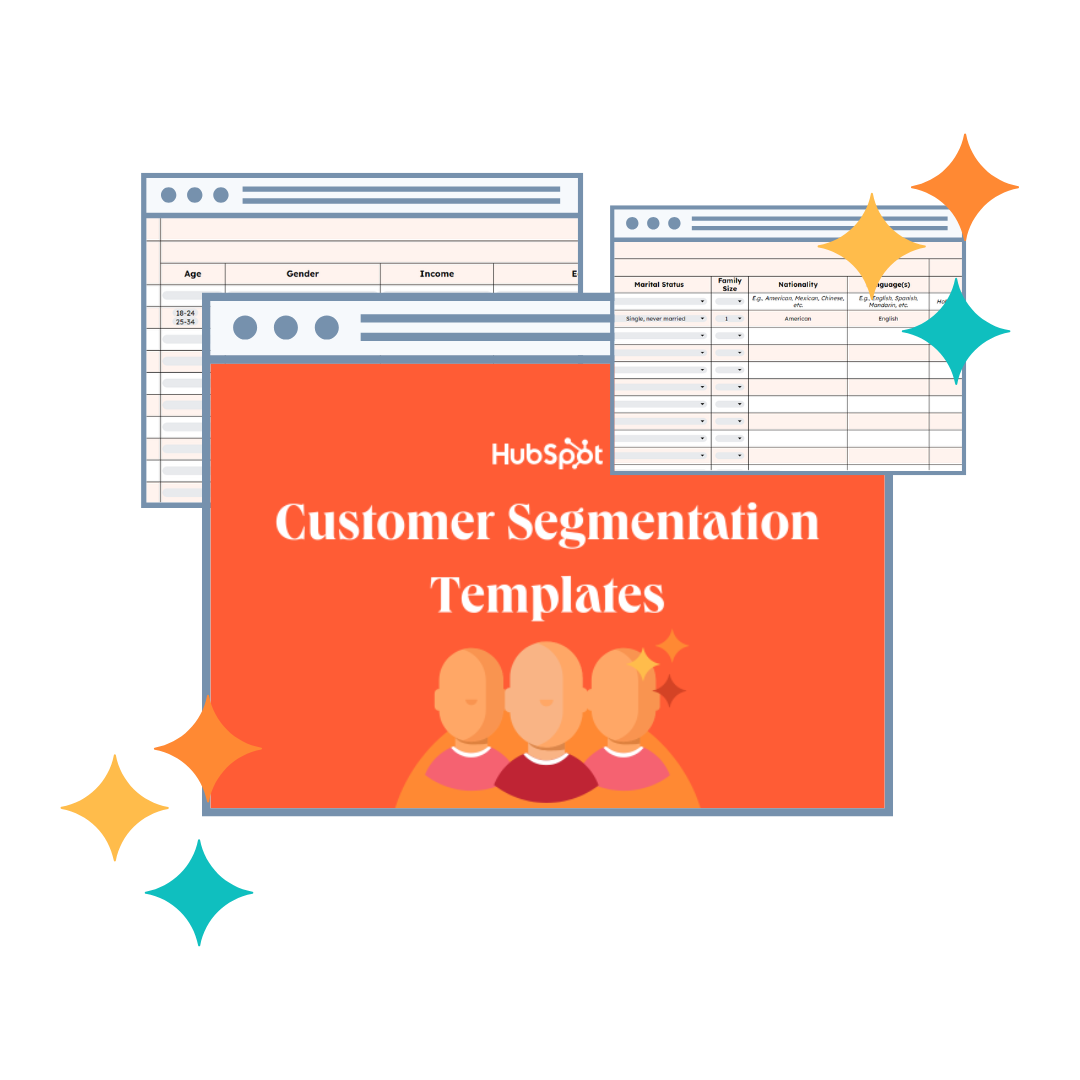
Free Customer Segmentation Templates
A comprehensive template to help you create detailed customer profiles based on characteristics, including...
- Demographics
- Psychographics
- Technographics
- And more!
Download Free
All fields are required.
Form not available
What are the benefits of customer segmentation?
1. Get a competitive marketing edge.
Segmenting customers goes beyond putting people into categories. When marketers segment customers, they learn about them in depth and can use that information to create content tailored to each segment’s unique needs and challenges.
“If you deliver a personalized customer experience via email or CRM, you’ll always have an edge over competitors that use a one-size-fits-all approach,” says Michael Maximoff, co-founder at Belkins.
Maximoff points to Driveline, a retail brand that Belkins worked with to generate leads. To get the best results, Maximoff’s team split Driveline’s ideal customers into two segments. The first was retailers; the second, brands.
Maximoff continues, “We then drilled down again and divided each segment into previous and new clients before sending them customized messages. The outcome of this customer segmentation process was the closing of a $1.5M deal.”
2. Target customers better with paid campaigns.
Customer segmentation improves marketing ROI by making campaigns more relevant to each group. Whether a team is running PPC, LinkedIn ads, or Facebook ads, segmentation can help focus ad spend on audiences that are more likely to respond.
“With paid marketing on social media, we’ve realized that we need to know our audience demographics and their interests. By segmenting customers into different groups, we can identify the unique needs, preferences, and behaviors of each segment,” says Adam Wright, founder of Human Tonik.
Segmentation helps marketers match ads to customer needs, preferences, and behaviors. It can also help teams focus their budget and effort on higher-value customer groups rather than treating every segment the same.
3. Improve your email nurture campaigns.
What appeals to Gen Z might not appeal to millennials. The same can be true for entry-level employees and directors in the same field, whose priorities, responsibilities, and information needs can differ. Understanding these differences helps marketers organize customers into email segments and send more relevant nurture messages that build affinity for the brand.
Corey Donovan, president of Alta Technologies, says this shows customers a business wants to cater to their needs rather than clutter their inboxes.
4. Strengthen your support and communication.
Client segmentation doesn’t just improve marketing — it also helps businesses deliver better customer experiences after the sale. By understanding the unique needs and behaviors of different customer groups, support teams can anticipate common challenges, personalize their outreach, and communicate through the channels customers prefer.
Windy Pierre, an ecommerce and performance marketing leader, says segmentation is the cornerstone of his strategy. Pierre says, “At its core, segmentation allows us to meet customers where they are in their buying journey, tailoring our communication and support to drive both satisfaction and loyalty.”
This deeper understanding also helps businesses identify opportunities to improve their products, services, and support resources for specific customer segments, making it easier to resolve issues efficiently while building stronger long-term relationships.
Types of Customer Segmentation
Customer segmentation models organize customers based on shared data. The eight models below cover demographic, geographic, psychographic, behavioral, technographic, needs-based, value-based, and firmographic segmentation. Teams can also use predictive segmentation to combine historical data and modeled patterns to anticipate likely customer behavior.

1. Demographic Segmentation
Demographic segmentation categorizes customers based on measurable personal characteristics. Common criteria include age, gender, income, education, occupation, generation, ethnicity, and marital status. Businesses can combine demographic variables when those characteristics are relevant to a product, service, or campaign.
For example, a luxury clothing brand could segment customers by income and age, then promote different styles and price points to the groups most likely to find them relevant.
Brands can also use demographic segmentation for market research, customer-experience planning, and brand strategy.
Benefits
- Helps brands send more personalized marketing messages.
- Helps teams focus campaign budgets on the audiences most relevant to the offer.
- Makes it easier to compare segment trends and map customer journeys over time.
2. Geographic Segmentation
Geographic segmentation divides customers based on location, including country, state or province, region, city, or neighborhood. Segmenting customers geographically can help marketing teams tailor messaging, products, and campaigns to local circumstances. Beyond physical location, geographic segmentation can incorporate context such as:
- Preferred language. Adapt communications and ads to the language customers prefer.
- Transportation. Consider how customers move through a location when planning out-of-home campaigns.
- Workspace. Consider where and how customers work when that context affects the product or message.
With this segmentation model, brands can tailor campaigns for:
- Locations observing different holidays or events.
- Seasonal needs that vary by region or time of year.
- Regions with different cultures, regulations, or market conditions.
Benefits
- Helps teams tailor offers and pricing to local market conditions.
- Makes campaigns more relevant to customers in different locations.
- Helps businesses account for local regulations and market constraints before launch.
3. Psychographic Segmentation
Psychographic segmentation groups customers based on characteristics such as personality, attitudes, values, interests, lifestyles, and opinions. These factors can help marketers understand what motivates different customer groups and which messages or offers may resonate with them.
For example, a footwear brand could group customers by interests such as running, basketball, or hiking, then tailor messages and product recommendations to each interest group.
Benefits
- Helps brands tailor messages to customers’ interests, values, and motivations.
- Can reveal shared interests that connect customers within a segment.
- Gives marketers additional context for personalizing campaigns and customer experiences.
4. Behavioral Segmentation
Behavioral segmentation groups customers based on their actions and habits. Behavioral segmentation can track purchase history, product usage, support requests, website activity, and engagement across social media and email. Common behavioral segments include:
- Lifecycle stage. Group customers by where they are in the customer journey, such as new, repeat, or loyal customers. Pierre says, “Segmented campaigns targeting mid-value customers with personalized offers saw a 12% increase in upsell success rates compared to generic campaigns.”
- Website activity. Group customers by website actions, such as the first page they visit, the landing page they click through to, or how often they return.
- Last customer engagement. Group customers by their most recent interaction with the business. A positive interaction may indicate readiness for a relevant offer; a negative interaction can signal that the service or success team should follow up.
- Ecommerce activity. Group customers by actions in an online store, such as abandoned carts, past purchases, or product page visits. Pierre says, “Customers who frequently abandon carts are flagged for proactive engagement, an automated follow-up email sequence offering incentives or assistance. This strategy reduced cart abandonment by 8%.”
CRM platforms centralize behavioral information such as purchase history, inquiries, referrals, voucher redemptions, and customer complaints.
Benefits
- Can support cart-recovery campaigns with more relevant messages.
- Helps teams spot negative behavior and feedback, enabling service reps to respond quickly.
- Supports purchase-history-based recommendations for existing customers.
5. Technographic Segmentation
Technographic segmentation groups customers by the technologies they use, such as device type, browser, operating system, software stack, and AI. For B2B teams, technographic data can also include the software products a company uses, which can signal integration requirements or likely use cases.
For example, a software company might create different segments for mobile-first users, teams using a particular operating system, or accounts whose technology stack points to a need for a specific integration. Teams can use that context to tailor product guidance, onboarding, and marketing.
Benefits
- Helps teams tailor experiences to the devices and technologies customers use.
- Highlights integration or compatibility needs that may shape product fit.
- Supports more relevant onboarding, education, and product recommendations.
Free Customer Segmentation Templates
A comprehensive template to help you create detailed customer profiles based on characteristics, including...
- Demographics
- Psychographics
- Technographics
- And more!
Download Free
All fields are required.
Form not available
6. Needs-Based Segmentation
Needs-based customer segmentation groups customers based on the problems they aim to solve, the goals they seek to achieve, or the outcomes they expect from a product or service. Instead of focusing primarily on who customers are, needs-based segmentation focuses on why they buy.
For example, two customers may be the same age and have similar incomes but need different things from a project-management tool. One may prioritize team collaboration, while another may value automation that saves time. Businesses can use those differences to tailor messaging, product recommendations, and customer experiences. Some needs-based segments include:
- Product attributes: Group customers by the features, functionality, quality, or pricing they value most.
- Service needs: Group customers by the support, onboarding, training, or service they need to succeed.
- Delivery method: Group customers by how they prefer to receive products or services, such as online, in-store, self-service, or subscription.
Benefits
- Helps teams uncover customer problems that existing or new solutions could address.
- Supports more relevant messages for different customer needs.
- Helps businesses identify needs shared across multiple customers.
7. Value-Based Segmentation
Value-based segmentation groups customers based on the value they bring to a business over time. Teams may consider factors such as customer lifetime value, profitability, purchase frequency, or revenue potential.
For example, a subscription software company might identify its highest-value customers as those with long-term contracts, multiple product subscriptions, and low churn risk. It could prioritize those customers for premium support, exclusive offers, or loyalty programs while using different strategies to nurture lower-value segments.
Pierre says, “I categorized customers into tiers — high-value, mid-value, and low-value — and aligned support levels accordingly. High-value customers were given priority access to live chat and dedicated account managers, while mid-value customers received proactive check-ins through automated email workflows.” Value-based customer segments can draw on measures such as:
- Customer satisfaction and loyalty (CSAT) helps teams assess satisfaction, while NPS categorizes respondents as promoters, passives, or detractors. Pierre tells me, “After introducing segmentation-based support, CSAT scores for high-value customers rose by 15% within three months as they appreciated the tailored, high-touch approach.”
- Number of purchases. Purchase frequency can be one signal of a customer’s value, depending on the business model and the value of each transaction.
- Average purchase value helps distinguish customers whose transactions contribute different levels of revenue.
Benefits
- Helps teams prioritize resources for higher-value customer groups.
- Gives businesses another way to understand differences within an existing customer base.
- Supports differentiated messaging, service, and retention strategies based on customer value.
8. Firmographic Segmentation
Firmographic segmentation is a B2B approach that groups companies rather than individuals. It organizes business customers using shared company characteristics such as industry, company size, annual revenue, location, growth stage, or business model.
For example, a CRM provider might segment customers into startups, mid-market businesses, and enterprise organizations because those groups can have different budgets, buying processes, and product needs. Startups may prioritize affordability and ease of use, while enterprise customers may require advanced security, integrations, and dedicated support. Common firmographic segments include:
- Industry. Group companies by the market in which they operate, such as healthcare, manufacturing, retail, or financial services.
- Company size. Segment businesses by employee count or revenue to align offers with organizational scale and complexity.
- Growth stage. Distinguish startups, scaling businesses, and mature enterprises when their priorities and buying requirements differ.
- Business model. Group companies by models such as B2B, B2C, SaaS, ecommerce, or nonprofit.
Firmographic segmentation can support account management, expansion outreach, and customer success planning by helping teams tailor strategies to business customers with different company profiles.
Benefits
- Helps B2B sales and marketing teams focus on accounts that match their ideal customer profile.
- Supports messaging tailored to company industry, size, growth stage, or business model.
- Helps teams prioritize accounts based on fit and potential long-term value.
Featured resource: Customer Segmentation Templates
How to Segment Your Customers in 6 Steps
Customer segmentation is only valuable if you put your segments into action. Follow these six steps to build meaningful customer segments and use them to improve your marketing, sales, and customer experience. Check out these companies that have mastered customer segmentation for inspiration.
1. Define your segmentation goals and variables.
Start by identifying what you want to achieve with customer segmentation. Are you looking to improve email engagement, increase retention, personalize your website, or optimize your paid campaigns? Your objective will determine which segmentation model and variables make the most sense.
For example, if the goal is to reduce churn, behavioral data like product usage and purchase history may be more valuable than demographic information.
2. Prioritize your segmentation goals.
It can be tempting to segment customers in every possible way, but too many segments can become difficult to manage. Instead, prioritize the goals that will have the biggest impact on your business and start with one or two high-value segmentation strategies.
As the team gains confidence, layer in additional segmentation criteria to create more personalized campaigns.
3. Collect and organize customer data.
Next, gather the data you’ll use to build your segments. Pull information from your CRM, website analytics, email platform, ecommerce platform, customer surveys, support software, and other data sources to create a complete customer profile.
Before creating segments, clean and organize your customer data to remove duplicates, standardize fields, and ensure the information is accurate and up to date. Marketing Hub enables teams to build and activate targeted groups from unified customer and audience data.
Pro tip: This guide can help you find the right customer data types for your new customer segmentation strategy. You can also collect additional qualitative and behavioral customer data through:
4. Build your segments.
With your customer data organized, you can start creating segments based on the characteristics that matter most to your goals. Each segment should represent a group of customers with shared needs, behaviors, or traits that justify a different marketing, sales, or customer success strategy.
Aim for segments that are specific enough to support personalization but broad enough to make a measurable business impact. They should also be stable over time, easy for your team to understand, and simple to activate across your CRM, email platform, advertising tools, and other marketing channels.
As your segmentation strategy matures, consider combining multiple segmentation models, such as demographic, behavioral, and psychographic data, to create richer customer profiles. Predictive segmentation can use historical data, AI, and machine learning to identify patterns and estimate likely customer behavior. Dynamic segmentation platforms automatically update segments when customer data changes.
Pro tip: Learn how to segment and nurture your customers with HubSpot.
5. Activate your segments.
Once segments are built, put them to work across your customer journey. Personalize email campaigns, tailor website experiences, create targeted advertising audiences, prioritize sales outreach, or deliver customized customer support based on each segment’s needs.
The more consistently your teams use segmentation, the more value you’ll get from your customer data. You can use segment data to:
- Enhance each experience.
- Create more meaningful landing pages.
- Personalize emails.
- Prioritize customer outreach.
- Figure out the best timing for outreach.
- Anticipate support needs.
- Create new targeted content.
- Solve issues faster.
6. Review and refine regularly.
Customer behavior changes over time, so your segments should evolve, too. Review your segmentation strategy regularly to ensure your customer groups still reflect current behaviors, preferences, and business goals. Also, set clear criteria for each segment so you can move customers in and out of the groups as they meet or no longer meet the criteria.
Track key metrics like engagement, conversion rates, retention, and customer lifetime value to identify opportunities to adjust your segments and improve results.
Customer Segmentation Analysis
Customer segmentation isn’t a one-time project. As a business’s customers, products, and market evolve, its segments should evolve with them. Regular customer segmentation analysis helps marketers validate assumptions, identify new opportunities, and ensure that marketing, sales, and customer success teams are targeting the right audiences.

1. Review your segments for accuracy.
Start by verifying that the data powering the segments is still accurate and complete. Changes to products, pricing, customer behavior, or data sources can make once-reliable segments less effective. Compare data across the CRM, analytics, and marketing platforms to identify inconsistencies, and update segmentation criteria when necessary.
2. Measure segment performance against your KPIs.
Evaluate how each segment is performing against the metrics that matter most to the business, whether that’s conversion rate, customer retention, revenue, customer lifetime value, or engagement. Comparing segment-level performance to overall business goals can reveal which audiences deserve more investment and which may need to be redefined.
3. Gather feedback from internal teams.
Marketing, sales, customer success, and support teams interact with customers every day and often spot changes before the data does. Regularly ask stakeholders whether the current segments reflect real customer needs, buying behaviors, and common challenges. Their feedback can uncover opportunities to refine the segmentation strategy.
4. Collect customer feedback.
Quantitative data tells marketers what customers are doing, but customer feedback explains why. Use surveys, interviews, website feedback, support conversations, and social listening to validate segments and uncover emerging needs. Marketers may also find that different segments respond better to different feedback channels, so they should tailor their outreach accordingly.
5. Activate updates quickly.
Once marketers have identified changes, they should update their CRM, segments, workflows, and campaigns as soon as possible. Customer segmentation analysis only creates value when the insights are reflected in marketing, sales, and service strategies. Treat segmentation as an ongoing optimization process, regularly reviewing and refining customer groups as the business and its customers change.
Customer Segmentation Software
Customer segmentation tools solve different parts of the process, from organizing CRM data to resolving customer identities, targeting social audiences, analyzing customer feedback, and activating email segments. The five tools below are best suited to different segmentation needs.
1. Marketing Hub

Marketing Hub brings customer data, segmentation, campaign activation, and measurement into the same marketing workflow. Its audience segments feature uses HubSpot’s AI to help marketers discover high-value audiences, build precise segments using CRM and web visitor data, and activate those segments across marketing channels.
Teams can also create active and static CRM segments. Active segments update automatically as records meet or no longer meet the selected criteria, while static segments capture a snapshot of records at a particular point in time. HubSpot’s AI can also support AI-assisted customer segmentation.
Key Features
- AI-powered segment discovery: HubSpot’s AI analyzes available data to surface potentially valuable audience groups.
- Active and static CRM segments: Teams can use continuously updating segments or fixed snapshots, depending on the campaign.
- Connected activation: Segments can move from discovery and creation into marketing activation without exporting customer data into a separate tool.
Best for: Marketing and RevOps teams that want segmentation connected to CRM data and campaign activation, as well as enterprise teams that need shared customer definitions across functions.
Pricing
- Free: $0/month
- Starter: $7/month-per-seat offer for eligible new customers
- Professional: $800/month with an annual commitment or $890/month month-to-month, including three Core Seats plus a required $3,000 onboarding fee
- Enterprise: $3,600/month, including five Core Seats plus a required $7,000 onboarding fee. Marketing-contact volume can affect total cost.
What I like: Marketing Hub connects the discover-build-activate segmentation workflow directly to the customer data and marketing channels that teams use.
Pro tip: Learn how to create a contact management and segmentation strategy with HubSpot, or get started with these free customer segmentation templates.
2. Experian Identity Resolution

Experian Identity Resolution helps marketers connect fragmented online and offline identifiers into clearer consumer profiles. Experian’s current Resolution products include digital and offline identity graphs, offline identity resolution, identity append, and an activity feed.
For segmentation, the key benefit is a cleaner identity foundation: teams can consolidate duplicate or fragmented records, connect identifiers across channels and devices, and use that data to create more informed audience segments.
Key Features
- AI-driven identity resolution: Connects digital and offline identifiers to create a more unified view of consumers.
- Data cleansing and consolidation: Experian’s offline identity-resolution tools standardize records, correct or remove duplicates, and connect customer data to persistent profiles.
- Identity graphs: Digital and offline graphs help marketers connect identifiers across channels and devices.
Best for: Mid-market and enterprise organizations with large or fragmented customer databases that need to improve identity resolution before building cross-channel audience segments.
Pricing: Pricing available on request.
What I like: Experian addresses a prerequisite that segmentation teams sometimes skip: resolving fragmented identities and improving data quality before creating increasingly precise segments.
Pro tip: Run identity resolution before creating highly granular segments. Cleaner, better-connected records reduce the risk of building multiple segments around what is actually the same customer.
Free Customer Segmentation Templates
A comprehensive template to help you create detailed customer profiles based on characteristics, including...
- Demographics
- Psychographics
- Technographics
- And more!
Download Free
All fields are required.
Form not available
3. Sprout Social

Sprout Social is a social media management platform with Audience Targeting capabilities for organic publishing. Teams can use Audience Targeting in Compose to target Facebook and LinkedIn posts using network-specific criteria.
Sprout Social is therefore a narrower customer-segmentation tool than a CRM or identity-resolution platform: it is most useful when the segment needs to be targeted for a social post.
Key Features
- Facebook audience targeting: Apply available demographic, interest, and location criteria when publishing eligible Facebook content.
- LinkedIn audience targeting: Target eligible LinkedIn content by professional and firmographic criteria such as company size, industry, seniority, and location.
- Integrated publishing workflow: Apply targeting from Sprout’s Compose workflow rather than building a separate publishing process.
Best for: Marketing teams on Sprout Social Professional or Advanced that need to turn customer or audience segments into targeted organic Facebook and LinkedIn content.
Pricing
- Essentials, starting at $79/seat/month
- Standard, $199/seat/month billed annually or $249 month-to-month
- Professional, $299/seat/month billed annually or $399 month-to-month
- Advanced, $399/seat/month billed annually or $499 month-to-month
- Enterprise, custom pricing
What I like: Audience Targeting connects segmentation directly to organic social publishing, making Sprout useful when channel activation — rather than CRM segmentation itself — is the primary need.
Pro tip: Use audience targeting alongside Sprout Social analytics to compare how different targeted groups respond, then feed those insights back into the broader segmentation strategy.
Sprout Social also offers a HubSpot Marketplace integration to connect social activity with HubSpot.
4. Qualtrics

Qualtrics helps teams combine customer feedback, experience data, and behavioral signals to understand differences among customer groups. Its experience-management tools collect feedback across channels and use AI and analytics to help teams identify patterns, understand customer needs, and act on those insights.
For segmentation teams, Qualtrics is particularly useful when the “why” behind customer behavior matters as much as the CRM record itself.
Key Features
- Omnichannel listening: Collects feedback and experience data across multiple customer touchpoints.
- AI-assisted analysis: Analyzes structured and unstructured feedback to surface patterns and trends.
- Segmentation and customer insight: Helps teams use experience and operational context to distinguish meaningful customer groups.
Best for: Mid-market and enterprise organizations that want to combine customer feedback and experience data with operational customer information.
Pricing: Pricing available on request.
What I like: Qualtrics complements CRM-based segmentation with qualitative and experience data that can explain why customers in otherwise similar groups behave differently.
Pro tip: Use Qualtrics alongside your CRM rather than treating it as a replacement. The CRM can establish customer identity and activity, while experience data can add context about needs, preferences, and feedback.
5. Mailchimp

Mailchimp is an email marketing and automation platform with customer segmentation tools for grouping contacts by engagement, purchase behavior, demographics, predicted behavior, and other audience data. Standard email marketing segmentation is available across all Mailchimp plans, while Premium adds advanced segmentation capabilities.
Mailchimp also offers predictive segmentation for use cases such as identifying customers who may be likely to purchase again or churn.
Key Features
- Standard segmentation: Build segments using contact, engagement, and behavioral criteria.
- Predictive segmentation: Use modeled customer behavior to identify groups for targeted offers or retention campaigns.
- Advanced segmentation: Premium users can apply more sophisticated segmentation conditions.
Best for: Small and mid-sized businesses that want customer segmentation closely connected to email marketing and automation.
Pricing
- Free, $0/month
- Essentials, starting at $13/month
- Standard, starting at $20/month
- Premium, starting at $350/month
What I like: Mailchimp makes segmentation immediately actionable for email-first teams without requiring a separate enterprise segmentation platform.
Pro tip: Start with Mailchimp’s pre-built and standard segments, then add custom or predictive criteria when a campaign has a clear reason to treat a customer group differently.
Mailchimp also offers HubSpot Marketplace integrations that sync contacts and email activity between the two platforms.
Common Customer Segmentation Challenges
Data Quality
Customer segmentation is only as accurate as the data behind it. Duplicate records, outdated contact information, inconsistent formatting, and missing customer data can all lead to inaccurate segments and ineffective campaigns. Poor data quality can result in customers receiving irrelevant messaging, being assigned to the wrong audience, or being excluded from campaigns altogether, making it difficult to personalize the customer experience.
How to avoid it: Regularly audit CRM and customer databases for duplicate, incomplete, or outdated records. Standardize data collection across systems, validate new customer information at the point of entry, and use data enrichment or identity resolution tools when appropriate. The cleaner the customer data, the more reliable the segments will be.
Over-Segmentation
Creating too many customer segments can make a marketing strategy unnecessarily complicated. While personalization is valuable, dozens of highly specific segments can become difficult to manage, leaving teams with too many campaigns to build and audiences too small to produce meaningful results.
How to avoid it: Start with a handful of high-impact segments tied to business goals, then expand only when there’s a clear need. Focus on segments that are large enough to justify personalized messaging and different enough to require distinct marketing, sales, or customer success strategies.
Stale Segments
Customers’ needs, behaviors, and preferences change over time, so once accurate segments can become outdated. New products, pricing changes, market trends, or shifts in customer behavior may all affect whether a customer still belongs in a particular segment. If segments aren’t updated regularly, personalization becomes less effective.
How to avoid it: Treat customer segmentation as an ongoing optimization process rather than a one-time exercise. Review your segments on a regular cadence, monitor key performance metrics, and update your criteria as customer behavior and business priorities evolve. Whenever possible, use dynamic segments, such as HubSpot’s active segments, that automatically update as customer data changes.
Cross-Team Misalignment
Customer segmentation is most effective when marketing, sales, and customer success teams work from the same customer definitions. If each department creates its own segments or uses different criteria, customers may receive inconsistent messaging and disconnected experiences throughout the customer journey.
How to avoid it: Establish shared segmentation criteria and document how each customer segment is defined. Store segments in a centralized CRM or customer data platform so every team works from the same source of truth. Regular cross-functional reviews can also help ensure the segmentation strategy continues to support company-wide goals.
Frequently Asked Questions
What are the 4 types of customer segmentation?
The four primary types of customer segmentation are demographic, geographic, psychographic, and behavioral segmentation. Demographic segmentation groups customers by characteristics such as age or income; geographic segmentation groups them by location; psychographic segmentation focuses on values and interests; and behavioral segmentation groups customers by actions such as purchase history, product usage, or engagement.
Businesses may also use technographic, needs-based, value-based, and firmographic segmentation when these models better align with their goals.
What are some examples of customer segmentation?
Businesses can segment customers in many ways depending on their goals. Common examples include grouping customers by age, location, purchase history, customer lifetime value, industry, preferred communication channel, device type, shopping behavior, or product interests.
For example, an ecommerce retailer might create separate campaigns for first-time shoppers, repeat customers, and customers who have abandoned carts. A B2B software company might segment customers by company size and industry.
What are the 4 segmentation strategies?
The four classic segmentation strategies are demographic, geographic, psychographic, and behavioral segmentation. Together, they help businesses understand who customers are, where they are located, what motivates them, and how they interact with a brand. Organizations can combine multiple strategies when a single model does not provide enough detail.
What are the five customer segment groups?
There is no universally accepted list of five customer segment groups. One practical lifecycle framework includes new, active, loyal, at-risk, and inactive or churned customers. Businesses can use lifecycle segments to tailor marketing, sales, service, and retention strategies based on the customer relationship.
Segment customers to grow better.
Customer segmentation turns customer data into a practical way to make marketing, sales, and service more relevant. Strong segmentation strategies start with clear goals and reliable data, then evolve as customer behavior and business priorities change.
The next step is activation. With audience segments in Marketing Hub, teams can use HubSpot’s AI to discover high-value audiences, build precise segments from connected customer and visitor data, and use those segments across marketing channels. Explore HubSpot’s audience segmentation tools to put your segments to work in personalized campaigns.
Editor’s note: This article was originally published in February 2020 and has since been updated for comprehensiveness.
Free Customer Segmentation Templates
A comprehensive template to help you create detailed customer profiles based on characteristics, including...
- Demographics
- Psychographics
- Technographics
- And more!
Download Free
All fields are required.
Form not available