AI has made it easier than ever to create content. The hard part now isn’t producing more content, as any AI writer can do that. Instead, it’s about producing content that actually performs. 
That’s where the right AI content marketing tool makes a difference. The right tool will go beyond just content creation and also help content teams plan, optimize, distribute, and analyze content.
This guide covers the best AI content marketing tools that are available, what to look for when evaluating them, and how to choose a platform that drives real results.
Table of Contents
- What is an AI content marketing tool?
- How to Choose an AI Content Marketing Tool
- Best AI Content Marketing Tools for Websites
- How I Chose and Tested the Best AI Content Marketing Tools
- Frequently Asked Questions About AI Content Marketing Tools
What is an AI content marketing tool?
An AI content marketing tool is software that uses artificial intelligence to plan, create, optimize, distribute, and analyze content across websites and other digital channels.
Unlike standalone AI writing tools, these platforms are designed to support the full content lifecycle. A quality tool can connect ideation and production with SEO performance, user behavior, and conversion data.
Most modern AI content marketing tools combine multiple capabilities into a single system. This can include some or all of the following features:
- Generating blog posts or landing pages.
- Recommending keywords and on-page optimizations for SEO.
- Personalizing content for different audiences.
- Running experiments to optimize content performance.
- Tracking how content contributes to traffic, leads, and revenue.
The most effective tools go a step further by integrating directly with an organization’s CMS and CRM, so teams’ content strategies are informed by real customer data, rather than just prompts and estimates.
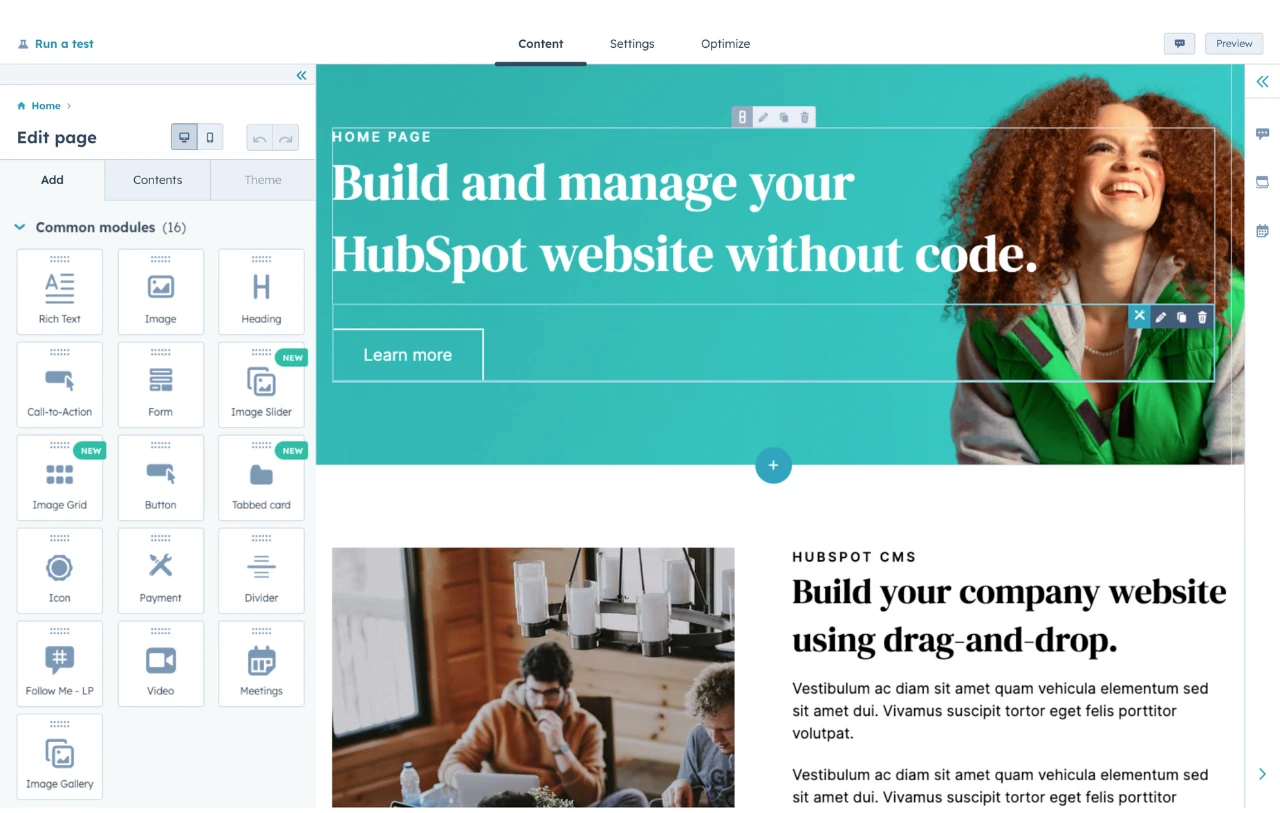
HubSpot's Free Website Builder
Create and customize your own business website with an easy drag-and-drop website builder.
- Build a website without any coding skills.
- Pre-built themes and templates.
- Built-in marketing tools and features.
- And more!
Key Benefits of Using an AI Content Marketing Tool
The right AI content marketing tool reduces manual work, improves content performance, and gives teams clearer visibility into what’s driving results.
Here’s how the right platform delivers value across a content team’s workflow.
- Faster content production at scale: Content teams can generate outlines, drafts, and variations in minutes, publishing more high-quality content without increasing headcount.
- Improved SEO performance: Teams rank content more effectively with real-time recommendations for keywords, structure, and internal linking.
- Data-driven decision making: Connecting content performance to metrics like traffic, engagement, and conversions helps teams prioritize content that drives measurable results.
- Personalized user experiences: Teams can dynamically tailor content based on visitor behavior, lifecycle stage, or CRM data to increase relevance and conversion rates.
- Continuous optimization and experimentation: AI-driven insights replace guesswork, helping teams run A/B tests, iterate on content, and refine messaging over time.
- Easier budgeting: AI reduces content production costs and provides teams with a clearer basis for planning their content marketing budget.
How to Choose an AI Content Marketing Tool
Choosing the right AI content marketing tool isn’t just about picking the one with the longest feature list. Instead, it’s about selecting a platform that fits seamlessly into an organization’s existing website and marketing stack.
One of the common mistakes teams make is adopting disconnected AI tools that generate content but don’t integrate with their CMS, analytics, or CRM. These siloed tools can often lead to more manual work, fragmented data, and limited impact on actual performance.
The best AI content marketing tools tightly integrate with the website, allowing content teams to create, publish, optimize, and measure content in one place. Platforms that connect directly to a CMS and customer data can automate workflows, personalize experiences, and tie content efforts to real business outcomes.
Here are some important things to consider when choosing an AI content marketing tool…
1. Tight CMS Integration
To avoid slowing down workflows rather than speeding them up, it’s essential for content teams to look for AI content marketing tools that integrate well with their content management systems.
Copying and pasting between tools or relying on other workarounds adds friction and, for larger teams, can reduce team buy-in.
AI tools that integrate directly with a CMS can automatically publish content, update sitemaps, and ensure faster indexing. Integrated tools remove bottlenecks and speed up content teams’ workflows.
Look for:
- Direct publishing to platforms like HubSpot CMS or WordPress, or at minimum a lightweight integration like a browser extension or Zapier.
- Real-time content updates and syncing that eliminate copy/paste workflows and keep content consistent across systems.
- API-first or headless architecture provides flexibility across channels, though this is typically only a requirement for larger enterprise organizations with more complex workflows.
Some tools even include built-in CMSs, offering the tightest integration possible. For example, HubSpot Content Hub includes its own flexible CMS and a suite of AI content marketing tools.
Different types of organizations might require different types of integrations:
- SMBs often lack dedicated technical teams, making ease of use and no-code integrations the top prioritySMBs
- Mid-market organizations may need more scalable workflows than SMBs, though no-code integrations are still preferable where possible.
- Enterprise organizations typically require more flexible integrations, such as APIs or other technical solutions, to support complex workflows at scale.
2. End-to-End Content Lifecycle Capabilities
Many AI tools focus only on content creation and AI article writing. While writing functionality is a key part of an AI content marketing tool, it’s only one aspect of what a true content marketing tool should offer.
The most effective tools support the full content lifecycle, from ideation to iteration:
- Content ideation and keyword research give teams a data-backed starting point.
- AI-assisted writing and editing accelerate production without sacrificing quality.
- On-page SEO optimization ensures content is structured to rank.
- Content distribution and publishing tools connect creation directly to delivery.
- Performance tracking and iteration close the loop between content and results.
The value of end-to-end capabilities depends on team size and complexity:
- Small teams reduce tool sprawl by consolidating multiple workflows into one platform.
- Growing teams can standardize processes across content, SEO, and growth.
- Enterprise organizations can align content with broader digital experience strategies.
Teams that consolidate these workflows into one platform spend less time on tool management and more time on content that drives results.
3. Data, Analytics, and ROI Visibility
If there’s no way to connect content to results, it’s difficult for content teams to justify the use of AI content marketing tools.
Whenever possible, look for tools that provide their own content analytics, or at least the ability to integrate with analytics platforms that do.
The most impactful analytics features to look for:
- Built-in analytics dashboards (traffic, engagement, conversions)
- Attribution tracking tied to leads or revenue
- Predictive insights (what content will perform next)
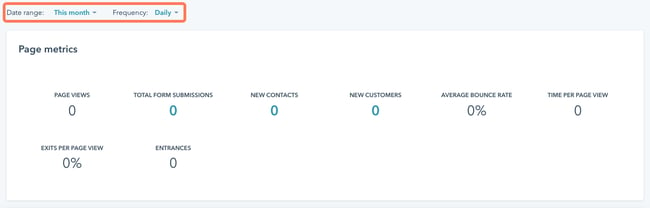
Analytics needs vary significantly depending on team size and technical maturity.
- SMBs benefit most from simple dashboards and clear content performance metrics that make it easy to quickly assess effectiveness.
- Mid-market teams should look for funnel attribution and campaign reporting that ties specific pieces of content or campaigns to actual revenue.
- Enterprise organizations typically require advanced analytics, forecasting, and BI integrations, including the ability to connect to existing data warehousing solutions.
The common thread across all three is attribution — knowing which content is driving results and where to invest next
4. Personalization and Customer Data Integration
Where AI content marketing can really take off is by using AI tools to create personalized experiences for different visitors.
An AI-powered content platform can automatically tailor content to individual users, improving engagement and conversion rates without manual intervention.
Manual content personalization can be difficult at scale because it requires significant effort to write content variants for each segment. By having AI tools handle personalized variants, it’s much easier to scale personalization efforts.
Connecting an AI content marketing tool to a CRM unlocks the full potential of content personalization. For example, HubSpot Content Hub’s all-in-one platform can seamlessly pull in real user data from the CRM to support AI content personalization efforts.
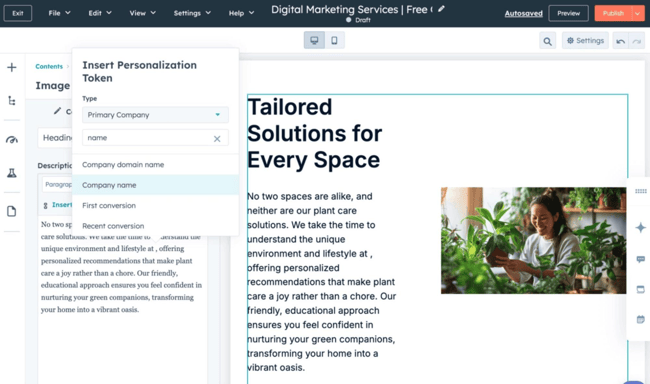
Look for:
- Dynamic content personalization based on behavior or lifecycle stage
- CRM integration for audience segmentation
- AI-created personalized content
- AI-driven recommendations for segments and targeting rules
Personalization needs grow with organizational complexity and available customer data:
- SMBs can already achieve meaningful results with basic segmentation and personalization, even without a large tech stack.
- Mid-market teams are well-positioned to implement more complex behavior-based targeting as their customer data matures.
- Enterprise organizations typically require real-time personalization across multiple channels, supported by deep CRM and data integrations.
Personalization doesn’t have to be complex to be effective, and even basic CRM-connected targeting outperforms one-size-fits-all content.
5. Brand Voice Controls and Governance
Effective AI content marketing requires governance features like brand voice controls and approval workflows. Scaling content with AI introduces risk if outputs are inconsistent or off-brand. Without consistency in voice and tone, content can feel disjointed and unpolished.
Quality AI tools for content marketing should include features to maintain a consistent brand voice across all channels and enforce brand style guidelines. The most important capabilities to look for:
- Brand voice training and tone controls keep outputs aligned with existing style standards.
- Style guide adherence ensures every piece of content reflects the organization’s established guidelines.
- Approval workflows and permissions add a layer of manual oversight before content is published.
- Collaboration features allow teams to review, comment, and refine content without leaving the platform.
The right level of governance depends on how many contributors are involved and how much content the team is producing. For most organizations, needs fall into three categories:
- SMBs can maintain consistent messaging without heavy editing by setting clear voice parameters upfront.
- Mid-market teams benefit from shared style guides and contributor workflows that maintain standards across multiple teams.
- Enterprise organizations typically require formal governance, compliance controls, and multi-stage approval processes at scale.
Many modern AI tools now include brand voice modeling and workflow controls, making consistency achievable even as content volume grows
6. Ease of Use and Time-to-Value
A powerful tool is useless if teams can’t adopt it quickly. The best AI content marketing tools are the ones that actually get used, which means ease of adoption matters as much as the feature set.
When evaluating options, prioritize these usability capabilities:
- An intuitive UI and low learning curve reduce the time between onboarding and productive use.
- No-code or low-code workflows allow content teams to move faster without relying on developers.
- Fast onboarding and implementation mean teams start generating value in days, not months.
- Optimized experiences for different user types, such as writers versus editors, ensure the tool works for everyone on the team.
No-code integrations and user-friendly interfaces are becoming the norm. Usability requirements still vary by organization size and technical resources, though:
- SMBs should prioritize simplicity and fast setup, especially when there is no dedicated technical team in place.
- Mid-market teams need to balance usability with advanced features, since simplicity alone may not support more complex workflows.
- Enterprise organizations should look for platforms that scale without sacrificing adoption or team buy-in.
Ultimately, the best AI content marketing tool is the one the entire team will actually use consistently.
Best AI Content Marketing Tools for Websites
While there are many AI content writing tools, not all integrate into broader content marketing workflows.
The tools below were selected because they integrate directly with a CMS, allowing content teams to create, publish, optimize, and measure content in a single system.
Best overall: HubSpot Content Hub
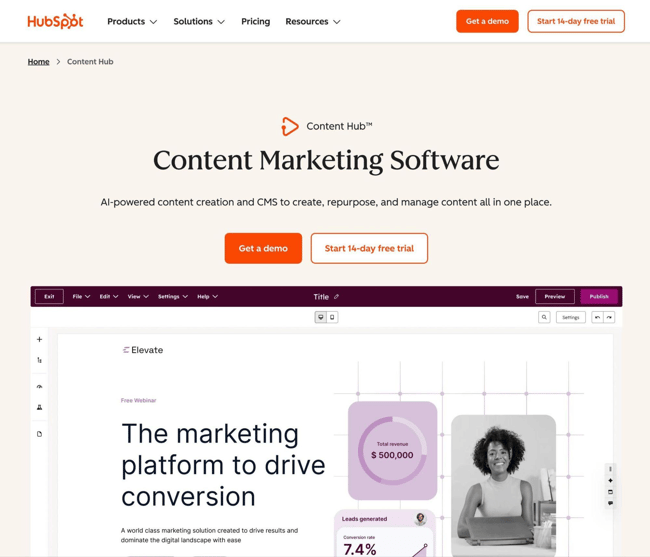
HubSpot Content Hub stands out as a complete AI content marketing platform because it combines a full CMS, AI content generation, SEO optimization, personalization, and analytics in one unified system.
Unlike standalone tools, Content Hub is built on top of HubSpot’s free CRM. That means every piece of content — from blog posts to landing pages — is directly tied to customer data. This integral link allows content teams to personalize experiences and track performance across the entire funnel.
HubSpot Content Hub enables AI-powered content creation and optimization inside the CMS. It offers AI-powered content creation tools for short- and long-form text, as well as other content types.
There’s even an AI Content Remix tool that lets content teams easily repurpose content for different verticals, such as repurposing a blog post into an email or social media post.
From there, HubSpot Marketing Hub automates content distribution, segmentation, and A/B testing, and HubSpot Smart CRM unifies customer data for personalized content and analytics.
Core AI Content Marketing Features
- Native CMS with drag-and-drop page builder and the option to generate a website using AI.
- AI-powered content creation for short-form and long-form content (blog posts, landing pages, case studies, etc.).
- Integrated Breeze artificial intelligence tools across the entire platform.
- Built-in SEO recommendations and optimization tools, including AI-powered on-page SEO such as meta titles and descriptions.
- AI content remixing (turn one asset into multiple formats automatically).
- Dynamic content personalization based on CRM data, including using AI to generate personalized content variations.
- A/B testing and experimentation tools.
- Full-funnel analytics and revenue attribution, without needing to use third-party analytics software.
- Other marketing automation tools, including email marketing.
One of the biggest advantages is how tightly everything is integrated. Every step of the content lifecycle, from creation to revenue measurement, happens without leaving the platform.This eliminates the need for multiple tools and makes it easy for teams to see the full picture and avoid data silos.
Pricing
HubSpot Content Hub has a free plan that lets businesses get started with AI content marketing at no cost.
For businesses that grow beyond the free plan, there are also three paid plans available:
- Starter, from $9 per month per seat
- Professional, from $450 per month, including 3 seats.
- Enterprise, from $1,500 per month, which includes five seats.
Here’s a full guide to HubSpot Content Hub pricing and plan tiers.
Businesses can also access Content Hub and AI content marketing tools as part of the HubSpot Customer Platform.
Best For
HubSpot Content Hub is the best option for teams that want an all-in-one platform to manage content, website, and customer data in a single system.
Best for content creation and on-page optimization: Surfer
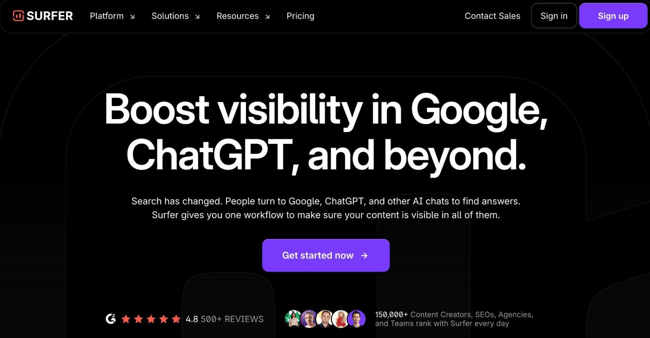
Surfer (formerly Surfer SEO) is one of the most effective tools for creating and optimizing content based on real-time search data.
It helps content teams not just create content using AI, but also optimize that content for visibility in search engines and AI-powered answer engines like ChatGPT and Perplexity.
While Surfer does not have a standalone CMS, it integrates with most popular CMS platforms, including HubSpot Content Hub.
The Surfer browser extension integrates with most CMS content editors (including HubSpot’s editor), while Surfer also offers a dedicated WordPress plugin for WordPress users. It also supports Zapier, which lets content teams publish directly from the Surfer interface to their CMS.
Core Features
- AI-powered content editor with real-time optimization scoring based on 500+ factors
- Integration with most CMS, including HubSpot Content Hub and WordPress
- SERP analysis based on top-ranking pages
- Keyword research and clustering, including topic discovery
- Content audits for existing pages
Pricing: Surfer’s Discovery plan starts at $49 per month.
However, most content teams will want to go with at least the Standard plan because it adds one-click content optimization and other AI content marketing tools. This plan starts at $99 per month.
Fixed plans top out at $299 per month, but there’s also an Enterprise option for larger organizations that need tailored packages.
What I like: Surfer can use AI to handle pretty much every part of the content creation and optimization process, which are essential aspects of content marketing. It can also integrate with most popular CMS and website builders, including HubSpot Content Hub.
Best for A/B testing and experimentation: Optimizely Content Marketing Platform
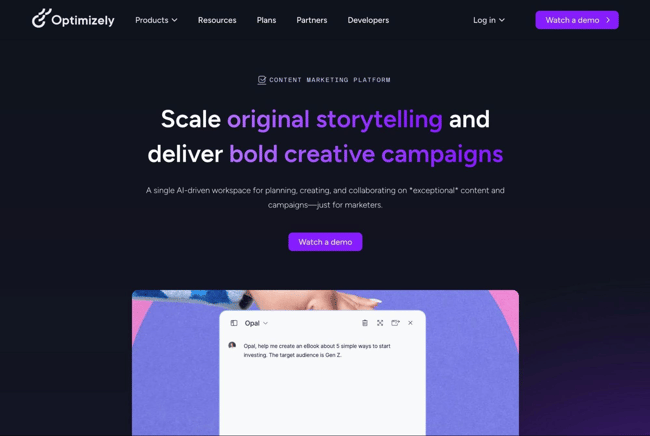
Optimizely is a well-known platform for experimentation and content optimization, particularly for enterprise teams that need robust testing capabilities across their website.
Optimizely got its start as a tool that was focused on A/B testing and experimentation, but it’s since expanded to offer a full content marketing platform and CMS.
It comes with its integrated Opal AI service to help with content creation, personalization, and other workflows.
However, it’s important to note that Optimizely’s pricing will put it out of reach for small businesses and solopreneurs.
Core Features
- AI content creation via Optimizely’s Opal AI.
- Advanced A/B and multivariate testing.
- AI-driven experimentation workflows.
- Editorial planning and campaign management, including multi-view calendars and shared workspaces.
- Personalization based on behavioral data.
- Built-in analytics to measure content performance.
Pricing: Optimizely does not publicly share its pricing, so getting a quote requires speaking with the Optimizely sales team.
Based on third-party reports, Optimizely’s plans typically start at around $36,000 per year, which means it’s really only an option for larger organizations.
What I like: Optimizely combines experimentation with content workflows, making it easier to test and optimize entire campaigns — not just individual pages. The big downside is that Optimizely’s pricing puts it out of reach for most small businesses.
Best for reporting and analytics: Sight AI
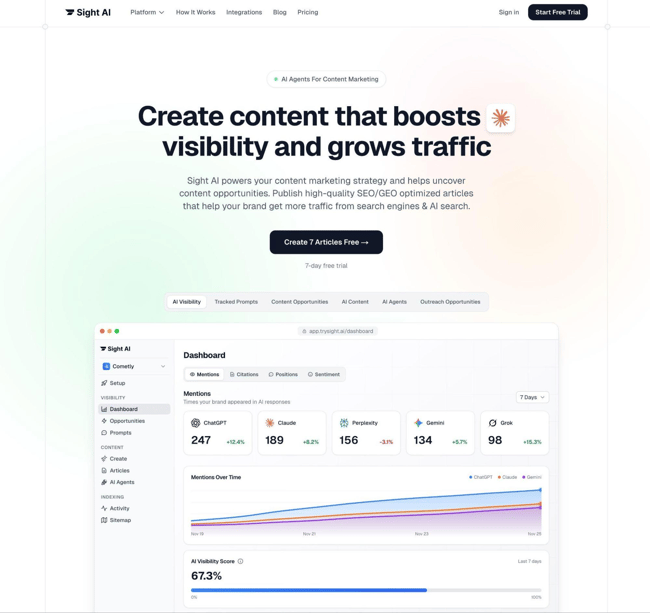
Sight AI is a newer platform built specifically for the AI search era. It combines content generation with reporting, helping teams track how their content performs across both traditional search engines and AI-driven platforms.
In addition to creating content that’s optimized for answer engines, Sight AI can also help teams discover content opportunities and plan their content strategies.
Core Features
- Full cycle content creation, including outlining, writing, optimization, internal linking, and visual creation.
- AI visibility reporting across platforms like ChatGPT, Perplexity, and others.
- Content performance analytics and sentiment analysis.
- Automated content publishing to CMS platforms. In addition to direct integrations with WordPress and some other platforms, Sight AI also supports Zapier to integrate with additional CMS, including HubSpot Content Hub.
Pricing: Sight AI starts from $39 per month for the Lite plan, with preset plans topping out at $399 per month for the Advanced plan. There are also custom enterprise plans for organizations with more unique needs.
What I like: Sight AI is one of the few tools built for AI search visibility, making it especially valuable as platforms like ChatGPT and Google AI Overviews change how users discover and interact with content.
Best for personalization: CoreMedia (AI-powered CMS)
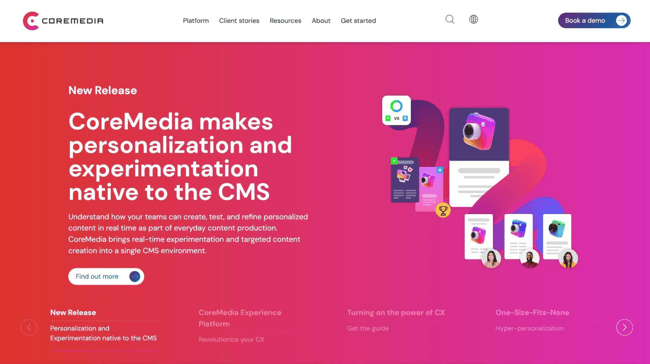
CoreMedia is a digital experience platform (DXP) with native AI personalization and experimentation capabilities, making it a strong choice for enterprise teams that want to deliver dynamic, data-driven content experiences directly through their CMS.
Its pricing puts it out of reach for smaller organizations, but larger organizations that want to put personalization first in their content marketing strategy might find it worth the investment.
Core Features
- Create content using AI.
- AI-driven content personalization based on behavioral and contextual data.
- Dynamic content delivery across channels (web, mobile, email).
- Real-time analytics and insights for personalization optimization.
- Integration with other AI tools and marketing platforms.
- Enterprise-grade CMS with omnichannel content management.
Pricing: As an enterprise-focused tool, CoreMedia does not publish its prices. Reach out to sales to get a quote.
What I like: CoreMedia puts AI-enabled personalization and experimentation at the forefront of its CMS, making it a solid option for larger organizations looking to go all-in on content personalization.
How I Chose and Tested the Best AI Content Marketing Tools
Because of the AI boom, there are a ton of content marketing AI tools hitting the market, in the form of brand-new tools and existing tools adding AI capabilities.
To curate this list of tools, here are some of the criteria that I focused on:
- Every tool on this list goes beyond basic AI writing to offer broader content marketing functionality, including optimization, reporting, experimentation, and personalization. The focus here is on platforms that do more than generate a first draft.
- CMS integration was a firm requirement. Every tool either offers a native CMS or integrates directly with third-party platforms like WordPress and HubSpot’s CMS, since siloed tools tend to add more friction than they’re worth.
- Budget accessibility was a priority. While a couple of tools on this list are enterprise-focused, the majority offer pricing plans that work for organizations of all sizes, from solopreneurs to large teams.
- Ease of use was evaluated with the whole organization in mind, not just technical users. For smaller businesses without a dedicated technical team, adoption and simplicity matter as much as features.
Frequently Asked Questions About AI Content Marketing Tools
How do I evaluate AI content marketing tools without rebuilding my stack?
Start by prioritizing tools that integrate directly with an existing CMS, CRM, and analytics platforms. Look for native integrations or APIs that enable layering AI capabilities on top of existing workflows rather than replacing them. This lets content teams test AI-driven content creation, optimization, or personalization without disrupting how they already publish and measure content.
It’s also helpful to run a controlled pilot. Choose one use case — like blog optimization or landing page personalization — and measure impact on a small set of pages. This approach reduces risk, speeds adoption, and provides clear performance data before making a larger investment.
What is the best way to maintain brand voice with AI?
Maintaining brand voice starts with training the tool on existing content. Many AI platforms allow content teams to upload guidelines, tone examples, or past content so outputs align with existing style. The more structured the inputs, the more consistent the results will be.
Content teams should also maintain at least some human oversight in the content publication process, even if it’s just having a human provide final editorial approval. Ideally, teams should use AI for drafting and iteration, but rely on editors to refine tone, ensure accuracy, and enforce brand standards. Over time, as the AI learns from feedback and approvals, teams can reduce manual effort without sacrificing consistency.
When should you automate content steps versus keep them manual?
Automate repetitive, data-driven tasks that benefit from speed and scale. This includes generating outlines, drafting first versions, optimizing for SEO, running A/B tests, and analyzing performance. These are areas where AI can save significant time and uncover insights faster than manual processes.
Keep strategic and creative decisions manual. Defining content strategy, positioning, brand messaging, and final editorial approval should remain human-led, though AI can still assist in these areas. The most effective content teams use AI to accelerate execution while retaining control over the direction and quality of their content.
How do I prove ROI from AI content marketing tools?
To prove ROI, connect content efforts to measurable business outcomes. Focus on metrics like organic traffic growth, conversion rates, leads generated, and revenue driven by content. The key is using tools that tie content performance to a CRM or analytics platform, so teams can see how specific pages and campaigns contribute to the pipeline.
It also helps to benchmark performance before and after implementation. Compare publishing speed, ranking improvements, and conversion metrics over time. By showing both efficiency gains (time saved, content produced) and performance improvements (traffic and revenue impact), content teams can build a clear, data-backed case for ROI.
Choosing the Right AI Content Marketing Tool
AI content marketing tools have evolved far beyond simple writing assistants, and the best ones now support the full content lifecycle from ideation to revenue attribution. The most effective platforms connect directly to a CMS and customer data, helping teams continuously improve performance rather than just produce more content.
For teams evaluating options, HubSpot Content Hub is worth consideration. Its combination of native CMS, integrated CRM, AI content creation, and full-funnel analytics makes it one of the few platforms that connects content efforts directly to measurable business outcomes.
HubSpot's Free Website Builder
Create and customize your own business website with an easy drag-and-drop website builder.
- Build a website without any coding skills.
- Pre-built themes and templates.
- Built-in marketing tools and features.
- And more!
Aeo